Madrid's Rocker Grandma: the woman Vallecas refused to forget
Ángeles discovered rock late in life, appeared on a Panzer record sleeve and inspired a monument funded by friends. Meet the woman behind the raised hand in Vallecas.
A cap, a smile and a raised hand
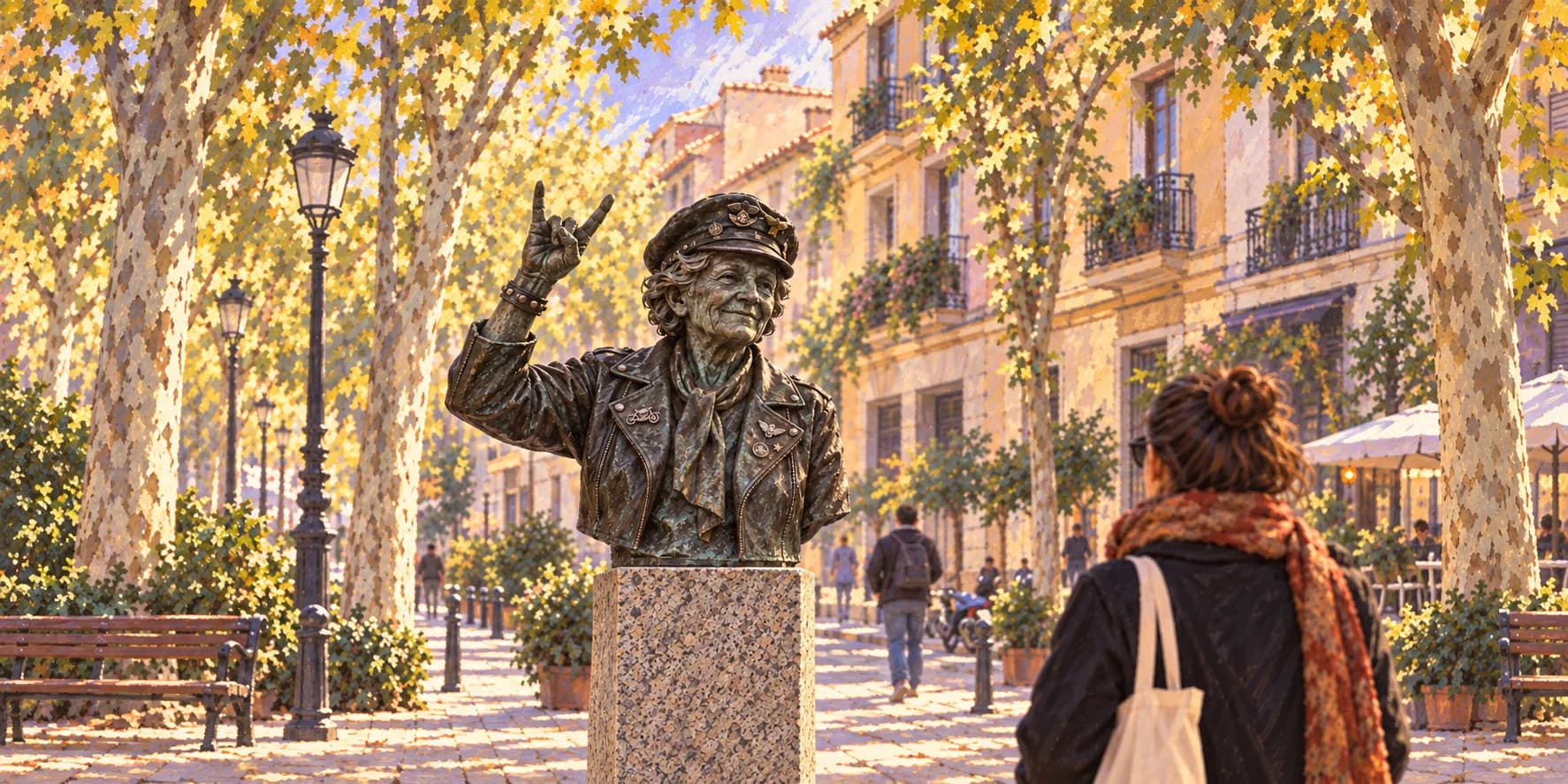
On Peña Gorbea boulevard in Vallecas, an older woman greets you from a pedestal. She wears a peaked cap, a scarf and a jacket covered with small details. Her right hand makes the heavy-metal horns. Her face is gentler than the gesture: a quiet smile remains.
This is Ángeles Rodríguez Hidalgo, Madrid's Abuela Rockera — Rocker Grandma. She was neither a singer nor a guitarist. She discovered new music late in life and became so loved that musicians and friends raised money to remember her in bronze. Her age is only the beginning of the story. What matters is what followed that discovery.
Find Rocker Grandma in WAONDERA whole lifetime before rock
Ángeles was born in Argentina in 1900. Long before the concerts, she was widowed at 41 and raised five children, working in homes and for Caja Postal, according to Somos Madrid's account.
That earlier life matters. Look only at the cap and jacket and it is easy to see an amusing character. Behind them were decades of work and responsibility. Music did not explain her whole life, but it opened a chapter that would leave a mark on other people.
Madrid City Council recounts that she became interested in rock in her seventies after accompanying her grandson to a concert. We have not established an exact date or first band. There is no need to invent either: the meaningful change is from going along for someone else to finding a place of your own.
From companion to a voice of her own
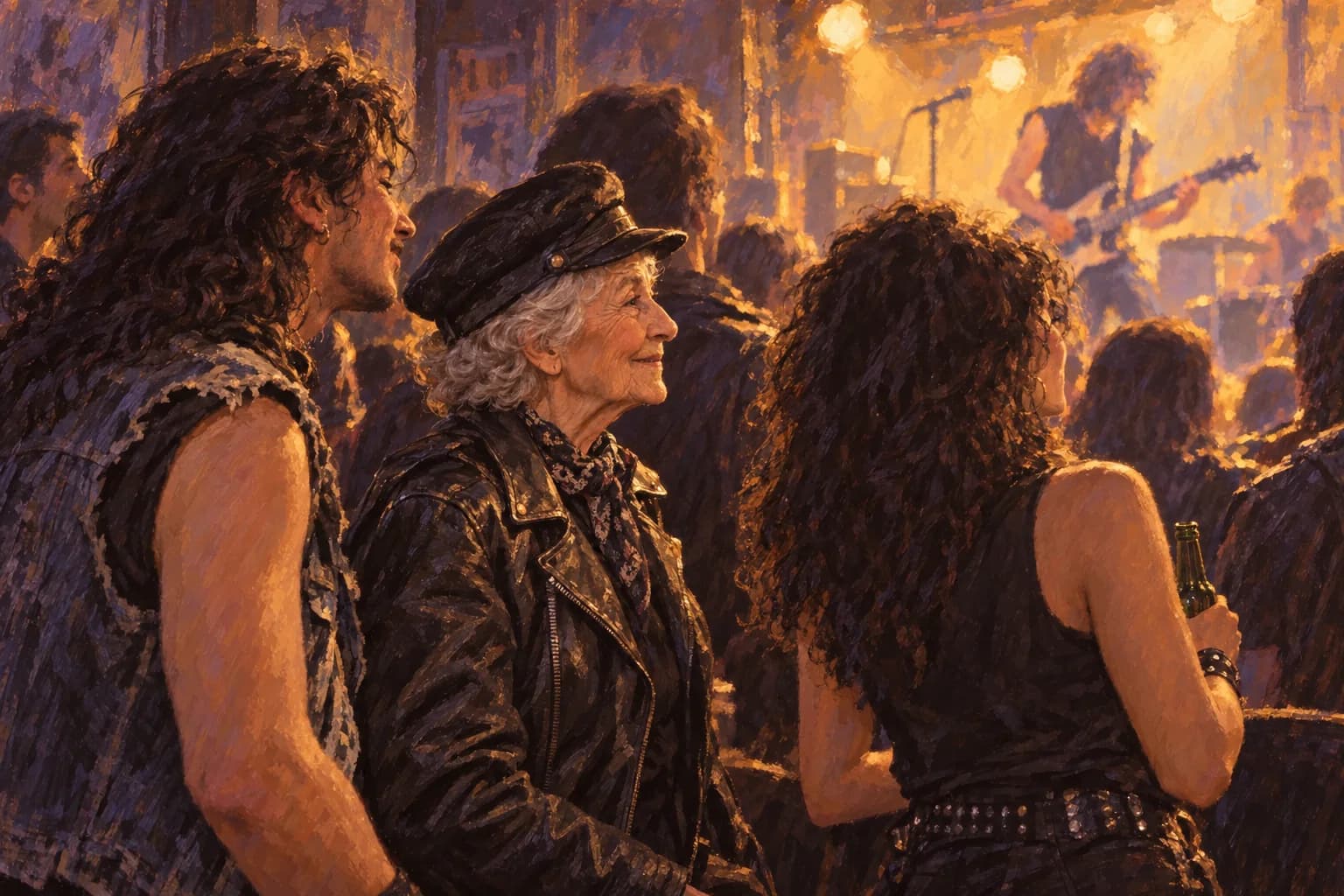 An evocation of her place among fans of different generations, not a reconstruction of a particular concert or identifiable companions.
Her appearances were no longer occasional. Ángeles became a familiar presence at concerts and clubs, and also took part in radio. An Uppers report recounts broadcaster Paco Pérez Bryan's memory of her arriving with her grandson and asking to join his programme. It is a retrospective recollection, not dialogue we can reproduce as eyewitnesses.
Turismo Madrid's selection of sculptures also recalls her contributions to Heavy Rock. She was not simply someone people looked at because she was different. She had something to say.
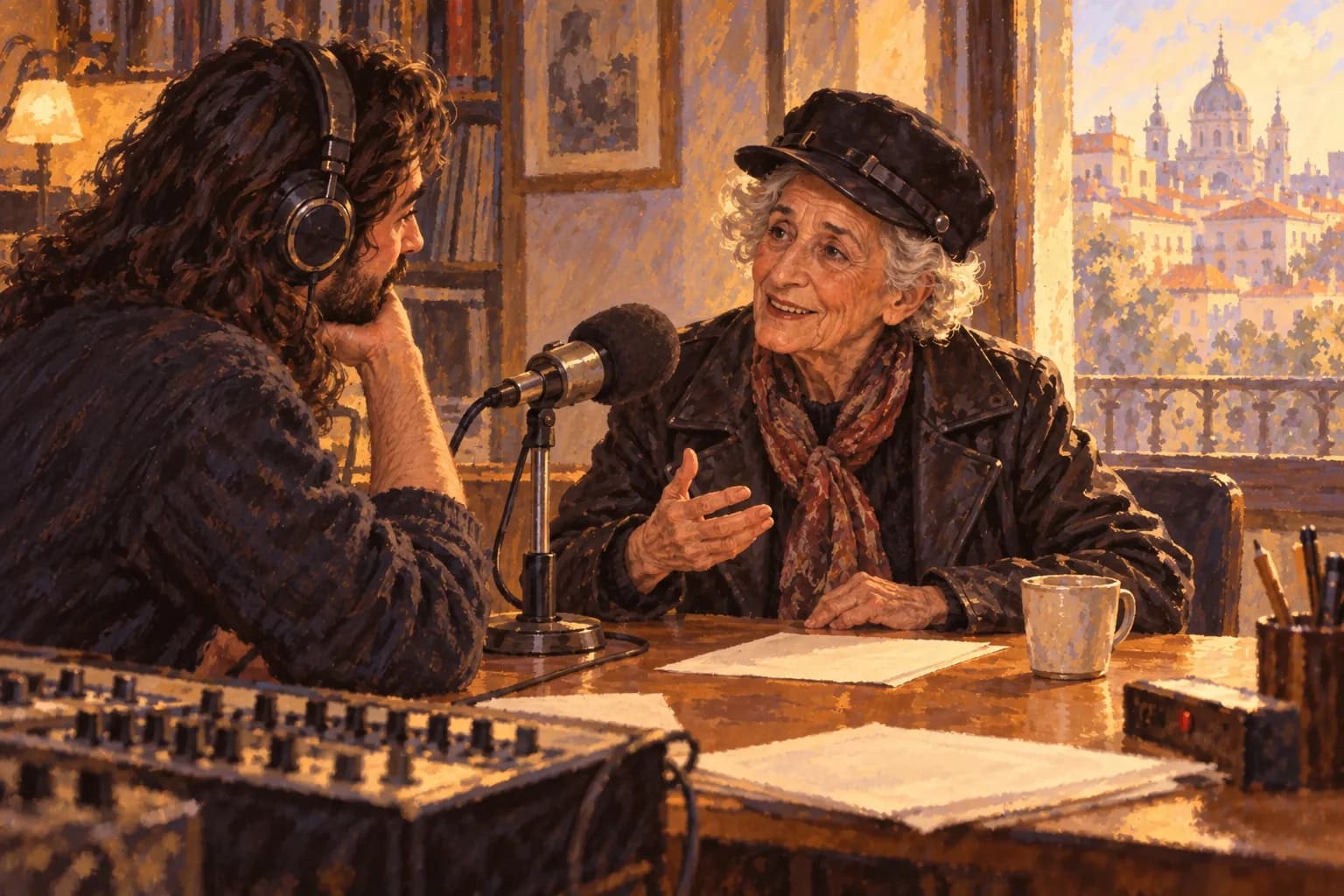 A voice within the music community: an imagined scene informed by her documented radio participation, not an actual studio or broadcast.
The record sleeve that became a monument
Panzer chose her for the cover of Toca madera. The cap, leather jacket and raised hand made her portrait a recognisable image of Spanish rock. Rockpapeltijeras recounts singer Carlos Pina's memory of the session: the clothes Ángeles wore for the photograph were borrowed from him.
It is a small detail that makes the image feel closer. A musician's clothes passed to her for a photograph; later, the gesture found another way to endure. Carmen Jorba's bust preserves the clothing and salute associated with that portrait, without asking us to mistake a record sleeve for an entire biography.
A tribute her friends helped fund
Ángeles died in 1993, aged 93. Her friends did more than remember her privately. The municipal heritage record explains that a concert at the Canciller venue, with contributions from Madrid Rock and Mario Scasso, helped pay for the sculpture.
City Council dates the bust's presence on Peña Gorbea to 1994. Sources disagree about some precise dates in that sequence, which we do not present as settled. The collective nature of the tribute is clearer: people who knew her wanted her to keep a place in the neighbourhood.
What to notice on Peña Gorbea
Look for the bust along one side of the boulevard, in San Diego, in the Puente de Vallecas district. The municipal heritage record describes the life-size bronze, its granite pedestal and plaques. Notice the scarf, lapels and wristband before reading the farewell. In translation, it says: “Goodbye, grandma, rocker friend… Only time separates us.”
Our cover is a painting. It retains the bust's distinctive forms, but interprets the light and surroundings; it does not document the sculpture's exact condition today.
Once you know her story, that raised hand may look less like a novelty. It can become the greeting of someone who still found something new to enjoy, and of a community returning her affection. You are not meeting a star on a stage. You are meeting a neighbour whose friends made her a monument.
Madrid holds other unexpected tributes, including the little monument to Paco the dog on Huertas. Sometimes learning who a statue remembers changes a walk more than adding another stop.
Keep exploring with Rocker Grandma in WAONDERSection
Stories behind places