Temple of Debod: the journey that saved a temple and changed Madrid
Before becoming a Madrid sunset spot, Debod was a temple threatened by rising water. Discover its journey in crates, its reliefs and what to notice next time.
Before the sunset, a rescue
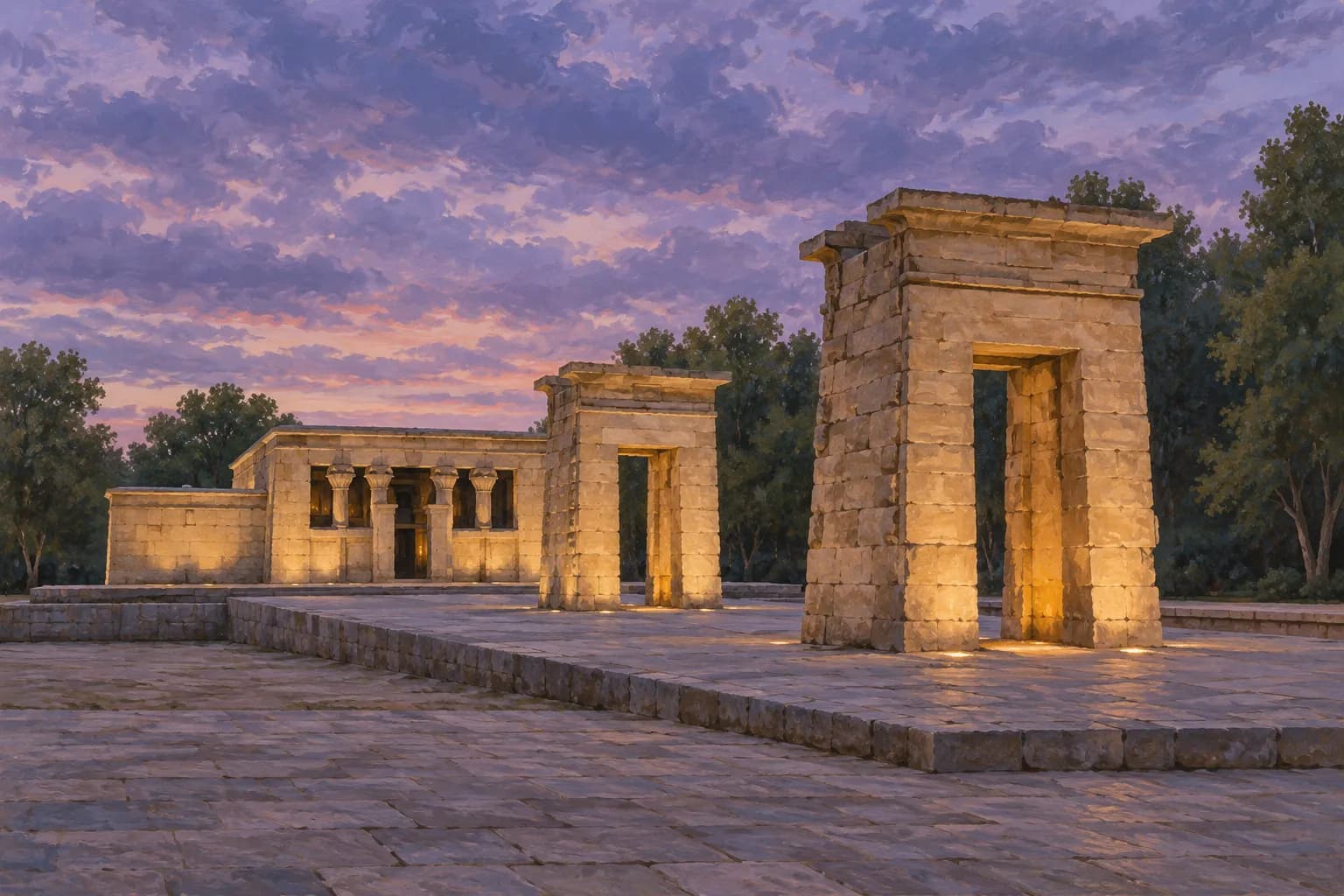
You might already have a photo of Debod on your phone. Two stone gateways, a changing sky and a low building that seems, for a moment, to belong somewhere other than Madrid. After enough visits, it can become part of your city without you ever asking how it got here.
It was not built to decorate a park. This is an ancient temple that had to move to survive. Egypt gave it to Spain in 1968 in recognition of Spanish participation in the rescue of Nubian heritage, as Madrid's account of its fiftieth anniversary explains.
Next time you pass, there is more to look at than the sky: stones that survived because many people found a way to move them.
See the Temple of Debod in WAONDERA king, a chapel and a world we no longer see
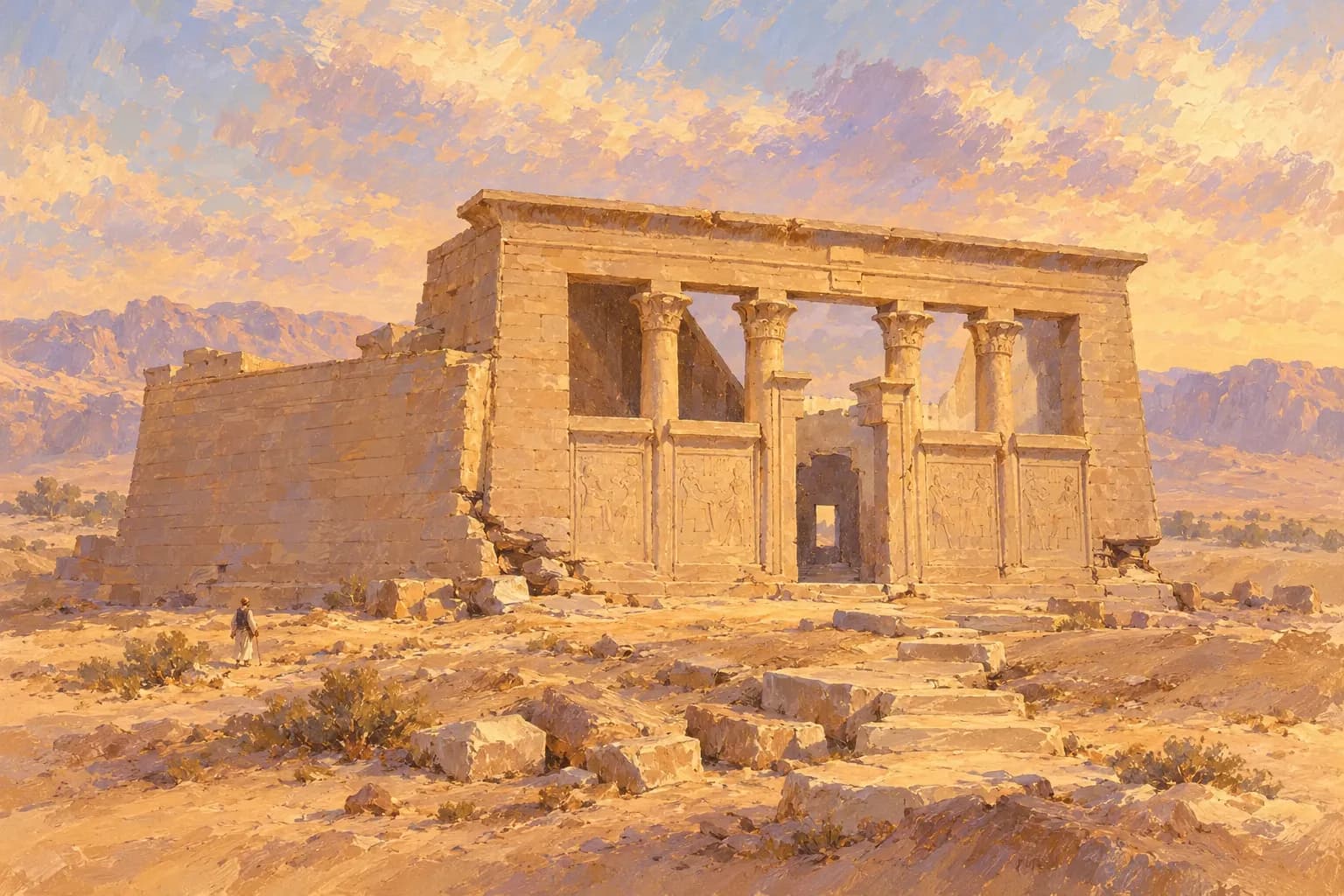 Debod before Madrid: an interpretation of a nineteenth-century view, not an exact reconstruction of the temple in antiquity.
The story begins far from Madrid, in Lower Nubia near Aswan. In the early second century BCE, the Meroitic king Adijalamani commissioned a chapel dedicated to Amun and Isis. Later rulers enlarged the complex. Debod was not created all at once: successive periods added space and memory around a small sacred core, as the city's history of the temple describes.
Inside, the chapel's reliefs offer a connection to that beginning. They depict the king making offerings to the gods. The museum's plan and guide adds a detail easily lost when looking at bare stone: the reliefs were brightly painted, while stars and vultures decorated the ceiling.
What looks restrained today belonged to a space filled with images. These figures were carved long before the streets you followed here existed. A walk through Madrid suddenly reaches into another world.
Historical drawings offer another way into its lost setting. A view by David Roberts held on Wikimedia Commons shows the façade among sand and scattered stone, without a Madrid garden in sight. The illustration in this section draws on that record; it does not imagine the temple on the day it opened two thousand years ago.
Even that façade did not survive intact until the rescue. The city's historical account places its collapse between 1850 and 1875; a third gateway fell later. The Debod that needed saving had already lost parts of itself.
The water that threatened to erase it
 Water and stone: an evocation of flooding in Nubia, not a record of a particular date or water level.
The danger did not begin suddenly with the High Dam. The city's history of the floods explains that, after the first Aswan dam and its extensions, Debod spent ten months of each year submerged. Water damaged the stone, and the reliefs lost their colours. That painted chapel was slowly disappearing even while the building still stood.
Construction of the Aswan High Dam threatened heritage across a large area of Nubia. Debod was not the only building in danger, and Spain was not the only country involved in the rescue. In 1960, UNESCO launched an international campaign bringing together expertise and resources to save monuments that would be submerged. Its account of the Nubian campaign explains the scale of that cooperation.
Standing before a complete building, the necessary choice seems strange: to preserve it, people first had to take it apart. Moving it meant separating it from its landscape; leaving it there could mean losing it. Madrid's Debod carries that difficult choice too. This is not a temple that has remained untouched in one location for two millennia.
From a building to stones: the waiting years
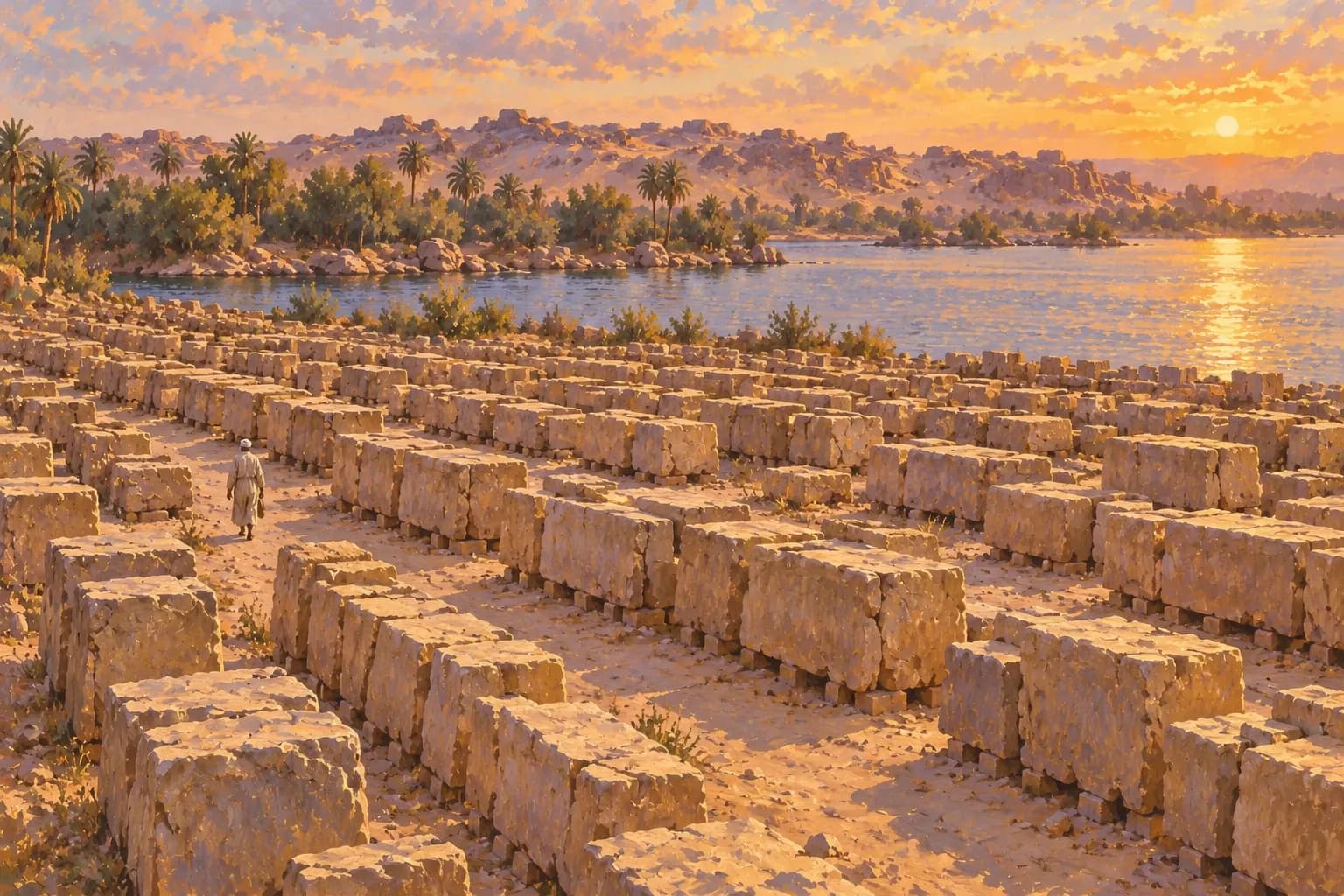 A temple taken apart: an evocative scene of the wait on Elephantine, not a plan or photograph of the historical storage site.
Once dismantled, the blocks were stored on Elephantine, opposite Aswan. They waited there for years before travelling to Spain. Not everything could be recovered: parts of the foundations and the landing terrace remained at the original site, according to the museum's account of the rescue.
The Museo de San Isidro's publication on the move counts 1,724 blocks weighing close to a thousand tonnes. This was not a handful of stones put aside for later: it was a whole building divided into fragments that needed to retain their relationship to one another.
Between those rows, there was no longer a room to walk through, or a doorway leading into another. There were parts of a building that needed to exist somewhere again. That distance between saving stones and recovering a temple is the part of the journey hardest to see from a Madrid park bench.
A temple arriving in crates
 Stones in transit: an evocative illustration of the journey, not a documented scene.
The museum records the journey: the pieces travelled down the Nile on barges to Alexandria, then crossed the Mediterranean aboard the cargo ship Benisa, bound for Valencia. In June 1970, ninety trucks brought 1,350 crates to Madrid, according to that municipal count. The temple you now recognise as a single silhouette arrived packed for transport.
Nubia → Elephantine → Alexandria → Valencia → Madrid. This was not the journey of a small object that would fit in a display case. Pieces had to cross water and roads before they could once again become rooms, lintels and doorways.
Think of that difference as you look at a lintel. What seems motionless now was once packing, transport and assembly. Preserving a monument does not always mean preventing it from moving. Here, survival depended on the opposite.
Building it again in Spain
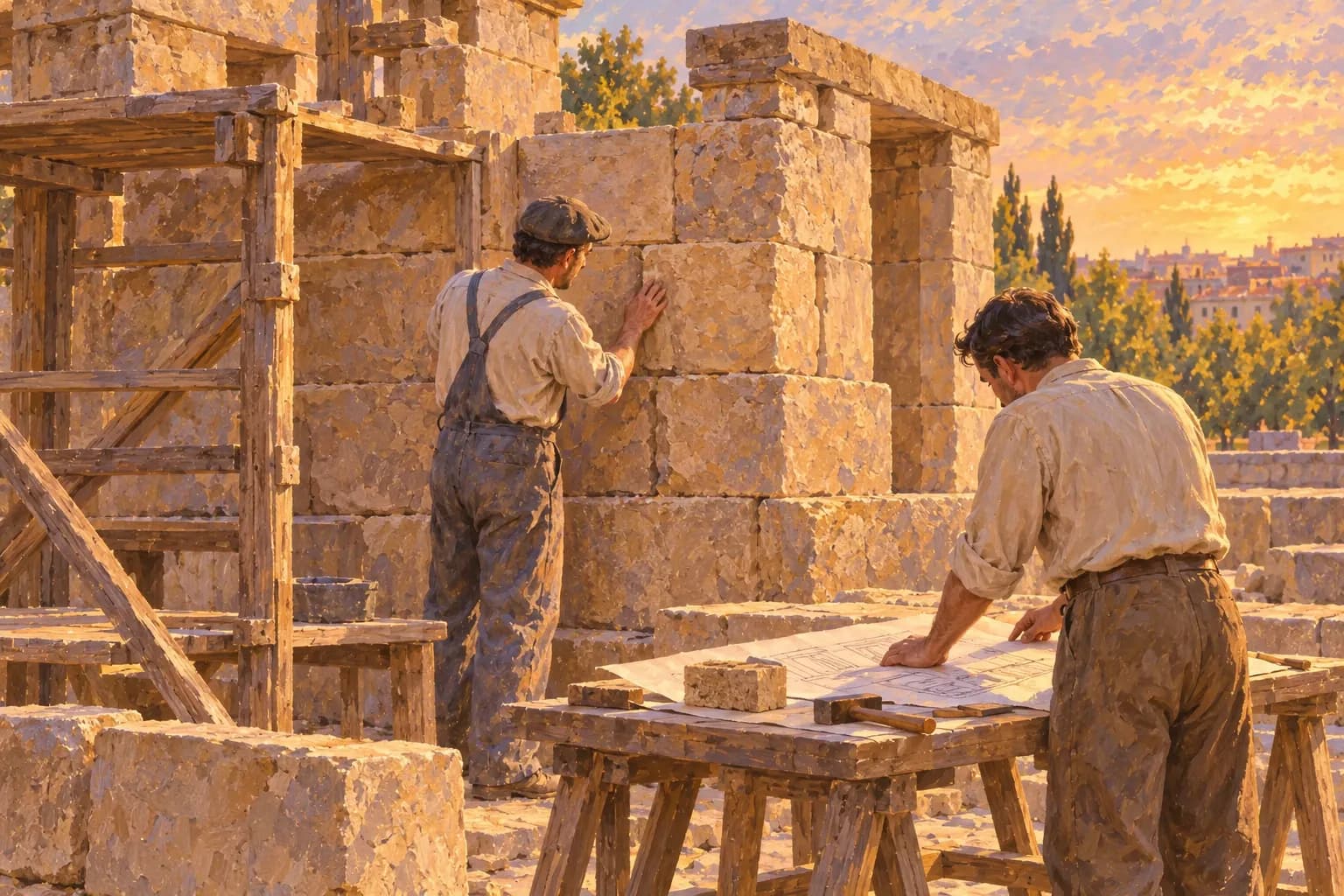 From fragments to a building: an evocation of reconstruction work in Madrid, not a portrait of identified technicians or a specific working day.
Arrival did not mean the job was finished. The stones needed an order again, the reliefs needed shelter, and the whole needed to become understandable as a temple.
The Museo de San Isidro's publication on Debod records a very practical difficulty: some stones had lost their numbering, while others carried incorrect references. Opening the crates and following instructions was not enough; the team had to identify where fragments belonged all over again.
The city's reconstruction chronology separates two stages: the original blocks and two gateways were assembled in 1970; in 1971, the decision was made to rebuild missing parts, including the façade, to protect the interior. The complex opened to the public in July 1972.
Between the crates and the first visitor came archival work, plans, and hands finding a place for each piece. That effort is easy to overlook when the building stands complete. What looks motionless today was, for years, a shared task.
What to notice next time
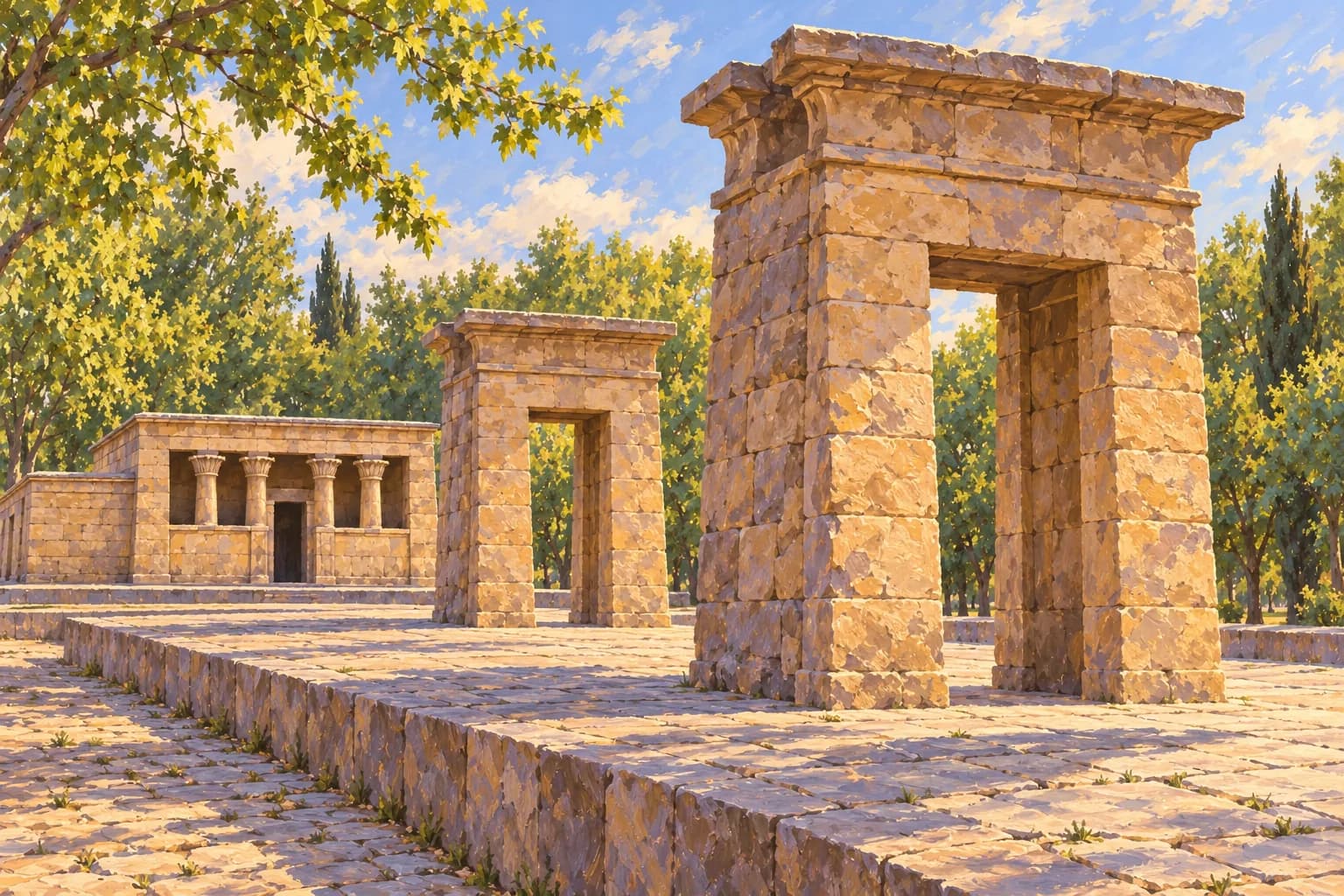 Two gateways lead towards the temple building. Light and surroundings are interpreted; this is not a photograph of current conditions.
Start by distinguishing the gateways from the temple. The two freestanding doors mark an approach towards the low place of worship beyond them. They are not three separate temples.
There is another, less obvious story: not every stone you see crossed the Mediterranean. The city's conservation record explains that missing parts were reconstructed using stone from Salamanca with a different tone. The façade protecting the interior belongs to that intervention.
Look at changes in colour and the joints, without expecting to identify every original block by eye. This is neither an abandoned ruin nor a complete replica: it is an ancient building preserved through modern decisions. Care did not stop at its inauguration; protecting its stones remains a task.
A different pause in a familiar city
Debod stands in Parque del Cuartel de la Montaña, beside Calle Ferraz and near Plaza de España. Your walk can be about observing it from outside; visiting the interior rooms is a separate decision. Check the official visitor information, which recommends booking ahead and warns that opening arrangements may change. Do not assume a reflection from a photograph, or a particular room, will be available when you arrive.
For more places nearby and elsewhere in the region, explore our selection of places in the Community of Madrid.
Perhaps your next photograph of Debod will hold more than the sky. Those gateways and that building carry two stories: the people who built a place for their gods, and those who, centuries later, made sure it did not disappear. The same stones; a different way of seeing them.
Find Debod in WAONDERSection
Stories behind places