The Madrid region in WAONDER: there is still more to discover
From the Royal Palace and Puerta de Alcalá to El Escorial, Alcalá and Aranjuez: stories and details for rediscovering Madrid and its region with WAONDER.
You might recognise the Puerta de Alcalá from a bus window. Know where Cibeles is without ever wondering what its water was for. Have crossed Plaza Mayor many times without looking closely at the paintings on one of its façades.
That is what can happen with Madrid: its best-known places become almost invisible through familiarity. You have been there. What you sometimes need is a question that changes the visit.
The Community of Madrid is one of WAONDER's supported regions. The capital is a good place to begin, but not the end of the story: El Escorial, Alcalá de Henares and Aranjuez offer different discoveries. This article suggests a way to look at both, whether you live here or are visiting.
Download WAONDER for your next walkMadrid city: a capital built in layers
Madrid is Spain's capital, but that role has a history. In 1561, Philip II chose the town as the seat of his court, a decisive moment in its transformation, as the Madrid History Museum explains.
That is a useful starting point for looking at its monuments. The city you walk through today is not an untouched snapshot of that moment. Buildings were added, others were lost, and familiar spaces acquired new lives.
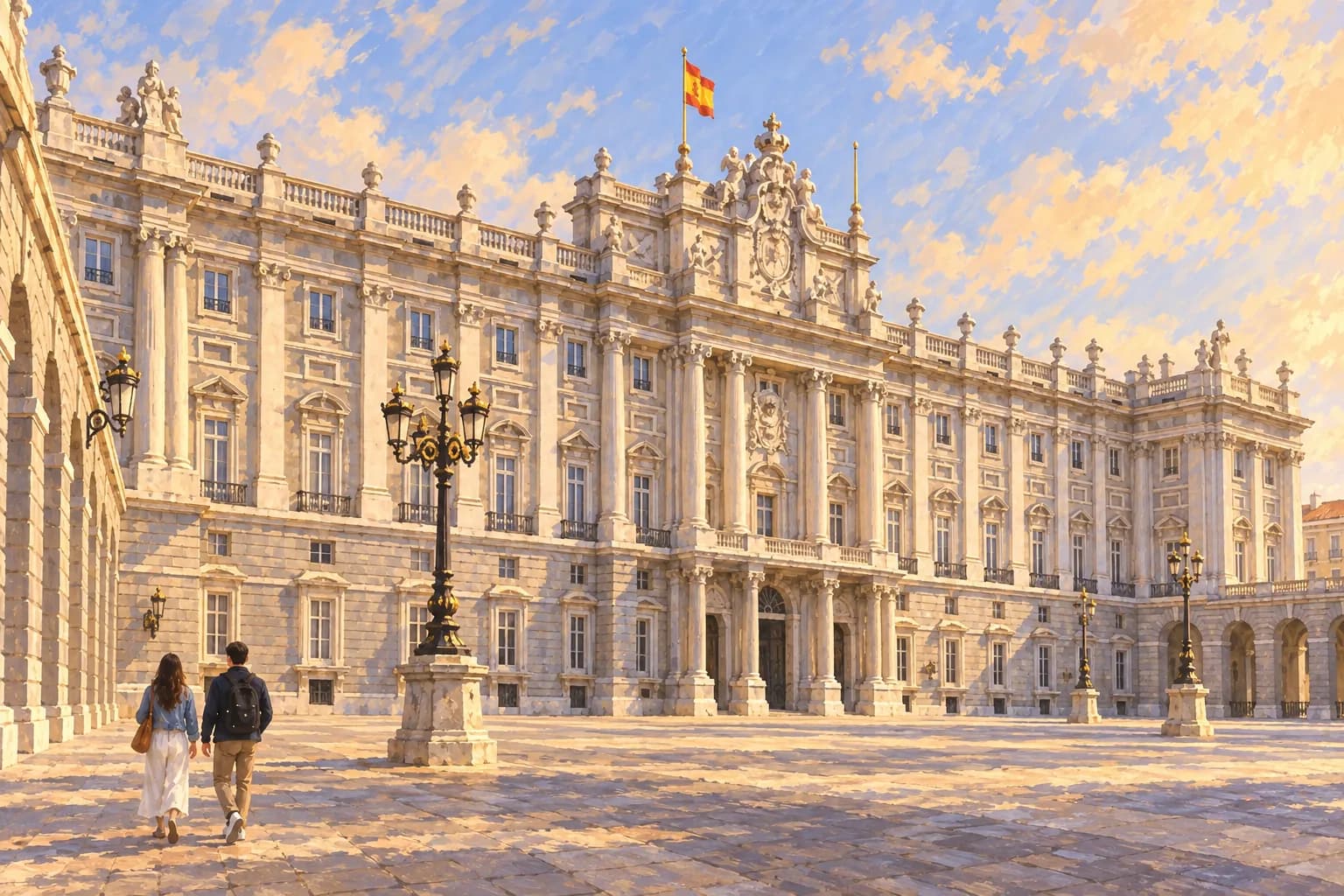 Pausing before the Royal Palace can also mean looking at what Madrid rebuilt. A painterly interpretation, not an exact photographic view.
The Royal Palace makes the point especially clearly. The earlier Alcázar burned in 1734; Philip V commissioned the palace we know, with construction beginning in 1738. Charles III would become its first royal resident. This sequence, documented by Madrid's official tourism site, changes the question at its façade: not only who lived here, but what stood here before. Grandeur can also carry the memory of a loss and a rebuilding.
Open Royal Palace in WAONDER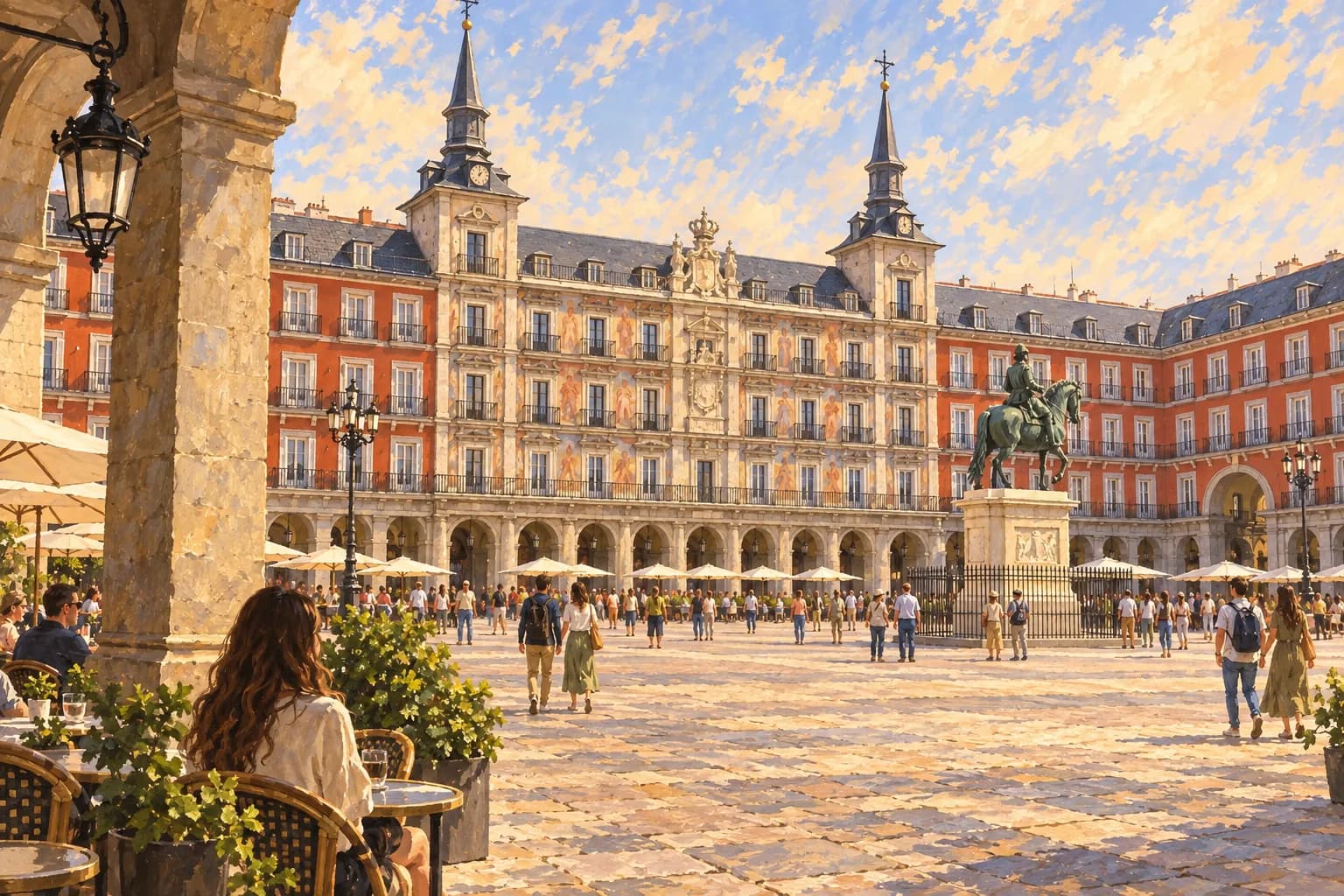 Life continues beneath the arcades; above them, Casa de la Panadería rewards a closer look. The murals and smaller details are interpreted rather than reproduced exactly.
Plaza Mayor tells another story of transformation. Juan de Villanueva took on its reconstruction after the fire of 1790. And the murals you see today on the Casa de la Panadería are by Carlos Franco, not a decoration preserved unchanged from the seventeenth century. The square's official guide explains both layers.
Next time you walk beneath its arches, look up at that façade. A historic square does not need to have stood still to hold a memory. Part of its appeal is discovering what each period added.
Puerta de Alcalá and Cibeles: symbols with a purpose
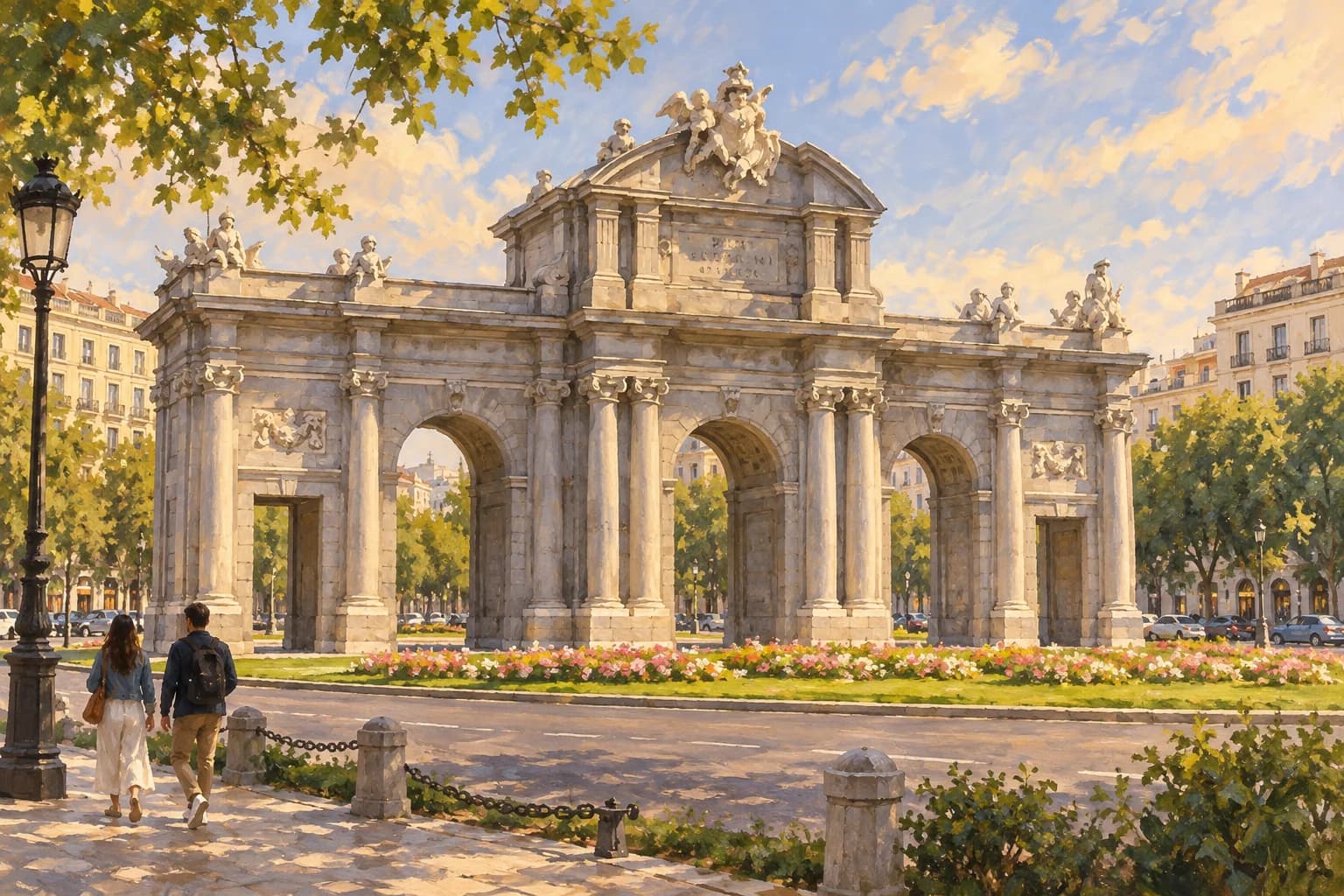 The Puerta de Alcalá in WAONDER's painterly interpretation. The surroundings, minor sculptures and viewpoint are not a photographic reproduction.
The Puerta de Alcalá was not built to be circled with a phone camera. It was an entrance to the city. Sabatini designed it for Charles III, and it opened in 1778; its name recalls the road to Alcalá de Henares. It has five openings and two differently decorated façades, according to Madrid's official tourism guide.
That last detail gives your next outing a small purpose: look at it from both sides, staying in pedestrian areas and out of the roadway. The face that greeted arrivals was more ornate. What seems like one familiar monument changes when your viewpoint changes.
Open Puerta de Alcalá in WAONDER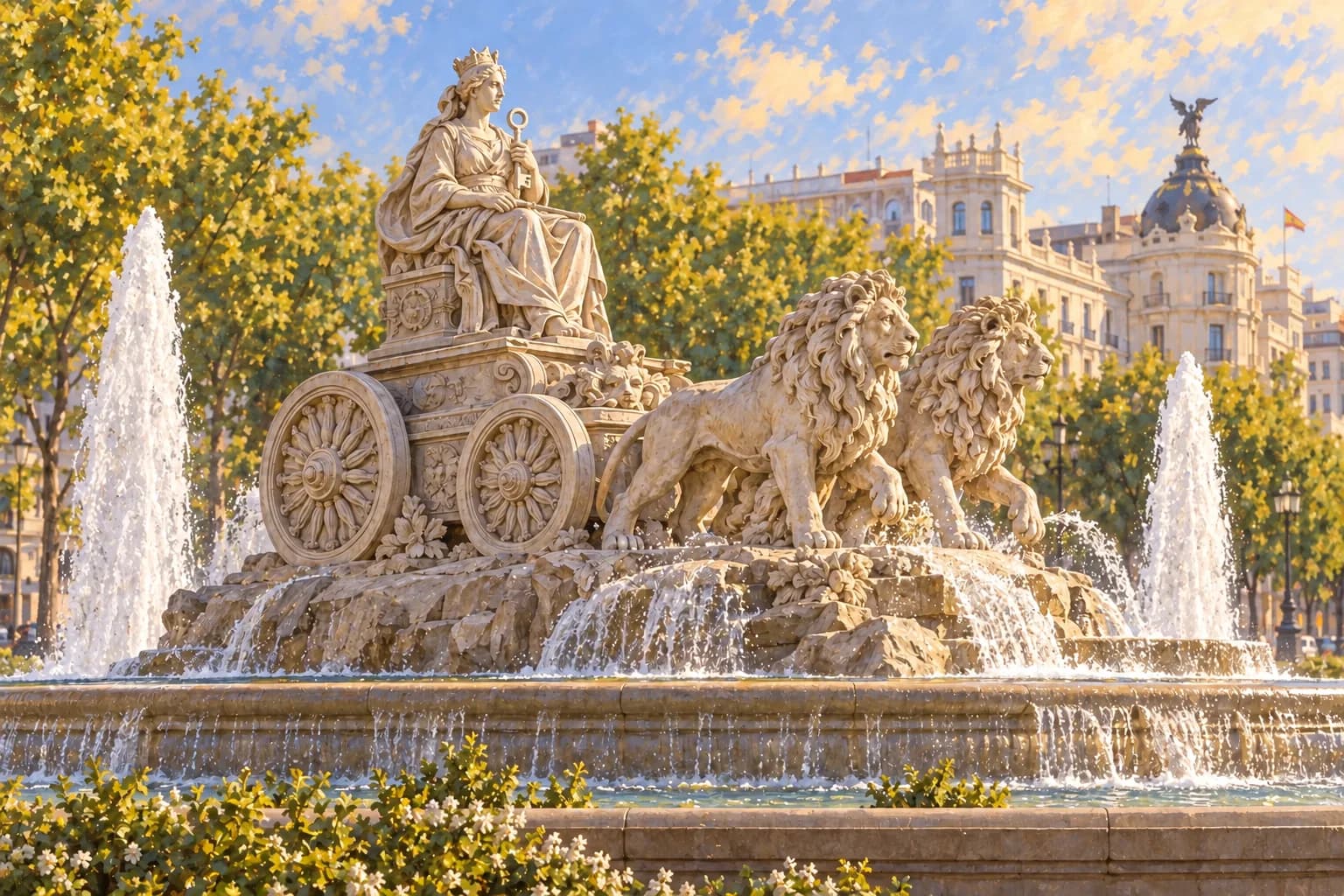 Beyond the postcard, Cibeles was also a source of water for the city. Illustrated without scaffolding, not a view of its current condition; see the restoration notice below.
Something similar happens with Cibeles. The goddess riding a chariot drawn by two lions, in the fountain built in 1782, is a familiar image of Madrid. But its water also supplied carriers who delivered it to homes, as well as people collecting it themselves. The municipal tourism page describes that practical role.
Before thinking only of celebrations or postcards, consider that everyday need. Sometimes a story gives a symbol back something as simple as its usefulness to the people living around it.
Before visiting: as checked on 28 September 2026, the official website warns that Cibeles is covered by scaffolding for restoration. Check its current notice; do not count on an unobstructed view of the fountain.
Open Cibeles in WAONDERFrom the Prado to El Retiro: a walk through art and knowledge
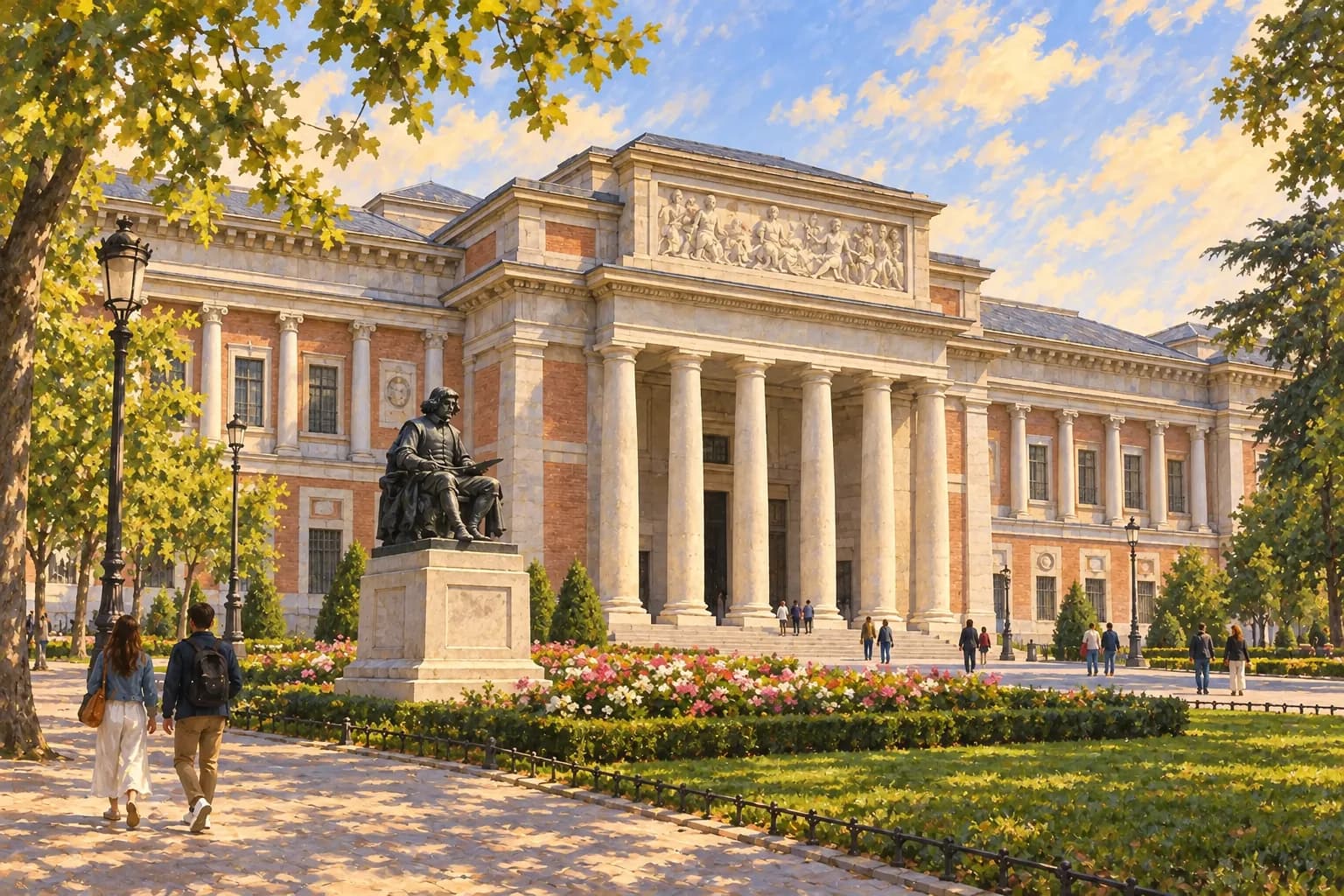 Before you step inside to see the paintings, the Prado itself offers a question. Its architecture is interpreted; gardens, smaller sculptures and viewpoint are not a photographic record.
The Prado Museum deserves a visit for its collections, but the building itself holds a surprise. Juan de Villanueva designed it in 1785 for a Natural History Cabinet. Its purpose changed, and it opened as a museum in November 1819, as the Prado's history explains.
Knowing that makes looking at its architecture a different experience from arriving with only paintings in mind. The building also expresses an ambition to give knowledge a prominent place in the city. The account of its expansion connects it to the Salón del Prado urban project, alongside the Botanical Garden and the Observatory.
Open Prado Museum in WAONDER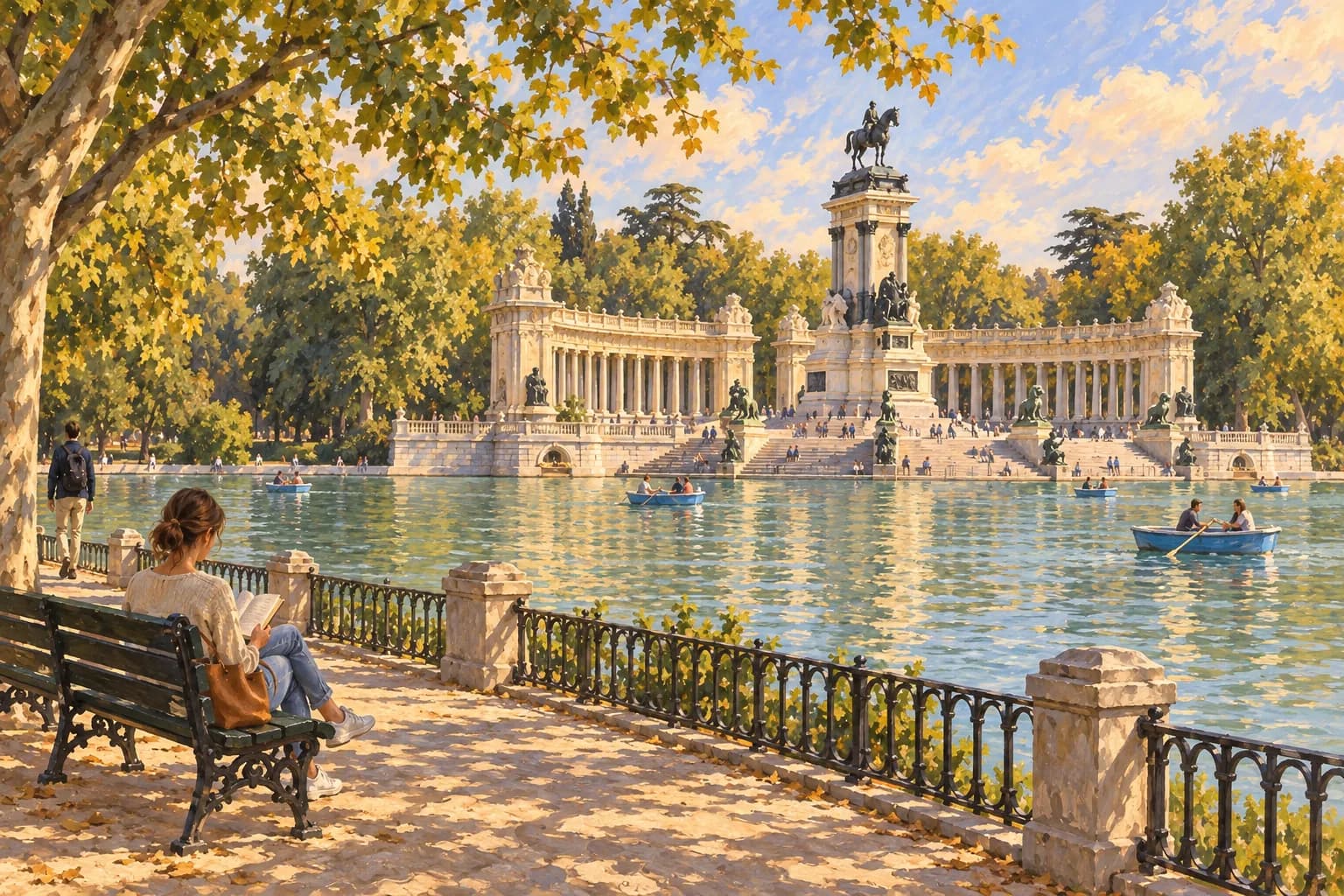 The Estanque Grande: somewhere to look, read or pause between stories. A painterly interpretation of the Alfonso XII monument and its surroundings, not a documented scene.
That relationship continues in El Retiro. The Paseo del Prado and Buen Retiro entered the World Heritage List in 2021 as a landscape of arts and sciences, rather than a collection of isolated monuments. UNESCO highlights the meeting of culture, nature and spaces for citizens.
A walk through this area can therefore be more than going from one building to another. Notice what lies between them: trees, fountains, gardens, places where you pause. The space linking the landmarks belongs to the story too.
Within the park, the Palacio de Cristal adds another twist: it was conceived as a large greenhouse for tropical plants for the 1887 Philippines Exhibition. Its transparency had a purpose before becoming the image so many people recognise. But it is not open for an interior visit at the time of this review: the official tourism page reports restoration work, while the Reina Sofía documents the artwork on the covering around it.
You can choose other places in the park for your outing. Check the Retiro access notices too: weather conditions may bring temporary restrictions. A story endures; visiting conditions change.
Debod: a story that travelled much further
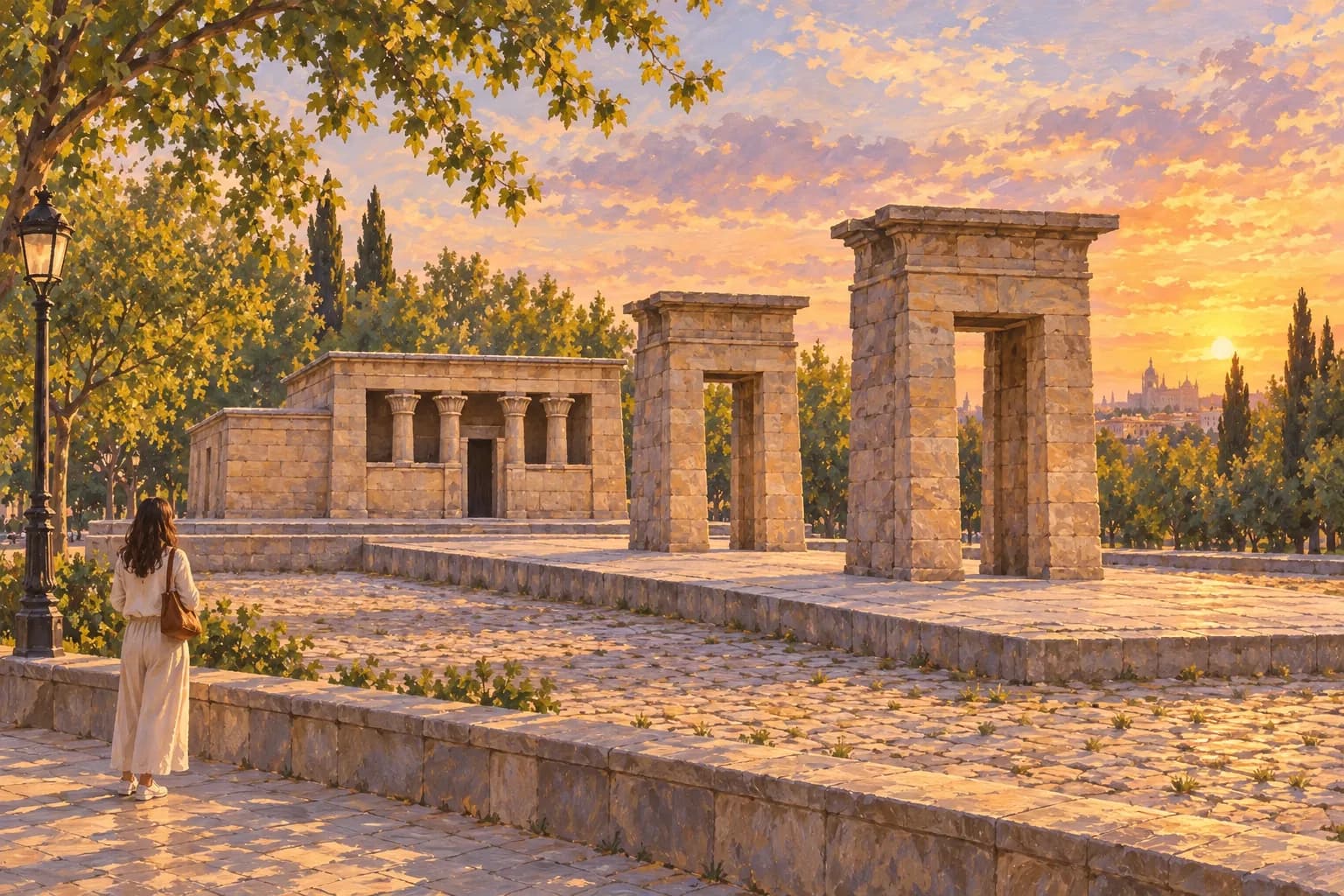 At Debod, a Madrid walk meets stones that travelled from Egypt. An exterior interpretation with the pool area dry; light, background and details are recreated.
The Temple of Debod, near Plaza de España, is not scenery built to look ancient. It is an Egyptian temple transported and reconstructed in Madrid, where it opened to the public in 1972. Its arrival belongs to the rescue of heritage threatened by the Aswan Dam, as Madrid's tourism guide explains.
That fact changes the scale of an ordinary walk. Facing stones that seem to belong to another landscape, you can consider the effort of preserving a place when its original location was threatened. The distance the temple travelled is part of what you are looking at.
If you visit, look beyond its silhouette. Ask what belongs to its original history and what belongs to its installation in Madrid. Check the official conditions before entering: seeing the exterior and visiting the interior are different experiences.
Beyond the capital: El Escorial and the wish to preserve knowledge
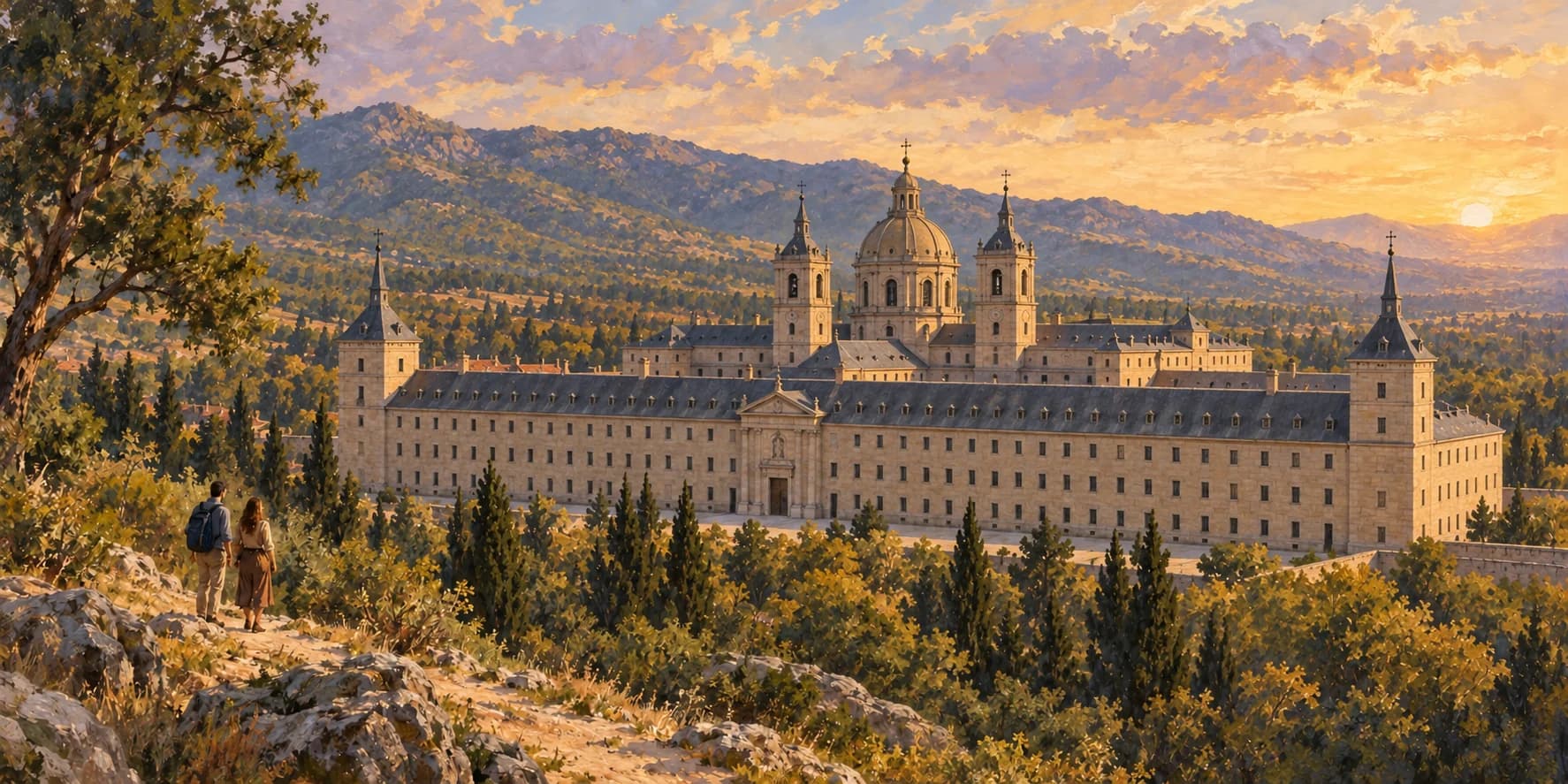
From outside, El Escorial makes an impression through sheer scale. Madrid's official tourism guide offers another way to read it: Philip II brought together a monastery, palace, royal burial place and library. Its restrained architecture was more than a backdrop.
Within that immense structure sits a very human ambition: bringing knowledge together instead of leaving it scattered. The Royal Library's account of its foundation describes Juan Páez de Castro's proposal to gather literary treasures from different collections; Philip II chose to place his library in the monastery.
Next time you look at the façade, try asking what its builders wanted to preserve. You are no longer simply facing a vast building, but a decision about what deserved to reach the future.
Open El Escorial in WAONDERAlcalá: one square, many lives
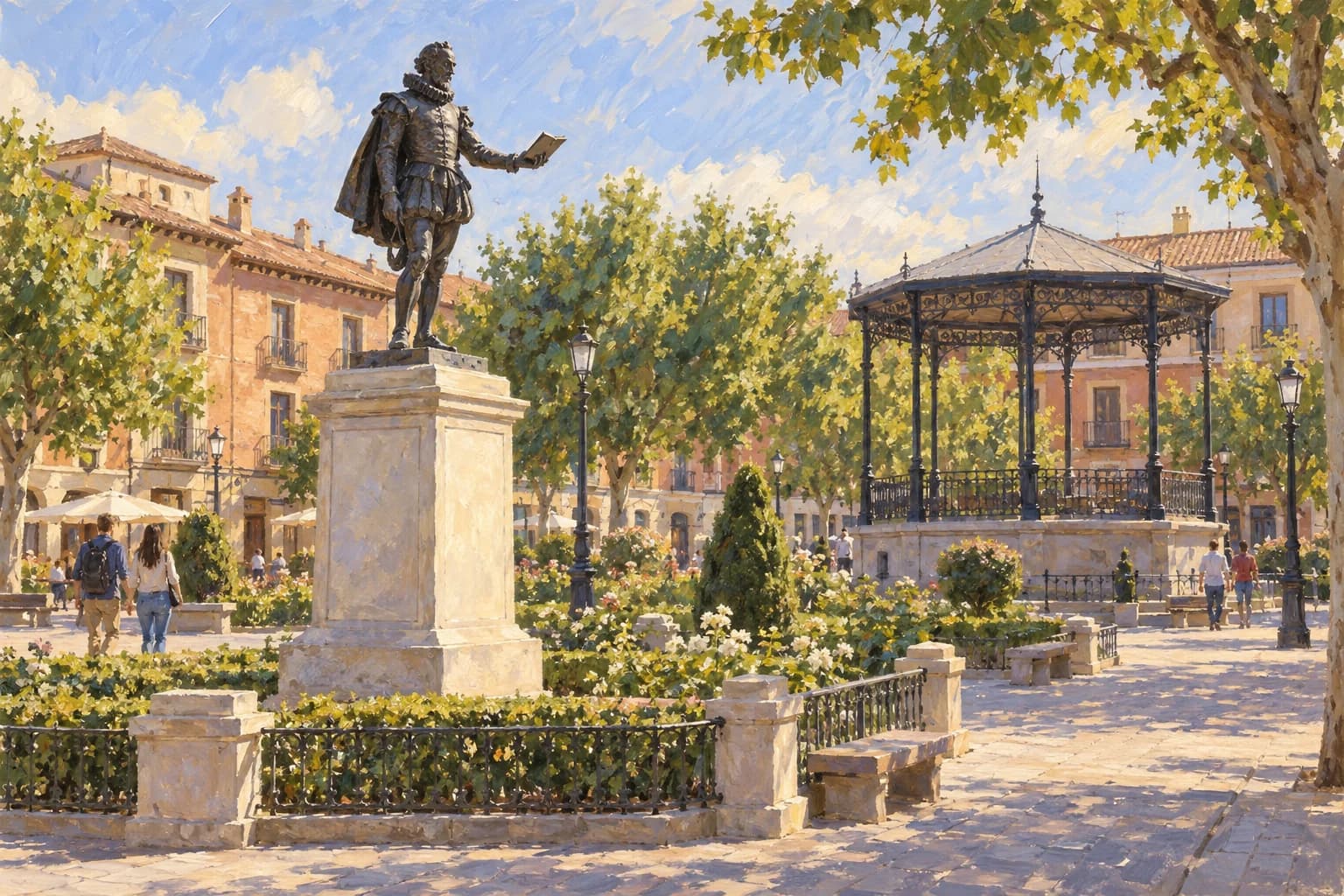 Plaza de Cervantes, interpreted in WAONDER's illustrative style. The composition and surroundings are not a photographic reproduction.
In Plaza de Cervantes, a tribute to the writer stands amid everyday life. The municipal tourism office identifies his statue, unveiled in 1879, and the Corral de Comedias beside the town hall.
The theatre offers a lovely change of perspective: one place can serve its city in very different ways. The municipal account of the Corral traces its evolution from an early seventeenth-century theatre to a covered performance space, a Romantic-era theatre and a cinema until the 1970s.
The continuity lies in the people arriving to see, listen and share something, generation after generation. A façade you might otherwise pass begins to hold many different afternoons. Next time you cross the square, the building will not have changed: what you know how to notice will.
Open Plaza de Cervantes in WAONDERAranjuez: heritage you can walk through
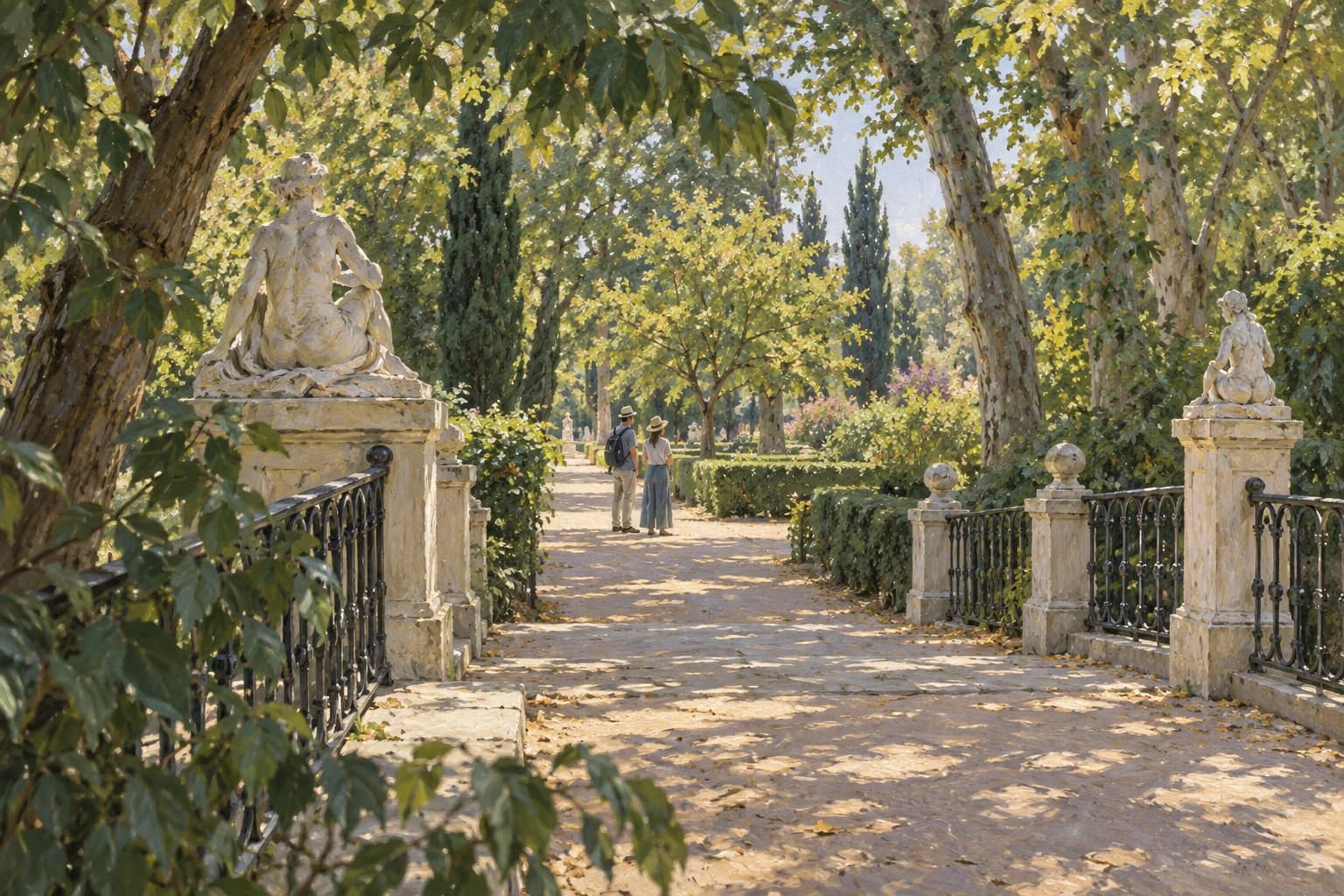 A walk inspired by the Jardín de la Isla in Aranjuez; the figures and viewpoint are interpretive, not a plan of its entrance.
In Aranjuez, exploring heritage does not mean spending the whole visit looking at a building. The garden has a story too.
The municipal tourism site explains that the Jardín de la Isla is surrounded by the Tagus and an artificial channel. Its layout arranges paths, small squares and fountains; Philip II advanced the garden project, with additions under later monarchs.
That changes an ordinary walk. Trees, water and paths become more than pleasant scenery: they are also part of how a place was made. A fountain can prompt a question about what it represents; a junction can make you wonder why the paths meet there.
Open Jardín de la Isla in WAONDERTurning curiosity into your next outing
I would not try to fit all these places into one day. Instead, choose a question and an area:
- In the historic centre: the Royal Palace and Plaza Mayor, to consider what Madrid rebuilt and the layers still visible on its façades.
- Along the Prado–Retiro axis: art, science and gardens, alternating monuments with the spaces that connect them. Adapt your selection to restoration and access notices.
- At Debod and nearby: an outing centred on a monument's journey and its meeting with another city.
- Beyond the capital: El Escorial, Alcalá or Aranjuez, choosing one as the destination for a separate outing.
These are editorial selections, not routes configured inside WAONDER. El Escorial, Alcalá and Aranjuez are separate trips, not stops on a single walking route. Check travel arrangements, official opening times, tickets and restrictions before deciding; a point on a map does not guarantee unrestricted access.
What the Madrid region catalogue contains
The working inventory reviewed for this article contains 32,431 place and map-point records. That combines well-known sites with elements of their surroundings; it does not mean 32,431 monuments.
Here is a selection by primary category:
| Category | Catalogue records |
|---|---|
| Public art | 2,113 |
| Monuments | 1,510 |
| Squares | 674 |
| Archaeological heritage | 567 |
| Museums | 165 |
| Industrial heritage | 90 |
| Palaces | 56 |
| Castles | 45 |
| Monasteries | 41 |
These are our catalogue categories, not an official heritage census or a count of unique buildings. The selection includes interactive and map-only points, with each record counted under one primary category. A large inventory does not imply equal density or information quality in every municipality.
The inventory distinguishes 11,118 records intended for interactive exploration and 21,313 map-only points. Map-only points provide context but do not open individual conversations. When you select a place, check what information and options it offers: we do not promise identical detail at every point or an available answer to every question.
For the Sunday you plan and the curiosity you do not
There are two ways to begin. You might choose an area before going out and give yourself time to notice it. Or you might remember WAONDER during an ordinary day, when you encounter a place you cannot name or have never really understood.
You do not need to cover the whole region or turn every walk into a cultural excursion. One square, sculpture or building can be enough to stop walking past without looking.
And it does not always have to be a grand palace. The story of Perro Paco and his statue in Huertas shows how much a small place can change once you know what lies behind it.
Already using WAONDER? Take another look at the places around you. Just discovering it? Start with somewhere that catches your attention and see what you can explore there.
You do not have to go far to come home with something new to tell.
Download WAONDERWAONDER's working catalogue inventory, reviewed on 28 September 2026; it is not a verification of every point in the published app. Linked sources support the heritage examples. Images are interpretive illustrations, not documentary photographs.
Section
Waonder updates