Barcelona in WAONDER: the city you haven't finished discovering
From the Sagrada Família's branching columns to El Born's buried streets: eight places and stories to rediscover Barcelona on your next walk with WAONDER.
You can recognise a city without quite knowing what is in front of you. You know where that house with the strange balconies stands. You've seen the mosaic lizard in a hundred photographs. You can name a basilica without reading a sign. But what were people trying to build there? Who made that ambition possible? Who was the space meant for?
In Barcelona, those questions can change a walk. A façade stops being a pretty backdrop and becomes a decision. A garden tells you about homes that were barely ever built. A church brings back the people who carried its stones.
Barcelona city is one of WAONDER's supported territories. This selection is not an announcement of coverage across Catalonia, or a complete inventory of Barcelona's heritage. It offers eight places to look at again, whether you live here or are visiting. You don't need to see them all. Sometimes one familiar place becoming unfamiliar is enough.
Download WAONDER for your next walkSagrada Família: a forest that holds up a building
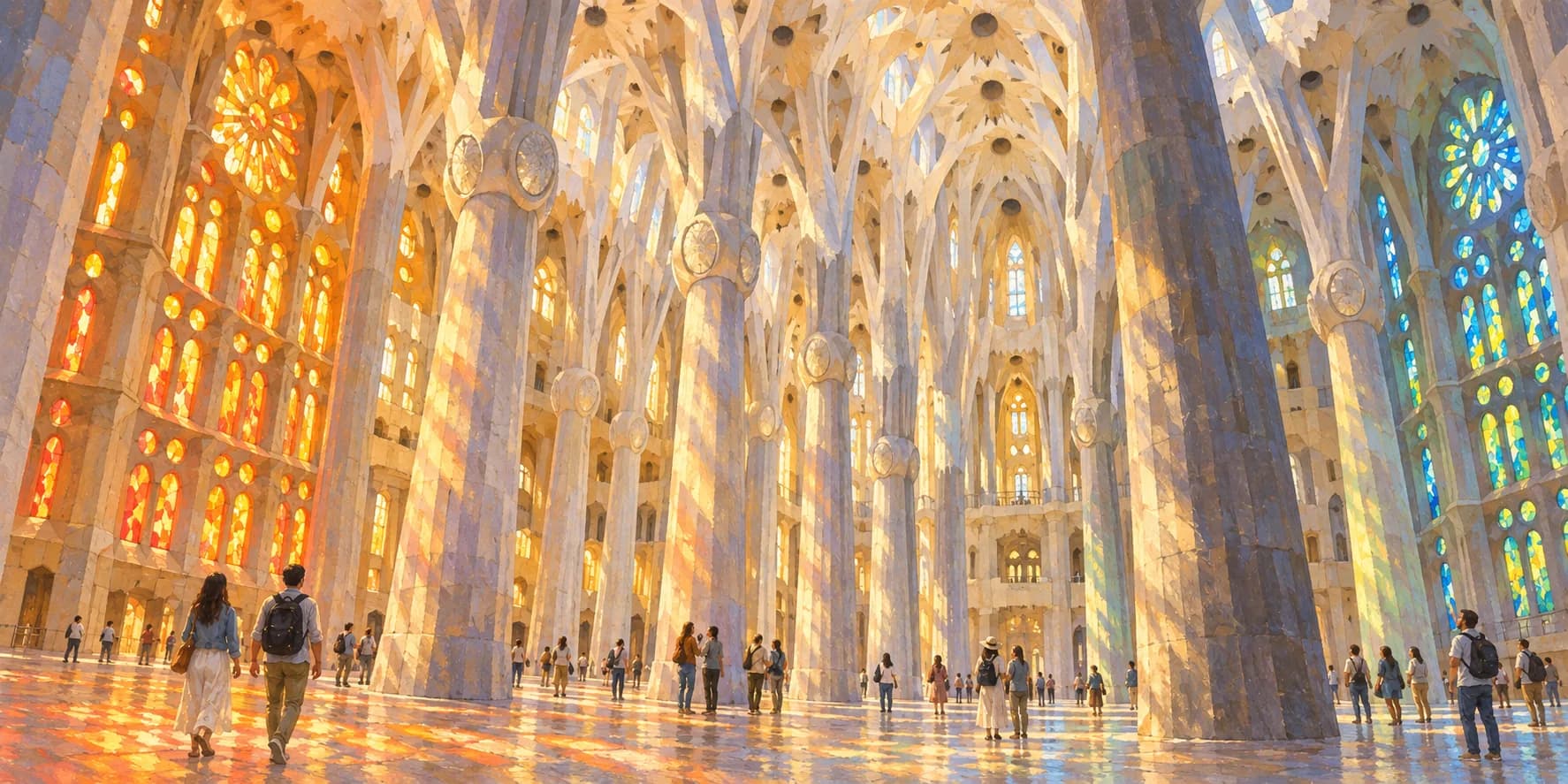
The cover reimagines the Sagrada Família's interior. It is a painterly interpretation, not a photograph or an exact record of its stained glass and ornamentation.
Try following a column upwards. Rather than simply ending in an arch, it divides and opens into a canopy that seems to grow. The forest comparison is more than an attractive description. The basilica's own explanation connects Gaudí's geometry, materials and branching forms with the distribution of structural loads.
What makes it moving is that an engineering solution also changes the experience of being inside. You can be looking at a structure while feeling as though you are standing beneath trees. Stained-glass light offers another way to read the room: the columns don't all seem the same when different colours reach them.
If you mostly know the building's outline, save a question for its interior: how did something so heavy come to look as though it was growing? You needn't memorise architectural terms. Just pause and look for the point where a column branches. That small act might give you a memory of the building that has nothing to do with its height.
Open Sagrada Família in WAONDERCasa Batlló: seeing another possibility in an existing house
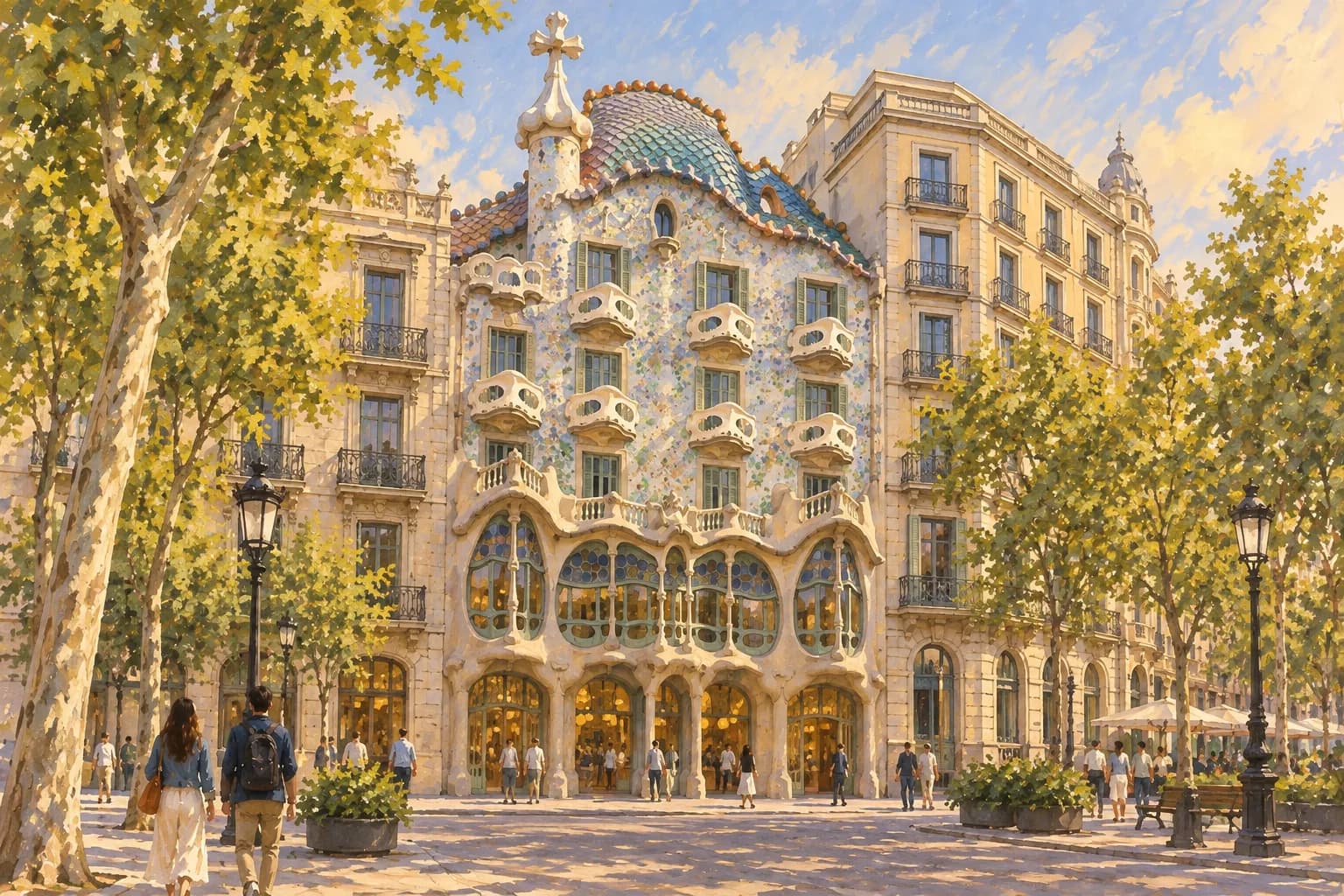 Casa Batlló: a transformation you can begin reading from the pavement. Painterly interpretation; surroundings and minor details are imagined.
Casa Batlló invites stories before you even know its own. Its balconies suggest masks. The supports around its large windows resemble bones. The roofline can bring an animal's back to mind.
One less visible detail changes the story: Gaudí did not begin with an empty plot. He transformed an existing house between 1904 and 1906, altering its façade and reorganising its interior. The building's official history explains how an initial proposal to demolish it became a refurbishment.
The question shifts. Not just “how did he imagine this house?”, but “how did he see this possibility inside another house?” Before you stands a radical way of looking again at something that was already there.
The reading of the roof as a dragon and the cross as Sant Jordi's sword is a popular interpretation acknowledged by Casa Batlló, rather than a proven account of Gaudí's intention. Enjoying that interpretation needn't mean mistaking it for a documented fact. Look at a shape, notice what it suggests, then ask what we actually know about it.
Open Casa Batlló in WAONDERLa Pedrera: behind the stone, a place to live
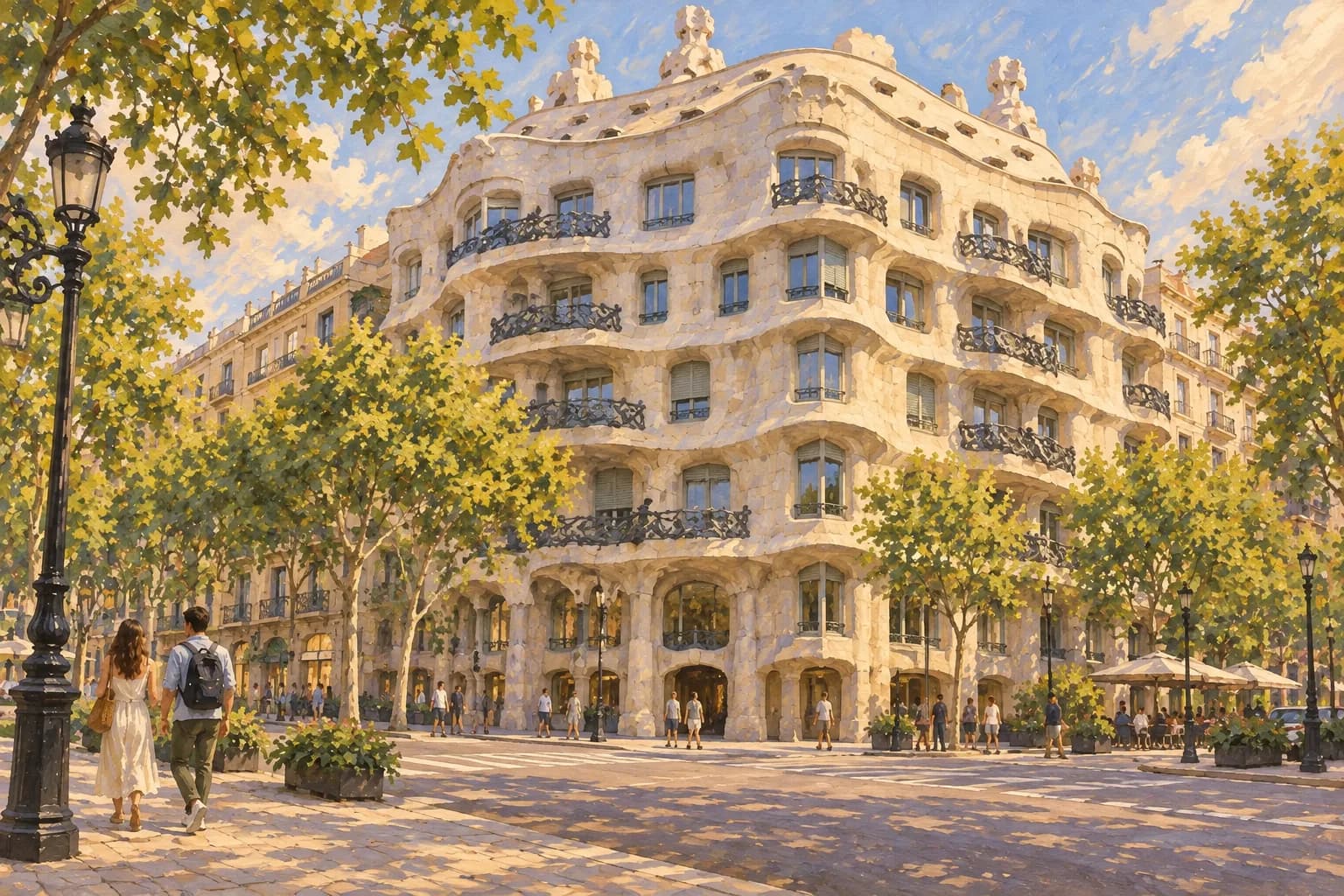 La Pedrera was a home before it became a famous image. Painterly interpretation, not an architectural survey.
Further along Passeig de Gràcia, Casa Milà, also known as La Pedrera, offers a different surprise. Its façade seems to move without going anywhere: one curve leads into another, while the balcony ironwork gives the stone a second texture.
Gaudí designed it for Rosario Segimon and Pere Milà; construction took place between 1906 and 1912. The institution responsible for it recalls its residential origins and a reception that wasn't always admiring. The heritage we recognise today also had to accommodate disagreements, tastes and domestic needs.
To understand it, look beyond the façade. Its interior courtyards reveal how the house is organised. Architecture does not stop where the photograph begins: it continues in the way light enters and spaces relate to one another.
Behind this extraordinary building lies a very ordinary question: what is it like to live here? Thinking about it while looking at the balconies restores a human scale. Before the house belonged to our photo albums, it belonged to people who opened windows, welcomed visitors and came home.
Open La Pedrera in WAONDERPark Güell: a project that found another life
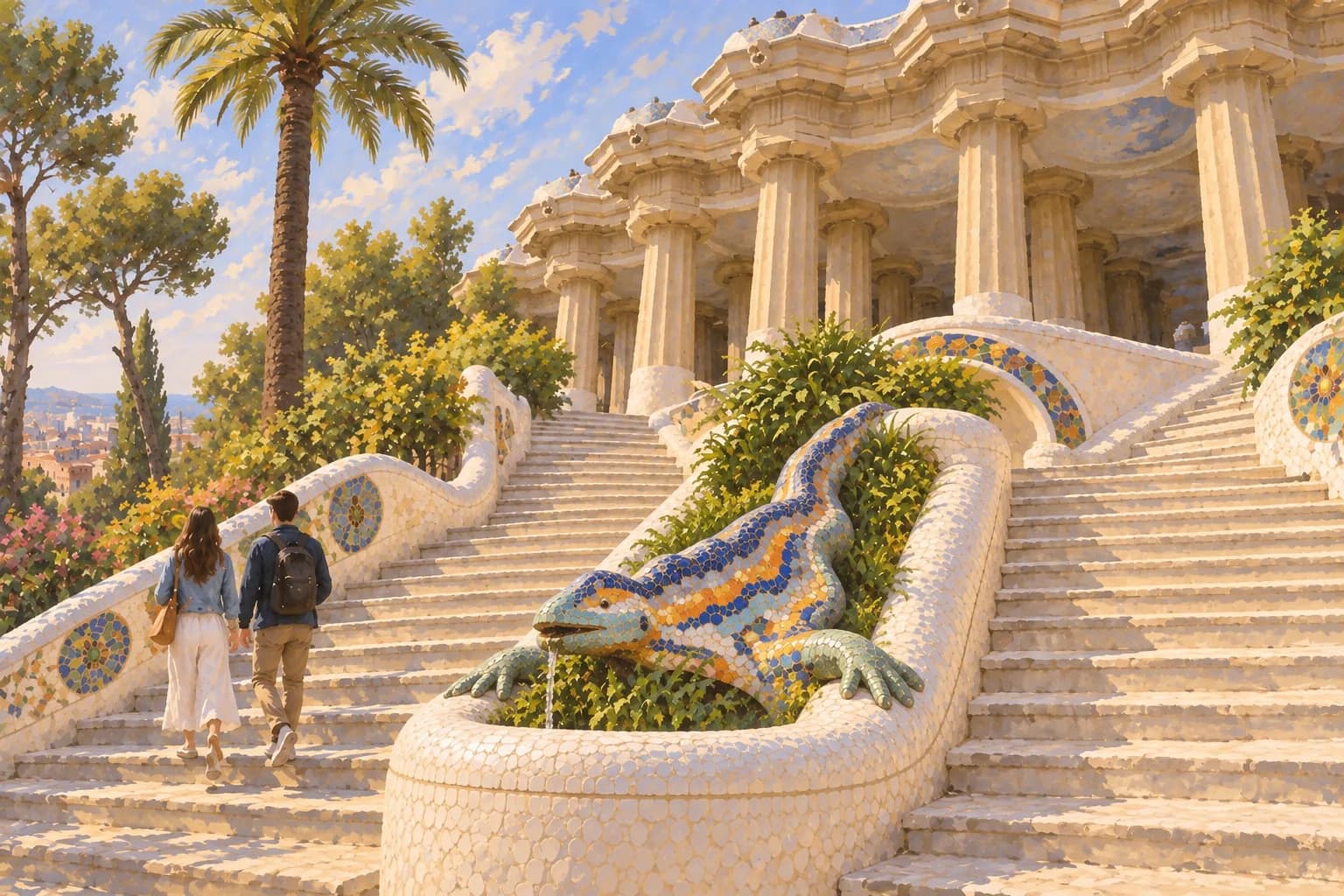 The salamander makes the place recognisable; its story takes you further. Painterly composition, not an exact copy of the mosaic.
Park Güell can feel as if it was always meant for visitors to wander through. Its origins were different: Eusebi Güell commissioned Gaudí to design a residential development of around sixty plots. Only two houses were built. The grounds eventually opened as a public park in 1926, according to its official history.
It's one of those stories that changes what you see without changing the place itself. The staircase, columns and spaces you walk through belonged to an idea of how a small community might live. The development did not succeed as intended, but it didn't disappear: it found another use.
When you look at the salamander, look beyond its colours. Ask what the place would be like if that housing scheme had worked. Would it feel the same? Who would be able to walk through it?
There is no need to turn an unsuccessful project into a tidy moral lesson. The contrast is enough: a place intended for a small number of homes became part of countless people's memories. Your next photograph might capture more than a famous mosaic. It might remind you of that change of purpose.
Open Park Güell in WAONDERSant Pau: caring through the spaces people inhabit
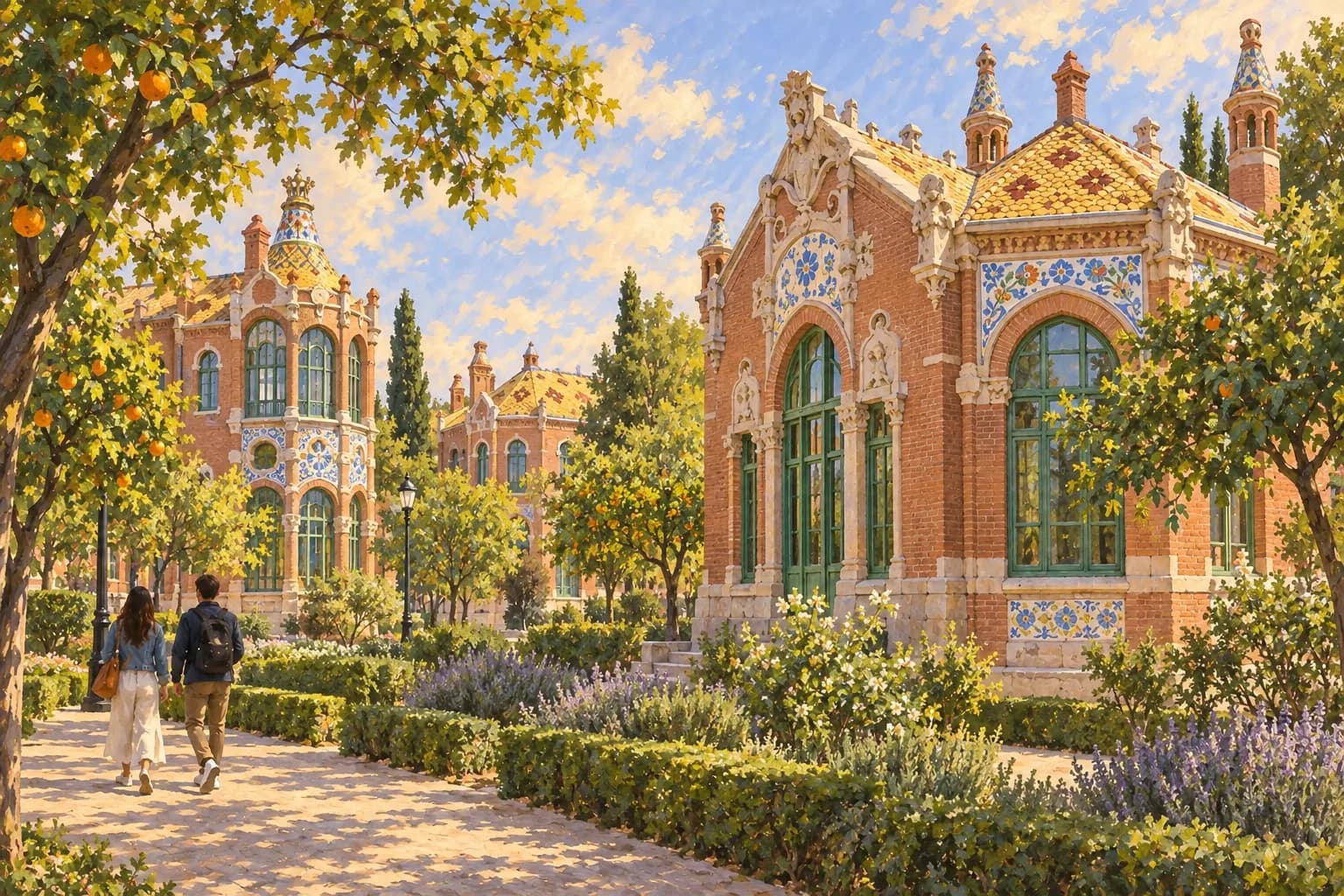 Sant Pau: light, gardens and architecture in a former hospital complex. Evocative illustration, not a depiction of present-day clinical activity.
At the Sant Pau Art Nouveau Site, beauty has a different history from the houses on Passeig de Gràcia. The question was not simply how to build something impressive, but what a place caring for sick people should be like.
Banker Pau Gil's bequest helped launch the project. Lluís Domènech i Montaner designed separate pavilions, gardens and underground connections, with attention to daylight and ventilation. The complex was inaugurated in 1930, as its history explains.
Consider the difference between picturing a hospital as one closed block and imagining a relationship between buildings and outdoor spaces. This isn't a claim that flowers cured people. It is a way of recognising the importance given to the surroundings of people who needed care.
If you visit, look at the relationship between garden, window and pavilion. Decoration stops being an isolated embellishment when you remember who the place was made for. In front of those ceramics, you might find yourself asking a simple, substantial question: what makes us feel cared for, beyond the treatment we receive?
Open Sant Pau in WAONDERPalau de la Música: a city making room to listen
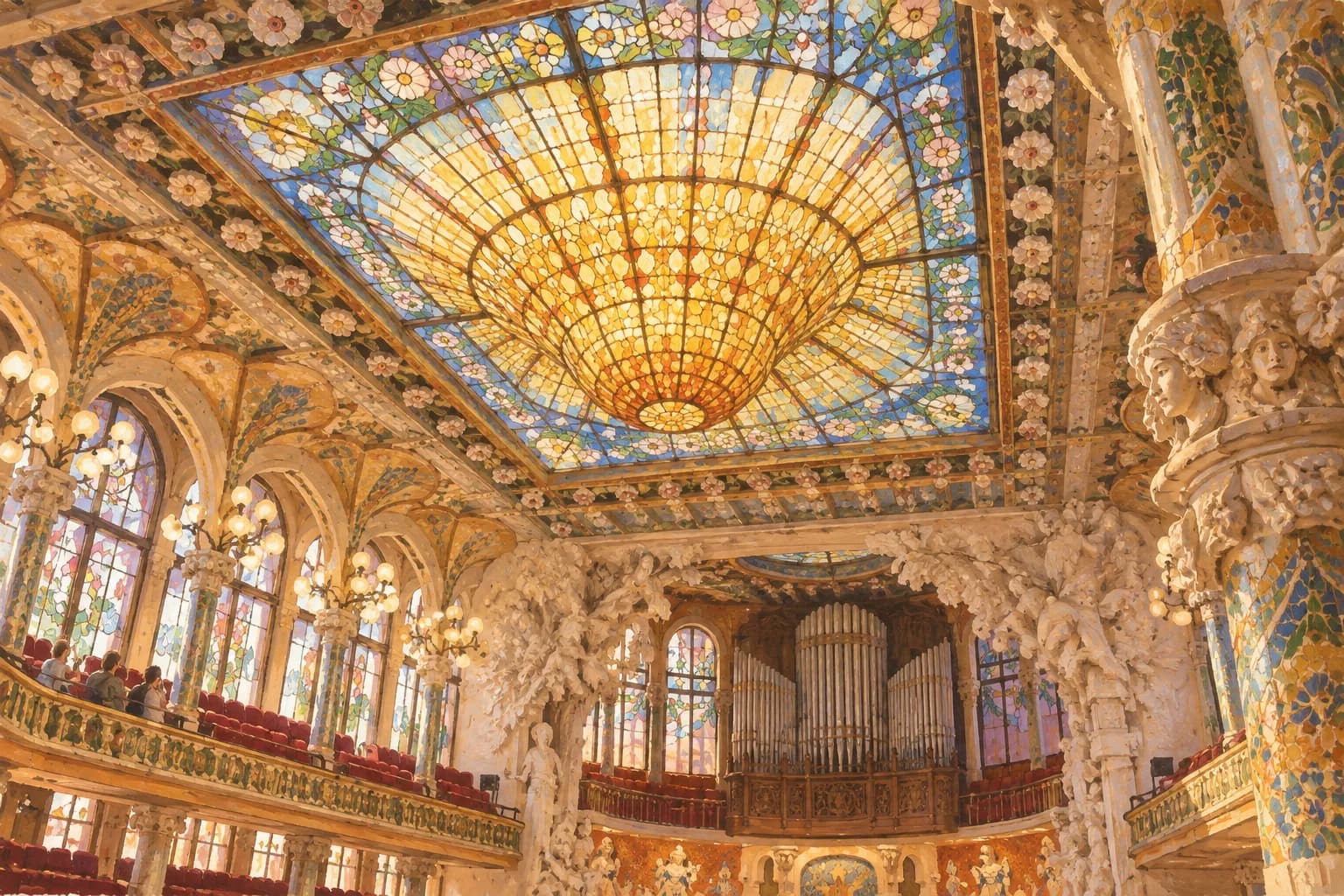 Light is part of the Palau experience too. Painterly interpretation; glass and sculptures are not reproduced detail for detail.
Not all of Barcelona's Modernisme is Gaudí's work. Like Sant Pau, the Palau de la Música Catalana was designed by Domènech i Montaner. It was built between 1905 and 1908 for the Orfeó Català, with contributions from a public subscription, according to the Palau's history.
That origin adds something to your impression of the building. This is not simply a beautiful hall. It is a space created around something people do together: sing and listen.
Inside, the central skylight introduces another presence. Its glass bulges downwards, and light passes through a surface that seems to gather sun and colour. Notice how it changes the relationship between ceiling and room: what normally feels like a boundary becomes a source of light.
Then sit for a moment, if your visit allows it. Imagine the difference between looking at an empty hall and hearing it fill with music. The architecture invites a question: what community wanted this place, and what keeps happening when people use it? A cultural building is not only what it preserves. It is also what it makes possible.
Open Palau de la Música in WAONDERSanta Maria del Mar: remembering the hands that carried the stone
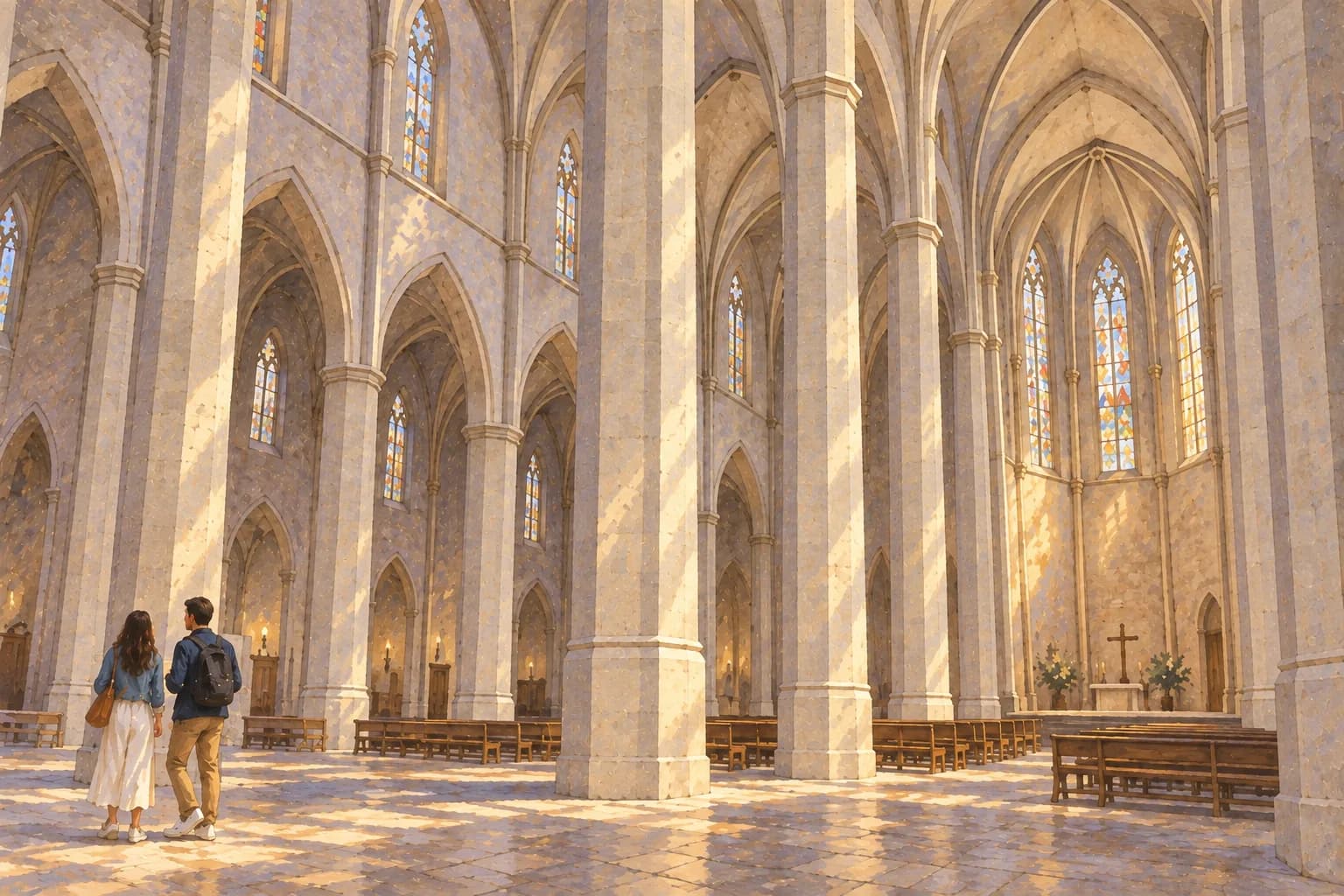 Stone and open space at Santa Maria del Mar. Illustration; visitors, lighting and secondary details are imagined.
Inside Santa Maria del Mar, the sense of space may draw your eyes upwards. Its history also invites you to consider the journey its stones made before reaching that height.
The basilica explains that stone came from Montjuïc, and recalls the bastaixos, the guild associated with loading and unloading ships whose members helped transport it. Its history also records other trades' contributions and donations. This was neither one person's achievement nor a building funded exclusively by ordinary workers.
That collective work deserves a place in how we look. A column did not become a column on its own. There was quarrying, transport, knowledge and effort. Thinking about that takes nothing away from the architecture; it brings back people we often leave outside the photograph.
In front of those octagonal pillars, try changing the question. Instead of “how tall is it?”, ask “how many hands made this space possible?” There won't be a simple number. That is precisely why it's worth pausing: buildings outlast the names of many people who helped create them.
Open Santa Maria del Mar in WAONDEREl Born: when the ground stops being just ground
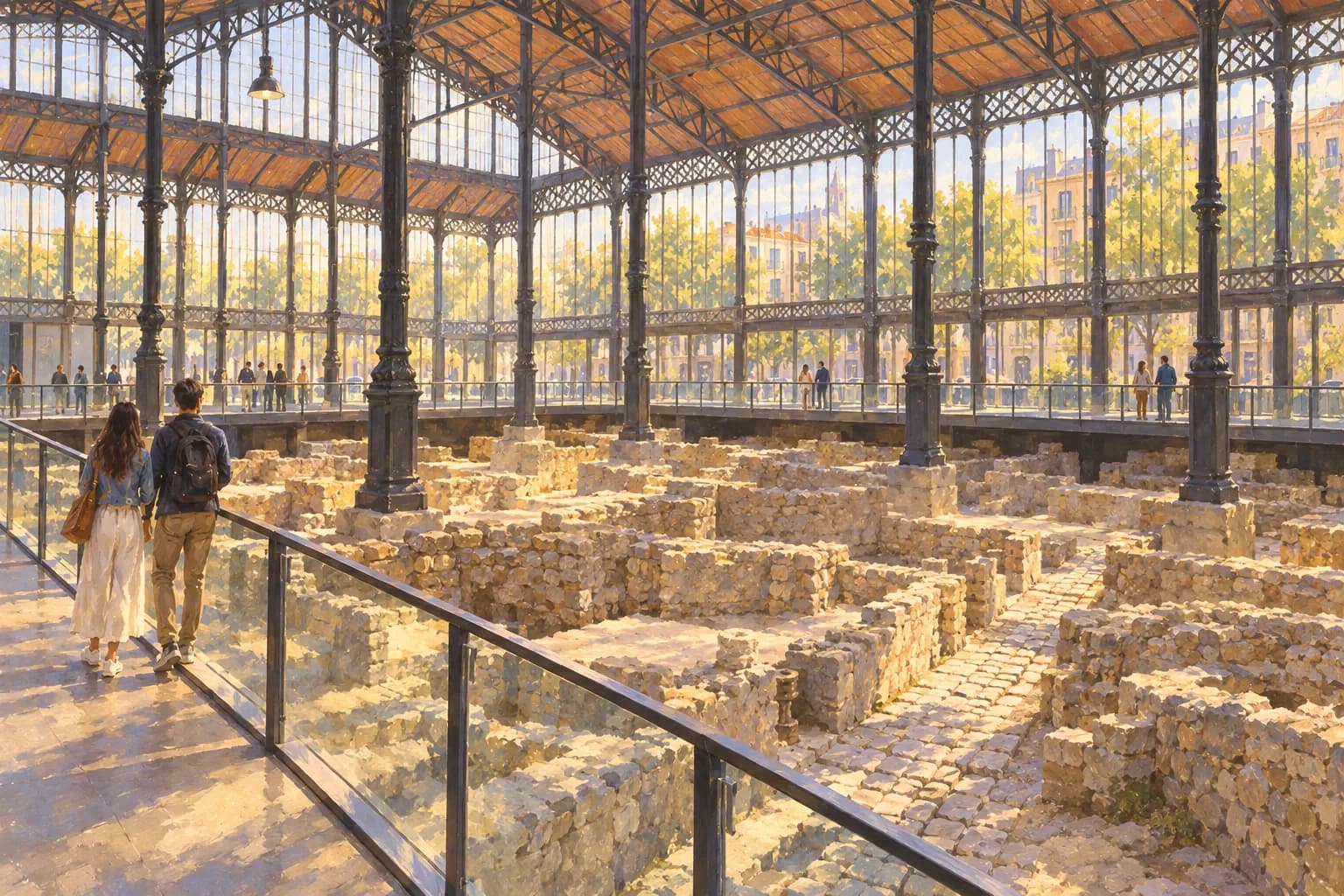 A city beneath another layer of city. Interpretation of the archaeological space, not an exact plan or reconstruction of every house.
At El Born, you can look down rather than up. Beneath the structure of the former market, surviving streets and buildings reveal another scale of Barcelona: lives lived between its major historical events.
The Barcelona History Museum connects the site with questions about everyday life in Barcelona around 1700, including access to water. It is a particularly relatable way into the past: not just through rulers and dates, but through needs we still recognise.
Looking at the remains of a room, you can consider its use without inventing exactly who lived there. Looking at a street's outline, you can imagine people passing without giving them names or scenes we cannot know. That distance has an emotional weight of its own. There were whole lives here, even if we cannot recover them all.
When you return to the neighbourhood outside, its paving may no longer feel like a surface without a history. The city we walk through is also what lies underneath it.
Open El Born in WAONDERA Barcelona that goes beyond its famous names
If you live here, you probably do not visit the Sagrada Família every weekend. Everyday curiosity also begins with a neighbourhood sculpture, a square or a church you usually walk past. The working inventory for Barcelona city, reviewed on 28 September 2026, contains 8,318 records of places, areas and map points: that does not mean 8,318 monuments, or coverage of all Catalonia.
This sample of primary categories shows other ways the catalogue might inspire you to look at the city. The counts include interactive records and map-only points:
| Primary category | Catalogue records | What you might want to discover |
|---|---|---|
| Public art | 935 | The story behind a sculpture you have seen for years without knowing who it represents. |
| Monuments | 708 | Why a place became a symbol, and which detail deserves a second look. |
| Cultural centres | 456 | How a space relates to its neighbourhood's memory and everyday life. |
| Squares | 306 | What stood there before, and why the space became a meeting place. |
| Churches | 293 | The relationship between stone, work and community that Santa Maria del Mar invites you to explore. |
| Museums | 93 | Which subject interests you before organising a visit, rather than choosing by fame alone. |
| Archaeological heritage | 429 | How a street changes when you start imagining the city beneath it. |
| Gardens | 967 | Which green surroundings you can recognise on the map to give a walk a different shape. |
| Viewpoints | 217 | What you are actually looking at when Barcelona opens up below you. |
Archaeology shows why a large count does not mean many available conversations: 403 of its 429 records are map-only. Across the inventory, 4,489 records provide that mapping context; the other 3,829 are not map-only and include 152 areas. Select a place and check the information and interaction it offers: not every point is an individual monument or has the same level of detail.
Each record is counted once under a primary category. The table is a selection, not a complete breakdown or an official census of unique buildings; the working inventory alone does not verify every point's availability in the published app.
The opportunity for your next walk is not to chase thousands of markers. It might be much smaller: finding out why that sculpture is there, or finally pausing in that square. The buttons in this article link to its featured places; WAONDER's map lets you continue exploring the places shown around you and ask where conversations are available.
Choose a question, not eight visits to tick off
These places are not a single route or a checklist to finish. For one outing, choose an area and leave room to stop:
- Passeig de Gràcia: Casa Batlló and La Pedrera offer two of Gaudí's approaches to housing. Seeing their façades from the street and visiting their interiors are different experiences.
- La Ribera and El Born: Santa Maria del Mar and the archaeological site connect work, neighbourhood and memory. The Palau suggests a separate outing around Sant Pere.
- Sagrada Família and Sant Pau: choose where you want to spend your time; if you combine them, check access and transfers before setting out.
- Park Güell: give it a plan of its own. Consider slopes, your companions' mobility and admission arrangements, rather than treating it as a stop next door to everything else.
For interior visits, check reservations, opening hours, accessibility and conditions on the linked official websites. This article does not promise free entry, admission without booking or a guided route inside the app.
With WAONDER, the idea is to bring that curiosity along: open the map, explore the places that appear and ask about whatever catches your attention where conversations are available. Recognising a place is the beginning of knowing it, not the end.
If you'd like to compare cities, our selections from the Community of Madrid and the Valencian Community offer other questions for places you may have thought you already knew.
Barcelona needn't surprise you all at once. On your next walk, one house, one column or one street making you look up—or down—a little more slowly might be enough.
Download WAONDERSection
Waonder updates