The Valencian Community in WAONDER: look beyond the postcard
The Silk Exchange, Serranos Towers, Alicante, Elche's palm groves, Peñíscola and Morella: stories for rediscovering the Valencian Community with WAONDER.
There are gates you've walked through without wondering what they once protected. Palm trees that seem to be there simply to offer shade. A castle you've seen from the beach so often that perhaps you've never really looked at it.
Familiarity has a small trick up its sleeve: it turns an extraordinary place into part of the background. Until someone tells you a detail, and you can't quite see it the same way again.
The Valencian Community is one of WAONDER's territories. That means more than Valencia city alone. Alicante and Elche, Peñíscola and Morella offer other ways to explore a region that doesn't fit into a single postcard. Here are some questions for your next walk, whether you live nearby or are visiting.
Download WAONDER for your next walkThe Silk Exchange: when trade left its mark in stone
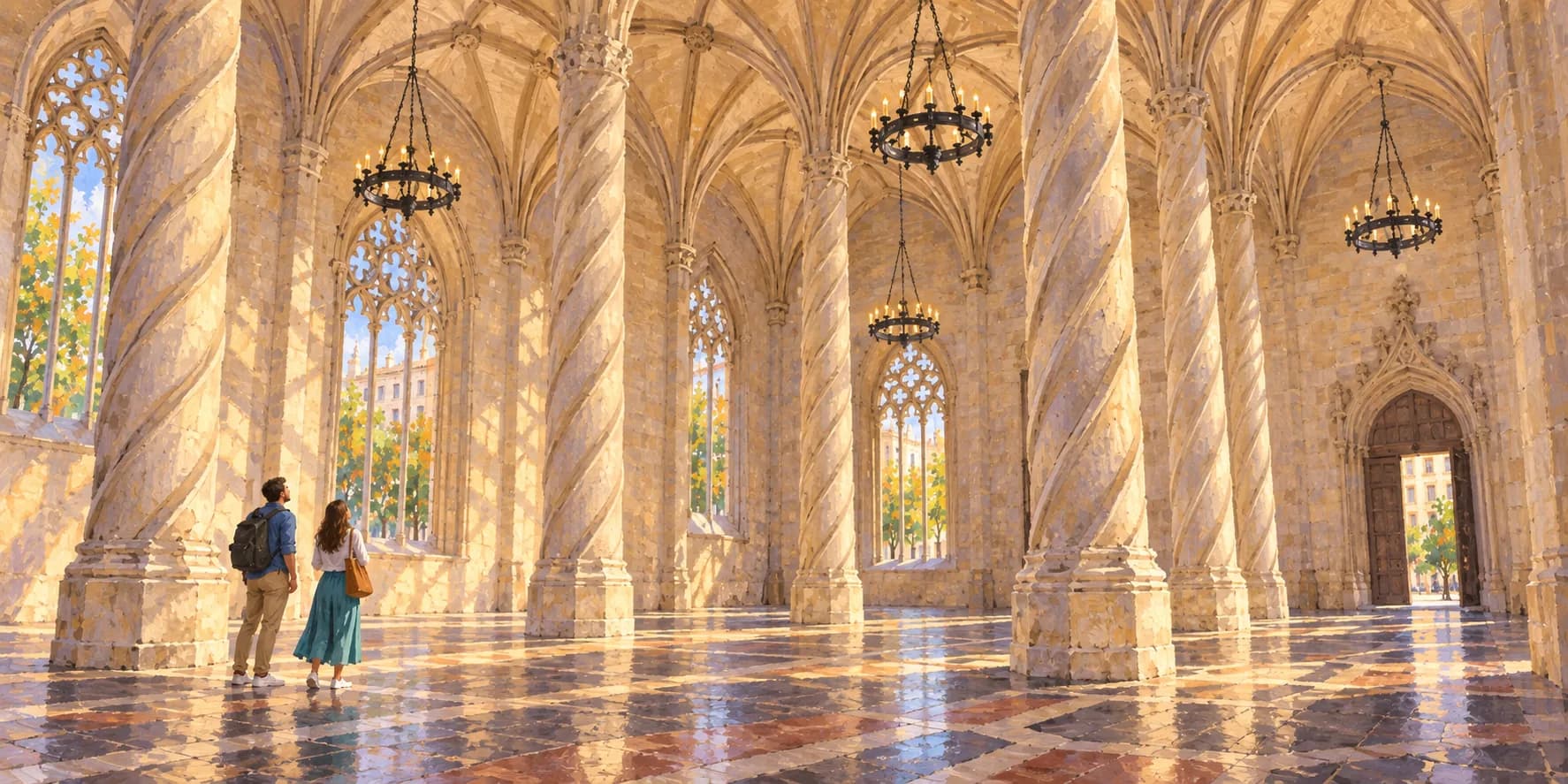
This article's cover reimagines the trading hall of La Lonja de la Seda, Valencia's Silk Exchange. It is a painterly interpretation: the light, visitors and decorative details are recreated, not a photographic record of the building.
If you go inside, start by looking up. The columns twist, and ribs branch out across the ceiling. The effect might suggest a place of worship, but this is a secular building devoted to trade. UNESCO recognises it as an expression of the city's mercantile power and highlights an inscription reminding merchants of their obligations to deal honestly.
That contrast is worth a pause: such a solemn room for something as human as exchanging goods, negotiating and trusting another person's word.
You don't need an architectural vocabulary to enjoy it. Follow one column with your eyes, from floor to vault. Then ask what the space was meant to communicate to someone arriving to make a deal. Next time you pass the Silk Exchange, you may see more than an old facade: a city trying to express who it was.
Open the Silk Exchange in WAONDERSerranos Towers: a gateway that also sheltered art
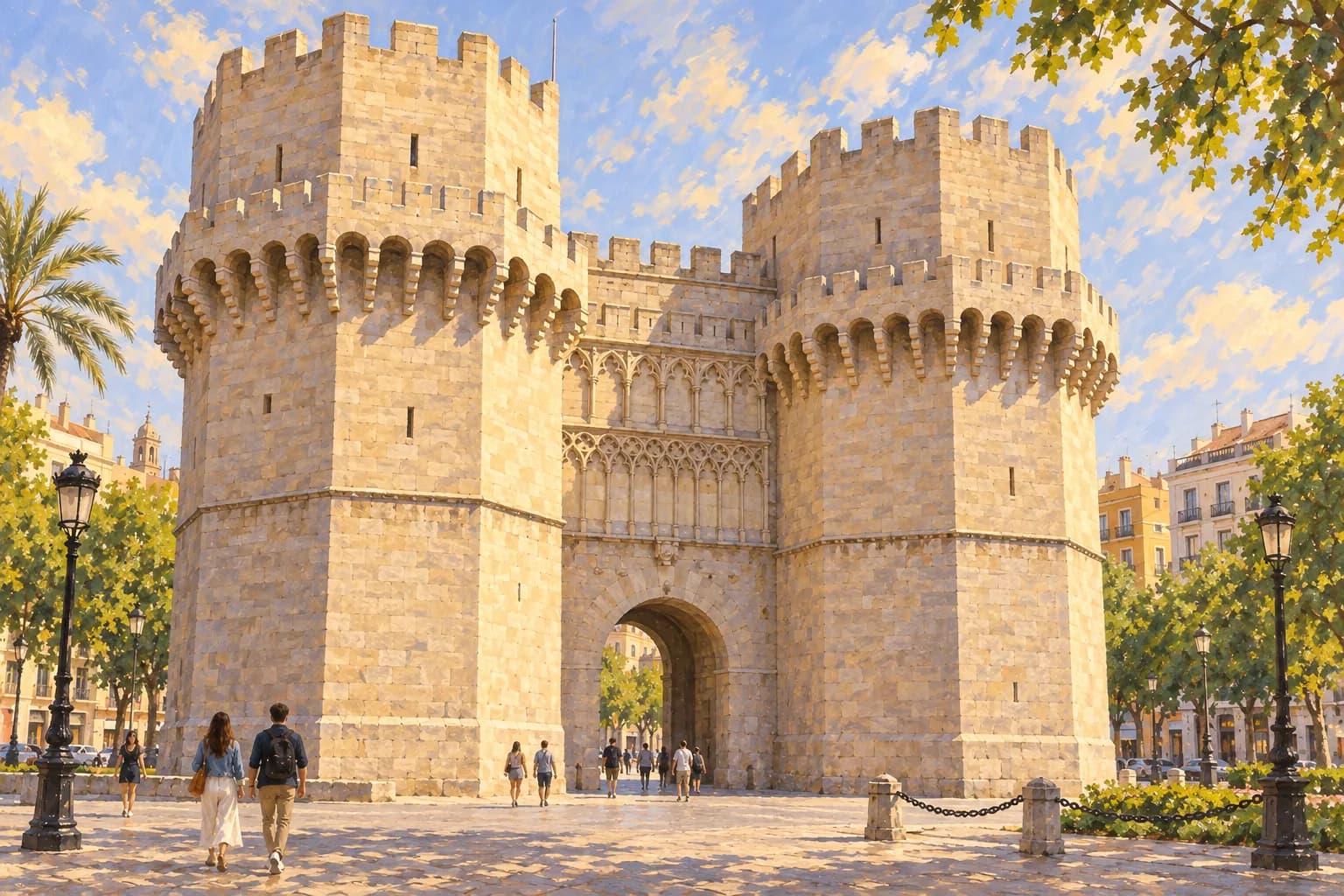 Serranos: a city entrance with more than one life. Painterly interpretation; ornament, vegetation and surroundings are recreated.
The Serranos Towers seem to explain their own purpose: thick stone, height, a gate controlling passage. But their story didn't end with medieval defence.
During the Spanish Civil War, they sheltered artistic heritage, including works from Madrid's Prado Museum. Valencia City Council documents the alterations made to protect it, including measures against damp.
That detail changes the emotional scale of a visit. Today's backdrop for a photograph was also a place chosen to care for something fragile. Towers built to withstand danger came to protect paintings.
From the square, notice their flat sides, the projecting features below the battlements, and the relationship between the two towers and the central section. The question is no longer just “How did they defend the city?” It's also “What did this city do to preserve what it couldn't replace?”
Open Serranos Towers in WAONDERThe Turia: walking where a river used to flow
In Valencia, you can be walking through a garden and, at the same time, through a decision about how a city should live.
After the flood of 1957, the Turia was diverted south. That left the former riverbed with a future to be decided; the gardens opened in 1986, according to Visit Valencia. The city's cultural website recalls the public campaign for a green riverbed rather than a proposed major road.
As you explore it today, try looking at the bridges from below. They help you read what was here before the paths and trees. An everyday walk has a history too: this space didn't appear without decisions, or without people advocating a different use for it.
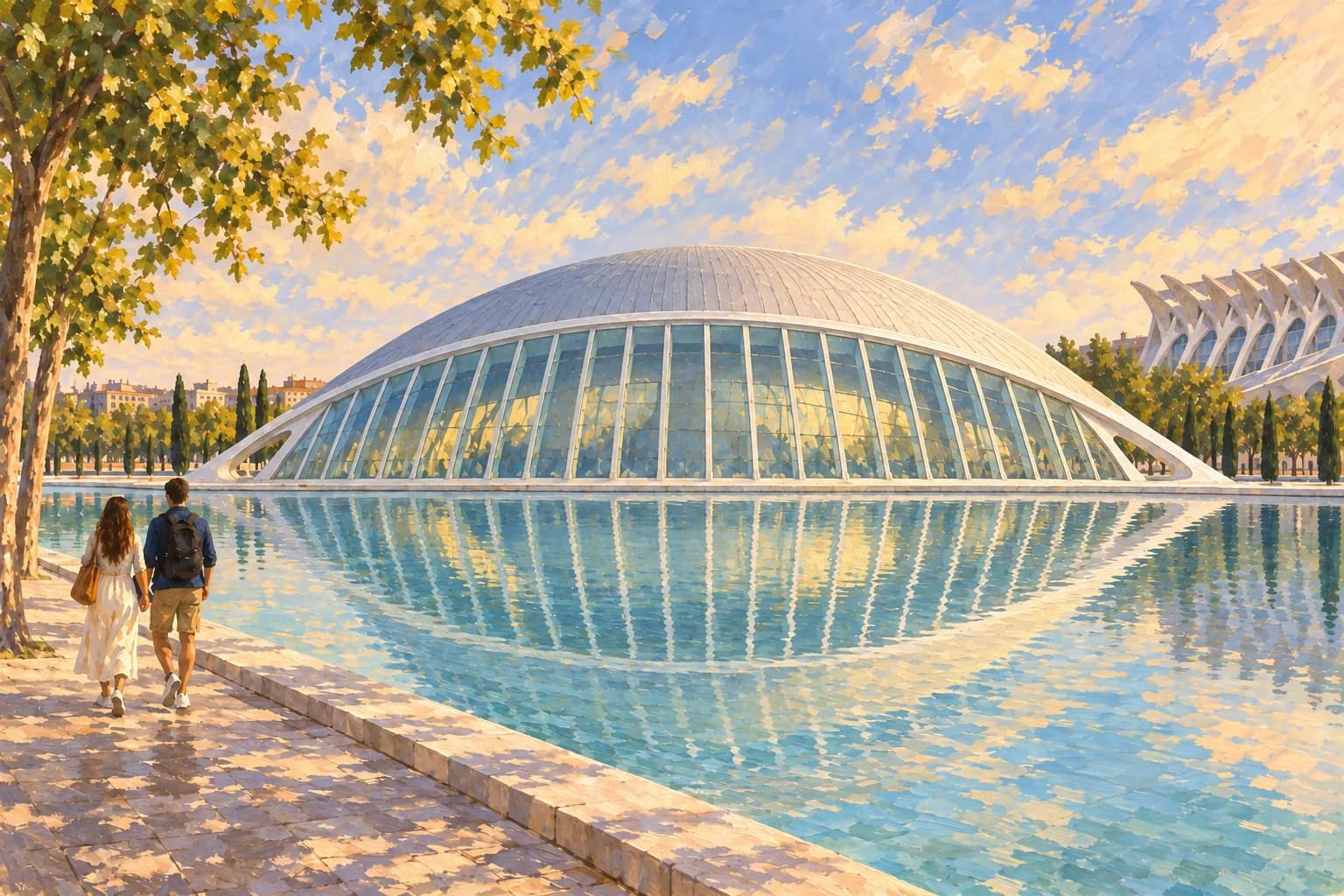 Contemporary architecture can spark a question too. Interpretation of the Hemisfèric; perspective and smaller details are not an exact reproduction.
Within the City of Arts and Sciences, the Hemisfèric offers a contrast with the Silk Exchange. Designed by Santiago Calatrava and opened in 1998, its form evokes a human eye, as the complex's official website explains.
There's no need to turn that comparison into a contest between old and new. You can approach both with the same curiosity: what shape was chosen, what it was intended to express, and what changes with the light. In one place, you follow a column; in the other, a curve and its reflection.
Alicante: looking up from the Postiguet
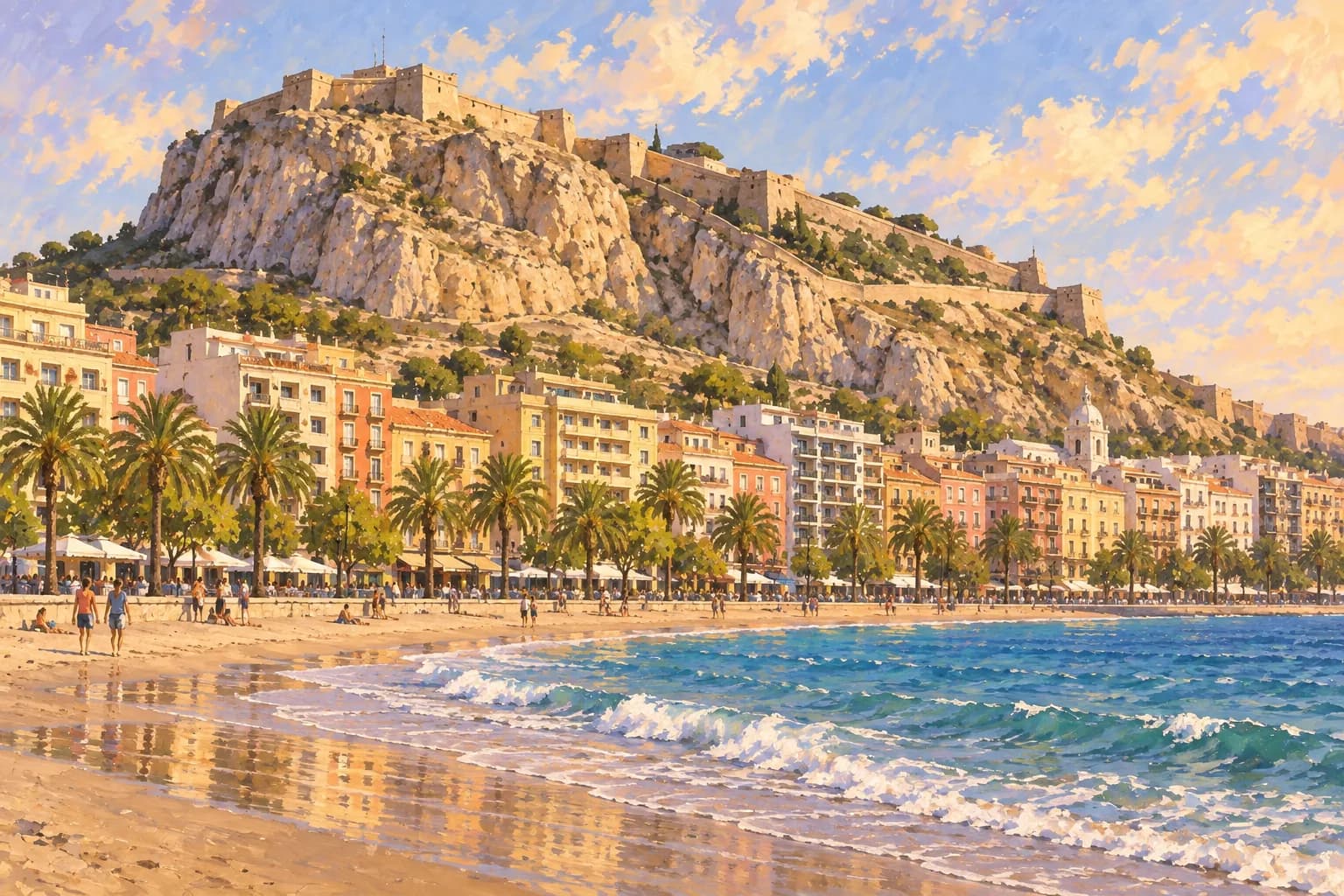 From the shore, Benacantil helps explain why the fortress stands here. Painterly interpretation; buildings, light and walkers are recreated.
In Alicante, Santa Bárbara Castle can accompany an entire walk along Postiguet Beach without receiving more than a glance. It's so much a part of the city's image that it's easy to leave it in the background.
Try doing the opposite: stop and look at how the fortress follows the rock of Mount Benacantil. This isn't a castle set on an arbitrary pedestal. Its position allowed control of the bay and the surrounding land; its enclosures belong to different phases of construction, as Alicante City Council explains.
That gives you a way to observe it without memorising a list of dates. Look for the lines of walls and the way they adapt to the slopes. Think about the difference between enjoying the sea view and having to watch what was approaching across it.
If you decide to go up, plan that visit separately and check the castle's official access information. Seeing it from the beach and exploring the fortress are different experiences; this article doesn't assume the climb is easy for everyone or that every form of access is free.
Open Santa Bárbara Castle in WAONDERElche: beneath the palms, work and memory
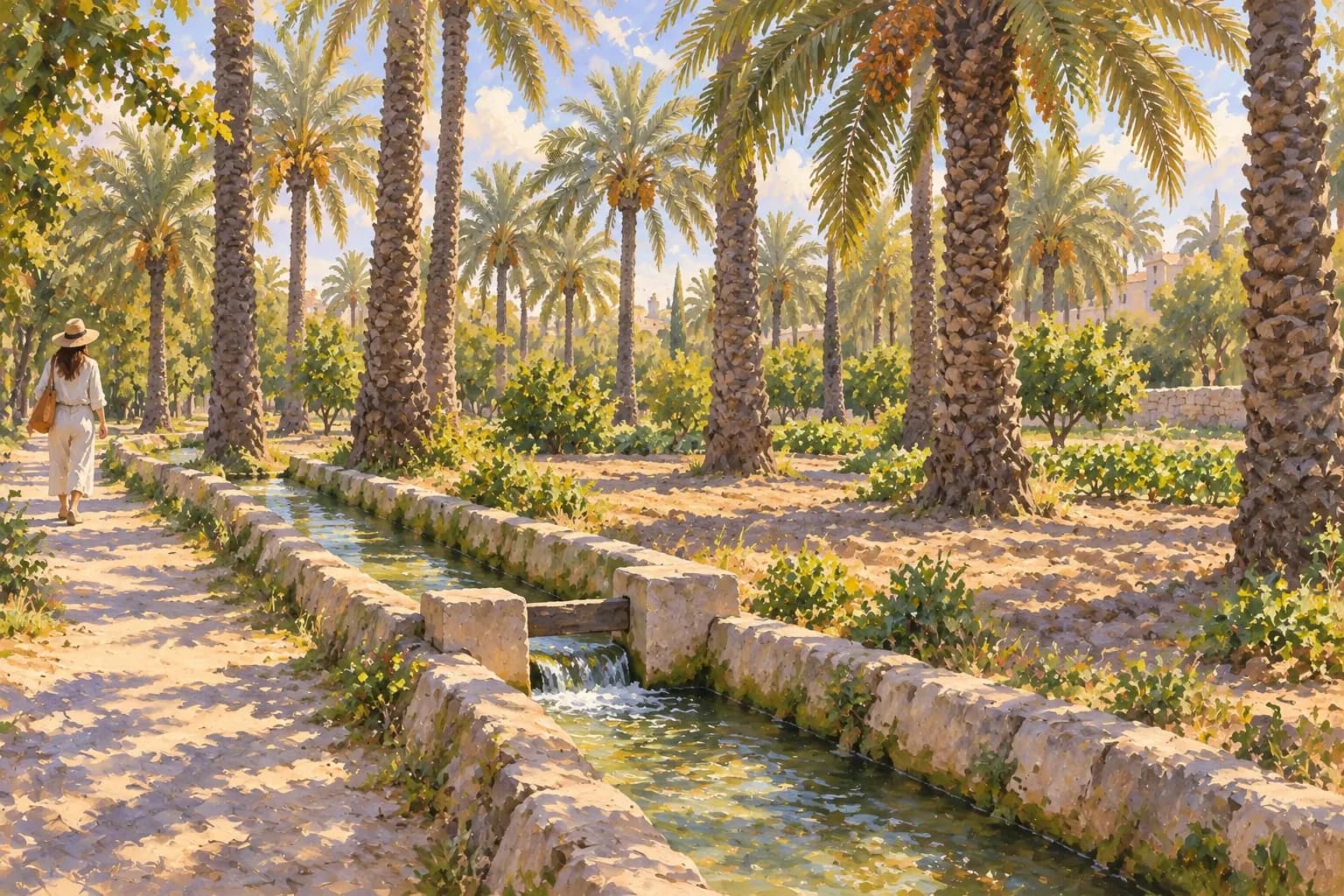 A landscape sustained by water and care. An orchard evocation, not a reproduction of a specific site or a plan of its irrigation system.
Elche's Palmeral invites you to look up, but one of its keys is down below.
UNESCO describes it as an artificial agricultural oasis: orchards bounded by date palms, connected to an irrigation system and a tradition of cultivation. It became a World Heritage Site in 2000. These aren't simply trees planted as decoration.
In an area open to visitors, notice the rows, the ground and, where visible, the irrigation channels. Elche City Council's Palm Grove Museum explains how channels and water dividers distribute the supply.
Understanding that brings people back into the landscape. The shade you enjoy also depends on inherited knowledge and work that continues. Sometimes discovering heritage isn't about finding something abandoned: it's recognising the effort that keeps it alive.
The Municipal Park and Huerto del Cura are possible starting points, not alternative names for the whole Palmeral. Respect paths and check each site's conditions; a visible orchard isn't necessarily open to the public. Don't touch the irrigation mechanisms either: they are part of that care, not an interactive attraction.
Open Huerto del Cura in WAONDERPeñíscola: behind the white town, a dispute
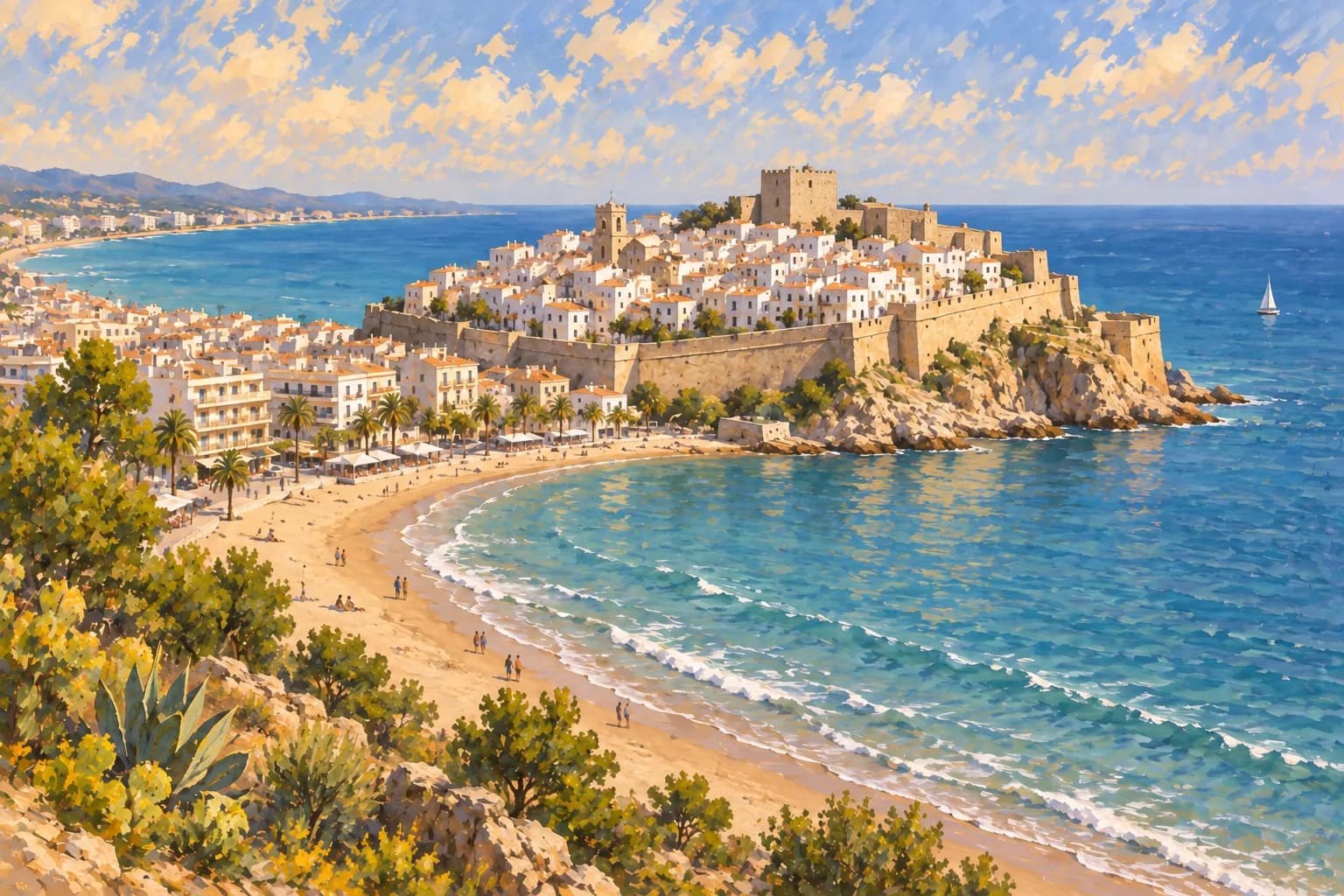 Peñíscola's story extends beyond its seaside silhouette. Painterly interpretation; street layout, viewpoint and fortress details are recreated.
In Peñíscola, it's tempting to stop at the first impression: white houses, walls and sea. But as you climb through the old town, your question might become more specific: why did a papal residence end up here?
The castle, built by the Knights Templar, became the residence of Benedict XIII, known as Papa Luna, in the fifteenth century, as the Provincial Council of Castellón explains. His name belongs to a period of contested papal authority, not simply a palace anecdote.
Without turning your visit into a complete lesson on the schism, you can pause over the difference between the landscape's apparent serenity and the tensions associated with its history. A beautiful view doesn't imply a peaceful past.
Choose a detail before taking the photograph: rock meeting wall, streets climbing uphill, or the castle rising above the houses. To enter the fortress, check tickets and rules on its official website. Exploring the old town and visiting the castle enclosure are not the same thing.
Open Peñíscola Castle in WAONDERMorella: understanding the region far from the sea
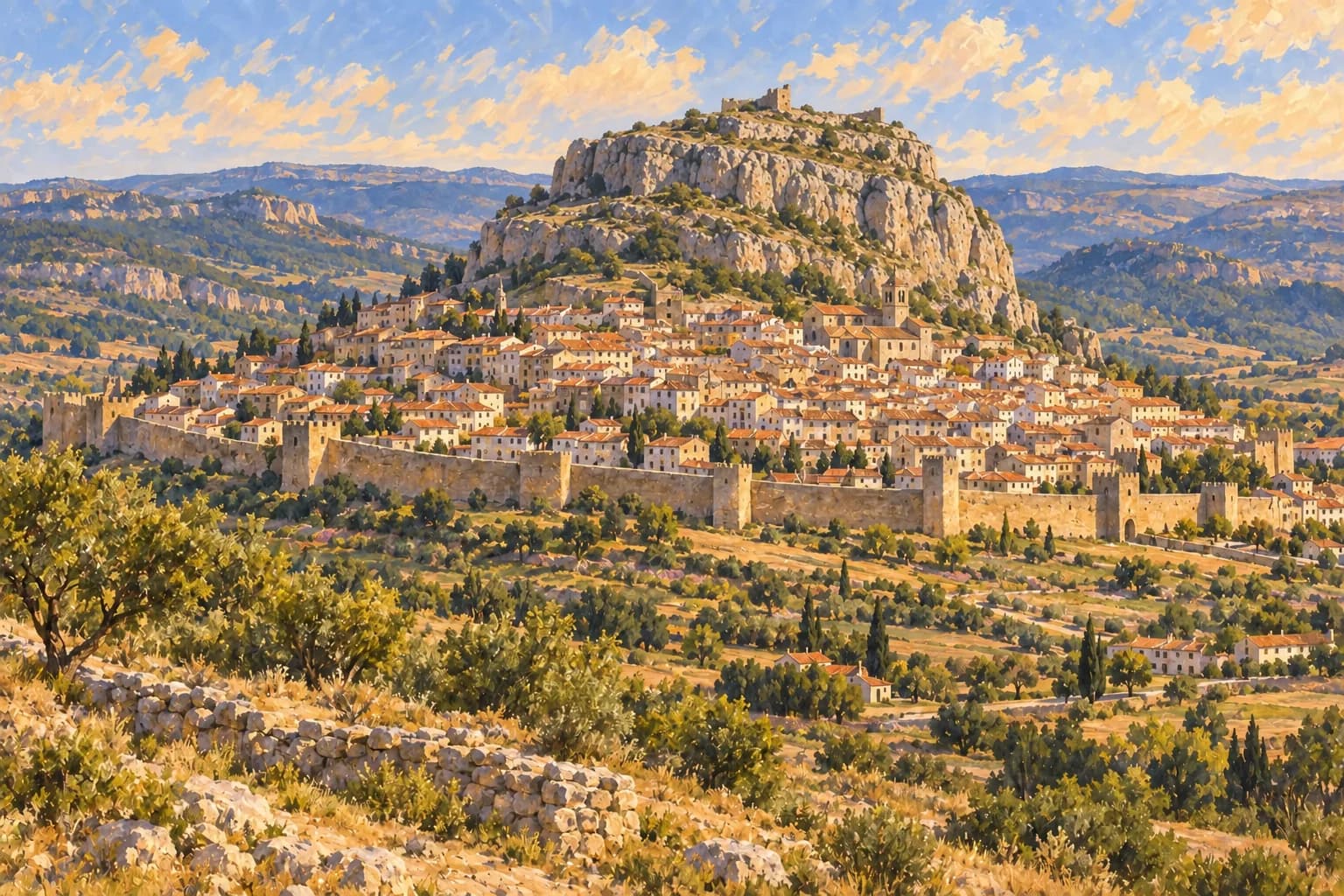 Morella opens another view of Castellón: rock, walls and inland life. Painterly interpretation, not an exact inventory of towers, buildings or ruins.
Morella asks you to expand your mental map. The Valencian Community is also inland country, changing terrain and towns whose shape depends on a rock.
Its castle uses the natural outcrop beneath it. The municipal tourism office connects its strategic importance to controlling passage between the interior and the coast and explains the fortress's changes over time.
Before focusing on an individual tower, look at the whole: rock, houses, roofs and walls. Then, if you explore the streets, look for the castle again from below. The scale changes; what was a distant silhouette becomes a relationship between your walk and the ground beneath it.
You don't always have to reach the highest point to enjoy an outing. Adapt your walk to the gradients, your time and your mobility. If you'd like to visit the fortress, check the municipal information; don't assume all its spaces are equally accessible.
Open Morella Castle in WAONDERBehind the figures: more questions to take exploring
This selection does not end at the Silk Exchange or the major castles. The working inventory for the Valencian Community, reviewed on 28 September 2026, contains 47,614 records of places, areas and map points. The scope is the autonomous community, not only the city of Valencia. The figure describes variety in the catalogue, not 47,614 monuments or exhaustive coverage of every municipality.
This sample of primary categories connects the figures to different kinds of curiosity. It includes interactive records and map-only points:
| Primary category | Catalogue records | A way to look beyond the postcard |
|---|---|---|
| Archaeological heritage | 6,812 | Ask what stood here before, without assuming every record is a large site open to visitors. |
| Public art | 1,752 | Stop at a neighbourhood sculpture and discover who it remembers or what it expresses. |
| Squares | 1,455 | See an everyday space as part of the history of the people who have used it. |
| Monuments | 1,294 | Go from recognising a silhouette to asking what it means to its surroundings. |
| Museums | 367 | Choose a subject that interests you for a future outing, beyond the most famous names. |
| Castles | 210 | Compare questions like those raised by Peñíscola and Morella: what did each position defend, and who needed to live there? |
| Palaces | 138 | Look at what a building says about those who commissioned it and the life it had afterwards. |
| Monasteries | 47 | Bring another question on an outing: how did this space relate to the surrounding territory? |
| Gardens | 7,607 | Recognise green surroundings on the map; appearing there does not mean every garden offers a conversation. |
Two categories make that distinction clearer. Of 210 castle records, 203 are intended for interactive exploration; of 7,607 garden records, 7,403 are map-only. Both add context to the catalogue, but not the same experience. Overall, there are 24,802 map-only records and 22,812 that are not map-only; the latter include 1,778 areas, rather than only individual places.
The figures come from the working inventory, not a verification of every point in the published app. Each record is counted once under a primary category; the table is not the whole catalogue or an official census of unique buildings. Check the options offered by the place you select, and do not confuse appearing on the map with admission to a site or a guaranteed answer.
For someone who lives here, that variety can become different reasons to go out again: notice a sculpture on an ordinary day, spend a Saturday around a square, or save a fortress for another outing. WAONDER is a way to bring that curiosity along, without having to tour the entire region for a walk to feel worthwhile.
Not one route to finish, but reasons to go out again
Valencia, Alicante, Elche, Peñíscola and Morella don't form one continuous walking route. This selection suggests separate outings, with transport to plan between towns. It isn't a guided route available inside WAONDER either.
You can start much more simply:
- If you live in Valencia: devote one outing to the Silk Exchange area and another to Serranos or a section of the Turia Gardens. One question per walk can be enough.
- If you're in Alicante or Elche: choose the relationship between a fortress and its rock, or between palm trees and water. You don't need to combine both cities on the same day.
- If you're planning a Castellón getaway: choose Peñíscola's coastal history or Morella's inland perspective, or give them separate days.
Open WAONDER, look at the area's map and explore the places shown. Sharing your location can help you orient yourself relative to your surroundings. When you select a place available for conversation, ask about whatever caught your eye: what it was used for, what changed, or which detail deserves another look. Not every map element has the same interaction, and a map doesn't replace a site's access rules.
If this approach to rediscovering a region appeals to you, continue with the Community of Madrid in WAONDER: another selection that distinguishes walks in the capital from outings further afield.
The point isn't to finish a list. It's to have more than a silhouette in your head next time you pass one of these places. A question, a story and a reason to stop.
Download WAONDERSection
Waonder updates