Bay Area in WAONDER: eight places to see the bay differently
Eight stories to explore San Francisco, the East Bay and the South Bay with WAONDER. Choose your area and discover the stories behind its places.
A bridge that also holds the memory of its builders. A theater someone wanted to save because a love story had begun there. Bells inspired by the memory of a sound on the other side of the country.
The San Francisco Bay Area has images we recognize even before visiting. But recognizing a silhouette is not the same as knowing its story. If you live nearby, you may have passed some of these places many times. If you are visiting, you can begin with the same small gesture: stop where something catches your eye, and ask.
The Bay Area is one of WAONDER’s territories. We have chosen eight places across San Francisco, the East Bay and the South Bay: to discover a story during a familiar journey or find a reason for your next outing.
Download WAONDER and discover another story nearbyChoose your area: the bay is not one walk
Start with the area where you live or will spend time. These links take you to each story within this article:
- San Francisco · water and architecture: Golden Gate Bridge, Ferry Building and Palace of Fine Arts. Choose a starting point beside the water; plan travel if you want to combine these settings.
- East Bay · music and working-life history: Oakland’s Fox Theater, Sather Tower in Berkeley and Richmond’s Rosie the Riveter center. Three reasons to devote an outing to one city, not three stops on a single walk.
- South Bay · layers of history and an unusual house: Mission Santa Clara and Winchester Mystery House in San Jose. Pick the subject that draws you in and check the venue’s visiting conditions.
You do not have to see all eight or do everything in one day. These are independent outings, not an automatic itinerary inside the app. The catalog’s scope and figures appear at the end; check transport, accessibility and official access information before setting out.
Golden Gate Bridge: people behind the postcard
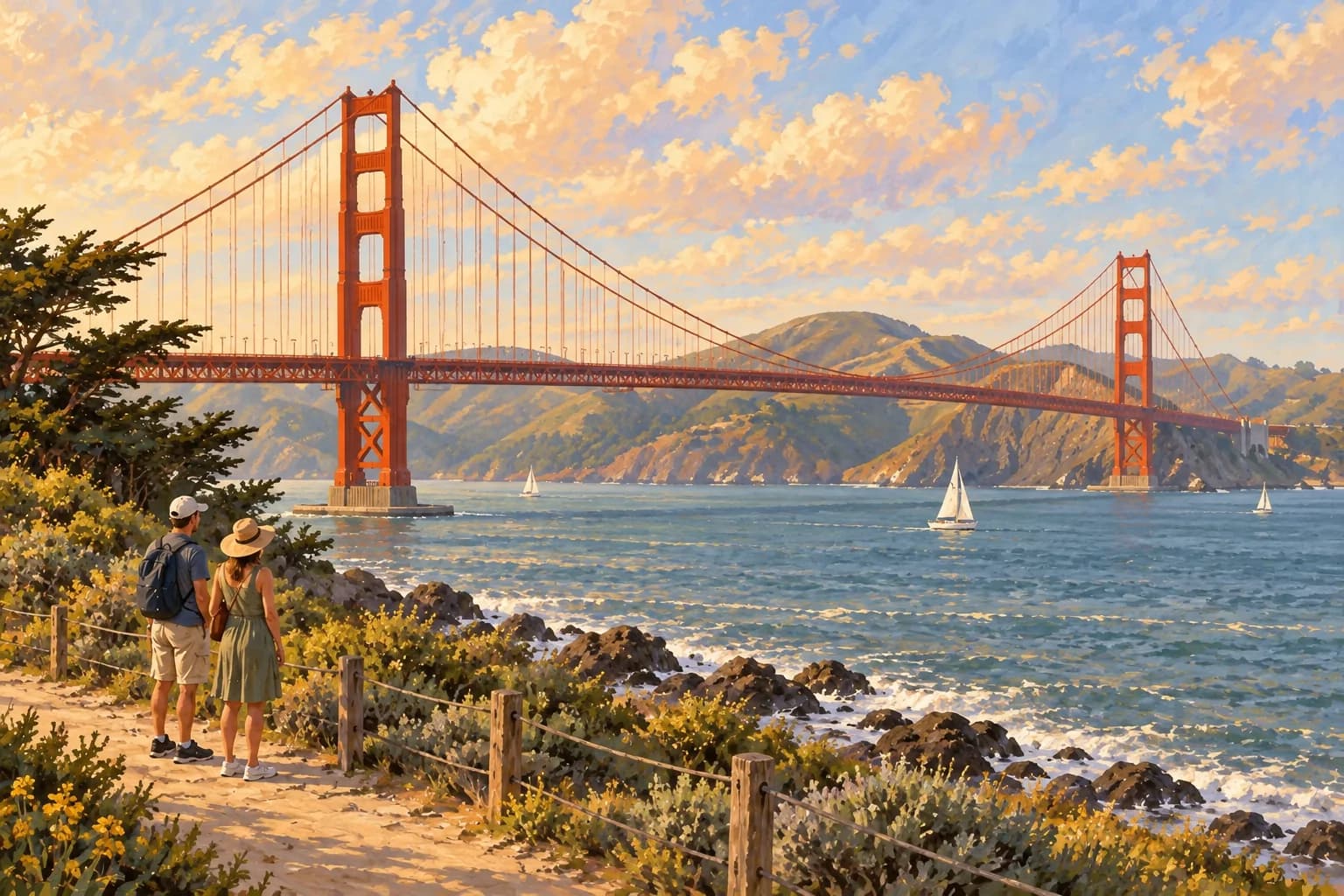
From the southern shoreline, the Golden Gate Bridge seems to draw a line across the strait. Up close, that silhouette separates into cables, steel and height: the space where its builders worked.
A net suspended beneath the roadway during construction saved 19 workers. Another 11 men died building the bridge. The bridge operator preserves their names and identifies the plaque that remembers them at the southern entrance to the west sidewalk.
You can enjoy the panorama from a public viewpoint or plan a closer visit. A photograph of the bridge and a plaque with names offer two ways of seeing the same work: its scale and the people who made it possible. Check which access points are open if you want to approach the plaque or walk across the bridge.
Explore the Golden Gate Bridge in WAONDERFerry Building: the building through which a city came home
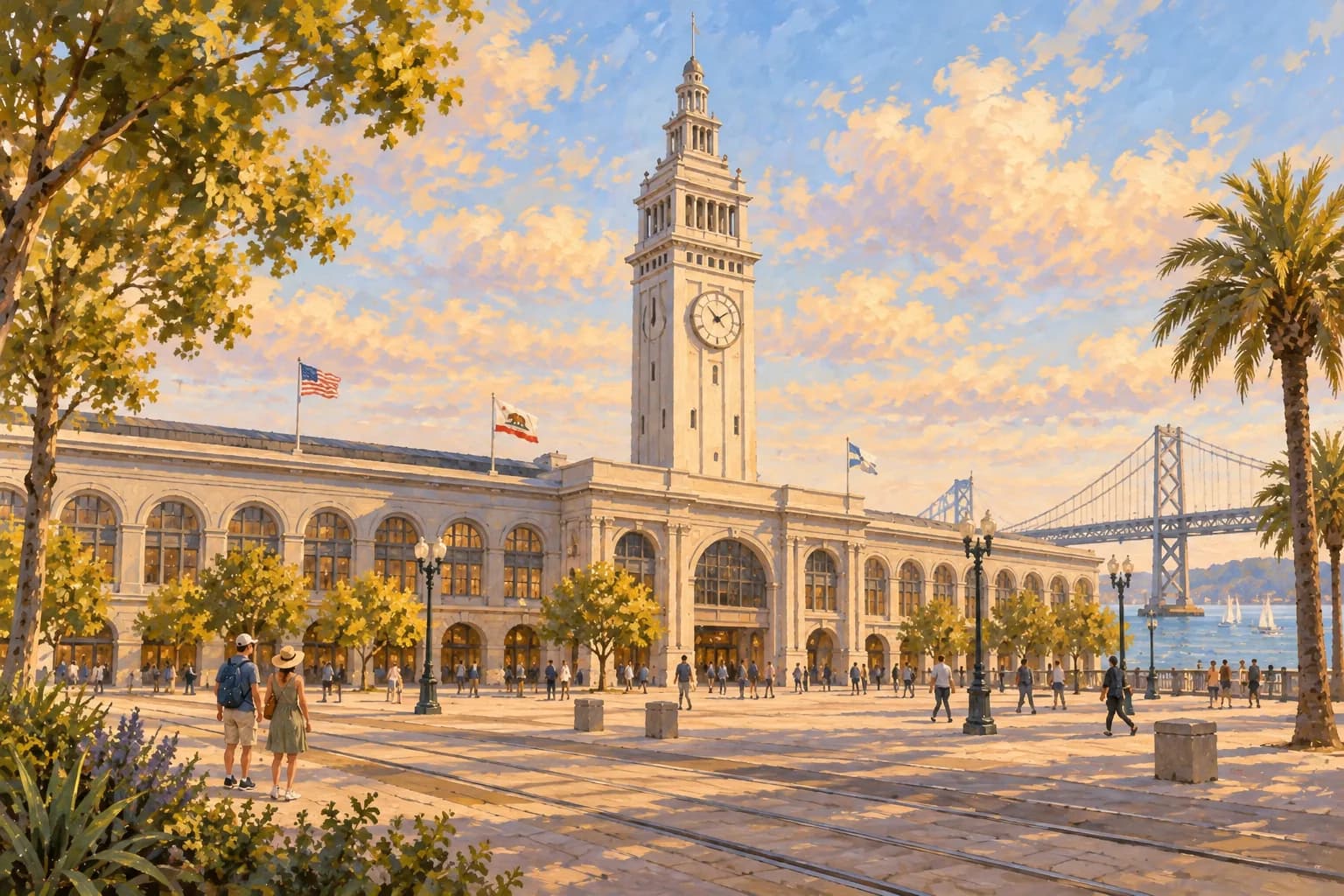 The Ferry Building and its clocktower on the Embarcadero. Architectural illustration.
On the Embarcadero, a clocktower seems to organize everything happening below it. The Ferry Building opened in 1898 as a transportation terminal. Bridges and cars reduced its importance; for decades an elevated freeway screened it from the city. After the freeway was removed, restoration culminated in its reopening as a marketplace in 2003, according to the building’s own history.
A terminal, an overlooked building, a marketplace: its history did not stop in a display case. It can still be part of a journey, a shopping trip or a meeting beside the water.
If you already pass through, look up at the clock before moving on. If you are planning an outing, choose the Embarcadero as your starting area. How does a building become part of a city’s life again? Here, you can explore that question between its arches and today’s activity.
Explore the Ferry Building in WAONDERPalace of Fine Arts: when something temporary becomes beloved
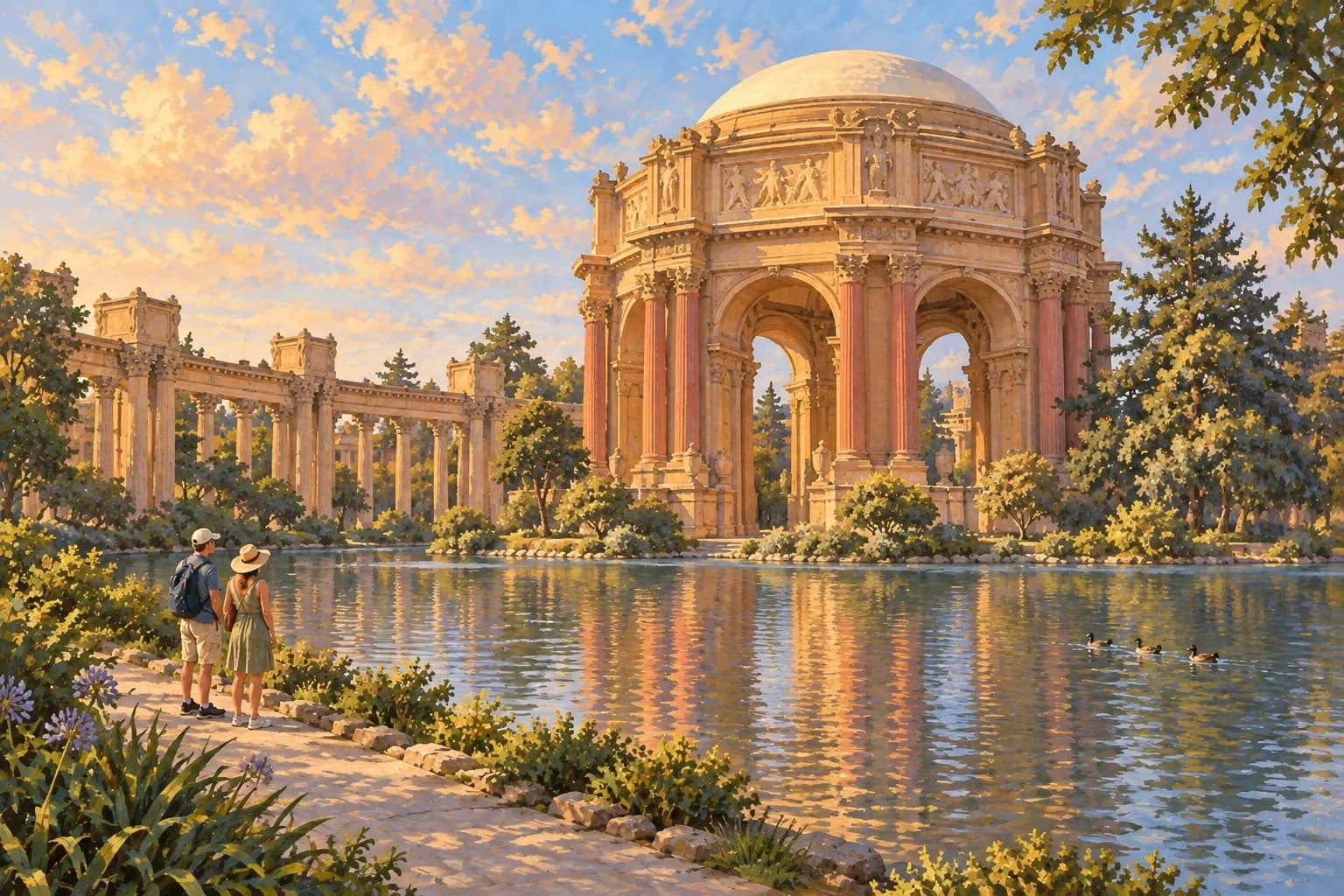 The Palace of Fine Arts rotunda reflected in the lagoon. Painterly evocation.
The Palace of Fine Arts might seem like a classical ruin that has stood beside the water for centuries. It is not: Bernard Maybeck designed it for the 1915 exposition. The original rotunda and colonnades were temporary and had to be rebuilt in durable materials, as San Francisco Heritage explains.
The effort to preserve it began during the exposition itself. While the rest of the fair disappeared, this ensemble remained. Its ancient appearance is an architectural choice; its survival is a story of preservation.
In the Marina District, walking around the lagoon lets you see how the dome, columns and their reflection change. It offers a focus for an outing spent looking closely, without turning every corner into another item on a checklist.
Explore the Palace of Fine Arts in WAONDERFox Theater, Oakland: saving the place where a story began
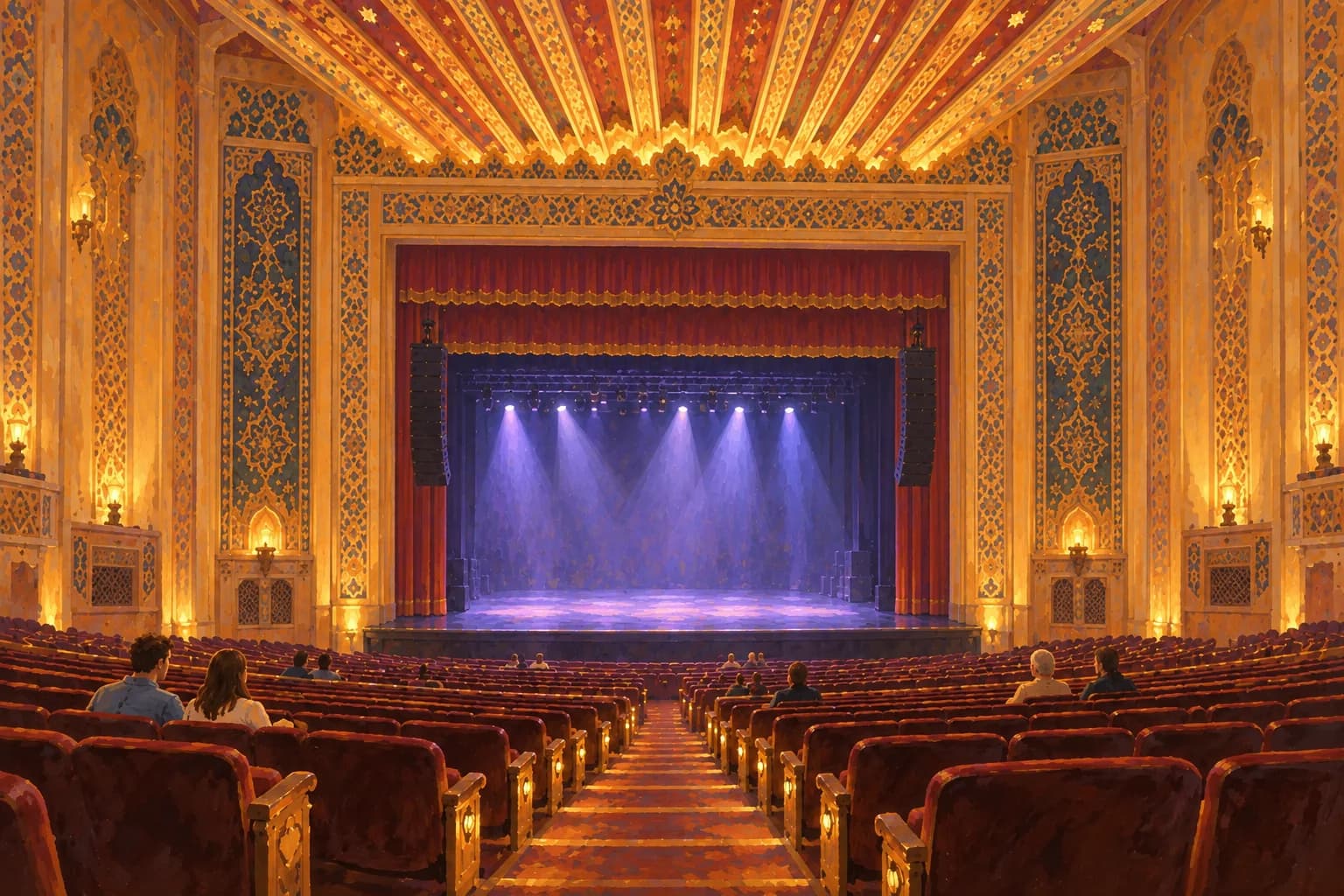 Inside Oakland’s Fox Theater. Illustrated evocation of the venue.
As young sweethearts, Erma and Mario DeLucchi spent Saturday-night dates at Oakland’s Fox. Mario brought Erma gardenias. Decades later, in 1978, they bought the theater, closed since 1966, intending to restore it. The venue’s history preserves those details of their courtship and records that Mario died soon after the purchase; the couple’s project never began.
The Fox eventually recovered through a long preservation effort. The gardenias belong to the past, but the building where those dates took place remains part of Uptown Oakland.
You can pause outside during an outing in the neighborhood or check the program to see the interior on an authorized visit. Next time you see its name, you may remember more than that evening’s concert.
Explore Oakland’s Fox Theater in WAONDERSather Tower, Berkeley: a memory turned into sound
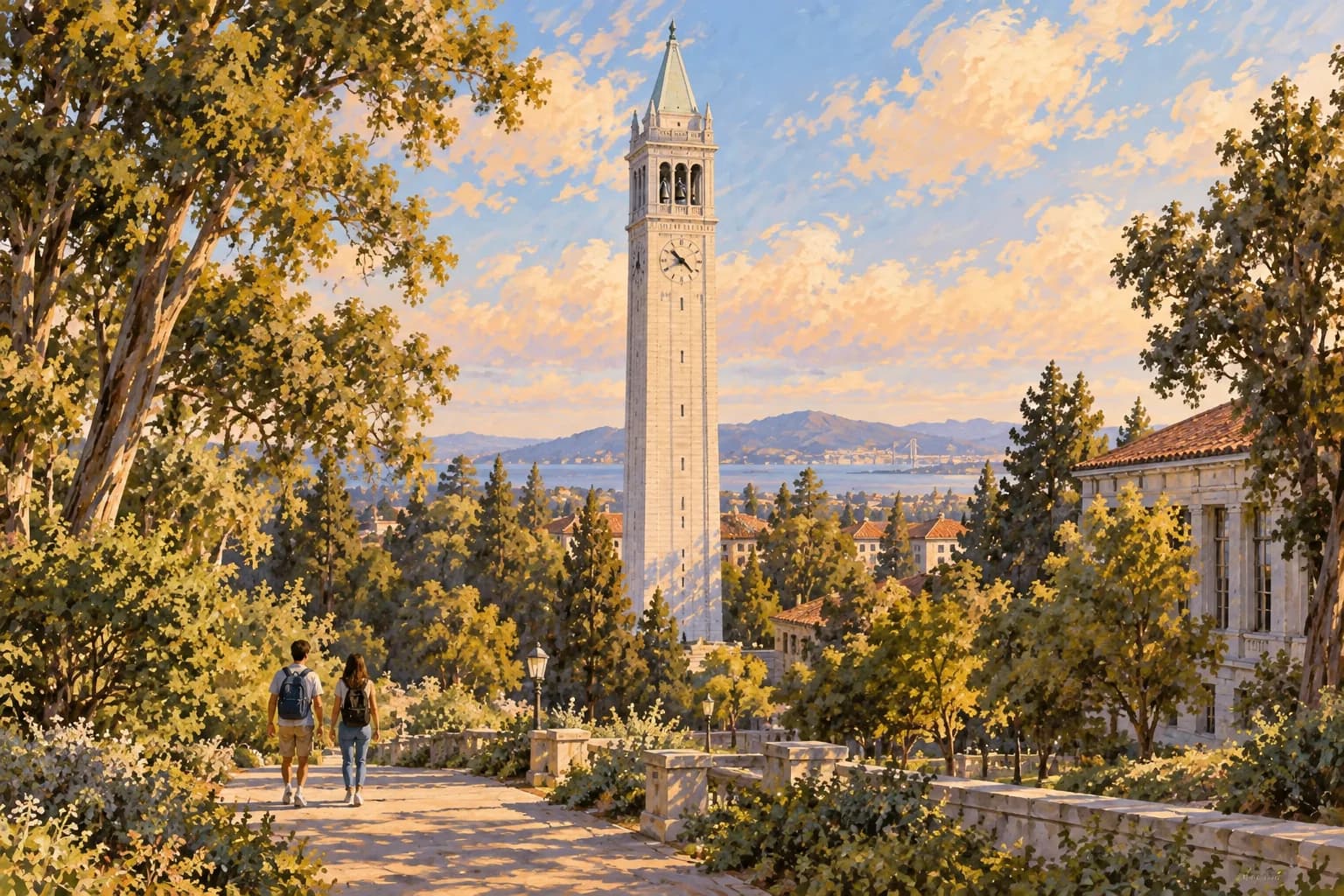 Sather Tower, the Campanile on Berkeley’s campus. Architectural illustration.
Berkeley’s Campanile, or Sather Tower, has an unexpected connection to New York. Jane Krom Sather, whose gift made the tower possible, remembered listening to the bells of Trinity Church near Wall Street. That memory inspired her wish for a bell tower in Berkeley, as the university documents.
Jane did not live to see the tower: construction began two years after her death. The sound she remembered in New York eventually gained a presence on Berkeley’s skyline.
On an outing around the campus, look for the tower and listen to its bells if your timing allows. Its story connects two cities through something a photograph cannot hold. Check the university’s official conditions for climbing the Campanile or attending an activity.
Explore Sather Tower in WAONDERRichmond: remembering the people who kept the work going
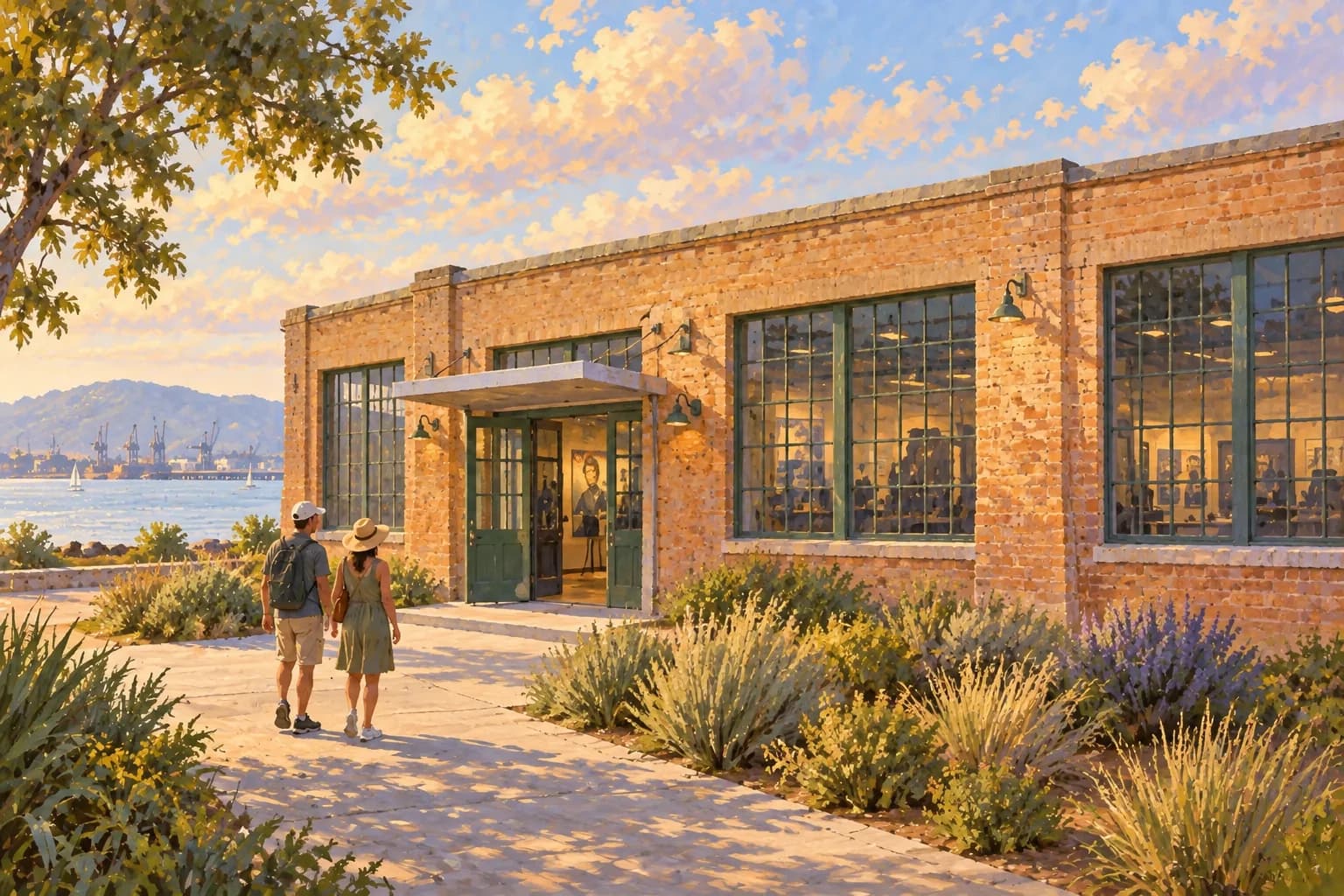 The former Oil House, now Richmond’s Rosie the Riveter visitor center. Illustration of the building.
In Richmond, a low, unassuming building can open a vast story. The Rosie the Riveter Visitor Education Center occupies the former Oil House, associated with the Ford plant and adapted for education in 2012, according to the National Park Service.
Here, curiosity takes you beyond a facade to the lives of people working on the home front during World War II. There were new employment opportunities, but also inequalities: the NPS recalls discrimination experienced by women from different communities. A shared history does not mean everybody lived it the same way.
If working-life history interests you, start with this building and its exhibitions before choosing other historical park sites. It offers an entry into Richmond through its workers, not only its large structures. The park’s sites are spread across the city: check each one’s access when planning your outing.
Explore the Rosie the Riveter center in WAONDERMission Santa Clara: seeing beauty without erasing what came before
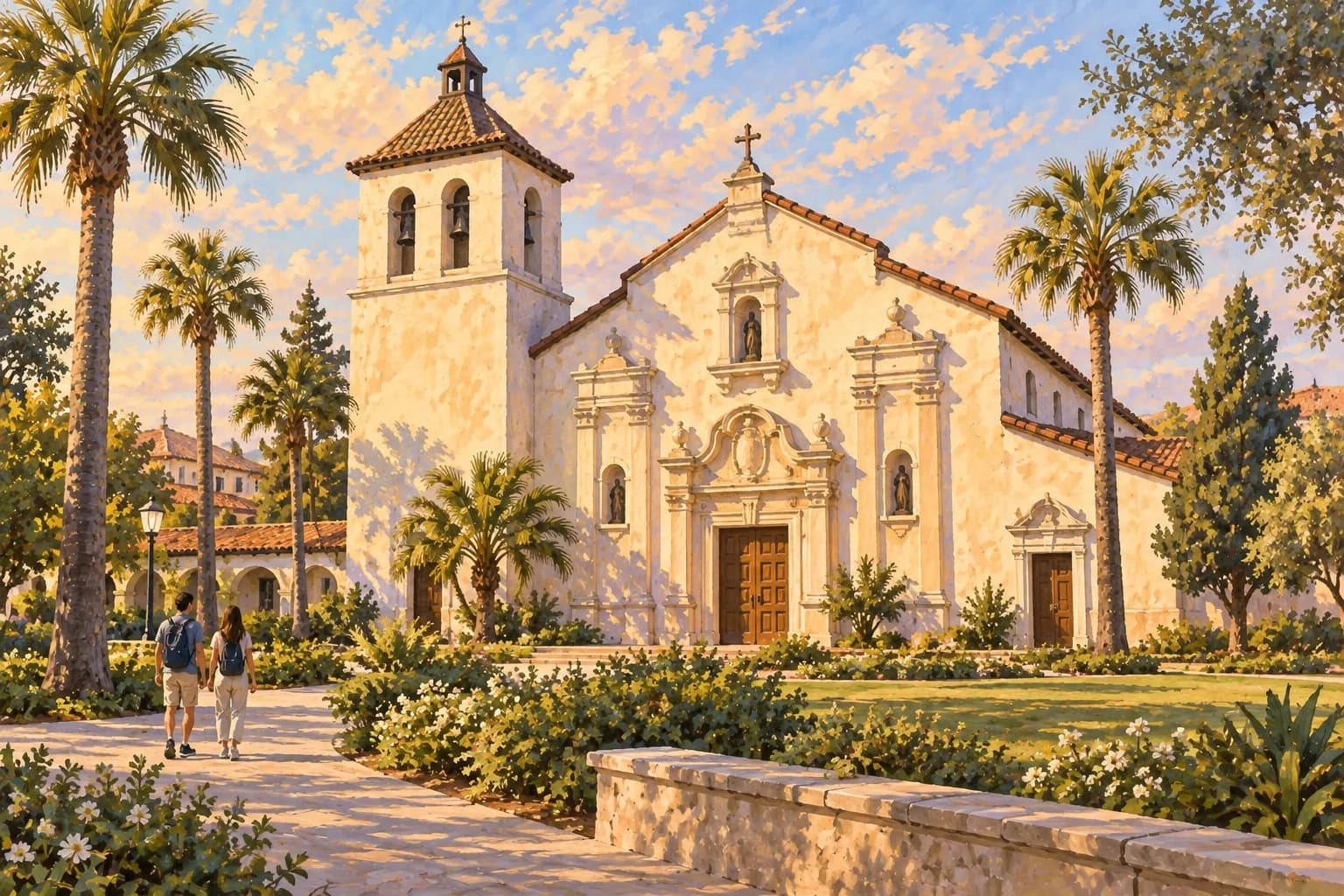 The present Mission Santa Clara church on the university campus. Architectural illustration.
Mission Santa Clara de Asís was founded in 1777, but the church today is not that first building: the mission moved, and a fire destroyed the preceding church in 1926. Santa Clara University’s history explains these transformations and the Ohlone presence before colonization.
Before the mission, this was Ohlone territory. The university’s Ohlone heritage resources offer a way to look beyond the facade and explore Indigenous perspectives on that past and its continuity.
If you choose this area to explore, bring that double attention: to the building you see and the history of the land beneath it. This is a working church and campus; respect access instructions and reserved areas.
Explore Mission Santa Clara in WAONDERWinchester Mystery House: a person before a legend
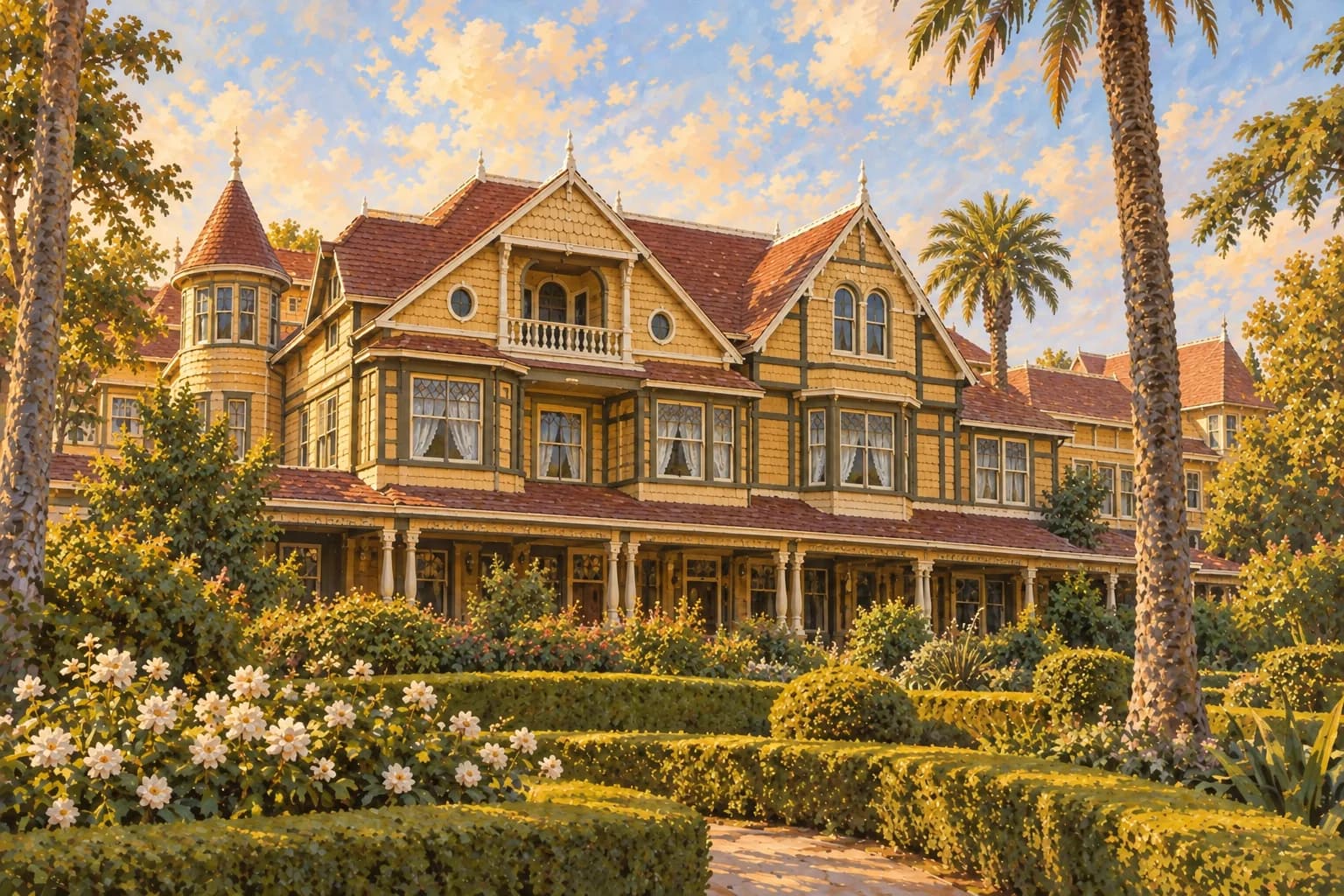 Winchester Mystery House in San Jose. Illustration of the present building and garden.
The Winchester Mystery House, in San Jose, may first attract you through its legends. But behind the name was a person: Sarah Winchester had lost her daughter and her husband before buying the house she would transform in 1886, according to the venue’s timeline.
Those losses do not let us guess her thoughts or establish why she made every architectural choice. Ghost stories should remain legends, not proven explanations. Another way in is through the house’s domestic systems: the venue describes its plumbing and staff-call system.
What was it like to live in a house like this? Among its volumes, roofs and windows, that question offers a way to approach Sarah without reducing her to a ghost-story character. To explore inside, arrange a venue visit under its current conditions; the WAONDER link does not replace admission.
Explore Winchester Mystery House in WAONDERWhat the Bay Area catalog contains
The eight places are an entry point, not a limit on curiosity. The working inventory reviewed on September 28, 2026 contains 13,110 records of places, areas and map references across 14 municipalities. They are not 13,110 monuments or a census of unique buildings: one complex may have records for different parts, and the classification includes everyday points.
These primary categories show different reasons to explore. Each record is counted once under its primary category; this table selects from the total, rather than adding another number to it:
| Primary category | Catalog records | What to look for behind the place |
|---|---|---|
| Churches | 2,246 | Communities, changing uses and layers of history; in Santa Clara, also what preceded the mission. |
| Parks | 1,485 | Time outside with a question about landscape or memory, not just a list of green spaces. |
| Public art | 1,222 | What a piece you may see daily expresses; some references only locate it on the map. |
| Monuments | 766 | Who we remember and why this point was chosen for remembrance. |
| Bridges | 624 | How a city connects and the work that made a crossing possible; not all are major bridges or conversation points. |
| Viewpoints | 515 | A reason to pause and understand the landscape, after checking access and conditions. |
| Cultural centers | 470 | Buildings marked by a community’s life, and spaces whose purpose has changed. |
| Theaters | 223 | Settings that hold memories and preservation choices, as Oakland’s Fox does. |
| Museums | 126 | Choosing a subject that interests you before a visit, rather than trying to see everything. |
| Industrial heritage | 40 | Recognizing the work behind a factory or modest building, as Richmond invites you to do. |
The composition matters: 5,616 references are map-only and 7,494 records are not limited to the map; the latter include 355 areas or regions, not only individual places. These figures come from the working catalog, not a live check of every record. Information depth and availability can vary. The inventory also contains services and other categories; not everything on the map is heritage or supports conversation.
The reviewed scope comprises San Francisco, Oakland, Berkeley, Richmond, Vallejo, Fremont, Hayward, San Mateo, Redwood City, Palo Alto, Mountain View, Sunnyvale, Santa Clara and San Jose. Records do not mean uniform coverage of every neighborhood or all nine Bay Area counties.
If you live here, you can start with a public-art reference on a familiar journey, return another weekend to explore a different area, and take the same habit with you when you travel. You do not have to be on vacation to discover a new story. This selection’s illustrations interpret places and details; they are not documentary photographs.
Place buttons open their shared-place links. If you need to install WAONDER, the fallback page offers the stores; we do not guarantee installation automatically restores the point. Discover other territories through WAONDER updates.
Next time a facade, a tower or a bridge makes you look twice, you may not need to leave the question for later.
Take WAONDER on your next walk around the baySection
Waonder updates