Florida in WAONDER: eight places beyond the postcard
From St. Augustine to Miami and the Gulf Coast: discover shell-stone walls, Cuban exile memories, inventors’ homes and a theater that crossed the ocean.
A wall that resisted attack because of the shells inside it. A tower that, for many families, meant starting again rather than looking down from a height. An Italian theater that found another life across the ocean.
Florida has beaches and major attractions. It also has places that change once you learn what happened behind their facades. Sometimes they are close to home. Sometimes they give you a reason to plan a different outing, without waiting for a vacation.
Florida is one of WAONDER’s territories. These eight places invite you to explore its heritage; they are not a route to complete in a day. We begin in St. Augustine, move to Miami, then look toward Sarasota, Fort Myers and St. Petersburg. Different areas, separate outings, the same curiosity: what is here that I have not yet learned to notice?
Download WAONDER and discover another FloridaCastillo de San Marcos: the fortress with the sea inside its walls
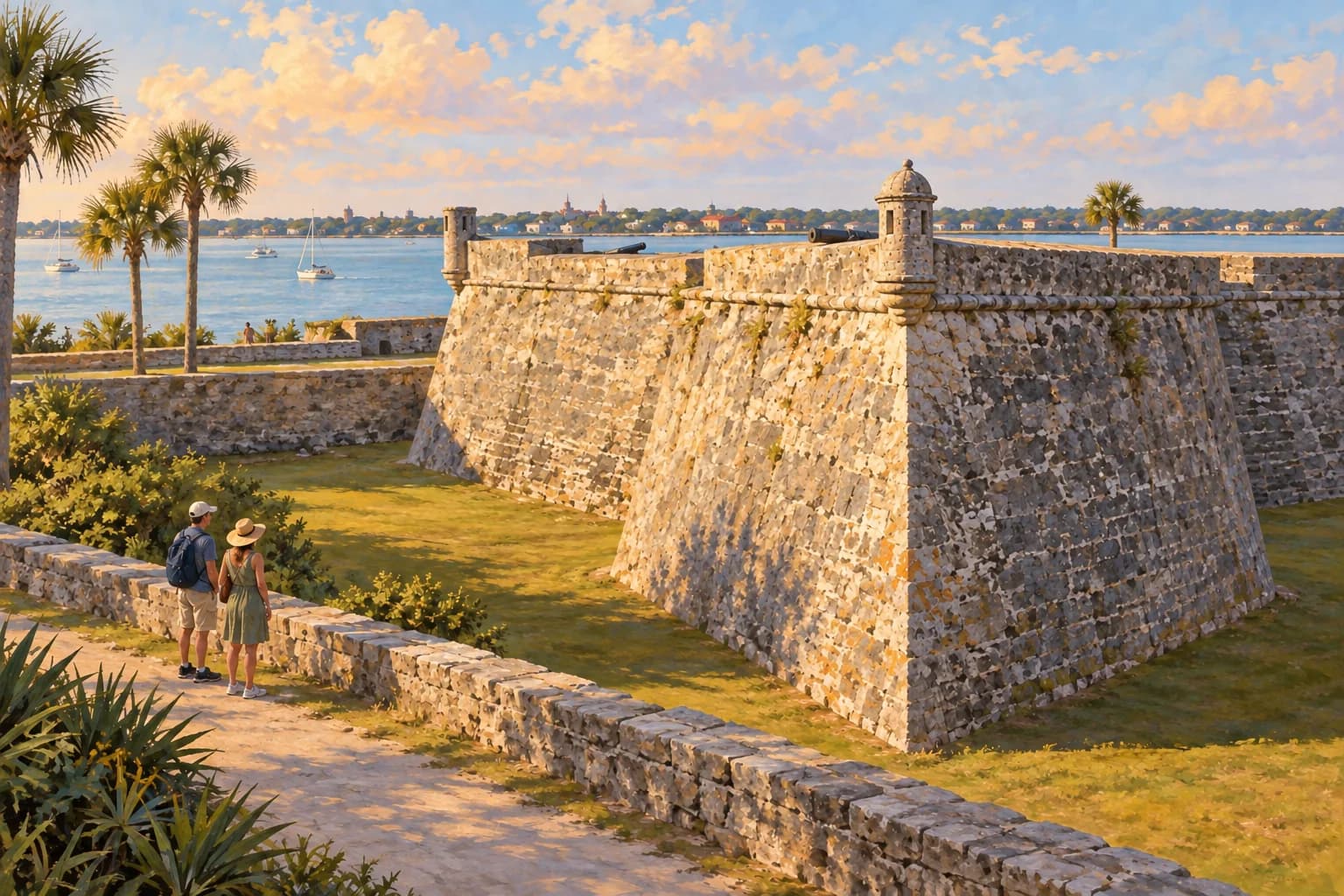
The cover interprets Castillo de San Marcos, in St. Augustine: a low fortress with thick walls and projecting corners. It is not a fairy-tale castle. Its shape answered a practical need: protection from artillery.
The surprise is in the stone. Coquina is made from shell fragments. Its porosity might seem like a weakness, but it helped the walls absorb impacts instead of shattering like harder materials. The National Park Service explains the connection between material and defense. Looking closely at a wall brings you closer to a decision that changed this place’s history.
Construction ran from 1672 to 1695. Telling only the engineers’ story would leave too many people out: the NPS documents forced Indigenous labor and the participation of both free and enslaved Africans, alongside craftspeople and other workers. The building’s resilience does not erase the hardships of those who built it.
You might arrive hoping for a photograph beside the bay. Take another question away with you: how can a wall tell a story of ingenuity and a story of power at the same time? That is a reason to look closely from permitted visitor areas, and to keep asking after you have learned its name.
Explore Castillo de San Marcos in WAONDERSt. Augustine Lighthouse: before it was a view, it was a nightly responsibility
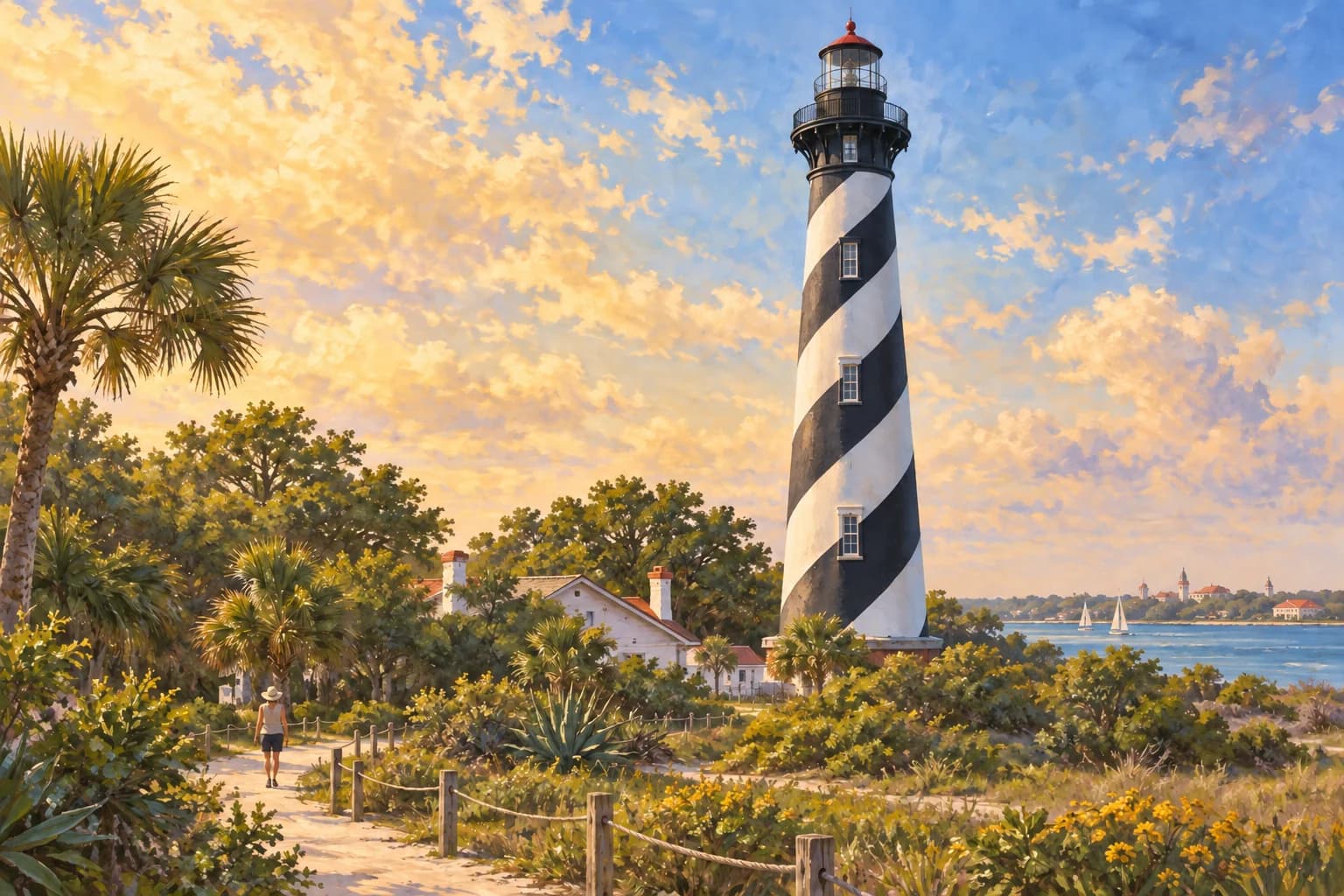 A signal for those arriving by sea. Painterly interpretation; lighting, vegetation and small details are recreated.
The spiral stripes make it easy to recognize. But a visible tower is not yet a useful lighthouse. Someone had to keep its light working.
On October 15, 1874, keeper William R. Russell first lit the lamp in the new tower. Its Fresnel lens had been made in Paris for this location, according to the museum’s history. Work done thousands of miles away became a guide for people approaching this coast.
That date gives the building another scale. Today you can lift your phone and save its silhouette in seconds. For years, keeping it useful required daily work. The keeper-service records describe maintenance, changes in fuel and a landscape where the sea was changing the coastline too.
Who looked after the light when everyone else had gone? The question puts people back into a view we sometimes reduce to a postcard. The lighthouse and museum offer another outing in St. Augustine, on Anastasia Island. Check access and tower-climbing conditions, especially if mobility is a consideration. You do not have to reach the top for the story to be worth the visit.
Explore St. Augustine Lighthouse in WAONDERFreedom Tower: a facade that also holds the memory of leaving home
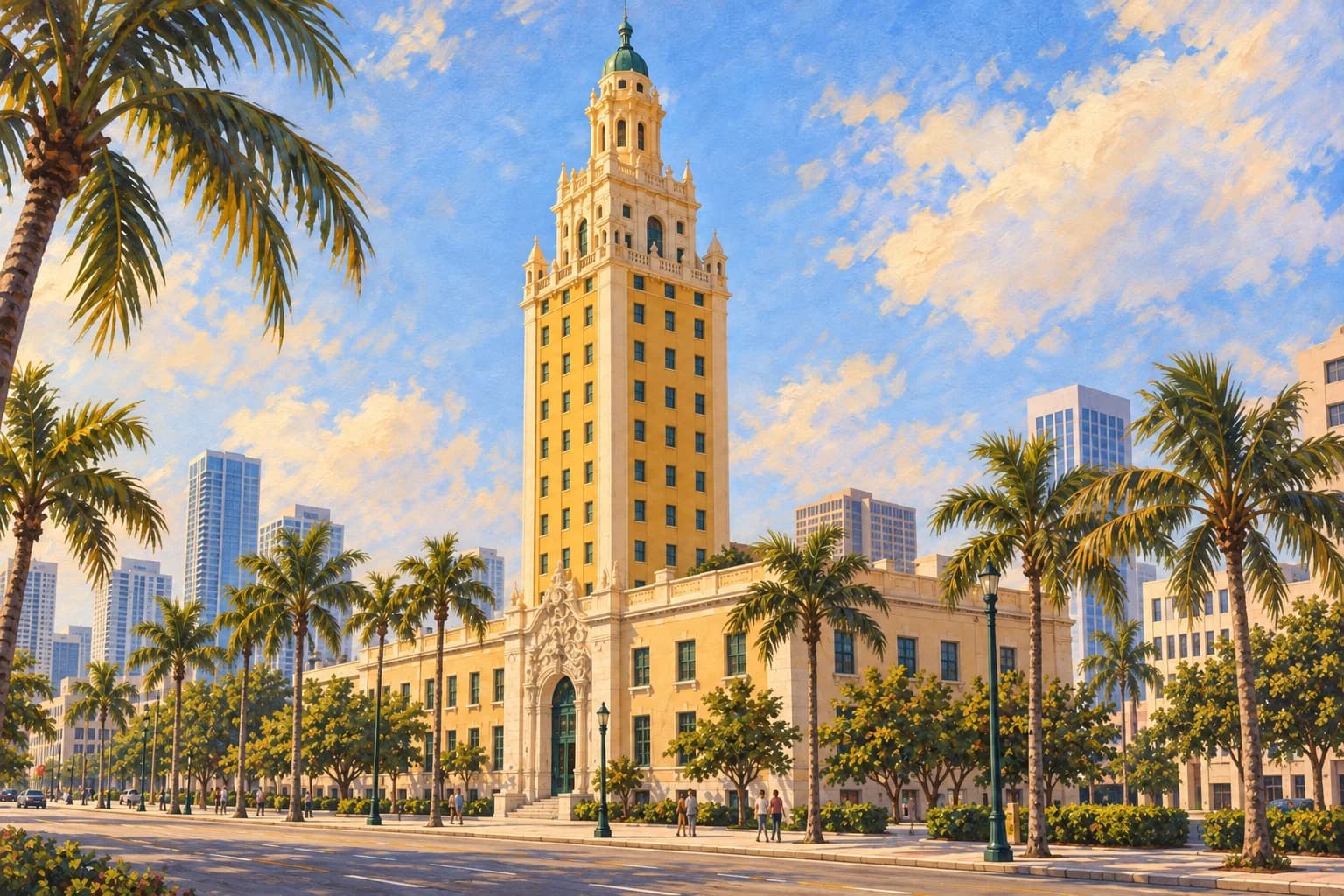 Freedom Tower: one building, very different meanings for a city. Architectural illustration, not a historical scene of a particular family.
In Miami, Freedom Tower might first catch your eye because it looks so different from the buildings around it. Its warm color and ornate crown belong to another chapter of the city. Its importance, though, cannot be contained in a description of its style.
It was built in 1925 as the headquarters of The Miami Daily News. Between 1962 and 1974, it served as an assistance center for Cuban refugees, as Miami Dade College records. A place designed to produce news became part of the lives of people trying to begin again.
We do not know the experience of every person who walked through that door. Reducing them all to one happy arrival story would be unfair. There were separations, uncertainty and different paths. What we do know is that the building has a deep connection to Miami’s Cuban memory. Learning about that role changes what you see from the street.
The tower reopened in 2025, its centenary year, with renewed exhibition spaces. Check current programming and admission conditions before visiting. If you often pass along Biscayne Boulevard, try pausing with a different question: what does this building mean to someone whose family had to leave their home behind?
Explore Freedom Tower in WAONDERVizcaya: a house that wanted to look old from the beginning
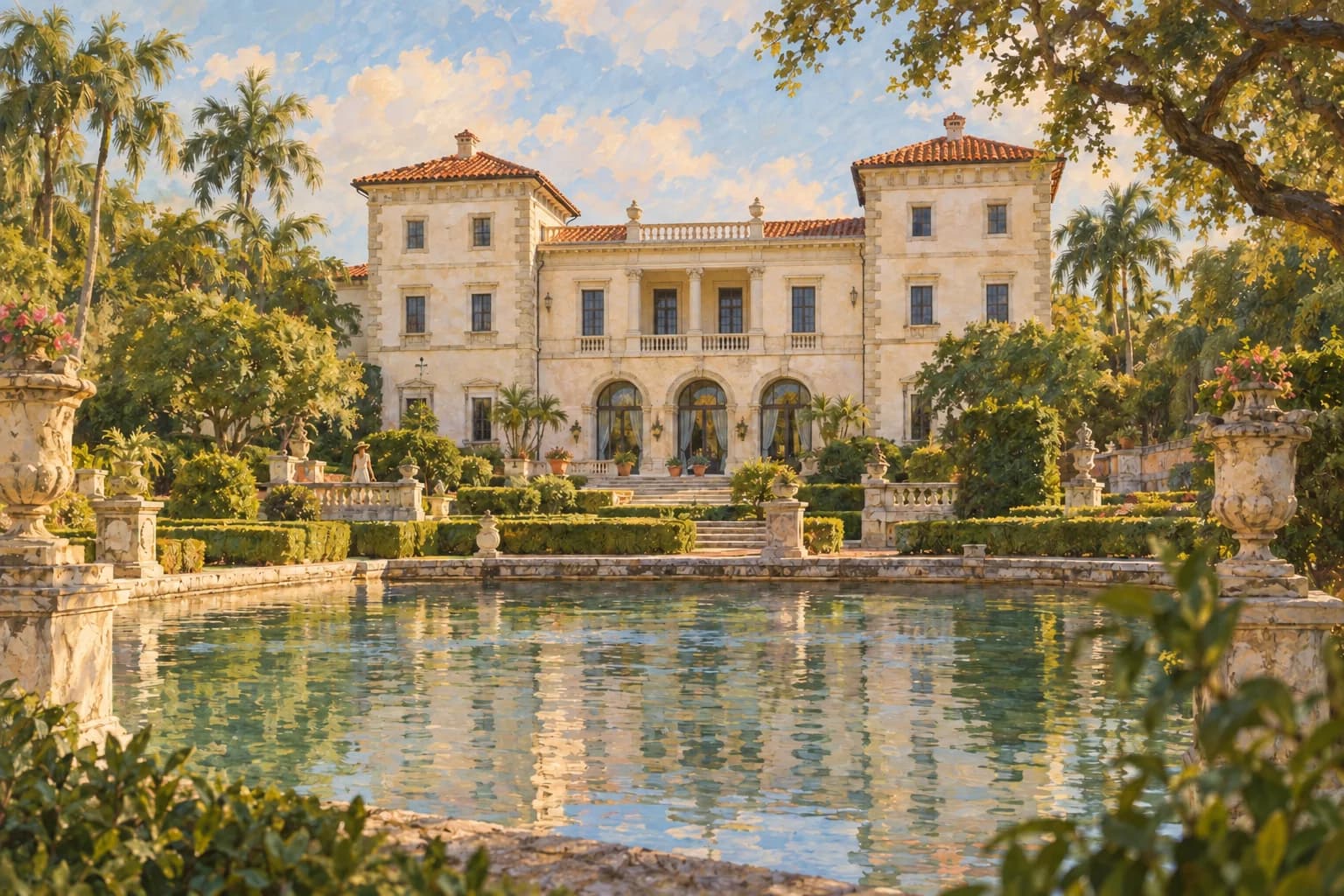 Vizcaya: the appearance of another era under Miami’s light. Illustration; gardens, reflections and secondary details are interpreted.
Vizcaya Museum and Gardens, in Coconut Grove, plays a small trick on the eye. Its architecture might suggest a European residence with centuries of history. Yet James Deering began spending his winters there on December 25, 1916.
The main-house description explains the contrast: an Italian villa reinterpreted for a subtropical setting, with an appearance rooted in the past and solutions that were modern at the time. Reinforced concrete and service systems belonged to a house that did not give up comfort in order to look old.
Here is a question that can make the visit richer: what makes a place seem old to us? Its stone, its objects, the shapes we recognize? Vizcaya lets you observe how that impression is made. It also invites you to think about the design and maintenance behind an apparently effortless scene.
The sea is not merely a beautiful view. A coastal setting also brings the work of conservation against moisture, salt and storms. The institution reports preservation work in 2026; check which spaces are accessible before planning a visit. Bringing one question can make your garden photograph the beginning of something more interesting.
Explore Vizcaya Museum and Gardens in WAONDERCà d’Zan: when a journey becomes a house
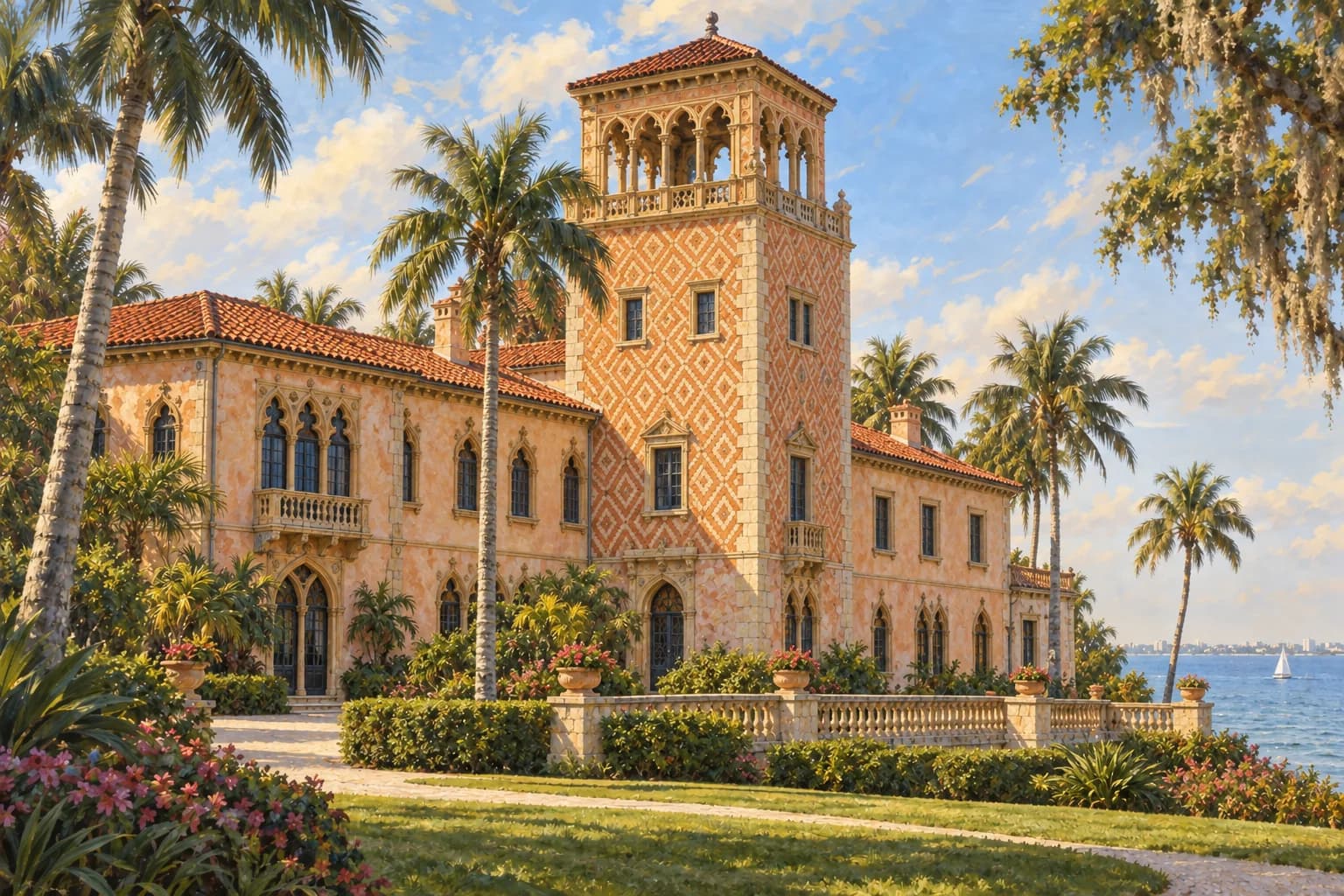 A memory of travels beside Sarasota Bay. Interpretation of the building, not an exact reproduction of its decoration.
Some journeys leave a photograph. Others leave a house. Cà d’Zan, the Sarasota home of John and Mable Ringling, draws its inspiration from the Venetian architecture they admired.
Its windows, colors and decoration invite a question: why is this architectural language here, beside a Florida bay? It is not a palace moved from Venice. It is a twentieth-century building that turned references from elsewhere into a project of its own. The Ringling docent materials describe Mable’s involvement and the visual material she gathered on their travels to guide the design.
Her involvement deserves attention. An eye-catching house can end up being told only through the most famous name attached to it, or through its cost. Noticing who imagined its details opens another story: how a way of looking becomes decisions about architecture, craftsmanship and light.
The wider Ringling complex also brings together art, circus history and gardens. You can build a visit around one interest rather than trying to cover everything. Which memory of a journey would you keep if it could become a place? It is a personal question to take to an exuberant facade.
Explore Cà d’Zan in WAONDERHistoric Asolo Theater: a stage that crossed the ocean
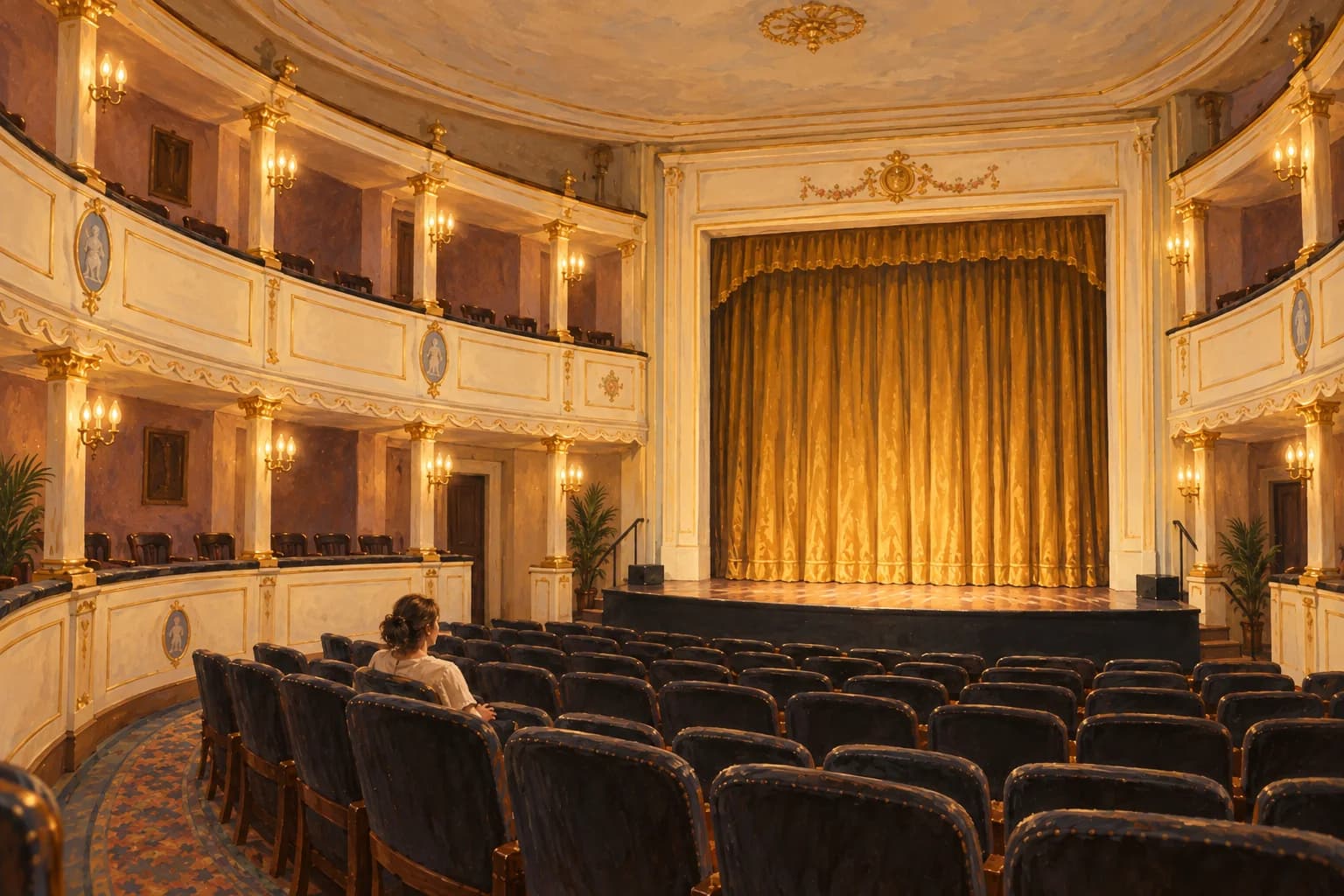 A theater with more than one life. Interpretation of its scale and layout; simplified decoration, not an inventory of its original panels.
Within the same Sarasota complex is a story that almost asks you to lower your voice before telling it. The Historic Asolo Theater originated in a theater built in 1798 in Asolo, Italy. Its historic components were dismantled and later reinstalled in Sarasota, where it welcomed audiences again in the 1950s, according to the history kept by the docent team.
The entire Italian palace did not travel. Parts of a room did, to be assembled in another setting. That distinction makes the story more interesting, not less: someone chose to preserve, move and return a purpose to something that could have remained a collection of stored fragments.
Think about what separates a theater from a collection of ornaments. The boxes matter, but so does the possibility of someone sitting down again, waiting and looking toward the stage. Can a place keep part of its identity after changing countries?
Do not confuse this room with Asolo Repertory Theatre, another Sarasota institution. Check the historic theater’s visiting conditions before counting on seeing its interior or a performance. Knowing about its journey is already a reason to seek it out.
Explore the Historic Asolo Theater in WAONDEREdison and Ford: curiosity also grew in a garden
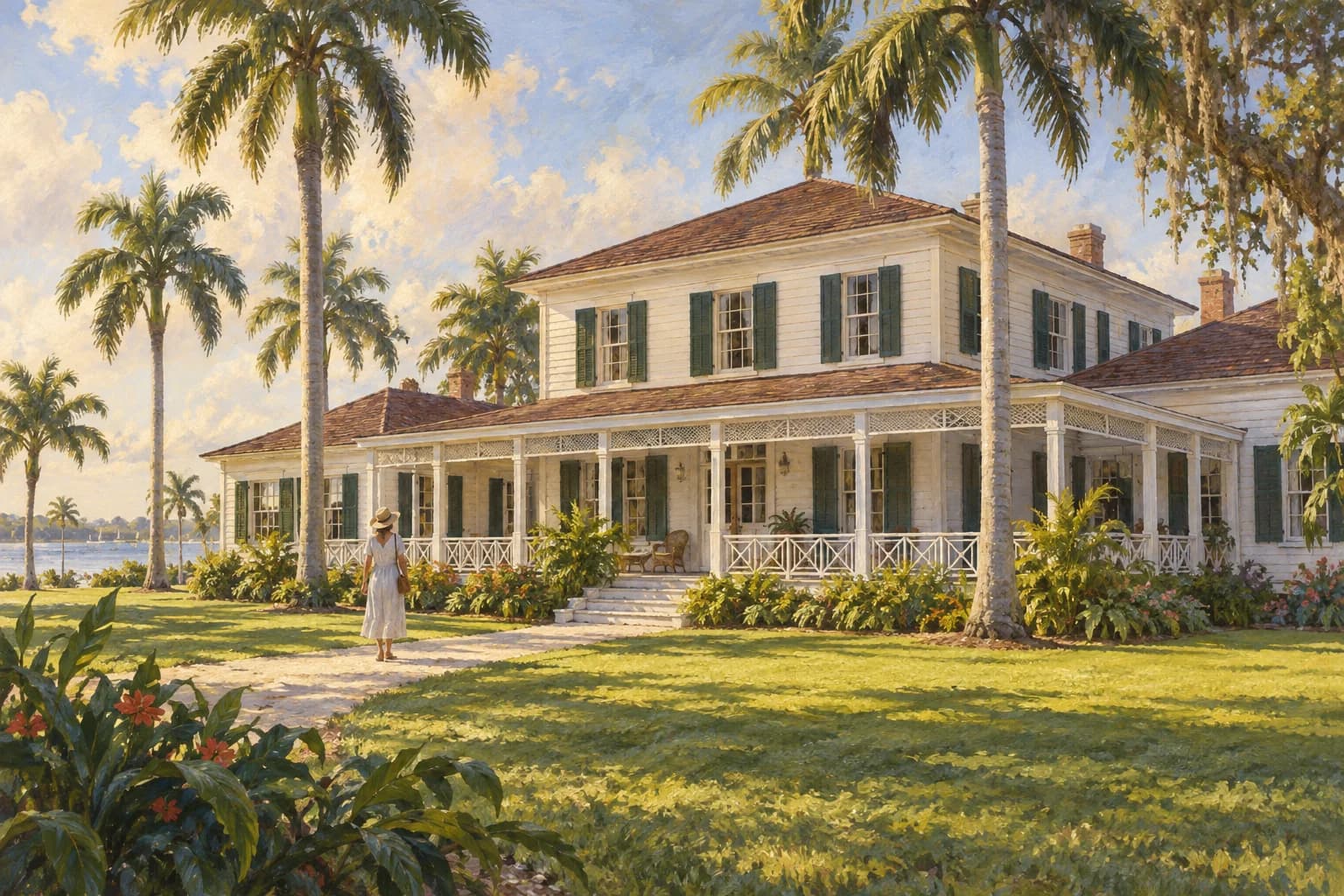 Fort Myers: winter homes and questions that kept working. Architectural interpretation, not a portrait or a scene of the inventors.
In Fort Myers, a house with a veranda might first look like somewhere to rest. The Edison and Ford Winter Estates add another layer: domestic life meets experimentation here.
Thomas Edison arrived in 1885 and acquired land beside the Caloosahatchee River. Henry Ford bought the neighboring house in 1916, after visiting Edison. The history of the homes also recalls Mina Edison, who gave the family estate to the city in 1947.
Curiosity did not stop at the front door. In 1928, a laboratory was built for research into plants as a source of rubber. The museum explains the project backed by Edison, Ford and Harvey Firestone. A garden could be pleasing to look at and part of an industrial question at the same time.
There is no need to invent a conversation to feel the contrast. It is enough to look at a peaceful house and know that ideas were being tested nearby. What would we stop discovering if we thought we already knew everything? Famous names draw us in; working spaces and the people who preserved them may give us a reason to stay a little longer.
Explore the Edison and Ford Winter Estates in WAONDERDalí in St. Petersburg: the surprise begins before the first painting
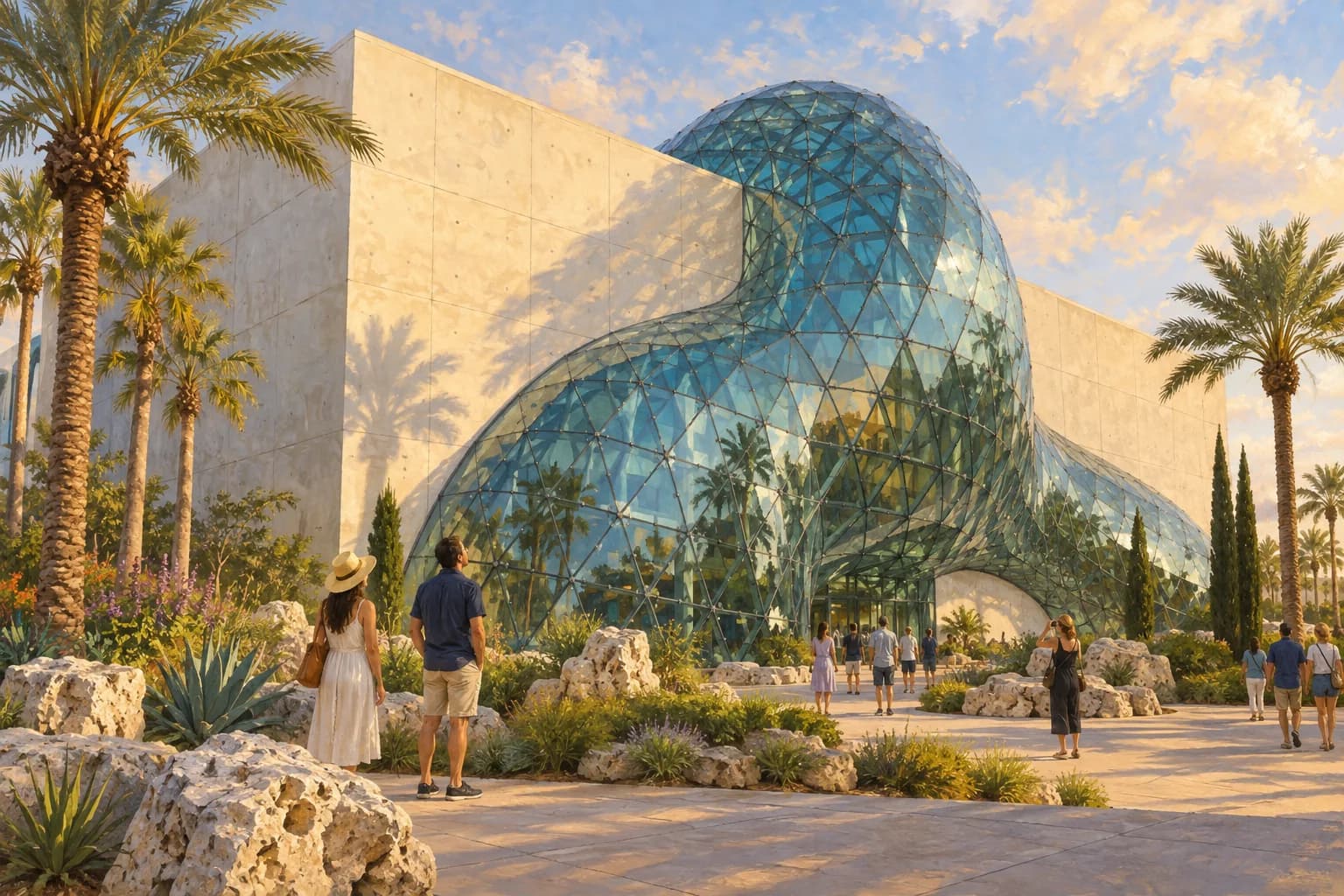 The Enigma puts a question on the facade. Illustration; secondary geometry and surroundings are recreated, not a photograph of the building.
In St. Petersburg, not the city of Tampa or Figueres, the Dalí Museum offers a contrast you can begin to read outside: a fairly restrained concrete volume beside a glass form that seems to escape its straight lines.
The current building opened on January 11, 2011. Designed by Yann Weymouth, it incorporates a geodesic envelope of triangular panels known as the Enigma, according to the museum’s own account. Its architecture brings solid protection together with a form that awakens the imagination.
Before going inside, look at that meeting of shapes. Can a building prepare you to see differently? You do not have to know about Surrealism to ask. Begin with something accessible: how a reflection changes, where a straight line ends, how a curve appears.
Then decide whether to continue into the collection and current programming, checking official admission conditions. A cultural visit does not have to start with a list of works you are supposed to know. It can begin with the pleasant puzzlement of a facade and the wish to understand why it looks that way.
Explore the Dalí Museum in WAONDERBeyond these eight places: what Florida’s catalog brings together
The featured places are a way in. Florida’s working inventory, reviewed on September 28, 2026, contains 35,340 records of places, areas and map points. They are not 35,340 monuments or an official heritage census. The variety matters because your next question might start with a sculpture, a park or a less familiar building.
This selection of primary categories shows different occasions to explore. Counts include interactive references and map-only points; they are not an extra total to add to the inventory:
| Primary category | Catalog records | A reason to look again |
|---|---|---|
| Churches | 7,046 | Ask which community gave life to a building you might pass on a familiar journey. |
| Parks | 5,109 | Plan some time outside and look for the memory, landscape or transformation connected to the place. |
| Public art | 4,873 | Pause beside a piece and ask who it remembers or what it wanted to express; many are map references, not conversation points. |
| Cultural centers | 727 | Discover a building’s changing uses and its relationship to the city, as Freedom Tower invites you to do. |
| Monuments | 716 | Look at who is remembered and who is left out of the story, rather than only reading a name. |
| Museums | 408 | Choose a question about art, science or memory before planning a visit, as at Dalí or the Edison and Ford homes. |
| Theaters | 357 | Look for the life behind a stage; Asolo shows that a room can have a journey of its own. |
| Lighthouses | 28 | Look from the perspective of someone arriving by sea, not only through a coastal photograph. |
| Fortifications | 23 | Understand the materials, work and conflicts behind walls, as at Castillo de San Marcos. |
The inventory distinguishes 17,680 map-only references and 17,660 records not limited to the map. The latter include 2,521 areas or regions, not only individual buildings. These figures describe a working inventory, not a live check of every point’s quality or availability. The depth of information varies, and eight featured places do not represent every part of the state equally.
The useful thing is not to finish a number. It is to have a tool at hand when a shape, a name or a story makes you pause. A good outing can start with one place and one question.
Your next outing: start with an area, not the whole state
If you live in Florida, choose what fits your week: a pause along the way, a planned visit or a little curiosity somewhere familiar. If you are traveling, apply the same idea to the area where you will already be spending time.
- St. Augustine: the fortress and maritime memory. The castle is beside the historic center; the lighthouse is on Anastasia Island. Plan how to travel between them.
- Miami: the memory of Freedom Tower and the contrast at Vizcaya. They are not adjacent stops; they tell different stories of the city.
- Sarasota: Cà d’Zan and Asolo are part of The Ringling complex. Check admission and access to each space rather than assuming one ticket includes everything.
- Fort Myers: homes, gardens and a laboratory at the Edison and Ford Winter Estates. Decide what you want to explore and how much time to allow.
- St. Petersburg: the Dalí Museum building and, if you choose, its collection. Check official access, exhibitions and booking information.
There are considerable distances between these cities. Check transport, heat, weather, accessibility and possible closures. We are not proposing an automatic route inside the app or guaranteeing admission to venues. The illustrations interpret the places: they are there to spark curiosity, not to serve as access plans.
In WAONDER you can continue from the place that interests you and ask your own questions. The links in this selection lead to individual points; if you need to install the app, the fallback page offers the stores, without guaranteeing that installation automatically restores the place. Other WAONDER updates show how the same curiosity takes shape in other territories.
Next time Florida offers you a familiar facade, you may see it differently. Not because the building has changed, but because you now know what to ask it.
Take WAONDER on your next outingSection
Waonder updates