Santander in WAONDER: the stories you cannot see from the bay
From Los Raqueros to La Magdalena and Cabo Mayor: eight places to discover Santander's harbour memory, art and overlooked stories with WAONDER.
Some cities are recognisable by their skyline. Santander also has a particular way of drawing your eye: a walk beside the water, changing light across the bay, a glimpse of the horizon between buildings. You might have passed the same spot hundreds of times and still find a reason to stop.
Bronze children at the edge of a quay. A palace among trees. A contemporary building that leaves room to look towards the sea. They are very different places, but they share a possibility: once you know their stories, you no longer see them in quite the same way.
The city of Santander is one of WAONDER's territories. In this article, we bring together eight places to take that curiosity on a walk. This is Santander city, not all of Cantabria, and it is not an endless sightseeing checklist. If you live here, one might be somewhere you have stopped noticing. If you are visiting, it could become the reason you remember Santander for more than a beautiful view.
Download WAONDER and take another look at SantanderLa Magdalena: from a royal summer home to a meeting place for ideas
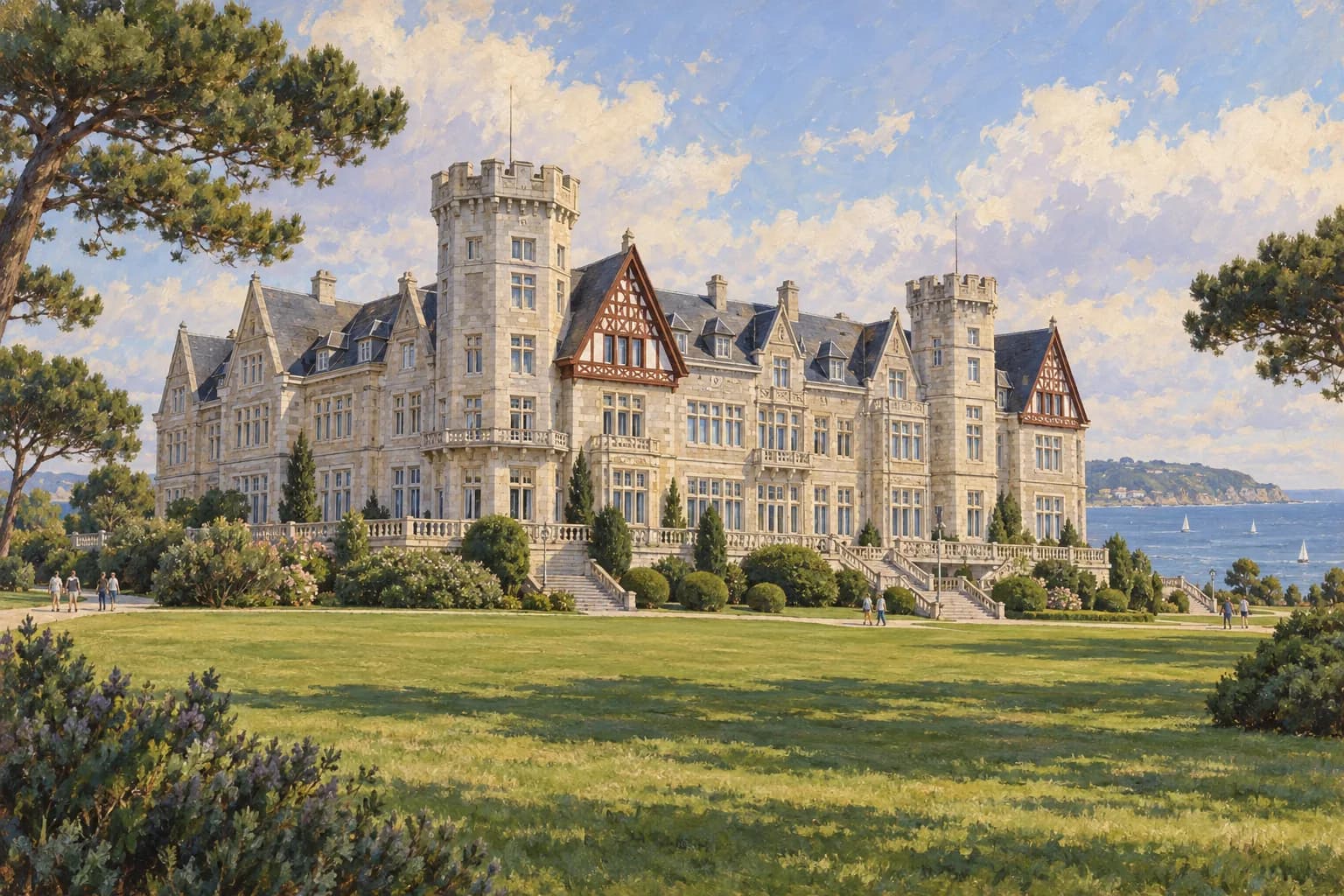
Our cover interprets Palacio de la Magdalena from its gardens. It is an illustration, not a photograph or an exact reproduction of every architectural detail.
The outline invites you to look up: pale stone, dark roofs, uneven towers and timber framing that recalls northern European architecture. But the interesting question goes beyond style. Why did Santander build a palace for a family who would not live there throughout the year?
Constructed between 1908 and 1912, it was a gift from the city to Alfonso XIII and Victoria Eugenia. Architects Gonzalo Bringas and Javier González de Riancho designed the project. The royal family began spending their summers here in 1913, according to the municipal history and the palace's account.
That origin changes what you are looking at. This is not simply a large house with an excellent view: it reflects a city's ambition to associate itself with those royal summers. The setting was part of the invitation.
Another life followed. The palace is now associated with the summer courses of the Universidad Internacional Menéndez Pelayo, as described in the city's information about the peninsula. A royal residence can also become a place for exchanging knowledge. Its history is more complex than one neat transformation, but the contrast is worth considering: the same walls can welcome very different people and purposes.
Next time you see it, notice the materials, then ask something else: how has this building related to the city that raised it? The palace and gardens may become more than the backdrop to a photograph.
Open Palacio de la Magdalena in WAONDERLos Raqueros: a photograph worth looking at twice
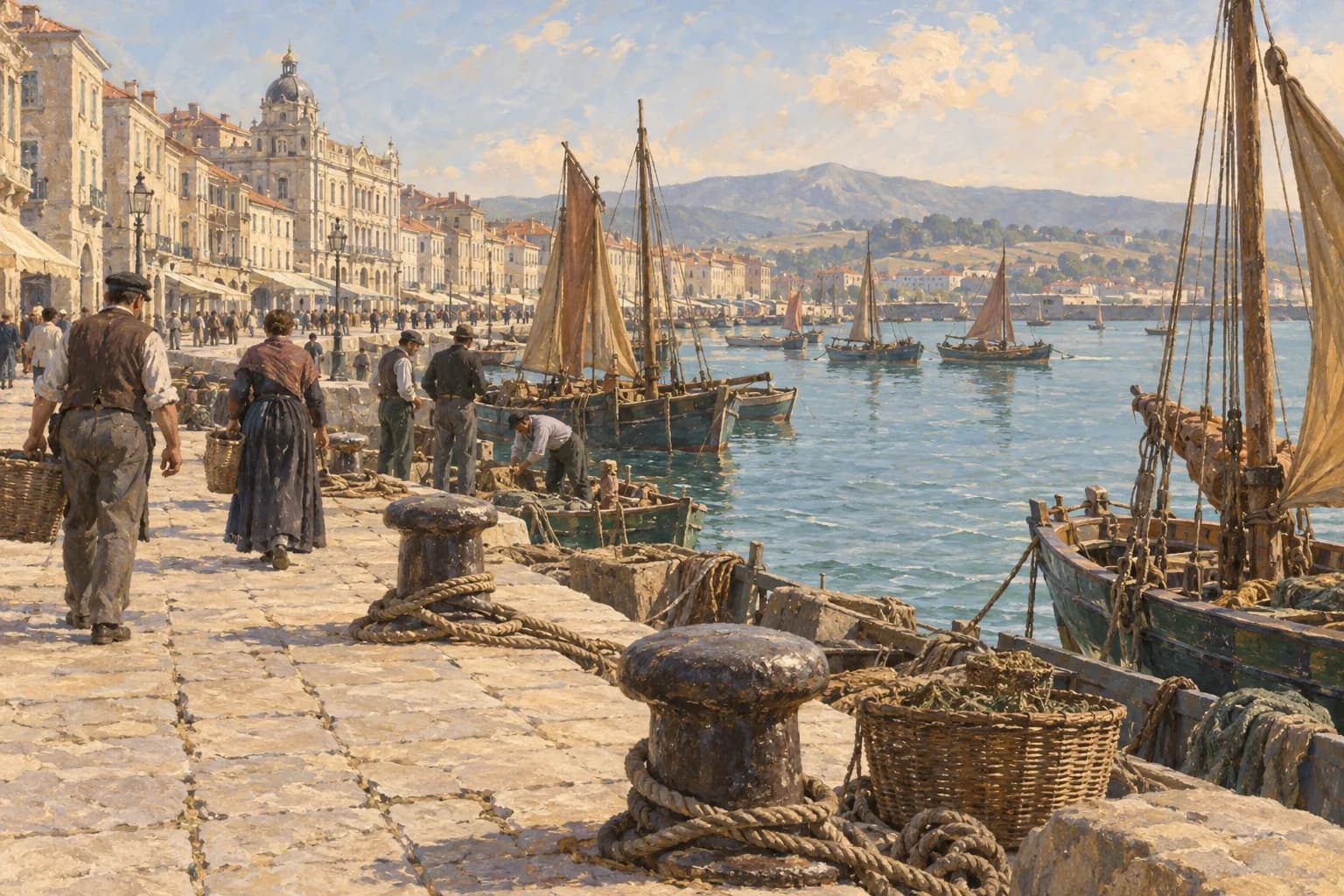 The harbour was the setting for very different lives. Historical evocation, not a reconstruction of a specific event or an image of the monument.
Los Raqueros, beside the quay, can make you stop before you even know their name. Four bronze figures look, wait or lean towards the water. From a distance, the scene might suggest play. Its history asks for a more careful look.
The group, by José Cobo, remembers poor children who dived to retrieve coins thrown into the water by other people. The city's Ruta Raquera connects that memory with the world also portrayed in José María de Pereda's novel Sotileza.
There is no need to make that inequality picturesque to feel the power of the place. The moving discovery is that figures we now photograph refer to lives with needs very different from our own. The same sea that offered leisure to one person could be a way of earning a few coins for another.
Pausing beside them might change the picture you were about to take. It becomes more than an unusual pose against the bay: it can also remember people who were missing from the city's grand portraits. We do not claim to know the biography of each figure or invent words for them. The sculpture opens a question worth carrying away: whose lives do we remember when we tell the story of a harbour?
Open Los Raqueros in WAONDERCentro Botín: building without erasing the horizon
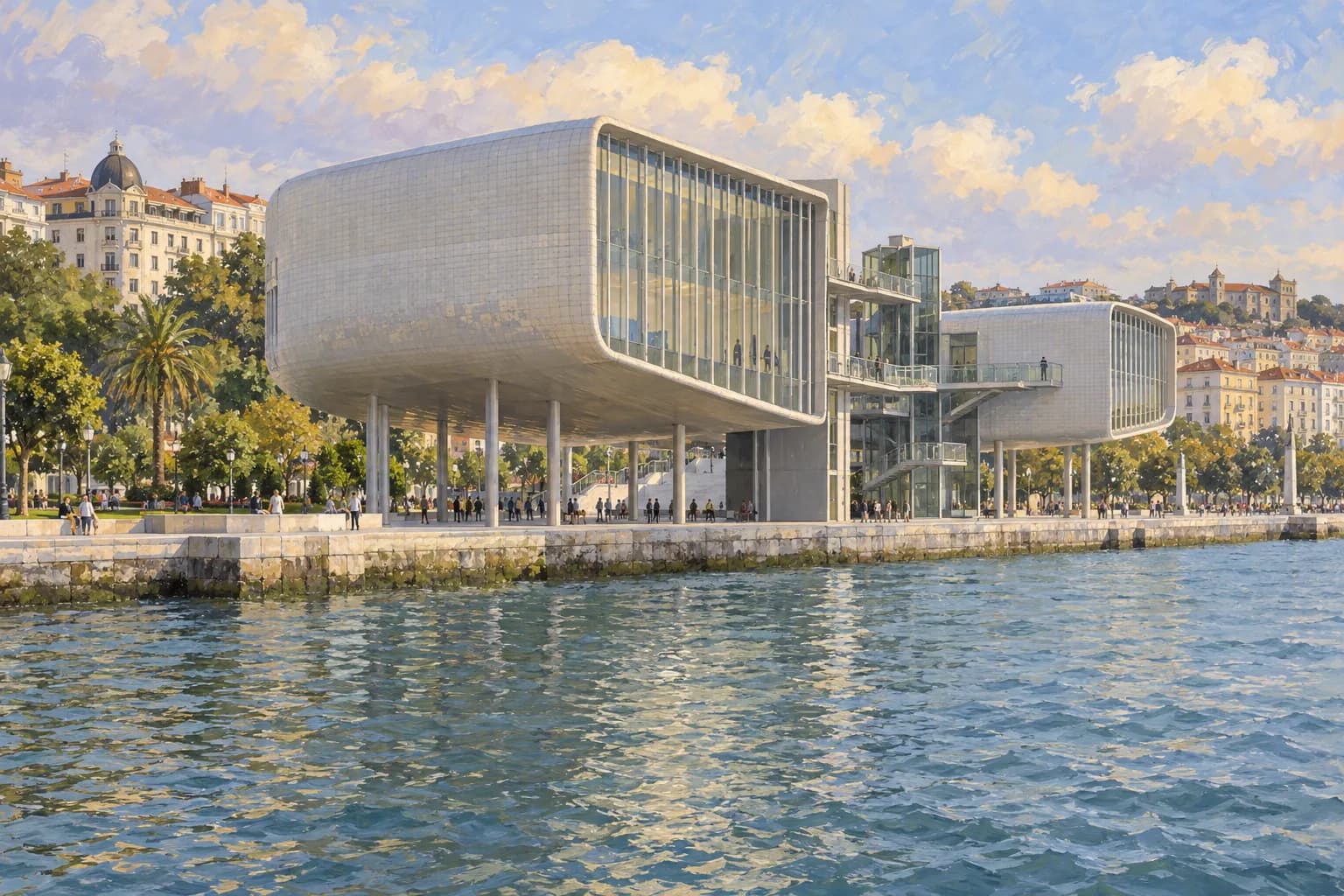 Centro Botín: look at the building and at what it lets you keep seeing. Architectural illustration; light and secondary details are recreated.
Some buildings aim to dominate a landscape. Centro Botín invites you to notice a different choice: raising its volumes while maintaining a visual relationship between the city, the gardens and the bay.
Designed by Renzo Piano with luis vidal + arquitectos and opened in 2017, it places its spaces in two bodies joined by walkways. The centre's description of the building explains its relationship with the surroundings. It is not floating: supports make the space underneath possible.
Try looking below it first, then upwards. Architecture can be read through what it leaves open, not just through what it occupies. You can explore that idea from the promenade, even if visiting an exhibition is a separate plan with its own conditions.
The question here is quite simple: how do you add something new to a city without losing what people already loved looking at? There is no universal answer. This building proposes one, turning an eye-catching shape into a conversation about the places where we live.
Open Centro Botín in WAONDERThe cathedral: what survived and what had to be rebuilt
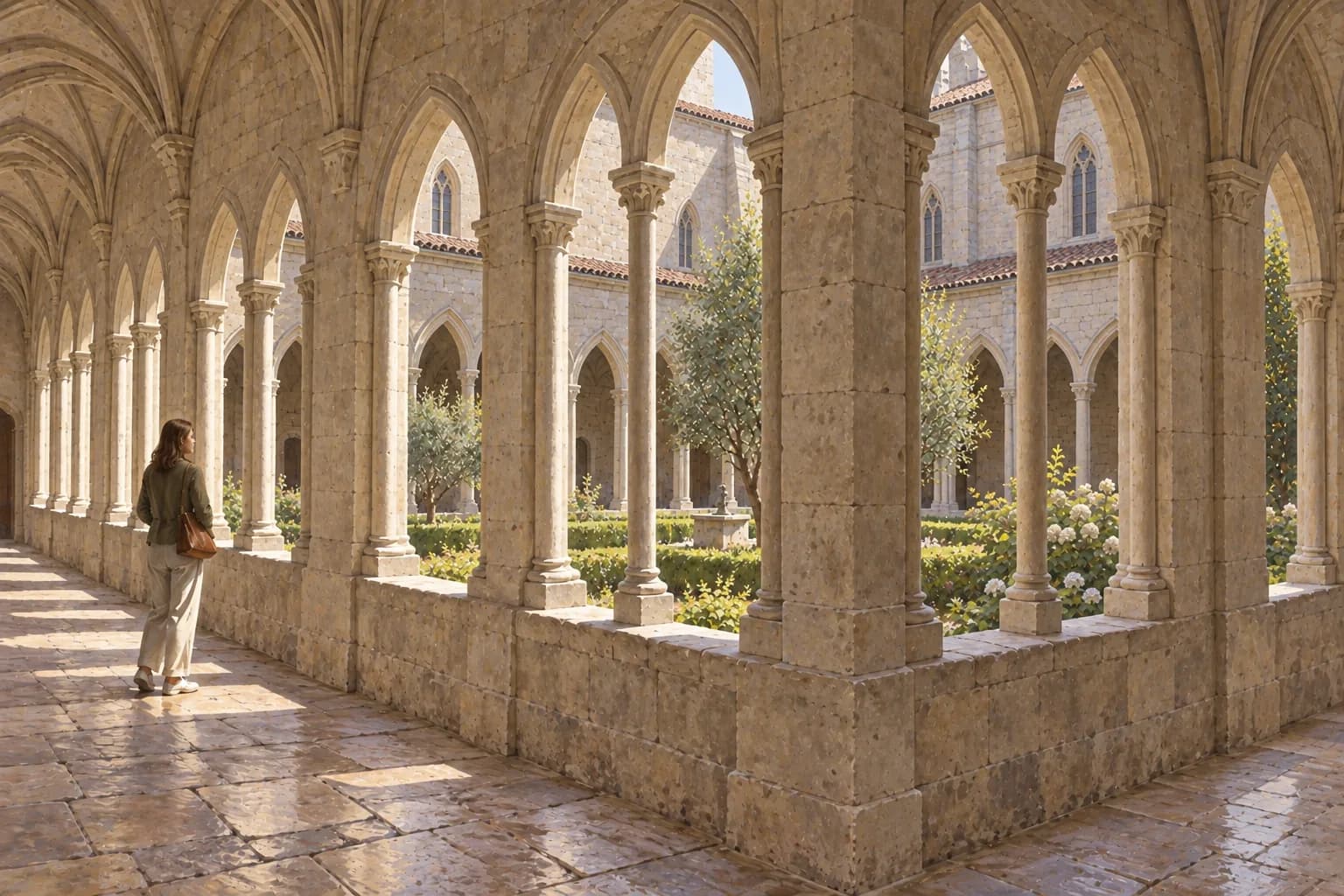 The cloister offers a quieter scale for approaching Santander's memory. Painterly interpretation, not an exact record of its ornament.
The Cathedral of Our Lady of the Assumption brings you close to a Santander that cannot always be read from a facade. The complex preserves older layers alongside the marks of a city that had to rebuild.
The fire of 1941 devastated much of the historic centre. The cathedral was partly reconstructed afterwards, as the city's information on religious buildings explains. Not everything that looks old reached us untouched; it would also be wrong to say that the entire building disappeared.
There is a quiet emotional weight to that distinction. A city preserves more than what it managed to save: it also preserves decisions made after a loss. The municipal fire trail helps relate today's places to that transformation.
In the Church of Cristo, the lower part of the complex, Roman remains can be seen beneath glass. Your gaze changes direction: after following an arch upwards, you might end up looking under your feet. These are not separate cities, but different times meeting in one place.
Before leaving, keep this question: which part of what I see belongs to what survived, and which to the effort of rebuilding? It is a way of looking at stone without forgetting people.
Open Santander Cathedral in WAONDERMercado del Este: a city also tells its story through everyday errands
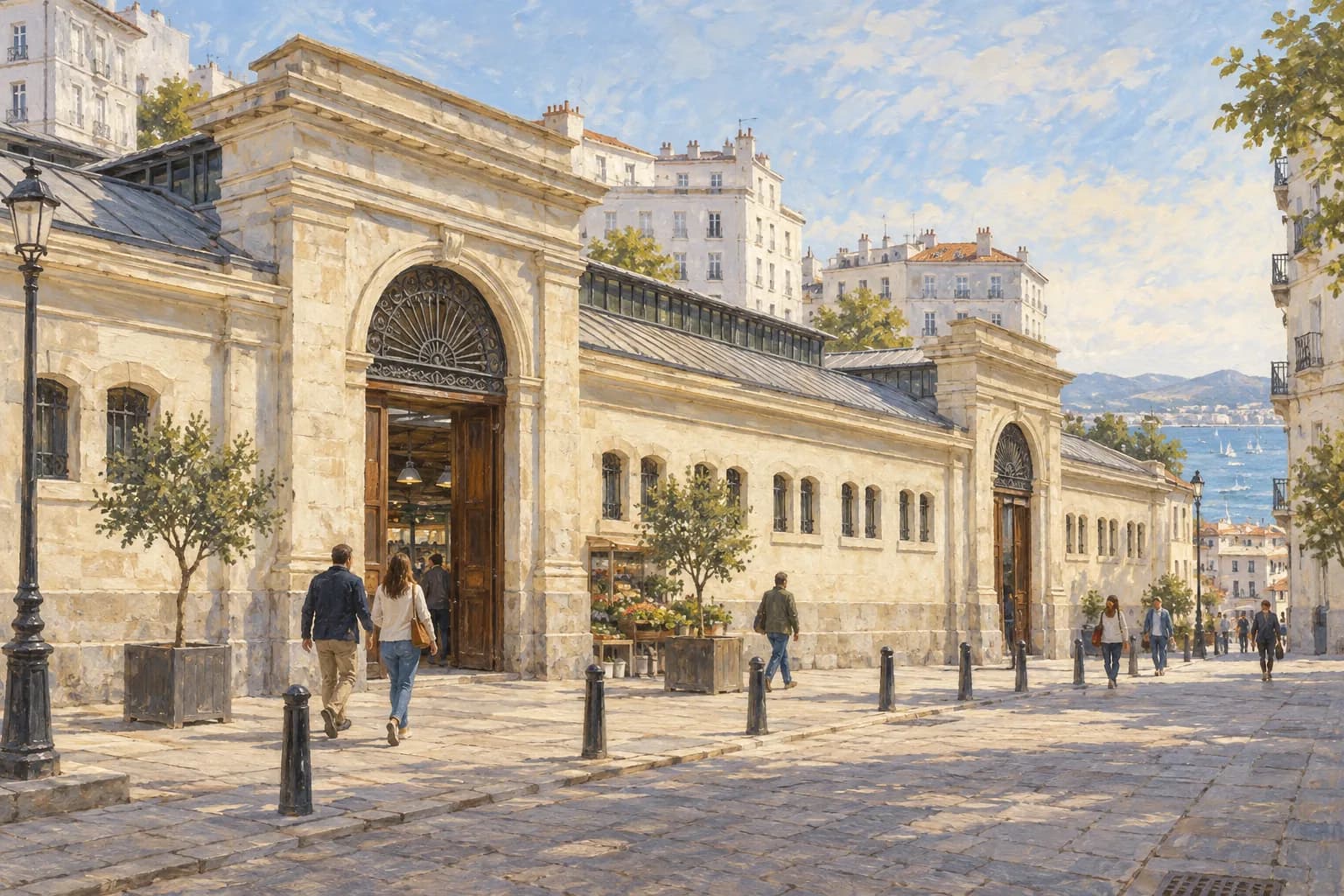 Mercado del Este: heritage on an everyday scale. Illustration; activity, light and immediate surroundings are recreated.
Not all heritage needs a tower to attract attention. Mercado del Este, with its low profile and street-level entrances, offers a story in ordinary gestures: arriving, walking through, looking around, meeting someone.
Designed by Antonio Zabaleta and built between 1839 and 1842, it has an interior arrangement resembling a small network of covered streets. The market's own history highlights that layout. Trade was not just something that happened inside; it also helped shape the space.
That detail deserves a different kind of attention. Usually, you go to a market looking for something specific. Here, you can also notice how a building makes movement and encounters possible. A place designed for practical activities can become a keeper of urban memory.
Restoration is part of its story; we are not presenting everything visible today as unchanged nineteenth-century fabric. Caring for a building can also mean adapting it so it continues to have a life. Outside its door, the question may feel less grand than at a palace, but it is just as interesting: what makes a place of everyday use become heritage?
Open Mercado del Este in WAONDERNaves de Gamazo: when a working space learns another language
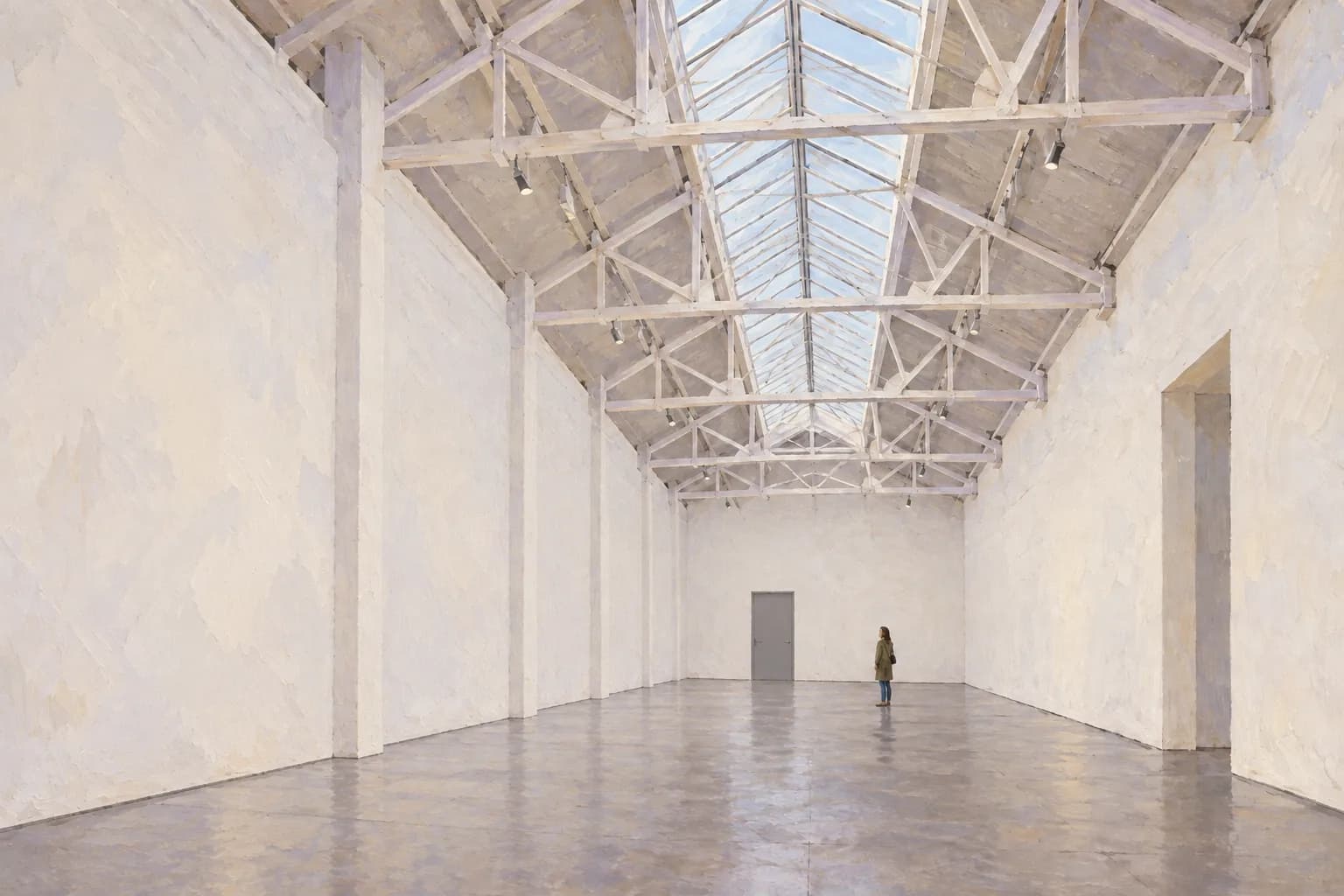 Gamazo: industrial structure helps you read the new purpose. Illustration of the space, not a depiction of a current exhibition.
Naves de Gamazo reveals another relationship between Santander and the sea: the industrial spaces that supported it. Before looking at an artwork, it is worth looking at the place receiving it.
Fundación ENAIRE explains that the complex brings together two halls, dating from 1908 and 1950, restored to house an art centre that opened in July 2021. Its history and project keep the connection with industrial architecture visible.
The roof trusses and spacious interior help you understand that connection. You do not need to know which exhibition is showing to appreciate the change: a space associated with the working harbour can now receive other kinds of attention and conversation.
This does not mean the past was replaced by something simply “better”. The interesting part is the coexistence: a new purpose can make us look again at a structure we once walked past. If visiting conditions allow you inside, look up at the roof too. The story of the container deserves some of the time we usually reserve for its contents.
Open Naves de Gamazo in WAONDERThe Maritime Museum: the sea does not end at its surface
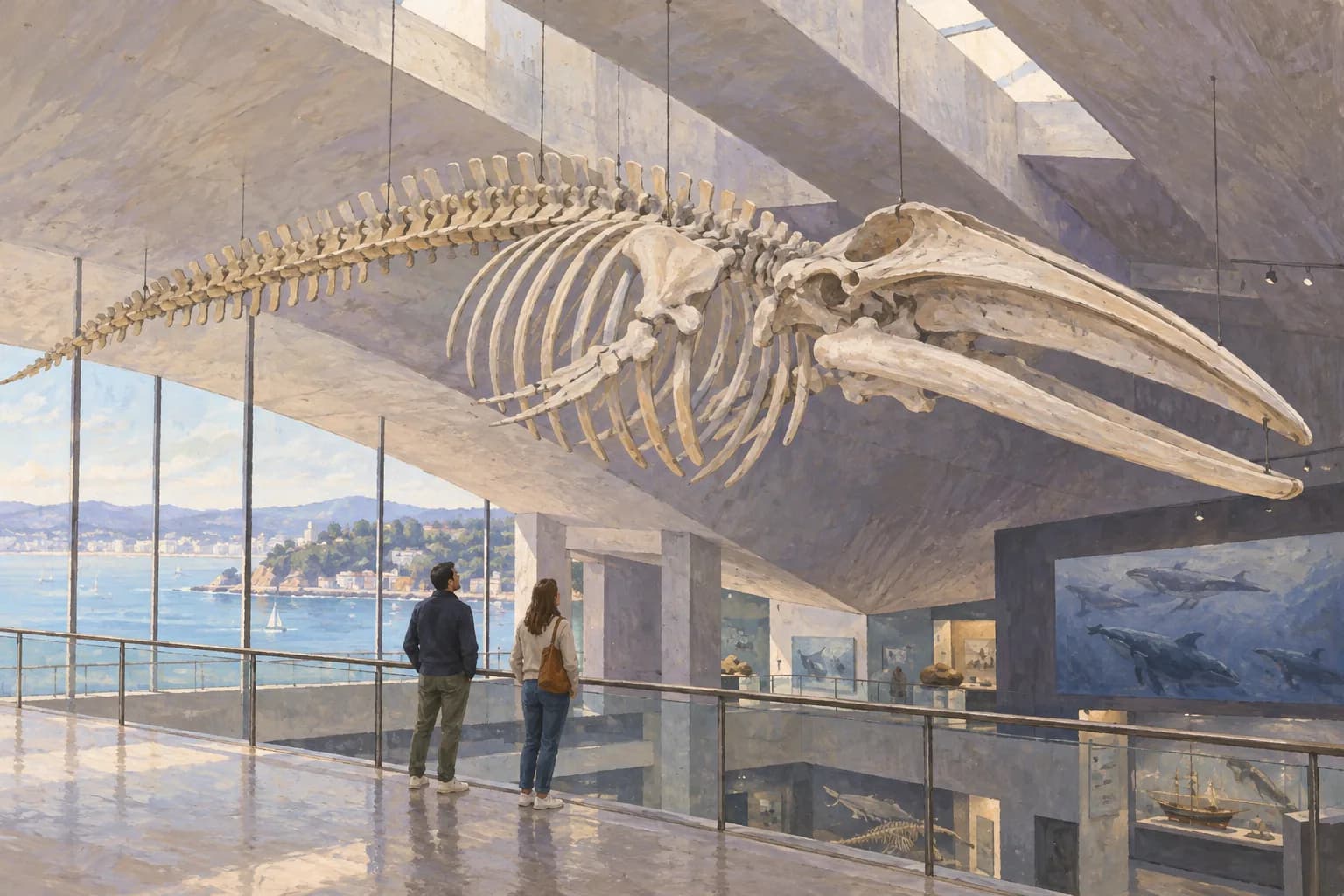 Marine life can change our sense of scale. Evocative illustration, not an exact reproduction of a specimen or museum room.
After looking at the bay from outside so many times, the Museo Marítimo del Cantábrico invites you to do the opposite: step into what the sea means, supports and conceals.
Its scope brings together marine life, fishing, maritime history and navigation, according to the municipal introduction to the museum. That combination matters. It is neither simply somewhere to admire animals nor just a collection of boats: it connects nature, knowledge and work.
Consider the difference between seeing a vessel as a shape on the horizon and asking about the skills, risks and trades behind it. Or between looking at water and remembering the life beneath it, most of which remains out of sight during a walk.
Curiosity changes scale. The sea that makes a city beautiful has also shaped entire lives. A museum visit can restore some of that depth to your next view of the bay. Check visiting information and available galleries before setting out; this illustration does not promise a particular object on display.
Open Museo Marítimo del Cantábrico in WAONDERCabo Mayor: a light that was not built to be photographed
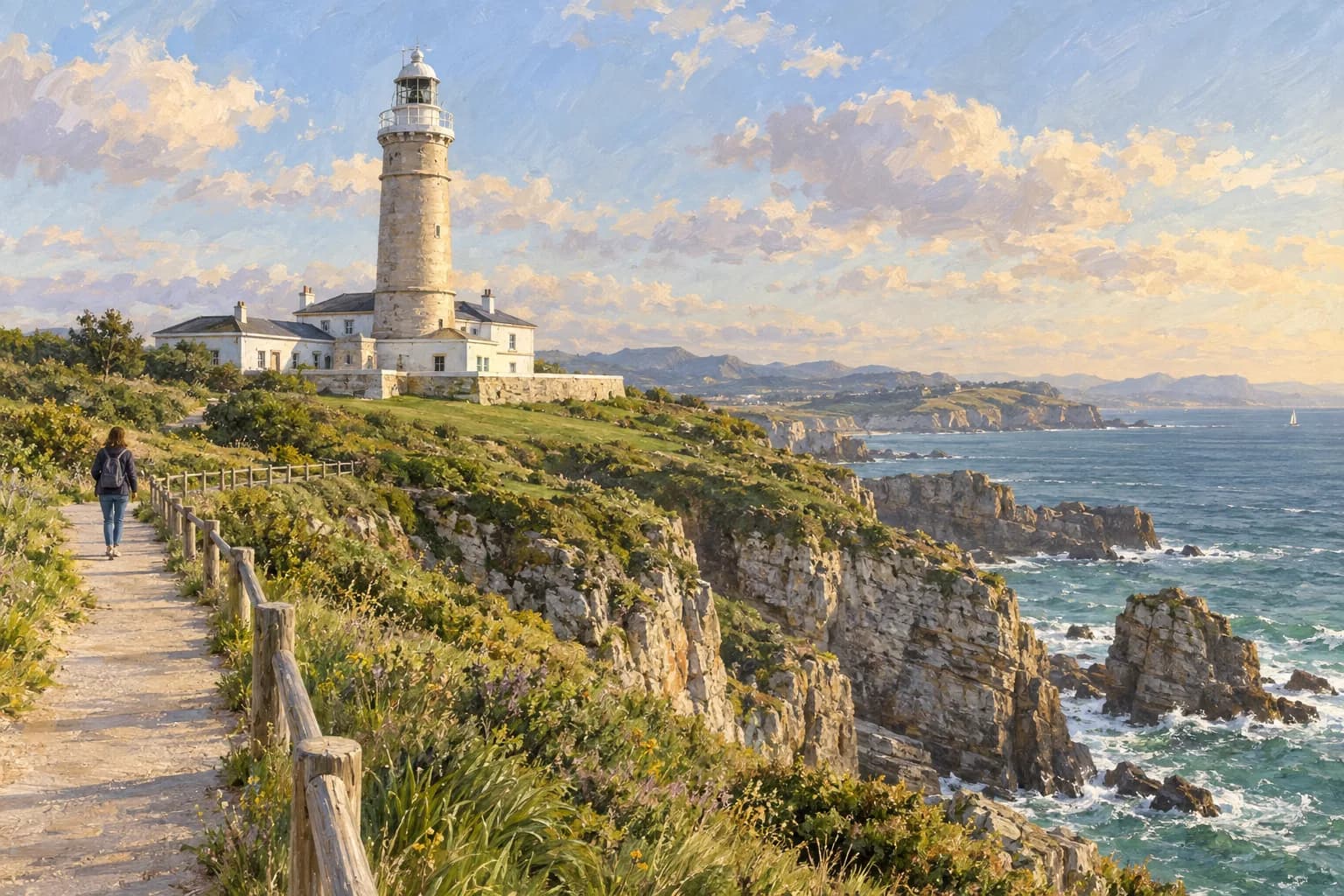 Cabo Mayor: a signal for someone approaching from the sea. Illustration; sky, vegetation and people are recreated, not guidance for approaching the cliff edge.
Cabo Mayor lighthouse makes you look towards the horizon. Its story becomes stronger when you change perspective: not someone arriving on foot from the city, but someone needing to recognise the coast from a vessel.
The Santander Port Authority dates its first illumination to the night of 15 August 1839. The municipal Cabo Mayor trail recalls earlier signals using flags by day and fire by night. The building turned a need for orientation into a lasting presence on the cape.
You do not need to invent a particular shipwreck or farewell to feel its meaning. A light can be a navigational signal and, at the same time, the chance to recognise where you finally are. That shift in perspective makes the lighthouse more than a picturesque ending to the landscape.
If you plan an outing here, check access conditions, weather and the mobility needs of your companions. We are not assuming access to the tower. There is plenty to notice from designated areas, without approaching unsafe edges.
Open Cabo Mayor lighthouse in WAONDERBeyond these eight places: what Santander's catalogue contains
La Magdalena and Los Raqueros are starting points, not the whole range of places to explore. The working inventory for Santander city, reviewed on 28 September 2026, contains 1,144 records of places, areas and map points. The interesting part is not finishing that number: it is finding a question that changes a walk you thought you knew.
This selection of primary categories can help you choose a starting point. The figures include both interactive records and map-only points:
| Primary category | Catalogue records | A question to take on your next walk |
|---|---|---|
| Public art | 97 | Stop at a sculpture and ask who it remembers, as with Los Raqueros. |
| Monuments | 86 | Look beyond the name: what did the city choose to remember? |
| Churches | 80 | Look for traces of different periods; the cathedral shows why a building rarely tells just one story. |
| Cultural centres | 47 | Discover how a space relates to city life, rather than looking only at its façade. |
| Museums | 17 | Choose a question that interests you—sea, work, art—before deciding on a visit. |
| Industrial heritage | 10 | Notice the work behind the scenery: Gamazo invites another look at waterfront buildings. |
| Viewpoints | 23 | Turn the horizon into a question: which part of Santander makes more sense from here? |
| Lighthouses | 3 | Think of the people who needed that light to find their way, not only the photograph it offers today. |
| Gardens | 221 | Notice the surroundings of a walk; appearing on the map does not mean every garden offers a conversation. |
One distinction matters when you use the app: 585 records are map-only. Of the remaining 559, 79 represent areas rather than individual monuments. Within the gardens category, 213 of the 221 records are map-only. They provide context for exploring, not a promise of an answer at every point. Select a place and check the options it offers.
Each record is counted once, under its primary category; the table is a selection, not the whole inventory. It is not an official heritage census, a count of unique buildings or a verification of every point in the published app. Quantity does not measure the quality of every answer either.
For you, that variety might mean something much simpler: one day you stop at a sculpture; another you choose a museum for the weekend; another you notice an industrial building that used to be part of the background. WAONDER is a way to bring that curiosity along, without turning every outing into a major excursion.
What you will find in WAONDER, and how to take it on your next walk
Exploring Santander is not limited to one kind of heritage. You may encounter sculptures and monuments, churches, museums, industrial architecture, gardens, viewpoints and lighthouses. Some stories involve grand buildings; others begin with a working gesture or a city habit.
Not every point serves the same purpose: some help you read and orient yourself on the map; others let you open a conversation about the place. Explore the places shown around you and ask where conversation is available. The questions in this article are starting points for your own exploration.
You can begin with something specific: “Who do these figures remember?”, “Why was this palace built?” or “What was here before it became an art centre?”. If an answer makes you notice another detail, the walk has already gained something.
Choose one area, rather than eight compulsory stops:
- The centre and bay: the cathedral, Mercado del Este, Centro Botín and Los Raqueros connect urban memory with the harbour. Visiting interiors is a different plan from looking from the street.
- The waterfront and La Magdalena: Gamazo, the Maritime Museum and the palace offer outings you can adapt to your time and mobility. You do not need to combine them all.
- Cabo Mayor: give it an outing of its own, paying attention to access and weather. It is not presented as a stop immediately beside the centre.
For museums, the palace and cultural centres, check opening times, reservations, accessibility and entry conditions on their official websites. WAONDER does not replace an admission ticket, and this article does not announce automatic routes or free entry.
The idea is simple: carry a way to ask when a place catches your attention. That might happen this weekend, or on an ordinary day when you pass a monument you have never stopped to look at.
If you want to keep rediscovering cities, our selections for the Community of Madrid and Barcelona suggest other stories behind familiar places.
Perhaps the next time you look at the bay, you will also remember hands at work, a city rebuilding or a light offering orientation. The landscape will still be there. What will have changed is what you can see in it.
Download WAONDER for your next walkSection
Waonder updates