New York City in WAONDER: the city you thought you knew
Emily Roebling, a station people fought to save and neighbors who saw a future for abandoned tracks: eight places to rediscover New York City with WAONDER.
You recognize the bridge. You have met beneath that clock. You know where the lions are. And you can still walk past a story nobody has told you.
A woman sustained essential work behind the Brooklyn Bridge. Neighbors saw a different future for abandoned railway tracks. And a bronze dog in Central Park once stood before the living dog it honored.
New York City is one of the territories you can explore with WAONDER. These eight places offer a fresh look at familiar surroundings: when a facade catches your eye on the way home, when you are choosing a weekend outing or when you come to visit. You do not have to feel like a tourist to discover something in your own city.
Download WAONDER and see New York with fresh curiosityChoose a setting for your next outing
You do not have to see all eight. These links take you to their stories within this article:
- East River · the bridge and the people behind it: Brooklyn Bridge. Pause before its silhouette or make a separate outing of the pedestrian crossing.
- New York Harbor · a closer look at a familiar symbol: Statue of Liberty. Visiting Liberty Island requires its own transport and planning.
- Midtown · slowing down a familiar journey: Grand Central Terminal and New York Public Library. A station and a library can be more than places to pass through.
- West Chelsea · walking above industrial memory: High Line.
- Fifth Avenue and Central Park · art or a rescue story: Metropolitan Museum of Art and Balto. Choose how long to spend inside the museum and how long in the park; they are not a single stop.
- Queens · the future that stayed in the park: Unisphere, in Flushing Meadows–Corona Park. An outing distinct from the others.
Our scope is NYC, not the whole state of New York. The selection focuses on Manhattan, Brooklyn and Queens; it does not represent every neighborhood or provide an automatic in-app route. Distances, admission and accessibility need separate planning.
Brooklyn Bridge: another name to remember in your photograph
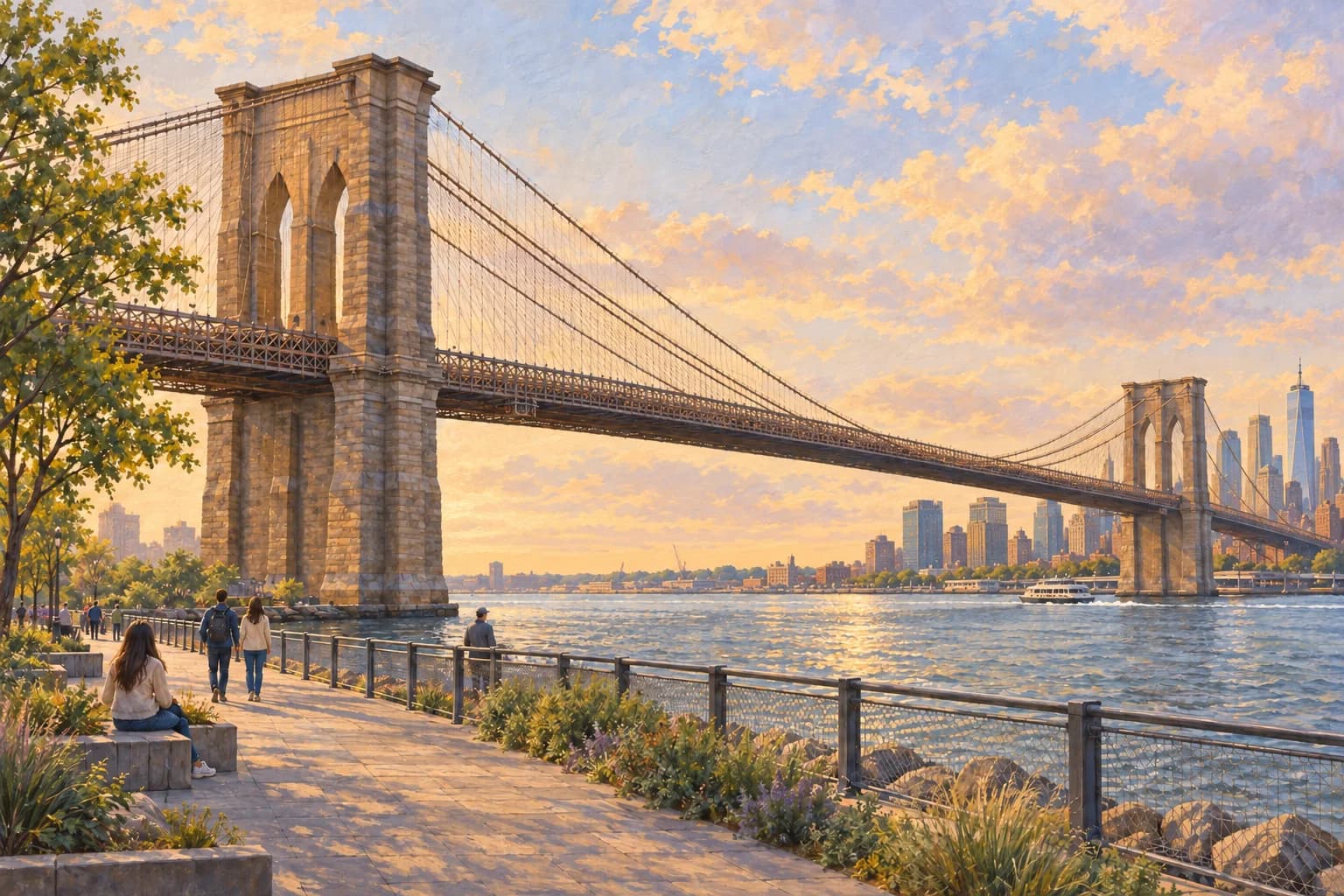
The Brooklyn Bridge's stone towers and web of cables can seem to hold New York in a single frame. They have linked Manhattan and Brooklyn across the East River since 1883, notes the city's Department of Transportation.
Behind that image lay a less visible task: getting knowledge from one person to others when the engineer in charge could no longer work as he once had.
In 1872, decompression sickness restricted Washington Roebling's work. His wife, Emily Warren Roebling, studied the plans, explained instructions and handled communications and negotiations essential to continuing construction. She was neither the bridge's sole creator nor the formal replacement for its chief engineer. Her contribution deserves recognition without erasing anyone else's. Brooklyn Bridge Park documents her role.
Next time you frame those arches, you can take away more than a famous silhouette. You can remember someone who helped bring the bridge to completion. Beneath it, Emily Warren Roebling Plaza gives you another chance to connect a name with a landscape you already knew.
Explore the Brooklyn Bridge in WAONDERStatue of Liberty: what the torch draws our attention away from
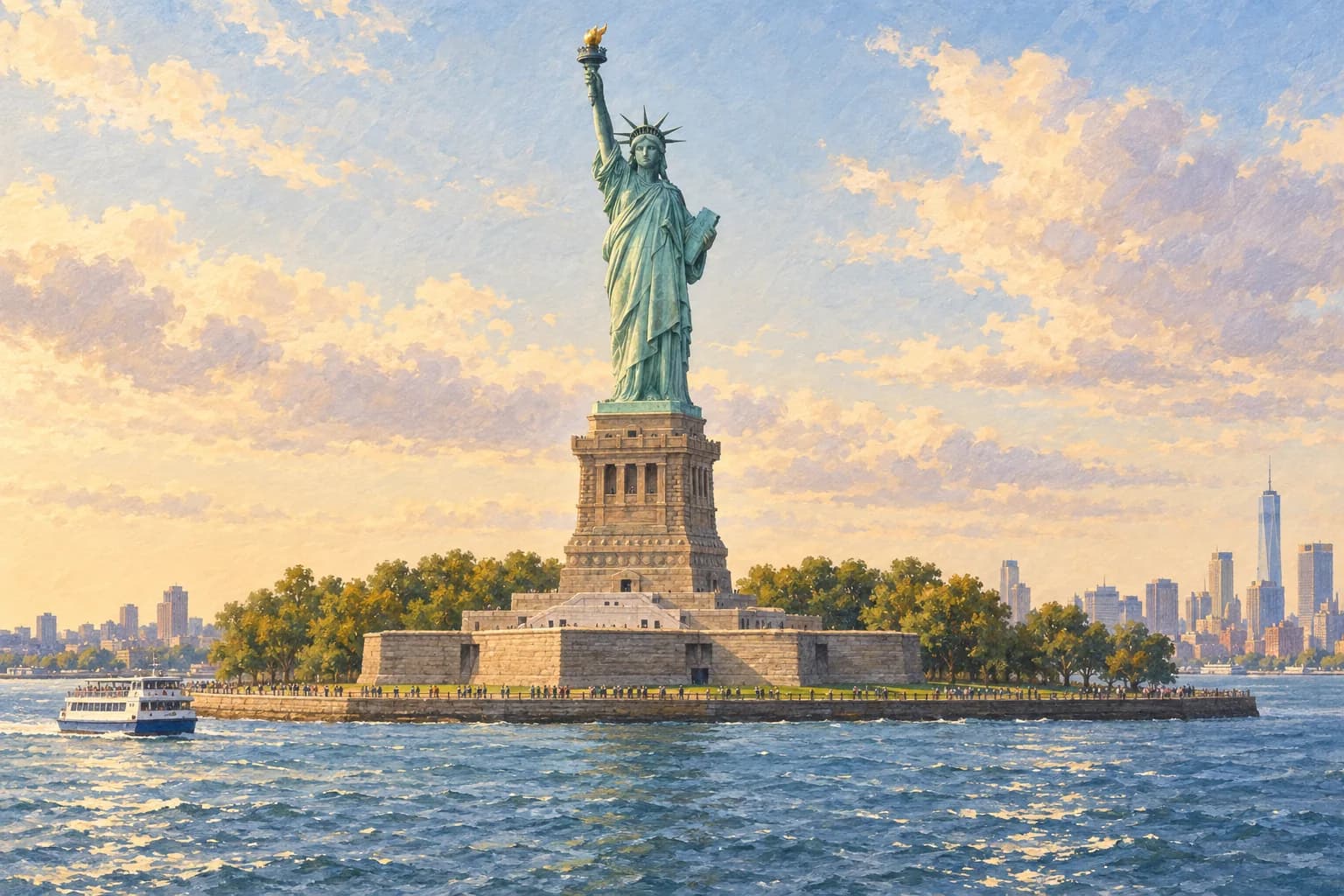 A painterly interpretation of the monument. The chains at its feet are not visible from this distance.
Some symbols are repeated so often that we think we have seen all of them. The Statue of Liberty is one: first the torch, then the crown, perhaps the green copper.
At her feet lie a broken shackle and chain, connected to the abolition of slavery. The National Park Service explains their meaning and the contradiction: when the statue was dedicated in 1886, the freedom it proclaimed had not become equality for African Americans. The detail is not visible from ground level, cautions the NPS's visitor FAQ.
Knowing this changes what you can ask even when you only see the monument from shore. Not all its meaning lies in the feature dominating a photograph. An important part of the story remains low down, almost outside our gaze.
To visit the island, consult the official transport and access guidance. Seeing the statue from a boat does not mean landing on Liberty Island or gaining admission to the pedestal or crown.
Explore the Statue of Liberty in WAONDERGrand Central Terminal: the place people chose to defend
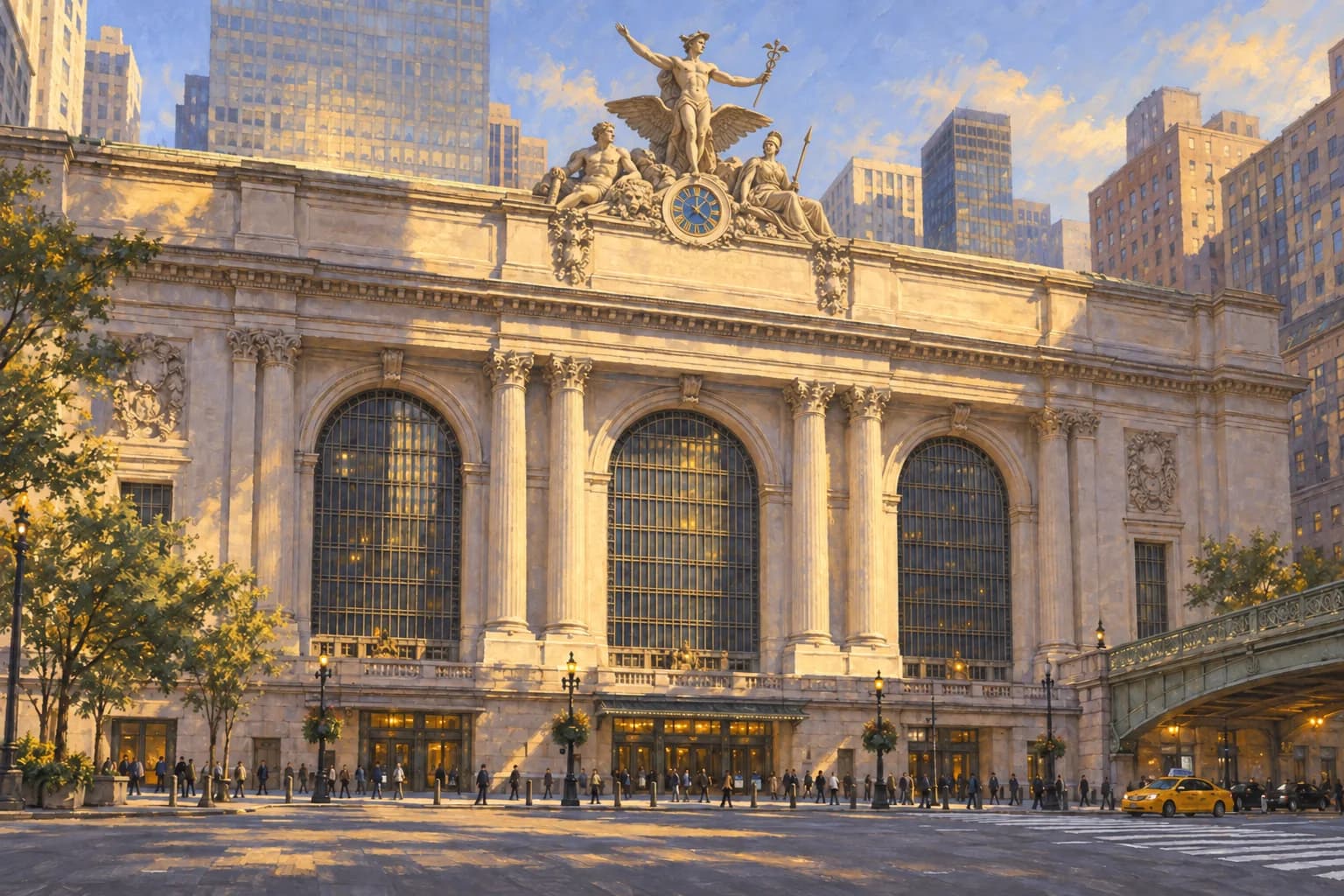 Grand Central Terminal. Architectural illustration; sculptural details are interpreted at a small scale.
A station can become somewhere we cross without seeing it. Arrive, check the time, move on. At Grand Central, that routine holds an unexpected question: what if this space had not survived?
The terminal opened in 1913. Decades later, a proposed tower above it would have removed important parts of the interiors. Jacqueline Kennedy Onassis and Brendan Gill joined others opposing the changes. The terminal's history, presented by the New York Transit Museum, follows the dispute and subsequent restorations: saving a building does not end when a development is stopped.
Start with something small: give a few minutes to a place you usually hurry through. Look at the great arches from the street, step inside without making it a race and remember that some places remain part of our lives because people chose to defend them.
Explore Grand Central Terminal in WAONDERThe public library: two lions for difficult times
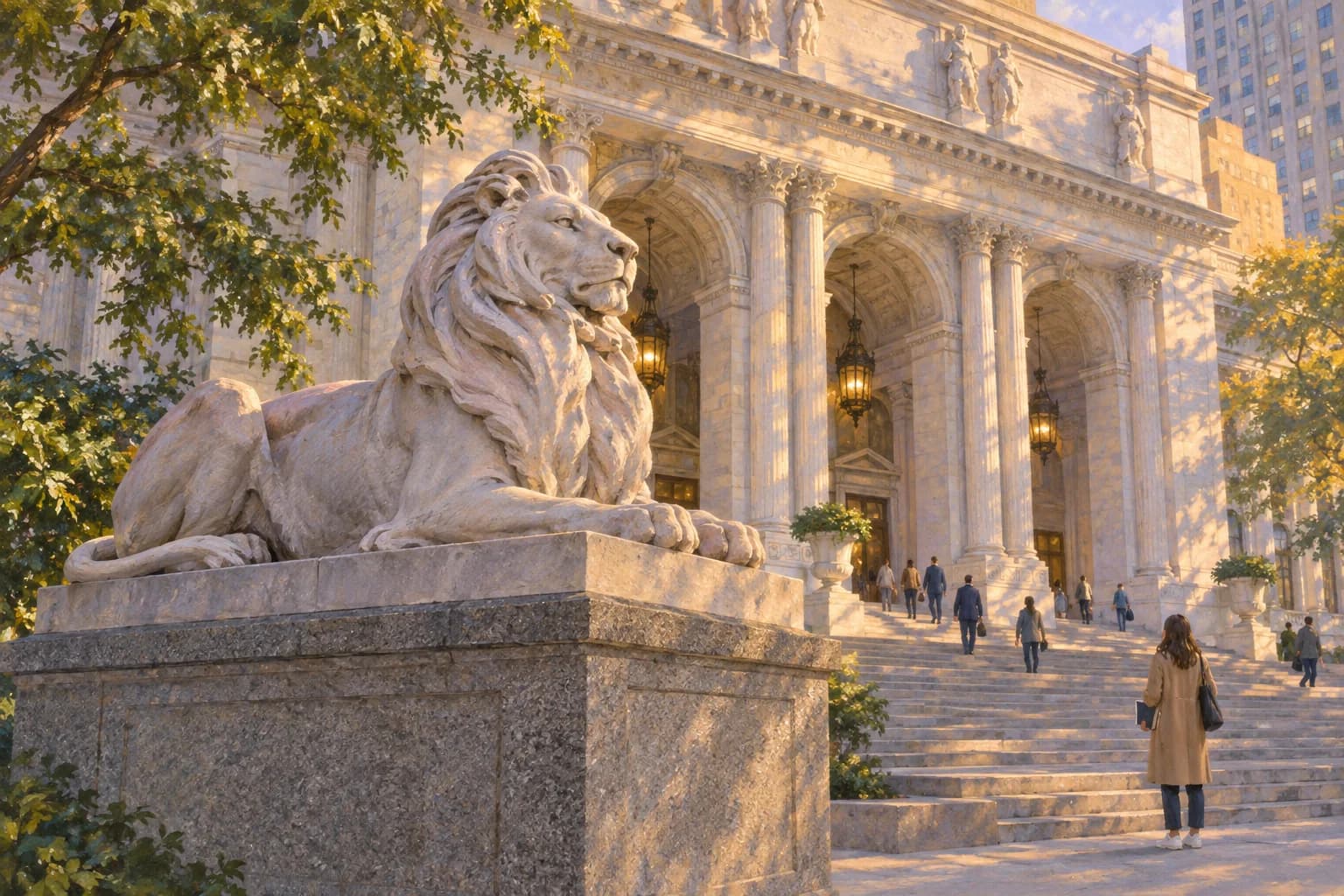 One of the library lions: marble, extended forepaws and an upright head, not an upright bronze lion.
The two lions outside the New York Public Library on Fifth Avenue are not simply called “the lions.” Their names are Patience and Fortitude.
During the Great Depression, Mayor Fiorello LaGuardia gave them those names for qualities he thought New Yorkers needed to get through those years, explains the library itself. They have accompanied the entrance since 1911.
It is a small story, but one that can stay with you. A name turns apparently decorative sculpture into a way of speaking about a city and the people who live in it.
Notice the posture: resting bodies, extended paws and heads held high. The NYPL's accessible description details their marble and form. Next time, perhaps you will meet “beside Patience,” rather than “beside one of the lions.” It will no longer be quite the same place to you.
Explore the New York Public Library in WAONDERHigh Line: the neighbors who saw a walkway in a relic
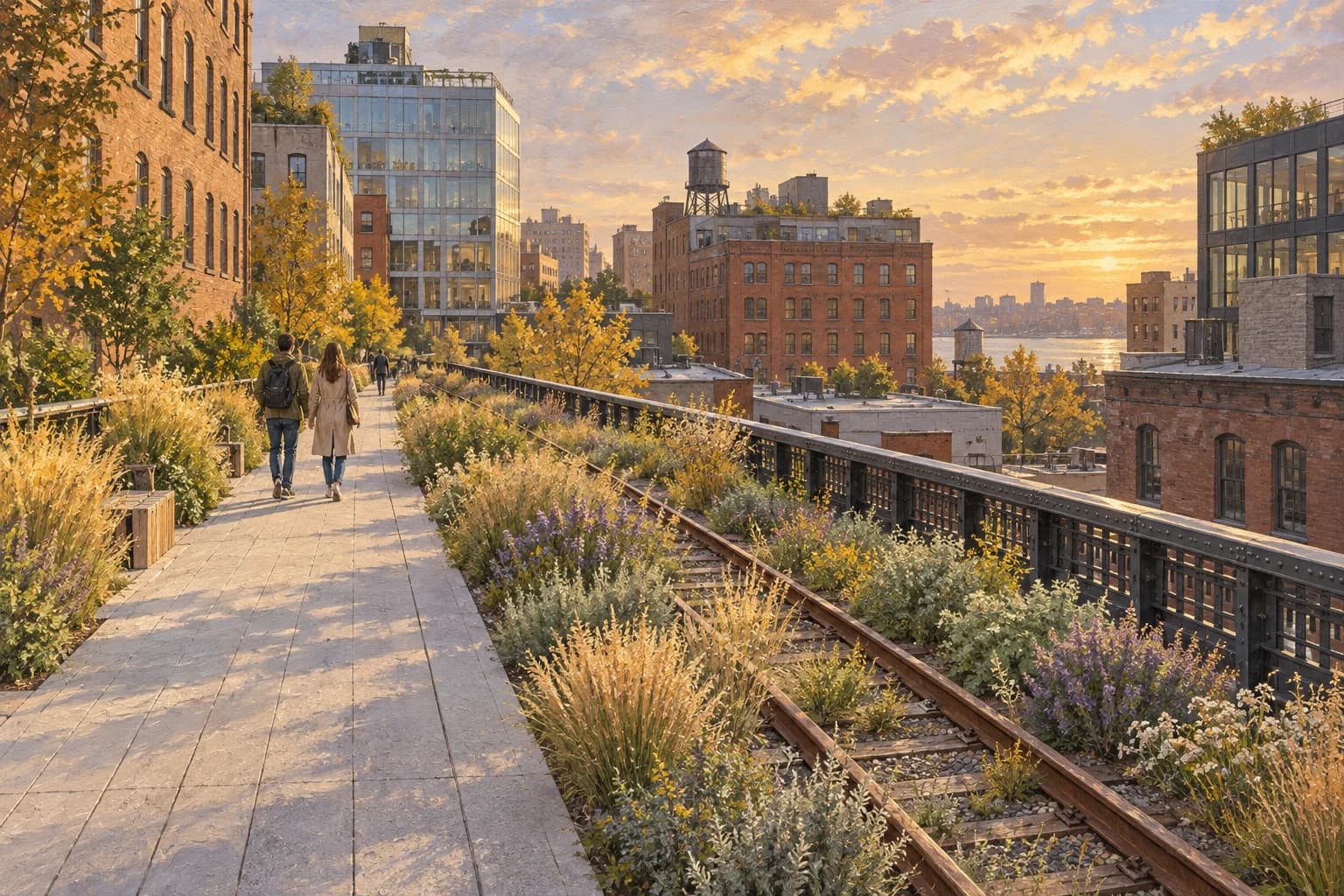 A landscape inspired by observed High Line features, not an exact section or an operating railway.
The rails emerging between the High Line's plants are not decoration imitating railway tracks. They are a clue to this elevated walk's former life.
After trains stopped running, the structure faced demolition. In 1999, neighbors Joshua David and Robert Hammond founded Friends of the High Line to advocate a different future. The park's first section opened in 2009, according to NYCEDC's project history. The High Line's own guide records its stages.
Here the detail that might stop you is almost at your feet. Notice how rails coexist with planting and how the walkway lets you see the street from another height. Before it became an outing someone could suggest, it was a possibility someone had to imagine.
For residents, that is a reason to return without waiting for an out-of-town guest: choose another season, look at the landscape and ask which traces of industrial life remain. Check the park's access, hours and notices before setting out.
Explore the High Line in WAONDERThe Met: a museum that did not start with that facade
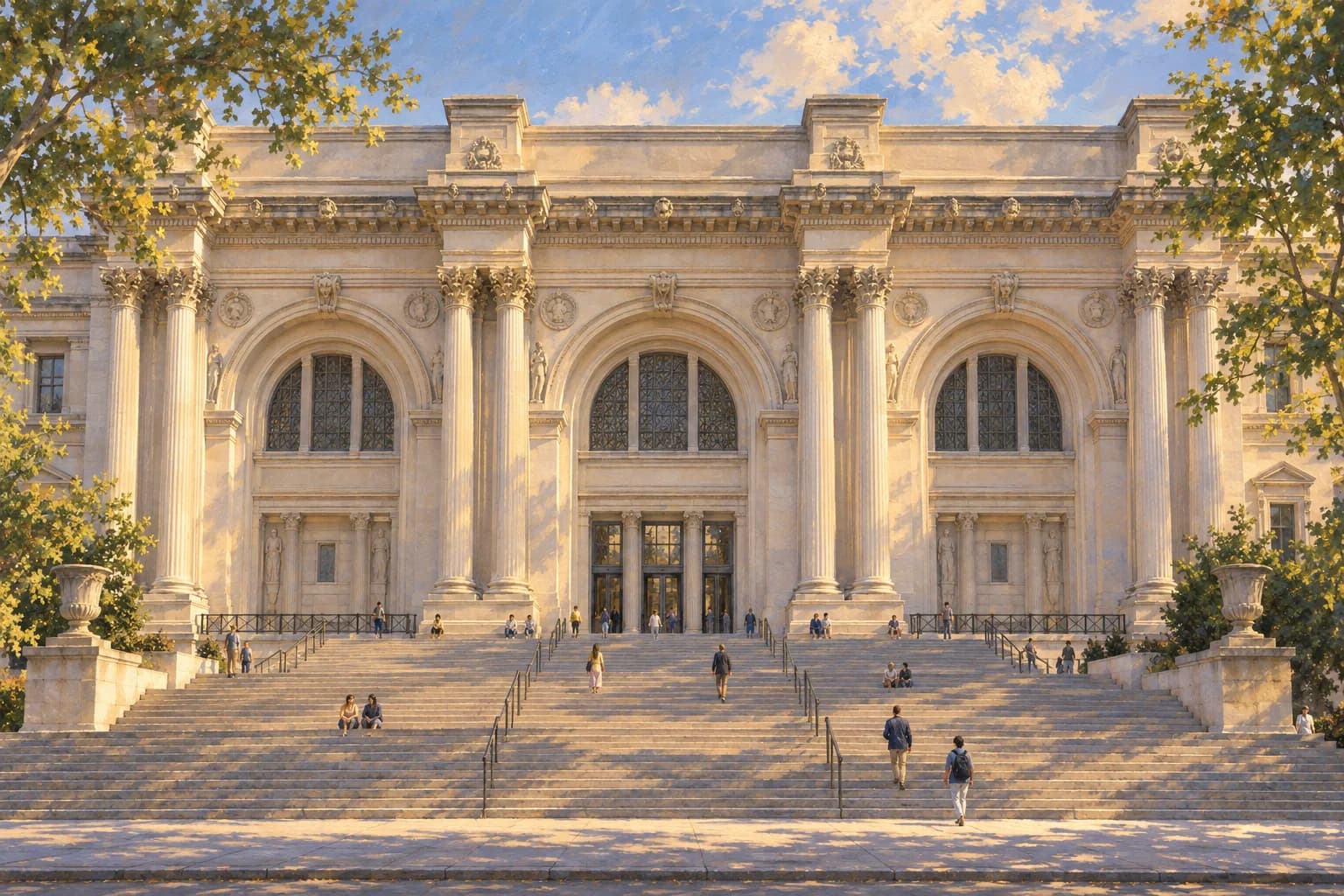 The Met on Fifth Avenue. An illustration of its present facade, not the museum's first home.
Before the Metropolitan Museum of Art's steps, it is hard to imagine a beginning without that monumental facade. Yet when it was established in 1870, it had no building of its own, collection or professional staff, recalls the museum's historical archive.
It moved to its present site in 1880; the Beaux-Arts Fifth Avenue facade we recognize opened in 1902. The Met's history distinguishes those additions and dates.
That beginning lets you see the building differently: not as something that appeared complete, but as an institution shaped over time. If “seeing everything” feels overwhelming, change the purpose of the outing: approach its architecture or, with admission, choose a part of the collection you genuinely want to explore.
You do not have to exhaust a museum for a visit to be worthwhile. Your next question can begin on the steps, before you cross the door. To go inside, review the current visiting arrangements.
Explore the Metropolitan Museum of Art in WAONDERBalto: the dog who met his statue
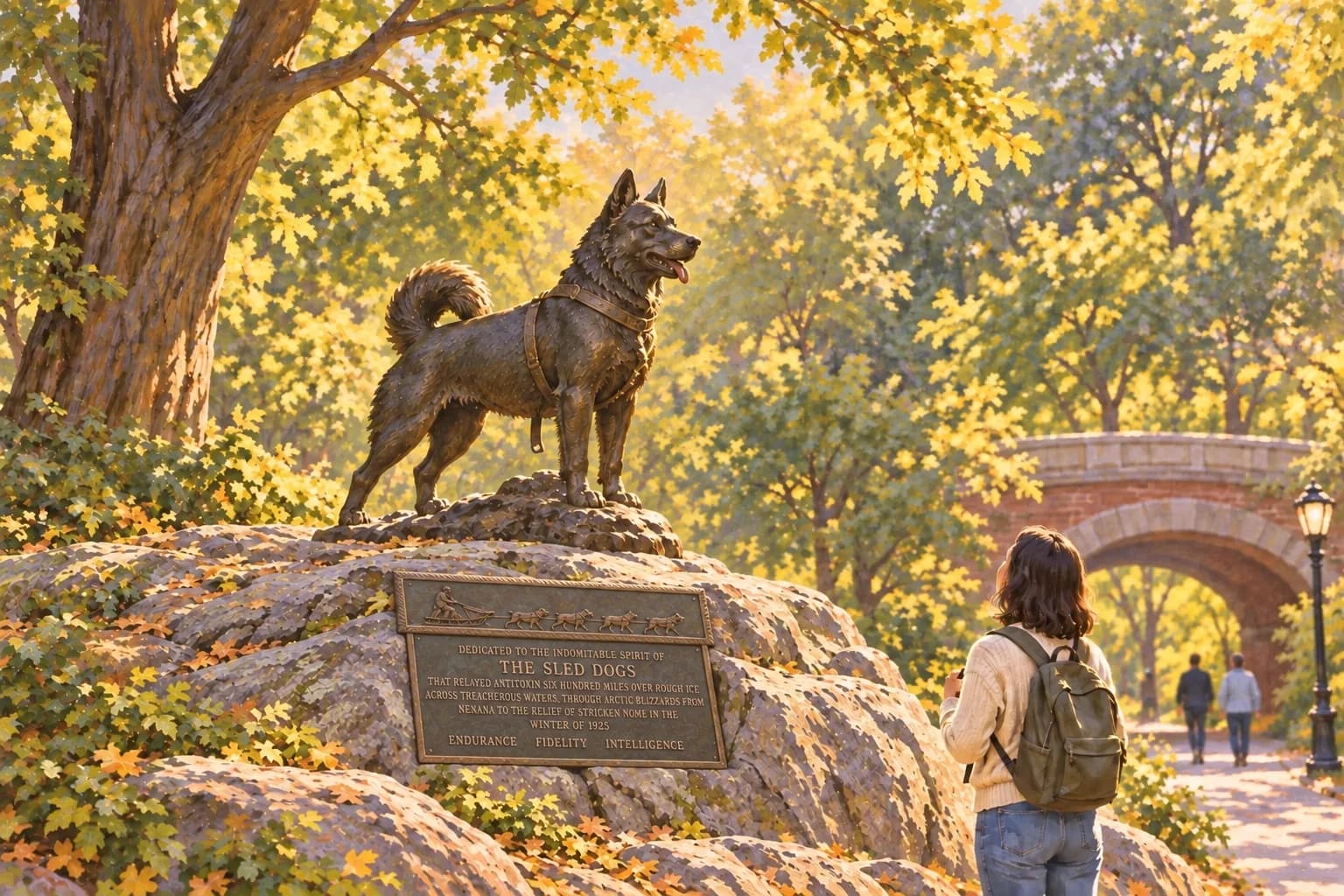 Illustration of Balto's monument. The plaque is a painterly interpretation, not a documentary transcription.
On Central Park's east side, near 67th Street, you can find a bronze dog wearing a harness. The image invites a photograph. Its story invites you to stay a little longer.
The living Balto attended the unveiling of his own statue on December 17, 1925. He had led the final stage of the antitoxin relay to Nome, Alaska, with Gunnar Kaasen and their team. Central Park Conservancy documents the tribute.
It was not one dog's achievement: Togo, other dogs and their mushers also made the relay possible. Knowing that does not diminish Balto; it gives more names and lives to what the monument represents. We tell that story, including the later rescue of some of its protagonists, in Balto in Central Park: the dog who attended his own statue unveiling.
Look again at the rock and harness after reading it. Perhaps now you want a photograph there not simply because the dog is famous, but because the place recalls a story that means something to you.
Explore Balto in WAONDERUnisphere: the world that stayed in Queens
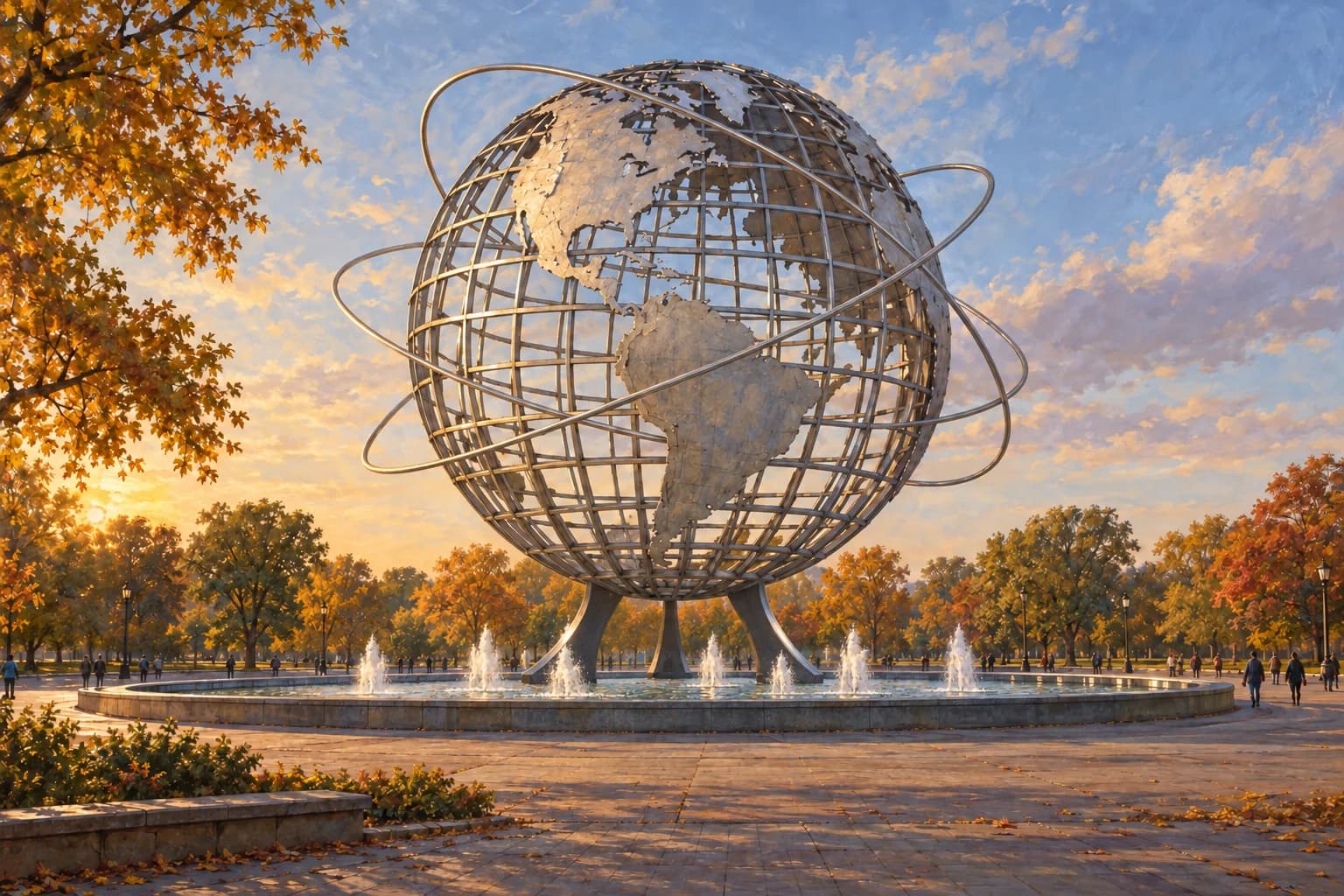 Unisphere in Flushing Meadows–Corona Park. Illustration; fountain operation can vary.
In Flushing Meadows–Corona Park, the horizon changes: an open world of steel, continents, meridians and great rings stands at the center of the landscape.
Designed by Gilmore D. Clarke, the Unisphere was the emblem of the 1964–1965 World's Fair. The New York City Planning Commission's report connects it to the ideal of understanding between peoples that accompanied the fair.
Today you can walk around its setting and change position until the lattice reveals another silhouette. What began for a temporary celebration still gives identity to an everyday place in Queens. A park outing can become a way of looking at the future another generation imagined.
This is an outing of its own, not a hurried final stop after a tour of Manhattan. People and surrounding open space make the globe's scale apparent; your visit need not depend on the fountains running.
Explore the Unisphere in WAONDERWhat you can find beyond these eight places
These protagonists are an introduction, not the entire map. The local inventory reviewed on September 29, 2026 contains 17,521 NYC-associated records: 7,942 are map-only and 9,579 are classified as non-map-only, including 440 area records. Some references help you get your bearings; others are intended for exploring information. Not every marker represents a place you can converse with.
This selection of primary categories suggests different reasons to go out. The figures count inventory records, not unique buildings or individually verified availability in the published app. Each record is counted under one primary category; not every category appears in this table.
| Primary category | Records | What it might prompt you to explore |
|---|---|---|
| Churches | 3,479 | A religious facade can open a neighborhood community's history; not every place of worship admits visitors. |
| Parks | 1,997 | Choose another setting for a walk and notice its memory, sculpture or transformation, not only its greenery. |
| Monuments | 1,119 | Give a name and context to a figure you pass every day; the inventory also includes map references without conversation. |
| Public art | 990 | Find a sculpture or intervention that makes you pause and ask about its artist, material or relationship with the place. |
| Bridges | 960 | Understand how a structure connects neighborhoods and lives. Segments and references may be included: these are not 960 distinct historic bridges. |
| Cultural centers | 468 | Choose a cultural outing and learn about the building's role; check its current program separately. |
| Museums | 149 | Shape a visit around a particular curiosity instead of trying to see everything; exhibitions and admission need checking. |
| Libraries | 238 | See everyday buildings as part of neighborhood heritage and discover who shaped their form or identity. |
| Theaters | 285 | Connect a facade with the city's performing life; a venue's history does not confirm today's performances or tickets. |
| Industrial heritage | 96 | Recognize traces of a working city beneath today's landscape: structures that might pass unnoticed without context. |
The larger figure does not necessarily mean more conversational possibilities. For example, the bridges inventory has 849 map-only records and 111 non-map-only records; for museums, the corresponding figures are 4 and 145. They serve different catalogue functions, rather than competing on quantity.
One question can change your next walk
WAONDER lets you explore places on the map and ask about their history or related information. The idea is not to add obligations to your weekend: it is to help you follow a curiosity you might otherwise leave behind.
Try a nearby place or one of these eight. A concrete question is enough to start: what Emily Roebling contributed to the bridge, why the lions have those names or what the High Line's tracks carried. If you share your location, you can start with places appearing around you; you can also explore another area on the map.
Check the responsible institutions' access arrangements before entering museums, libraries, parks or monuments requiring reservations. WAONDER does not replace their tickets or guarantee the same depth of information at every point. Opening a place link does not bypass permissions or registration the app may require.
If these fresh looks at familiar spaces appeal to you, continue with Washington, D.C. or the Bay Area. For New Yorkers, a first discovery can be much closer: in a place that has been part of your journey for years.
Download WAONDER and follow your next curiositySection
Waonder updates