Galicia arrives in WAONDER: remarkable places, closer than you think
From Santiago to Piornedo's thatched homes: eight stories and a look at the catalogue to explore Galicia with WAONDER, near home or on a visit.
You do not have to cross the world to find something you cannot explain. Sometimes it is enough to stop beside a tower you recognise from the road, a stone house or a few walls by the sea.
In Galicia, a Roman lighthouse still helps people find their bearings. A defensive wall has become an everyday walk. And beneath thatched roofs, you can discover a way of living that continued into the twentieth century. These are not just beautiful places: they are work, shelter, encounters and ways of making a home in a landscape.
Galicia is the latest addition to WAONDER in this series. We have chosen eight places to start exploring: familiar landmarks and buildings with stories closer to everyday life. If you live here, they can offer another reason to go out; if you are visiting, a reason to look beyond the names you already know.
Download WAONDER and find your next story in GaliciaChoose an area, not a marathon of landmarks
These links take you to the stories in this article. They are separate outings, not a walking route across Galicia or an automatically generated itinerary in the app:
- Santiago · an end to a journey, a beginning for questions: Santiago Cathedral.
- A Coruña · a signal beside the Atlantic: Tower of Hercules.
- Lugo · heritage within everyday life: Roman walls.
- Os Ancares · a house seen through the life it sheltered: Piornedo's pallozas, in Cervantes.
- Porto do Son · a settlement at sea level: Castro de Baroña.
- Carnota · the architecture of caring for a harvest: Carnota's hórreo.
- Esgos · rock, retreat and memory: San Pedro de Rocas.
- A Guarda · a different scale of landscape: Castro de Santa Trega, above the Miño estuary.
The selection includes places in all four provinces, but does not represent every municipality. Travel between areas and access arrangements need their own planning. You can choose just one story for your next free afternoon.
Santiago: the facade does not tell the whole story
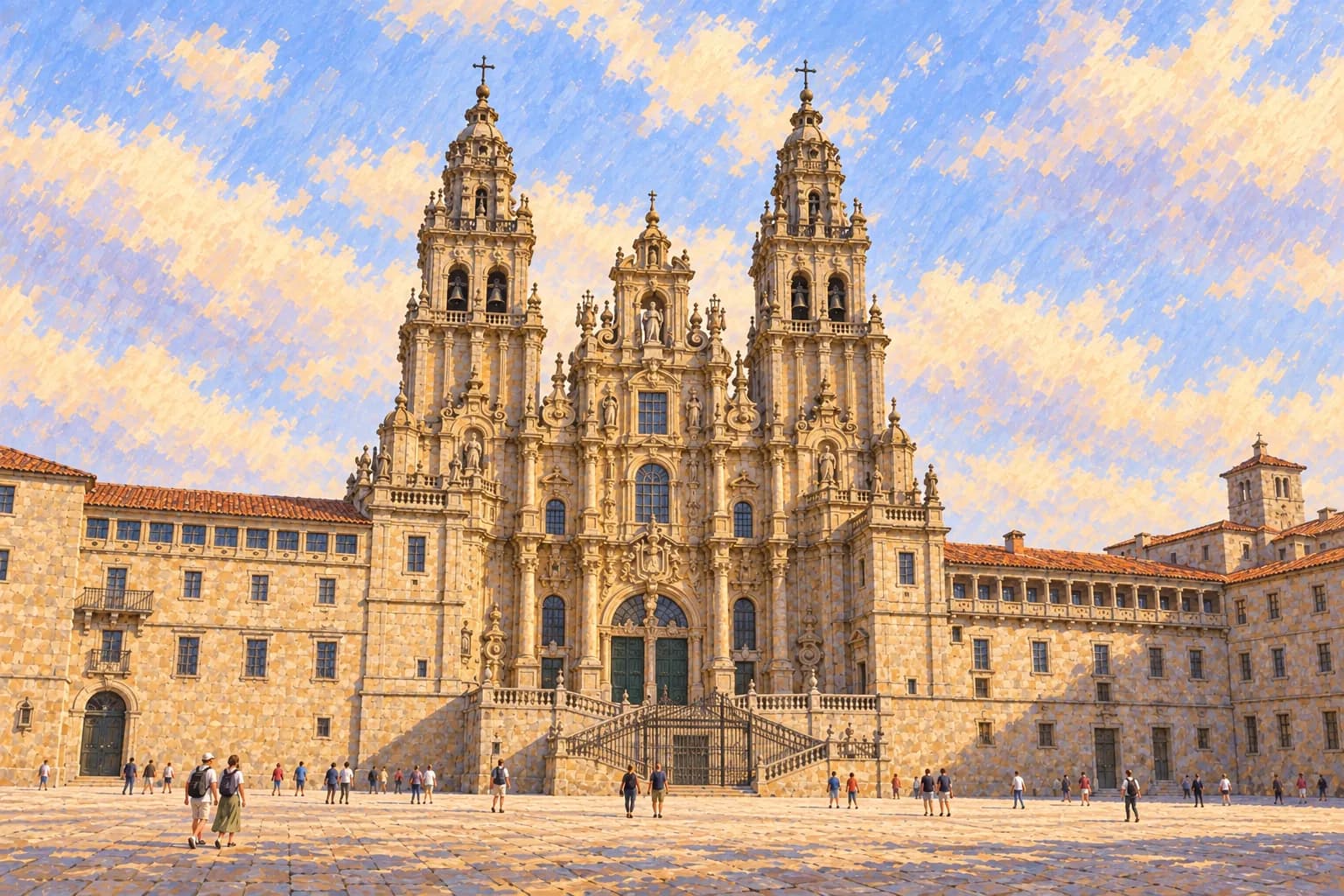 The Obradoiro facade, interpreted in paint. The Portico of Glory is inside, not in this square.
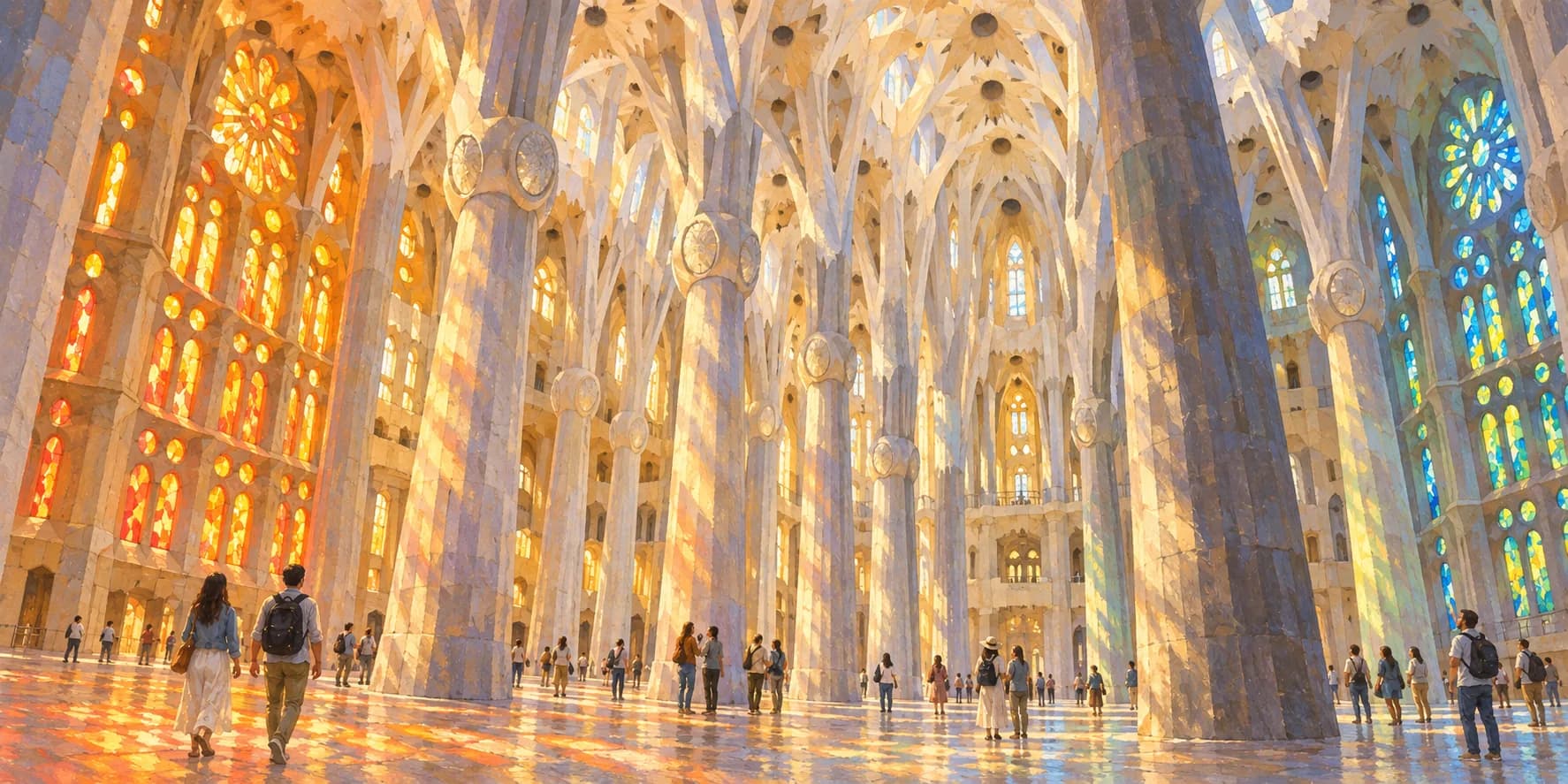
In the Obradoiro square, it is easy to raise a camera and feel you have seen the cathedral. Yet its best-known facade belongs to a different time from much of what stands behind it.
The Cathedral's own history explains that Romanesque construction began around 1075, while work on the present Baroque facade started in 1738, under Fernando de Casas. Centuries of choices separate the two.
Inside, another kind of looking awaits. In the Portico of Glory, Master Mateo's workshop gave figures individual faces and relationships; the elders on the central arch tune their instruments. The Portico's official account also describes its 2008–2018 restoration, which recovered surviving colour beneath accumulated dirt. The stone was not always the colour you might have imagined.
You do not have to finish the Camino to give it attention. If the cathedral is part of your familiar surroundings, you can return with one detail in mind: a face, an instrument, a layer of colour. Your usual photograph can be the beginning, not the whole visit. Check the visit arrangements for the Portico; entering the basilica does not provide access to every space.
Explore Santiago Cathedral in WAONDERTower of Hercules: a light with a job still to do
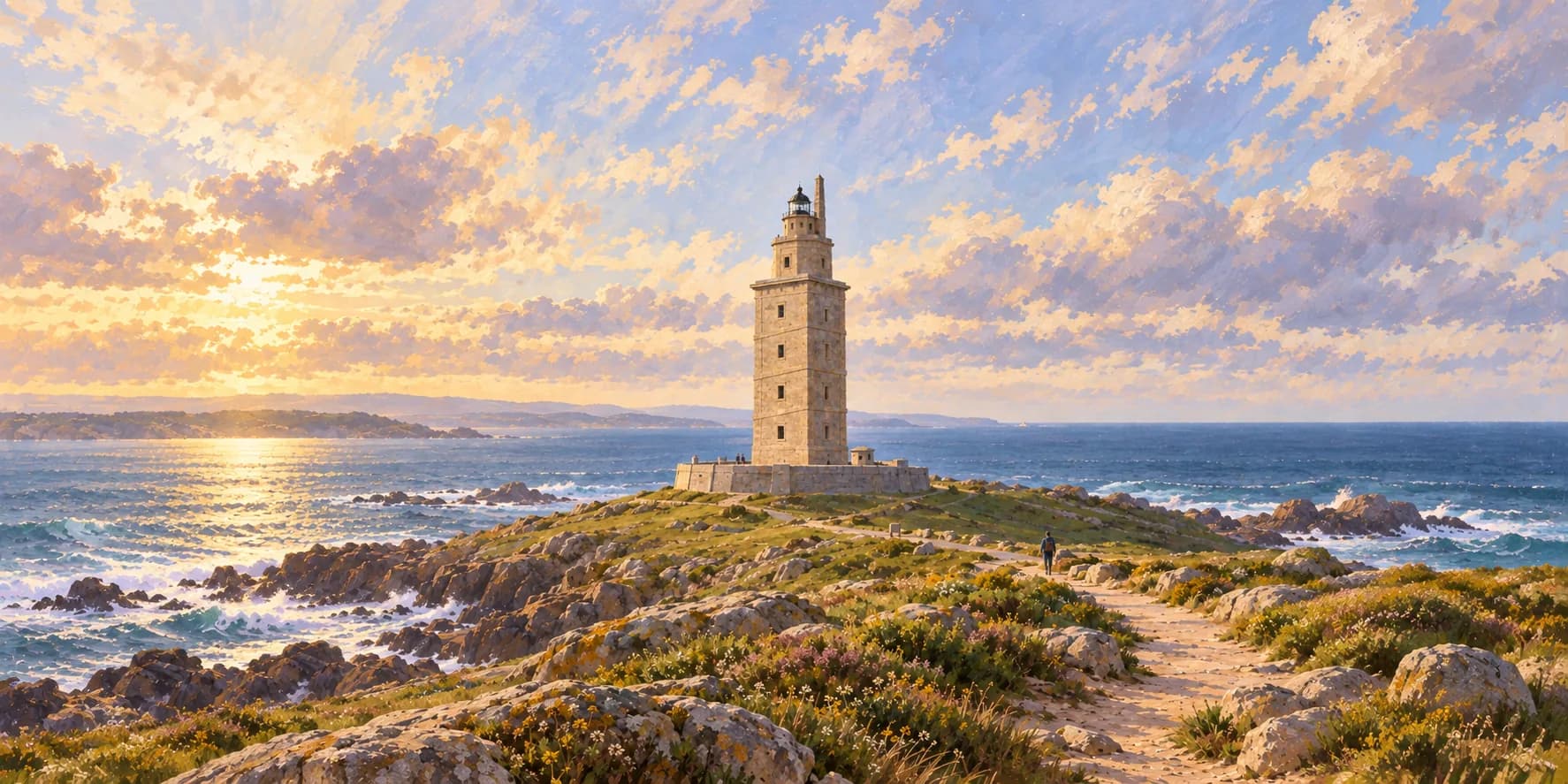
The Tower of Hercules, in A Coruña, is not simply a monument to seafarers. It is still a lighthouse.
UNESCO documents its Roman origins and continuing navigational use. Its present appearance includes an eighteenth-century intervention: the Neoclassical casing surrounds the ancient structure. This is not a Roman tower that has survived without alteration.
That contrast offers a story beyond the silhouette. A building can change its outer skin without losing its purpose. Before thinking about climbing it, you can observe the square shaft, the upper stages and its position facing the sea: a place built to help others find their way remains recognisable in everyday life.
To go inside, consult the City of A Coruña's information. Recognising the lighthouse from the coast and visiting its interior are different experiences.
Explore the Tower of Hercules in WAONDERLugo: walking on what once defended the city
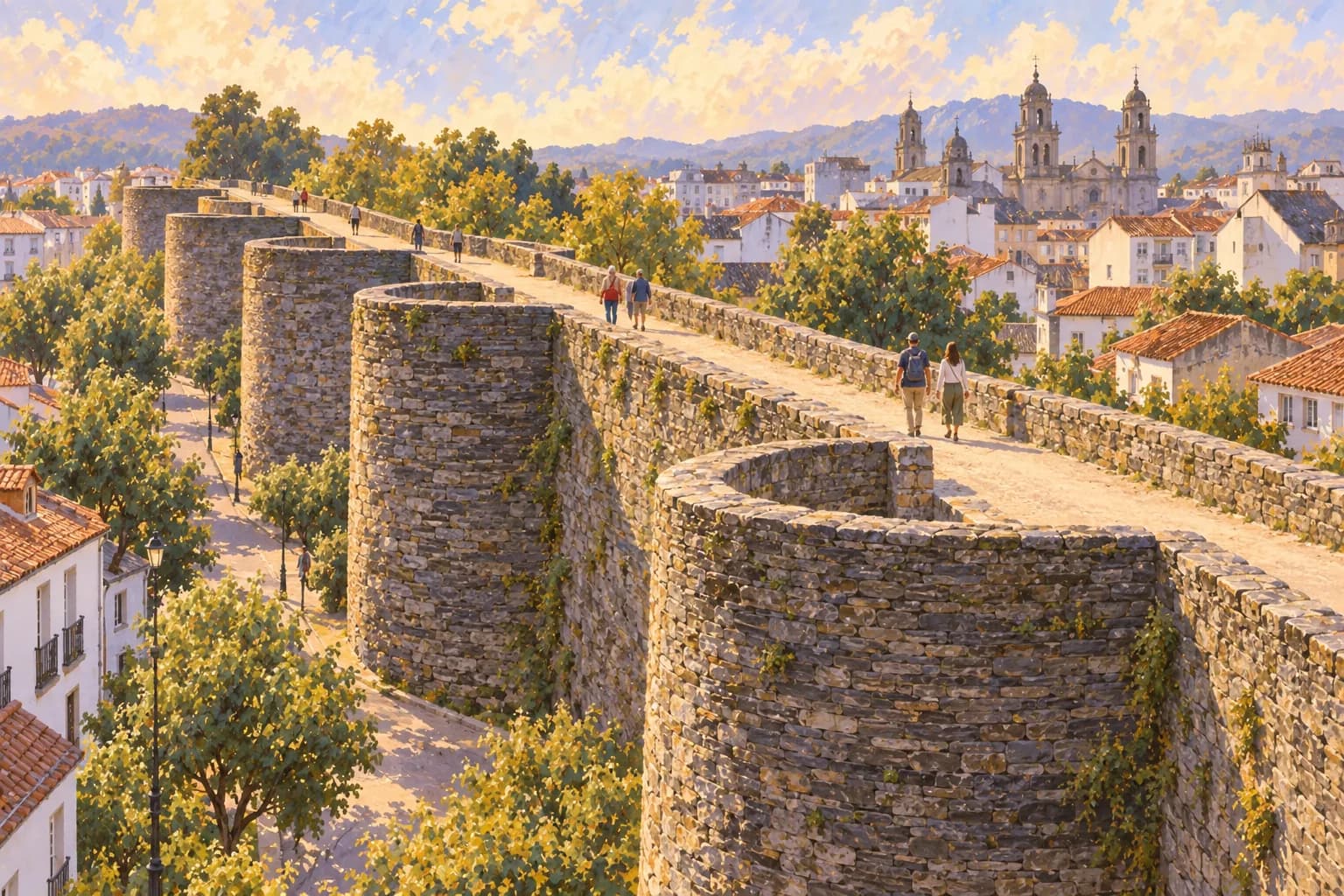 The walls as an urban walk. An illustration of their features, not a survey of an exact section.
In Lugo, some heritage is not only viewed from below. You can walk on it.
The Roman walls retain their complete circuit. UNESCO explains their defensive origins and place in urban life: residents and visitors have enjoyed them as a public space for centuries. They have undergone interventions and acquired new gates; preserving the whole does not mean every stone or entrance is unchanged from Roman times.
Here, history has an intimate scale: someone going for a walk after work. A structure built to divide and protect can also become a place to meet.
Notice the rounded towers, the texture of the slate and how the city approaches on either side. You do not need to complete the circuit to appreciate that change of purpose. Choose an entrance that suits you and check current conditions before setting out.
Explore Lugo's Roman walls in WAONDERPiornedo: a roof for sharing the winter
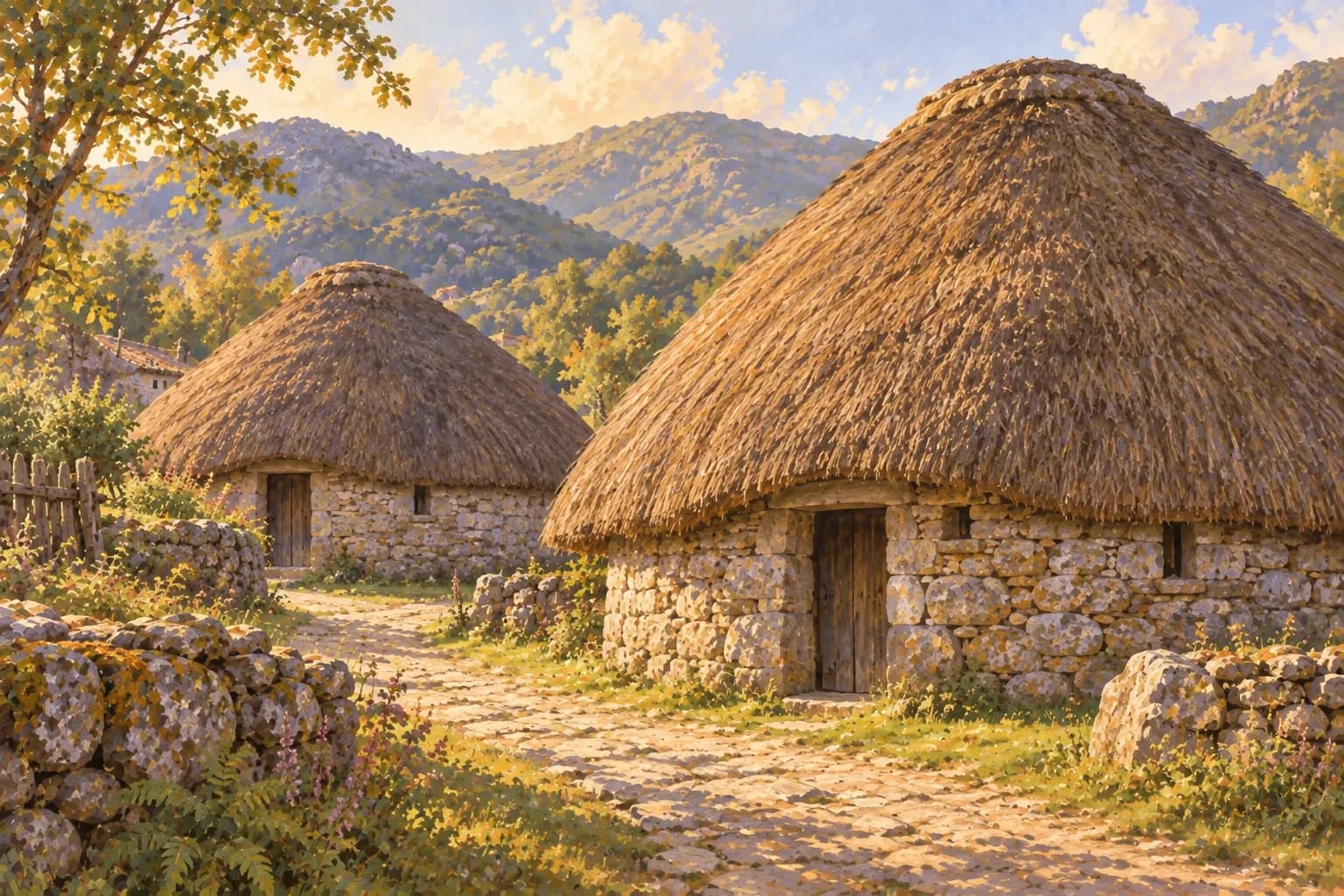 Piornedo's pallozas, in Os Ancares. A painted interpretation of traditional architecture.
In Piornedo, in the municipality of Cervantes, the roofs catch your eye before the walls. But a palloza makes more sense when you look beyond its picturesque shape.
The Provincial Council of Lugo describes homes shared by people and livestock, with areas for family life, the stable and storage. The hearth and the animals contributed warmth. These buildings were inhabited into the 1970s; they are not merely scenery from a remote past.
Look at the size of the thatched roof and the scarcity of openings. They point to a need: making a mountain winter liveable. The house tells a story of shelter and shared resources: the roof that now catches our eye was, for its inhabitants, a way of protecting everyday life.
Piornedo is a village too, not a stage set. Respect private spaces and check which museum pallozas can be visited; an interest in the architecture does not grant entry to every home.
Explore Piornedo's pallozas in WAONDERBaroña: the sea was work too
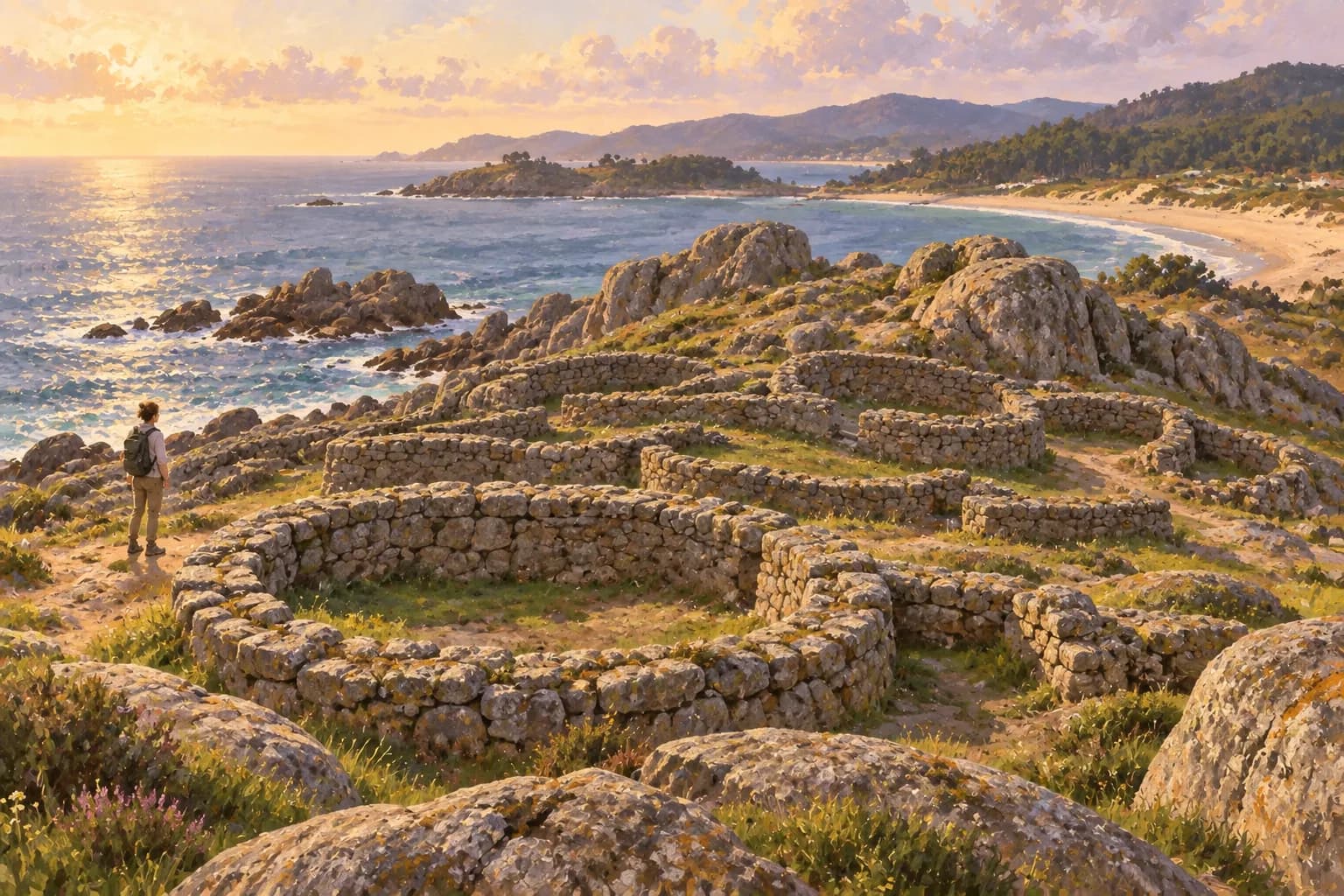 Castro de Baroña. A painted evocation of the coastal site, not an archaeological reconstruction.
The walls of Castro de Baroña, in Porto do Son, can look like an unfinished drawing beside the sea. Learning about them brings people back into those spaces.
The municipality of Porto do Son describes a community of farmers and livestock keepers. Finds also show the importance of fishing and shellfish gathering, alongside work such as metalworking, pottery and weaving.
The Atlantic was not merely a view. It helped provide food and shape daily life. Looking at an enclosure, an entrance or the relationship between the settlement and the shore can be more rewarding than photographing every circle.
Those traces of work change the ruins: where you first saw circles of stone, you start to recognise a community. Walk carefully through the site and avoid climbing its walls.
Explore Castro de Baroña in WAONDERCarnota: storing a harvest, building a future
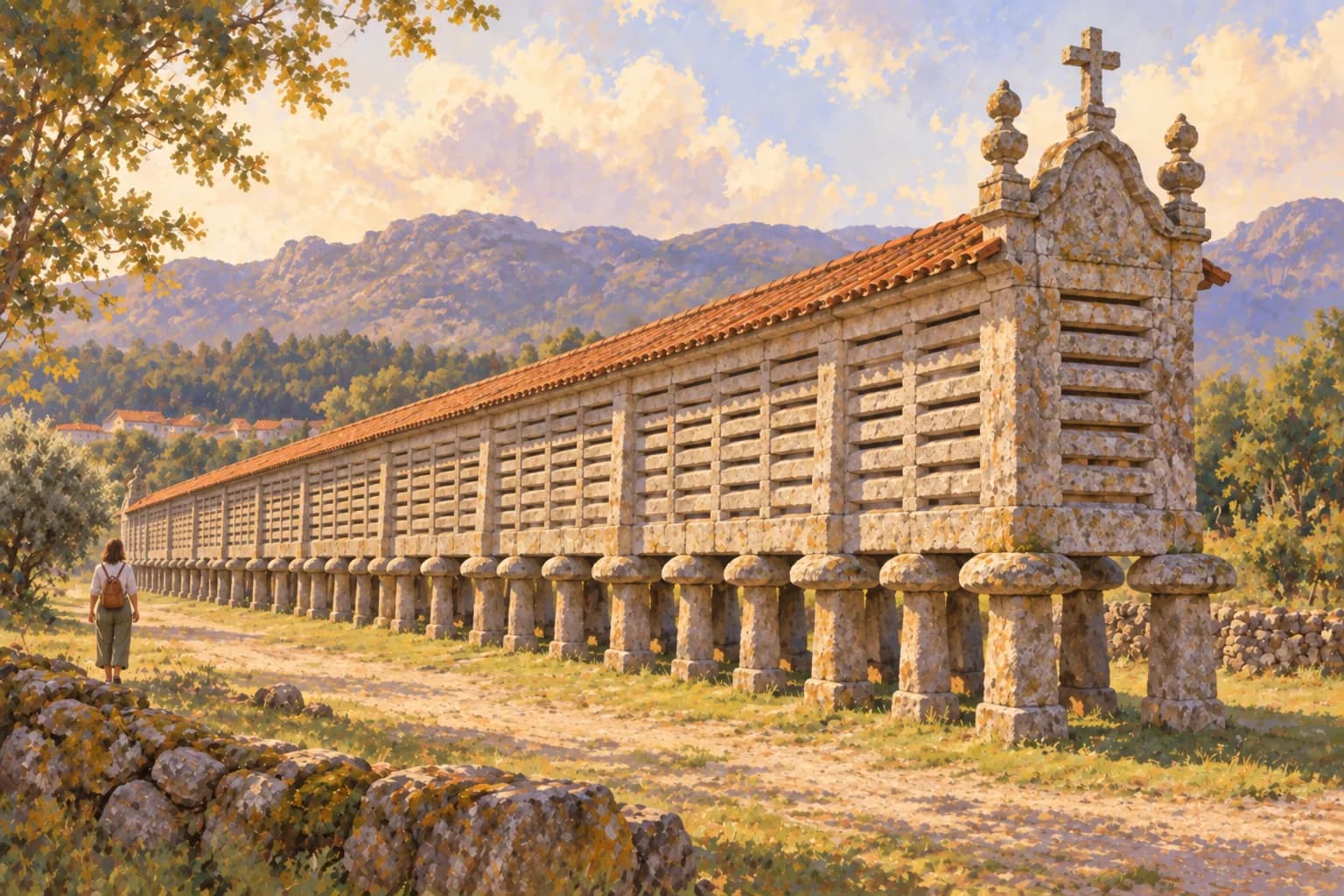 Carnota's hórreo: stone, air and a harvest to protect. An illustrative interpretation.
Carnota's hórreo has something that makes you look twice: its length. Behind that first impression, though, lies a task much more fundamental than impressing a passer-by.
The hórreos described by Tourism of Galicia were built to store harvests. Raising and ventilating their chambers serves that purpose; in Carnota, you can recognise those features in the supports and stone slots. The listing for the ensemble helps identify it beside its dovecote.
Instead of stopping at “how big”, you can think about what needed caring for here. A season's work, food held in reserve, a way of protecting what could not be lost.
Some heritage moves us because it speaks of needs we still share: caring, keeping and making it to the next day.
Explore Carnota's hórreo in WAONDERSan Pedro de Rocas: the mountain is not just a backdrop
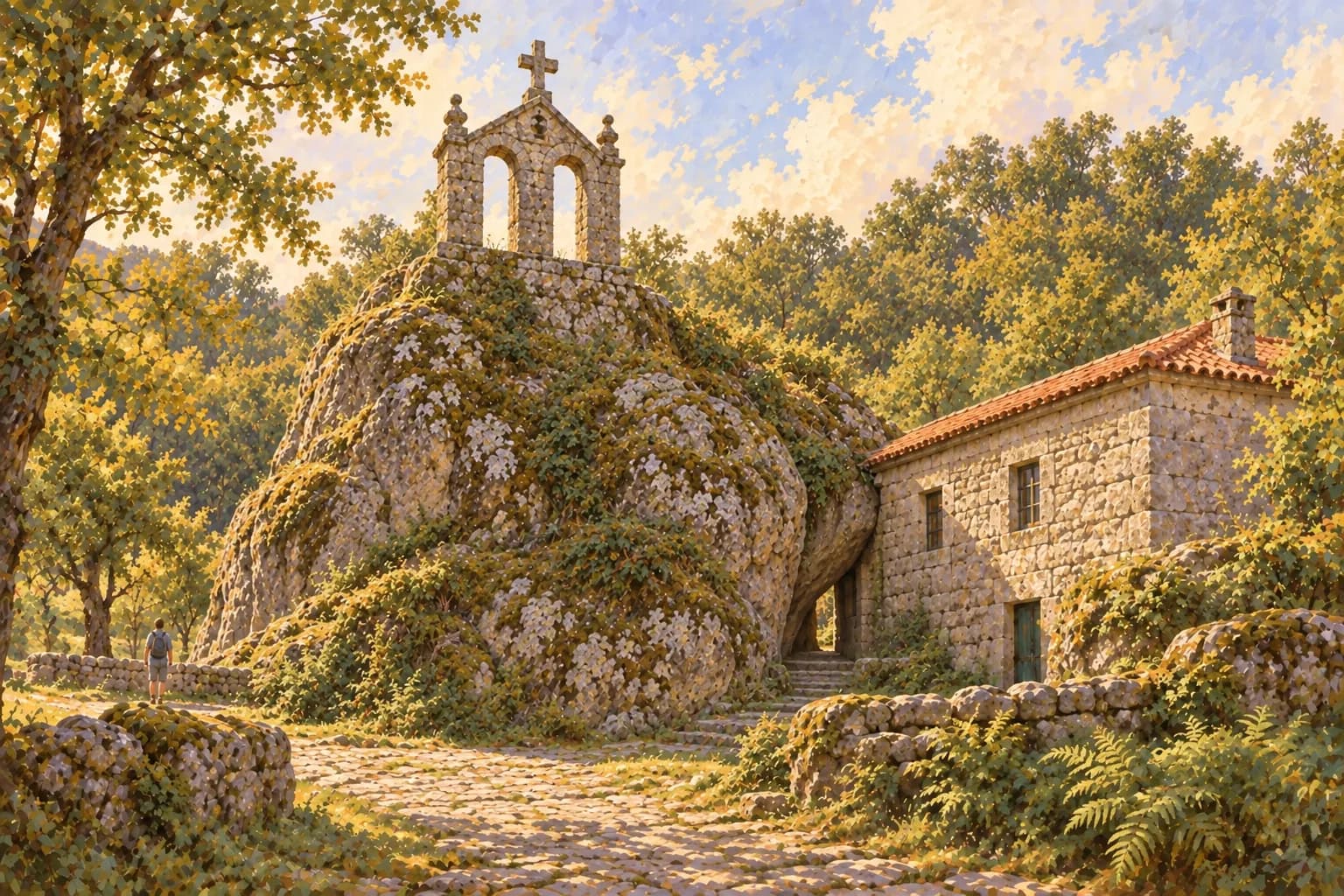 San Pedro de Rocas, in Esgos. Its bell gable on the rock distinguishes the ensemble; painted interpretation.
At San Pedro de Rocas, the rock does not simply surround a church: it is part of it. The rock-cut chapels and the bell gable on a monolith make it hard to separate building and mountain.
The Tourism Ourense account distinguishes different periods of the ensemble. The fire of 1928 caused decisive damage, and the bells were moved to another church. The gable that catches your eye on arrival therefore belongs to a history of change and loss, not a monastery frozen in time for centuries.
You can start with the silhouette and then consider how the place adapted: church, prior's house, memories preserved. The interpretation centre also introduces trades from the Ribeira Sacra. The button below links to the church, not to guaranteed access to every space in the ensemble.
Explore the church of San Pedro de Rocas in WAONDERSanta Trega: the houses before the panorama
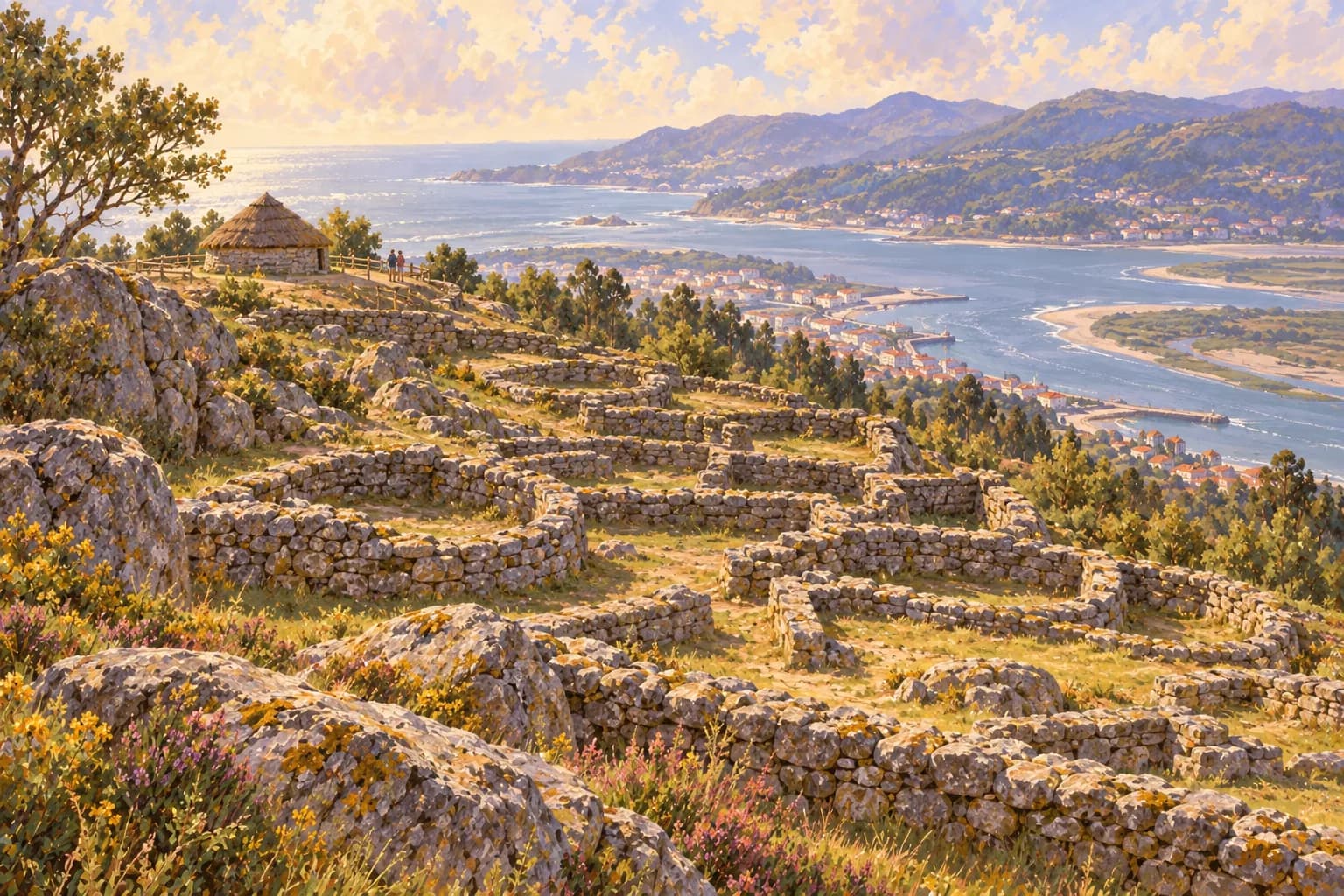 Santa Trega above the Miño. An evocation of the landscape and ruins; reconstructed roofs are not intact ancient homes.
In A Guarda, Santa Trega offers a view that can take over the visit: the Miño, the Atlantic and Portugal across the water. Before climbing for the panorama, it is worth looking at what lies at your feet.
Tourism of Galicia describes the settlement's houses and spaces: rounded plans, entrance courtyards and groups of buildings around larger spaces. It also notes that some buildings have been recreated. A present-day roof does not prove a house has survived intact from antiquity.
Between the immense landscape and the scale of a doorway are two ways of approaching the place. One locates you in the territory; the other leads towards domestic life. You can choose both without turning the settlement into a single photograph from above.
Santa Trega and Baroña are different outings: here you are on an elevated hillside above an estuary; there, on a rocky peninsula beside the ocean. Knowing the difference helps you choose your next discovery, rather than simply collect names.
Explore Castro de Santa Trega in WAONDERBeyond eight places: what the catalogue includes
In the Galicia working inventory reviewed on 29 September 2026, we count 94,359 records. They are not 94,359 monuments, unique buildings or conversations verified in production.
There are 21,857 map-only points and 72,502 records not restricted to the map. That second group includes 40,540 zones or areas and 31,962 records not marked as areas. Villages and other areas provide territorial context: they should not be confused with individual monuments. Volume does not certify the detail at each place or uniform coverage across the region.
The table selects ten primary categories. Each record is counted once under its primary category; this is not the full breakdown or an official heritage inventory.
| Category | Records | Something to look for on your next outing |
|---|---|---|
| Settlements and population centres | 38,869 | Give a nearby village a name and context. 38,859 are non-map-only areas, not that many monuments with individual conversations. |
| Churches | 14,902 | Stop at a facade, chapel or relationship between stone and landscape, as in Santiago or San Pedro de Rocas. Interior access is not implied. |
| Archaeological heritage | 6,688 | Compare ways of living and working, as at Baroña and Santa Trega, without assuming every record is a hillfort. |
| Parks | 2,457 | Choose a setting for a regular walk and notice which places spark curiosity. The category does not guarantee a signposted route. |
| Public art | 2,113 | Ask about a sculpture you encounter while walking: who made it and what it remembers, even if it is not a famous landmark. |
| Industrial heritage | 1,693 | Recognise traces of work in mills, installations or local buildings; verify each point's identity. |
| Viewpoints | 1,317 | Find another angle on the territory and connect it with history. 597 are map-only, not individual conversations. |
| Museums | 290 | Give a weekend a theme and decide what you would like to understand. Check hours and tickets with the relevant institution. |
| Lighthouses | 182 | Move from a coastal silhouette to its purpose. 101 are map-only: we do not promise a chat or entry at all of them. |
| Monasteries | 54 | Explore connections between architecture, community and landscape, with each ensemble's access conditions. |
These figures describe a reviewed local catalogue, not a point-by-point audit of the published app. Selection and information can vary by place. Nor are we announcing a comprehensive beach catalogue; a water source shown on the map does not imply drinking water.
For the walk you plan and the question you did not
You can choose an area before the weekend. Or remember WAONDER when an unfamiliar building stops you on your usual way somewhere. Both are good beginnings: you do not need to become a tourist in your own town or complete a whole list.
The buttons in this article link to the selected places. If you need to install the app, the general button takes you to both stores at the foot of this page. Interior visits, travel and access conditions still need separate preparation.
For another outing in a covered region, explore our places in the Community of Madrid. Meanwhile, Galicia does not need to be a list you finish: it can be the place you keep asking questions about.
Download WAONDER for your next walkWorking inventory reviewed on 29 September 2026. Addition reported by the team; not independent verification of every place in production. Linked sources support the historical examples, and the images are illustrations, not documentary photographs.
Section
Waonder updates