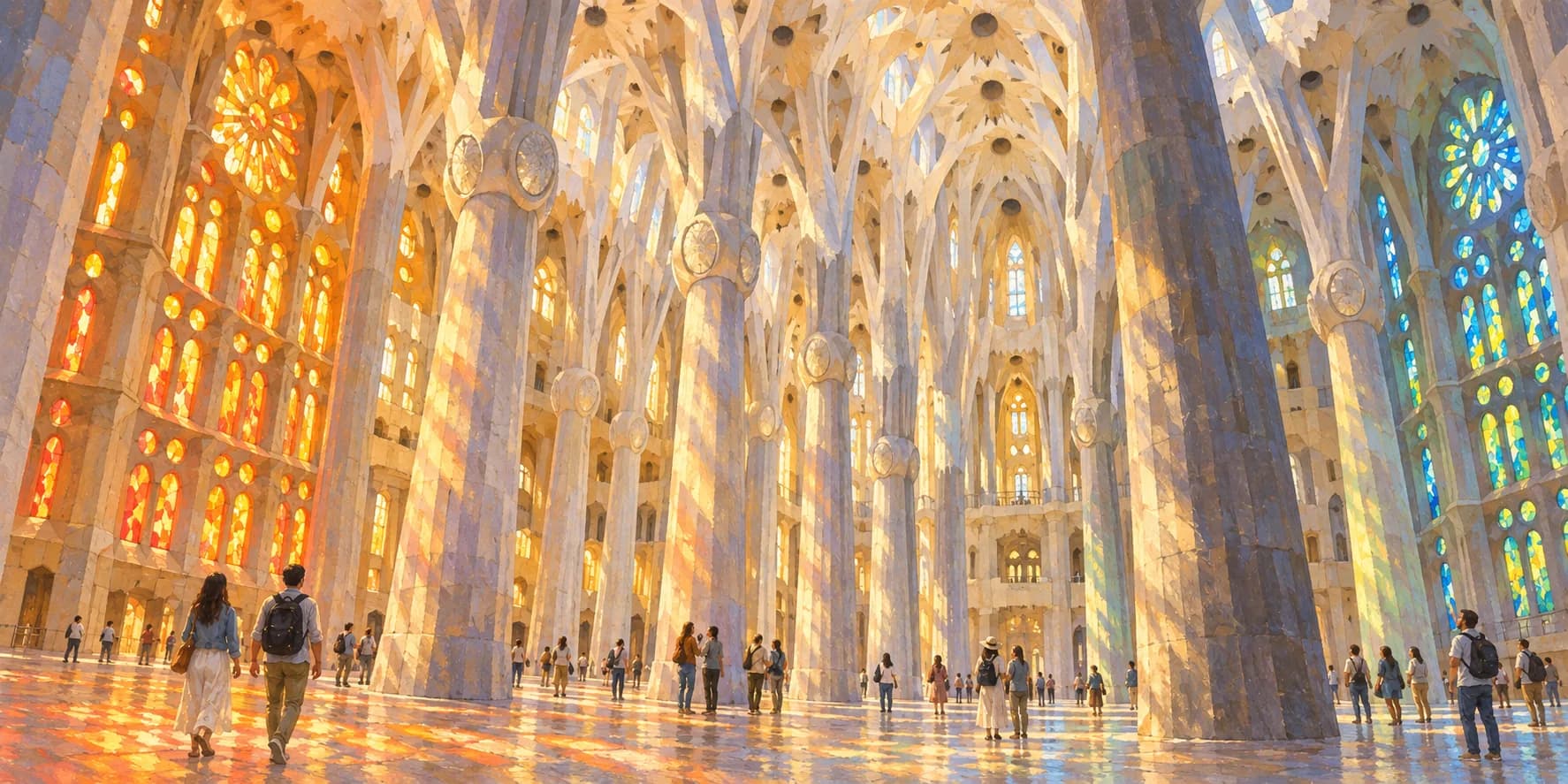
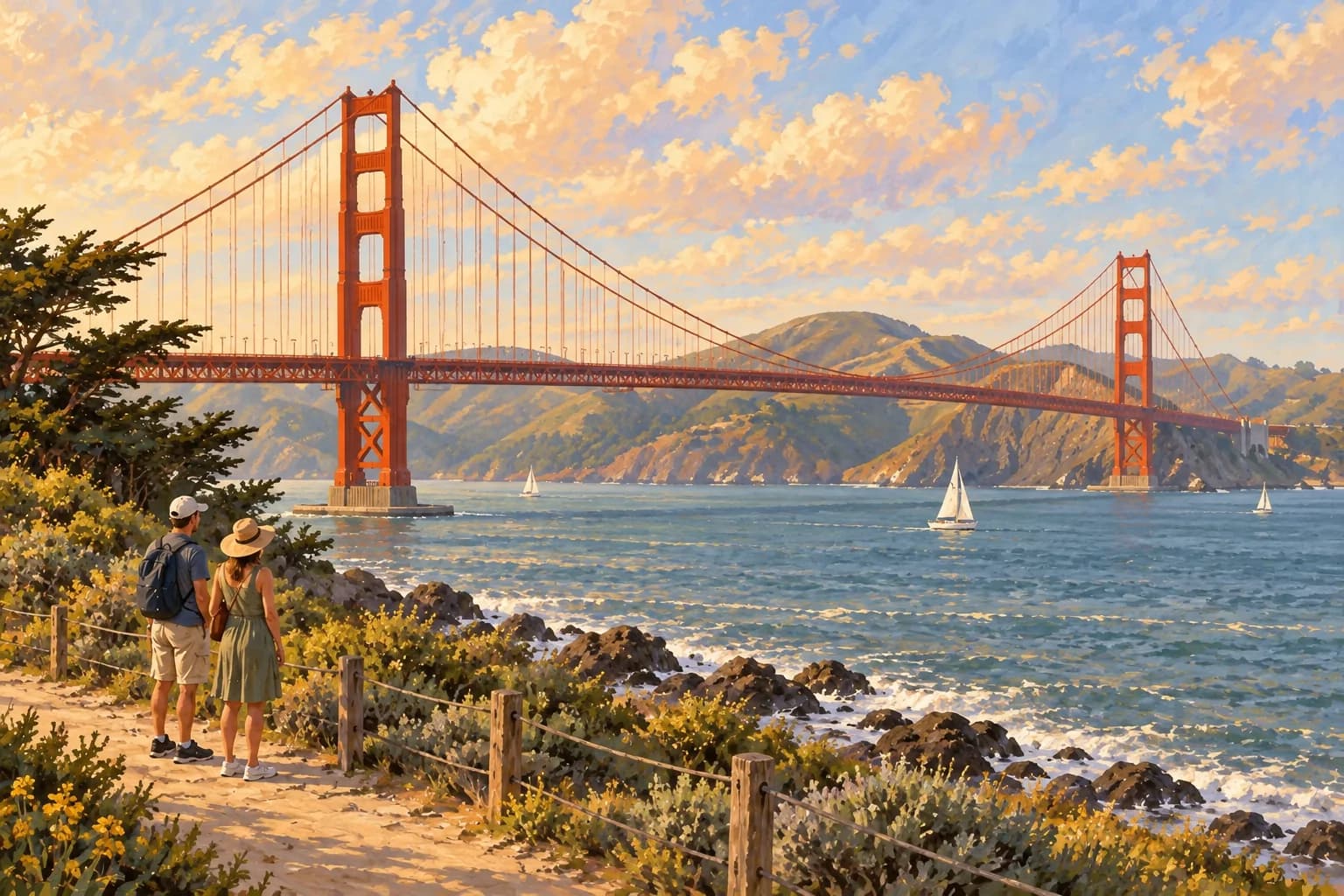
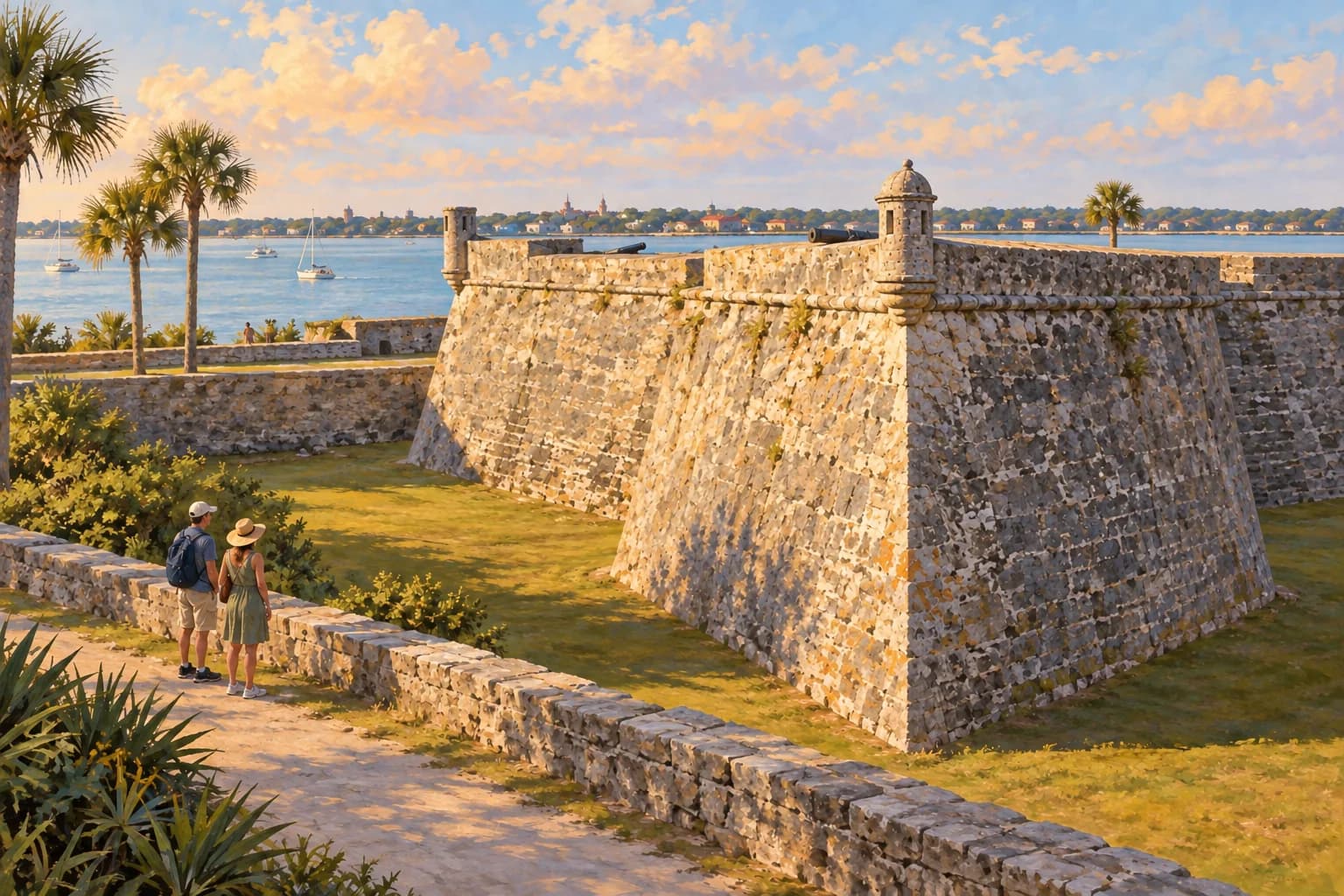
Castile-La Mancha in WAONDER: nine places worth a second look
From Toledo to Sigüenza via Cuenca, Almagro and Alcalá del Júcar: nine places in Castile-La Mancha whose stories you can explore with WAONDER.
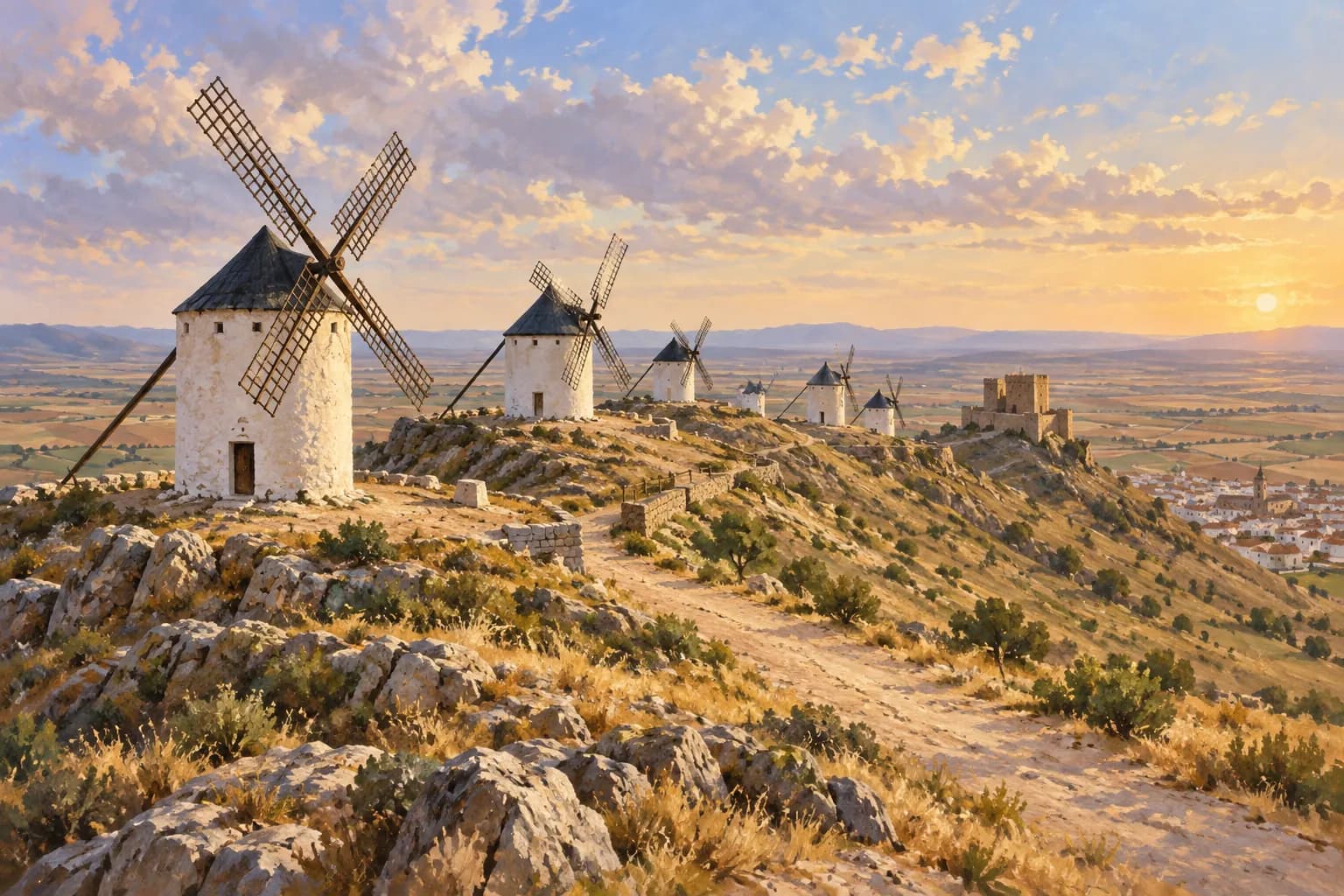
Windmills on a ridge look like a picture postcard until you ask why they were built there. A house hanging over a gorge looks impossible until you imagine living in it. And a small theatre can tell you more about the people who gathered to listen than a vast stage ever could.
Castile-La Mancha is now part of WAONDER's catalogue. We have chosen nine places across its five provinces to begin exploring it: not a race between monuments, but questions to take on a walk near home or on a short trip. If you live nearby, you may have passed one of them for years; if you are visiting, here is a reason to stop for more than a photograph.
Download WAONDER and find your next story nearbyChoose a province, not an impossible route
Jump to Toledo, Cuenca, Ciudad Real, Albacete or Guadalajara. These are independent outings, not a walk across an entire region or an automatically planned route in the app. Before entering a building, check current opening details with its official source.
Toledo
Cristo de la Luz: a thousand years in a small building
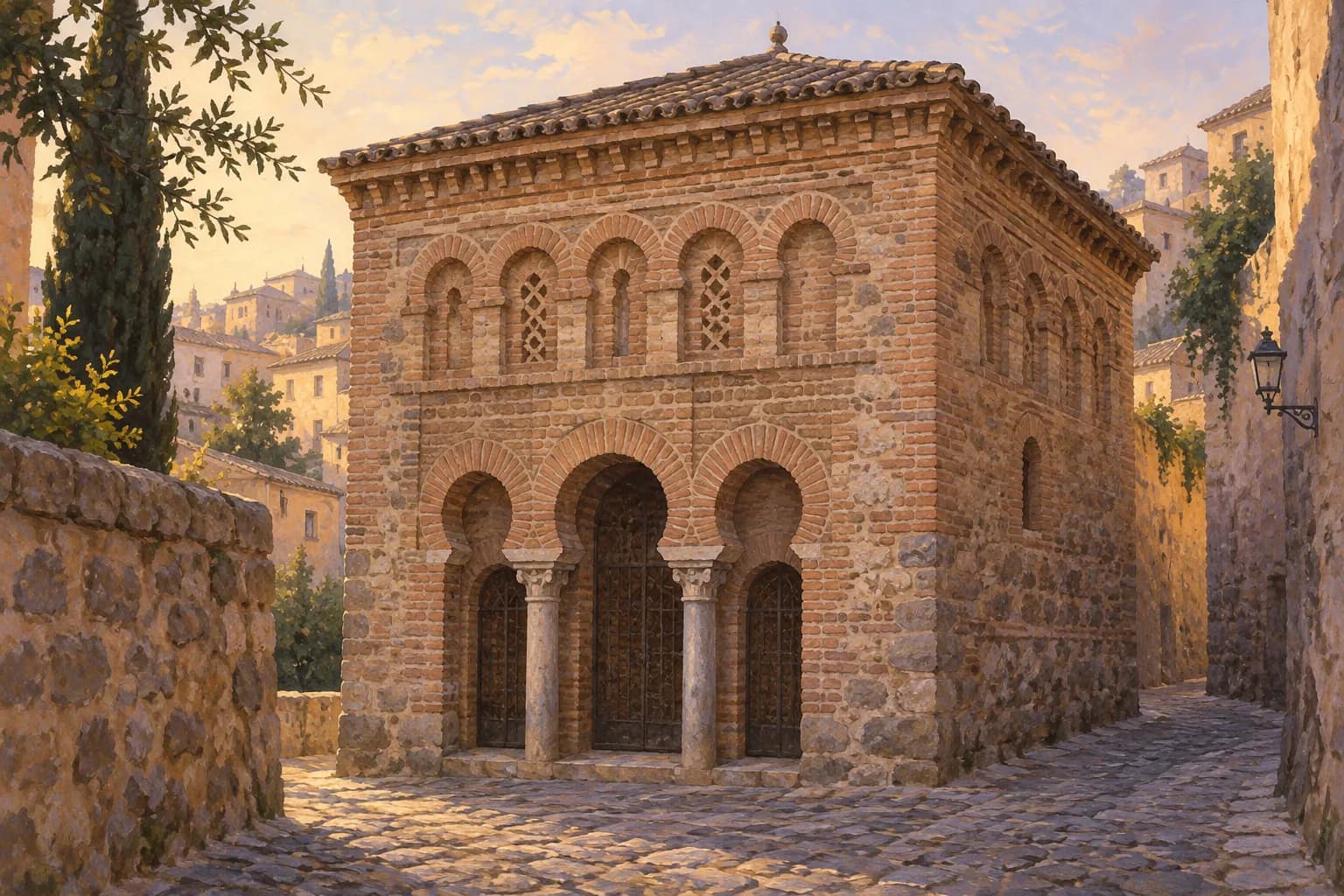 The architecture is illustrated; minor details are not a substitute for a photograph of the monument.
Toledo can overwhelm you with monumental buildings. The Cristo de la Luz Mosque invites you to do the opposite: approach a small structure and ask how many lives it has lived.
The regional tourism authority dates the former Bāb al-Mardūm mosque to 999. Its later use as a church left other visible layers. A few steps from its facade, Toledo's history stops being a list of civilizations and becomes a specific question: what stayed when the city changed, and what was added later?
You do not need to retell a legend as fact to find this place extraordinary. Look at the arches and the building's scale; begin with what is in front of you. Toledo's historic city is a World Heritage Site, but this stop works at street level.
Explore the Cristo de la Luz Mosque in WAONDERConsuegra: the windmills had a job to do
The windmills on Cerro Calderico are unmistakable. That may be why it is so easy to leave after taking their picture: you already think you know them from Don Quixote. But their sails were not built to illustrate a novel.
According to Castile-La Mancha's tourism authority, twelve of the thirteen windmills that once stood on the ridge have been restored. Using wind to grind grain answered a practical need where water was scarce. This famous landscape was also an answer to a problem of engineering and everyday work.
From the hill, notice how the mills line up high above the plain and think about the grain that had to reach them. The novel is a literary association, not evidence that Cervantes saw these exact buildings. Next time you spot them from the road, you might see more than “windmills”: you might see a community finding a way to make bread.
Explore Consuegra's windmills in WAONDERCuenca
Hanging Houses: a city leans into the gorge
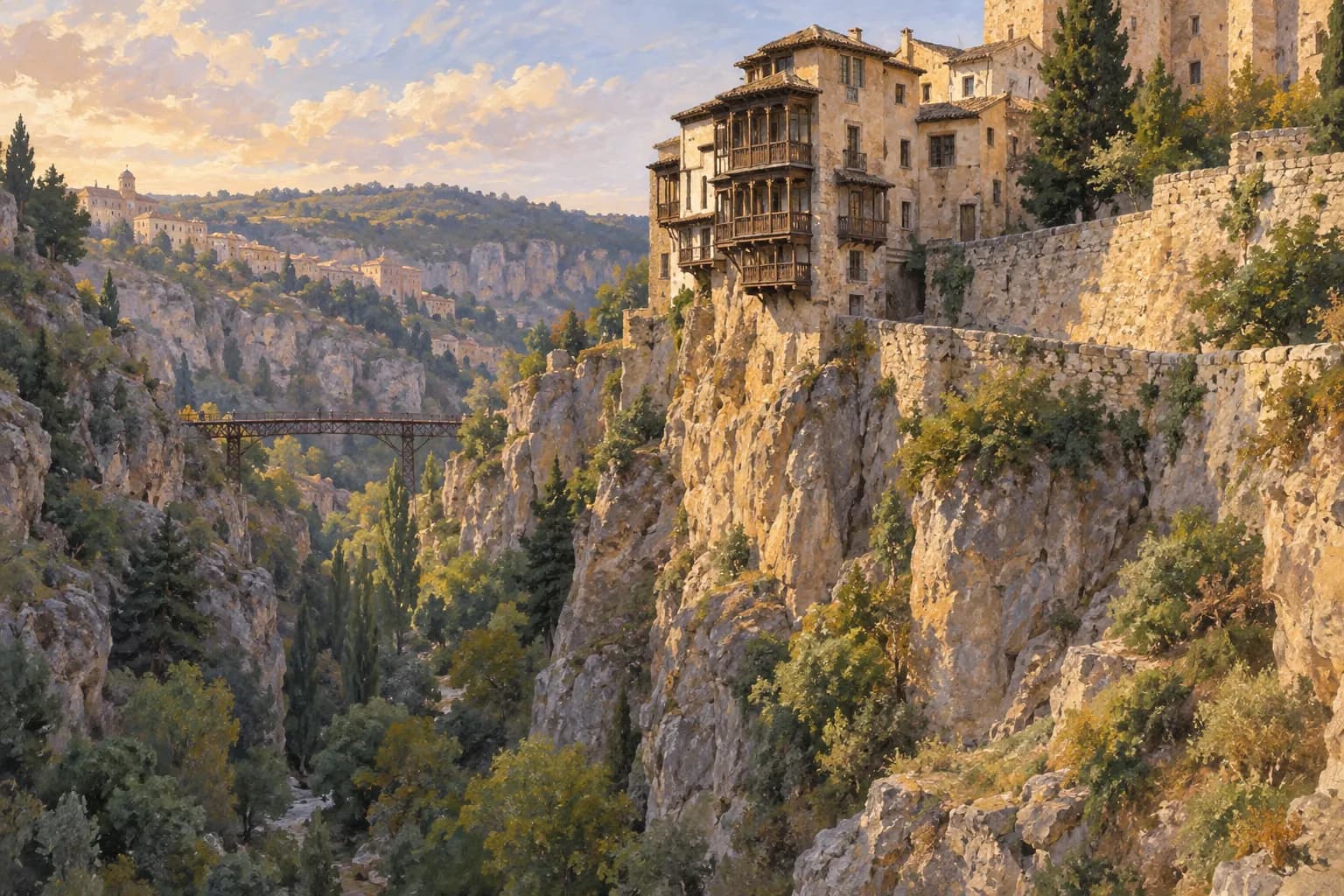 The Hanging Houses lean over the Huécar gorge: a painterly interpretation based on their real silhouette.
In Cuenca, the landscape is not just a backdrop to architecture. The Hanging Houses make you look at the balcony and the drop beneath it at the same time. Before they became a familiar image, they were homes on the edge of a city that learned to live with its gorges.
Regional tourism information traces the first documentary mentions to 1481. Today they are part of the historic city recognized by UNESCO. That status does not turn every wall into a museum exhibit: the fascinating part is imagining an everyday decision to open a home onto such abrupt terrain.
From outside, notice how the timber extends the house over the stone. Do not mistake that view for access to the interior, which depends on the space's current visitor arrangements. The question is not only how the houses stand, but what it was like to live in them.
Explore Cuenca's Hanging Houses in WAONDERBelmonte: a fortress was also a message
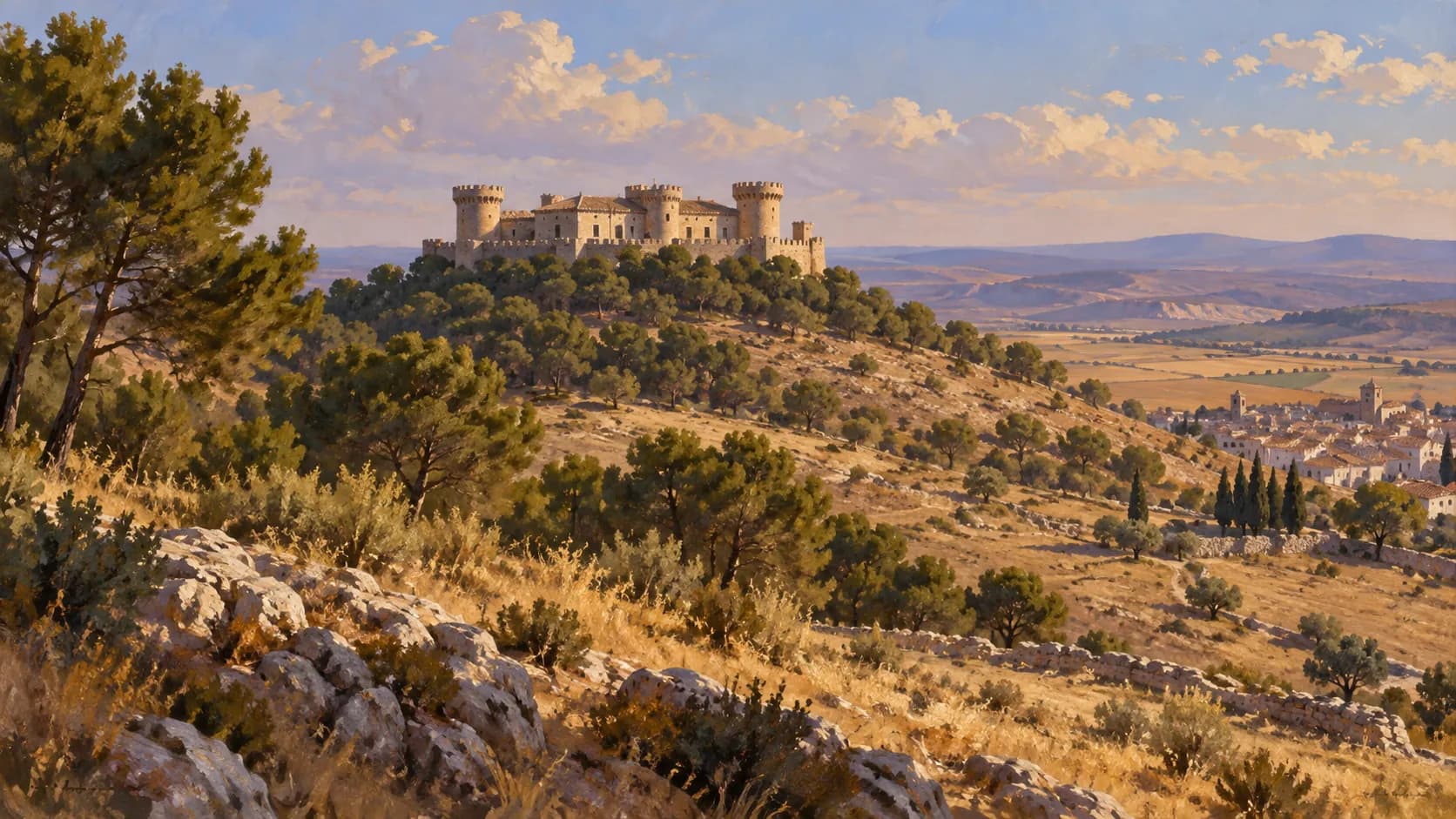 Belmonte Castle and its landscape: an illustration, not an exact plan of its star-shaped layout.
You see Belmonte Castle before you arrive. From afar its towers say “defence”; up close, its scale and architectural care also speak of prestige.
The regional account of the castle explains that Juan Pacheco commissioned it in the fifteenth century and highlights its star-shaped layout and cylindrical towers. It was more than a barrier against an enemy: it projected power across the surrounding territory.
A good beginning is to take in its outline before planning to go inside. Which parts seem designed to protect, and which to impress? Looking at the setting and visiting the interior are different experiences, so check access and tours separately.
Explore Belmonte Castle in WAONDERCiudad Real
Almagro: imagine the theatre from the courtyard
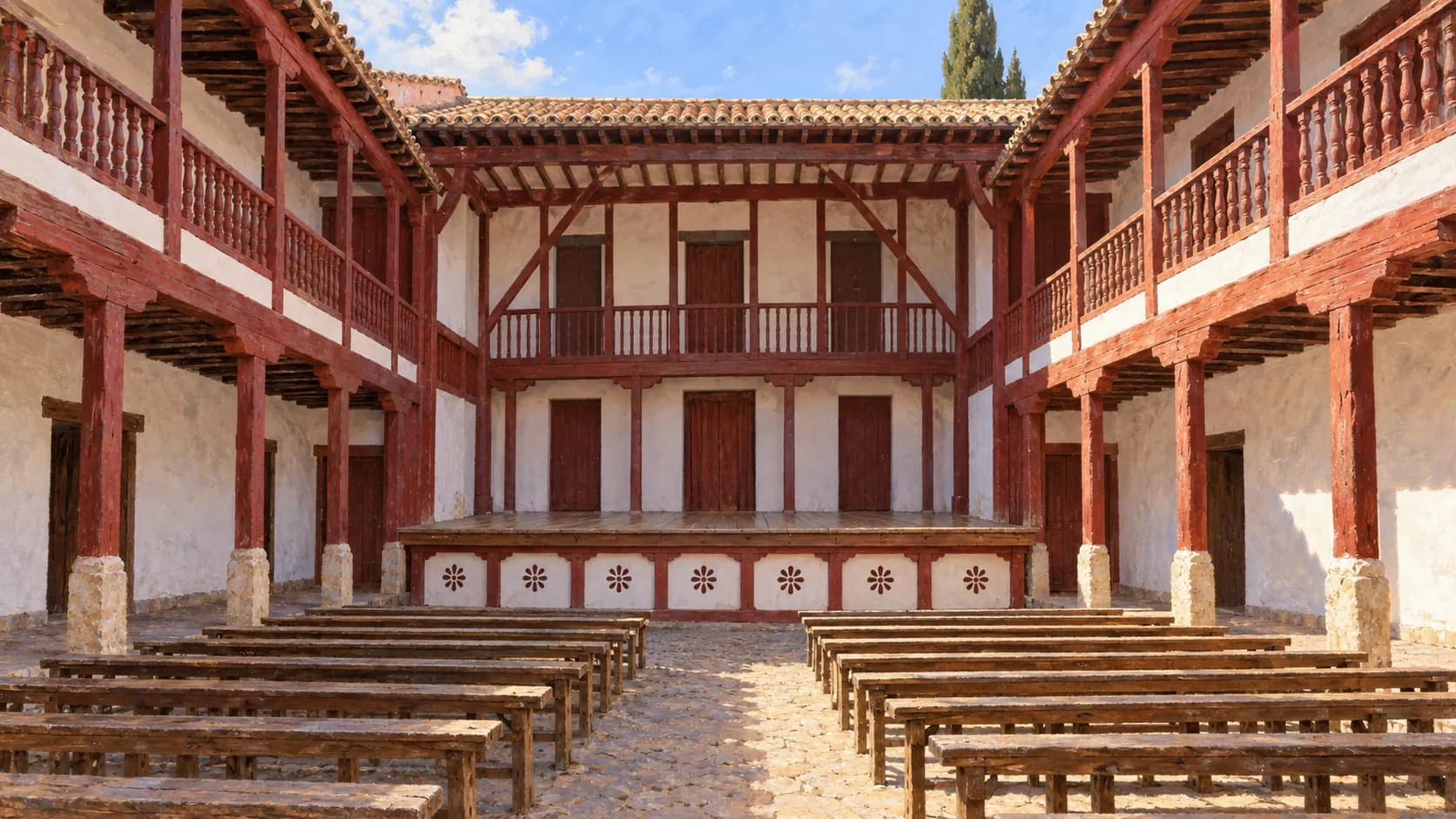 An evocation of the Corral de Comedias; its arrangement and colours draw on the real space.
At Almagro's Corral de Comedias, looking only at the stage means missing half the story. Turn around: the galleries and courtyard remind you that a performance brought together people who watched, listened and shared a space in different ways.
The theatre described by the regional tourism authority was built in 1628. That source also describes changes of use and interruptions: theatre was not performed here without a break for four hundred years. What matters is that its architecture still helps us imagine the relationship between actors and audience.
If a visit is available, notice the room's real size. You may be surprised by how close everything feels. A story from Spain's Golden Age does not begin only in a book: it also begins where someone waited for a performance to start.
Explore Almagro's Corral de Comedias in WAONDERAlmadén: the human cost of mercury
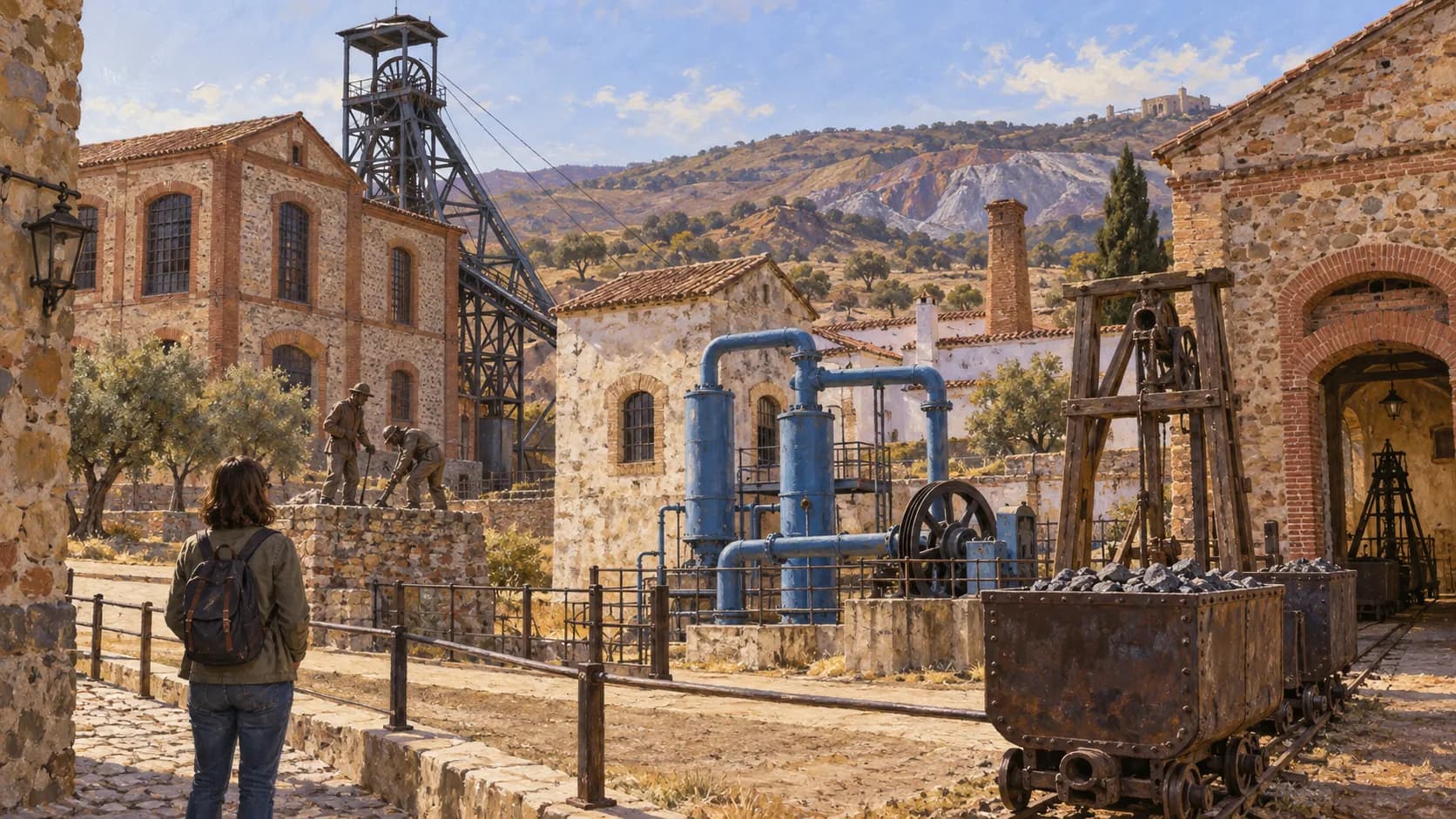 Almadén's mining heritage: an illustrated scene, not a reproduction of a particular museum room.
Almadén's Mercury Museum changes the tone of this journey. It is not enough to admire an old machine: you also have to ask what working with it meant for the people who kept it running.
The museum's official regional listing covers cinnabar, extraction and its effects on workers' health. UNESCO recognizes the mercury heritage of Almadén and Idrija, not this museum alone as an individual World Heritage site.
Naming the techniques without forgetting the people makes industrial heritage more than a collection of objects. You may leave with an uncomfortable but necessary question: how much of what we call progress depended on dangerous work we barely see today? Check official visiting arrangements if you want to go inside; the WAONDER link identifies the museum, not guaranteed physical access.
Explore the Mercury Museum in WAONDERAlbacete
Alcalá del Júcar: a tower above the river
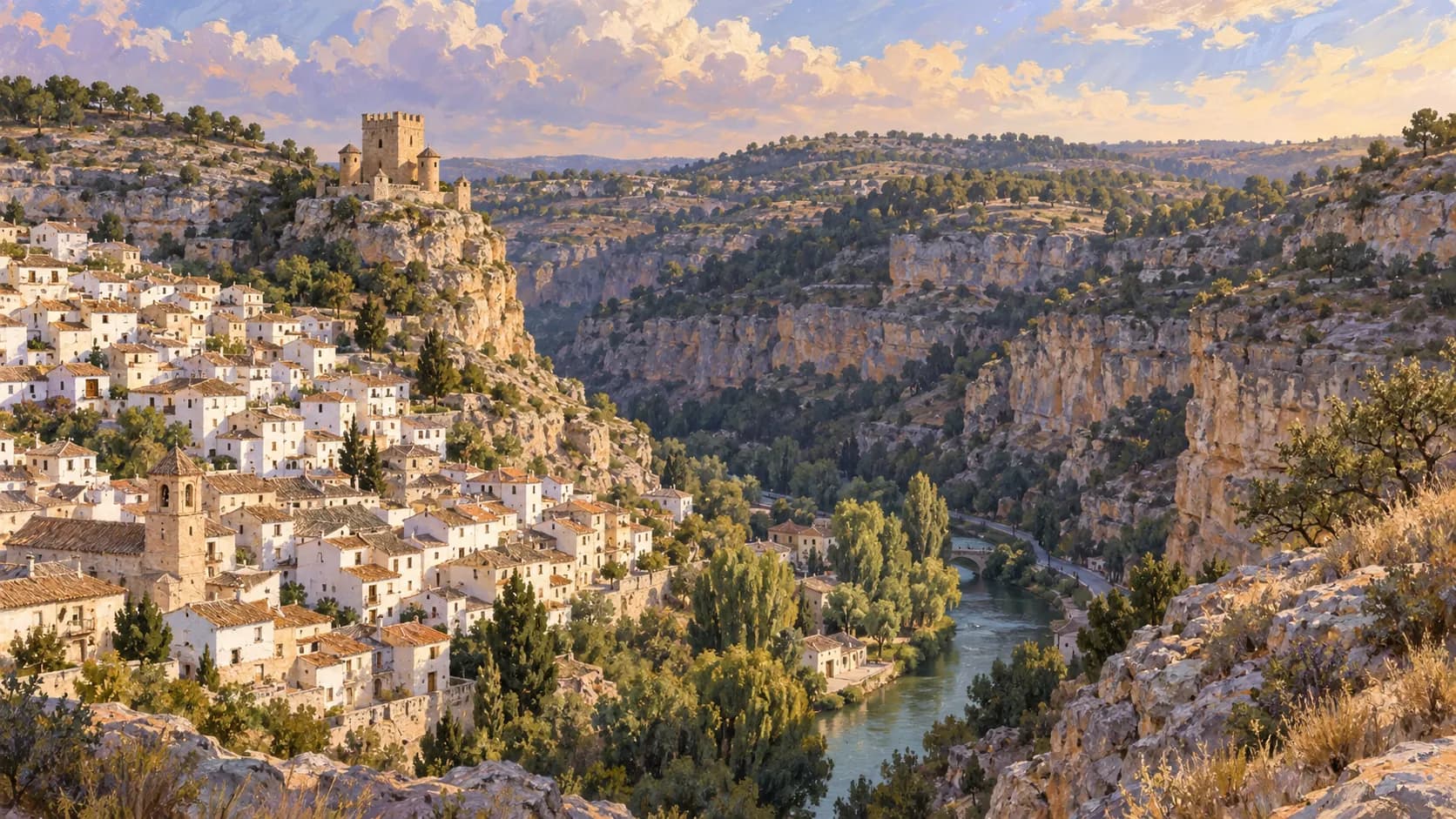 Alcalá del Júcar from the opposite hillside; an interpretive painterly scene.
In Alcalá del Júcar, white houses adapt to the slope and the castle sits above them. At first it looks like an impossible composition; look again and each height starts to make sense in relation to the village, rock and river.
The regional castle listing explains its defensive position over the settlement and the bend of the Júcar. That detail changes the visit: the fortress was not placed there to complete a postcard, but to command a strategic site.
You can start below and look up to the tower, or find a viewpoint that reveals the whole scene. They are different perspectives on the same story. The streets are steep and access conditions vary; this is not presented as an accessible walk for everyone without checking the route first.
Explore Alcalá del Júcar Castle in WAONDERGuadalajara
Infantado Palace: a facade that changes as you move
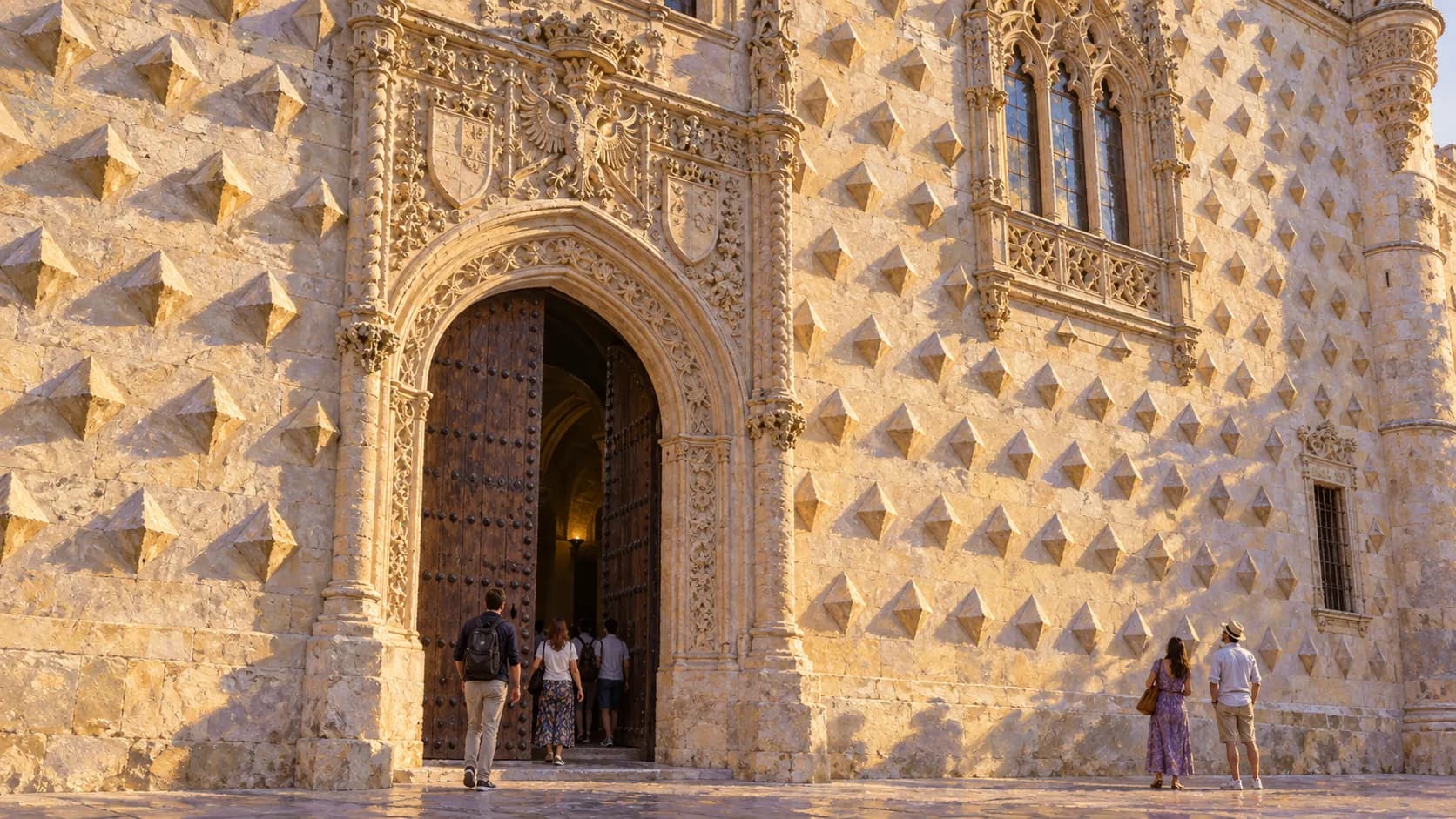 Interpretive detail of the facade's reliefs, not an exact copy of every carving.
Walk past Infantado Palace and shift one step sideways. The diamond-shaped stones on the facade catch the light differently. A wall that looked flat begins to move.
According to regional tourism information, the Mendoza family's palace was built in the late fifteenth century. The Patio de los Leones adds another dimension to that display of status; the building now houses the Guadalajara Museum. Its present use does not erase the first question: for whom was an entrance designed to impress before anyone even stepped through it?
You can enjoy the facade on an ordinary walk. To see the interior, check the museum's current visitor information: seeing the palace from the street and entering it are not the same promise.
Explore Infantado Palace in WAONDERSigüenza: when a cathedral looks like a fortress
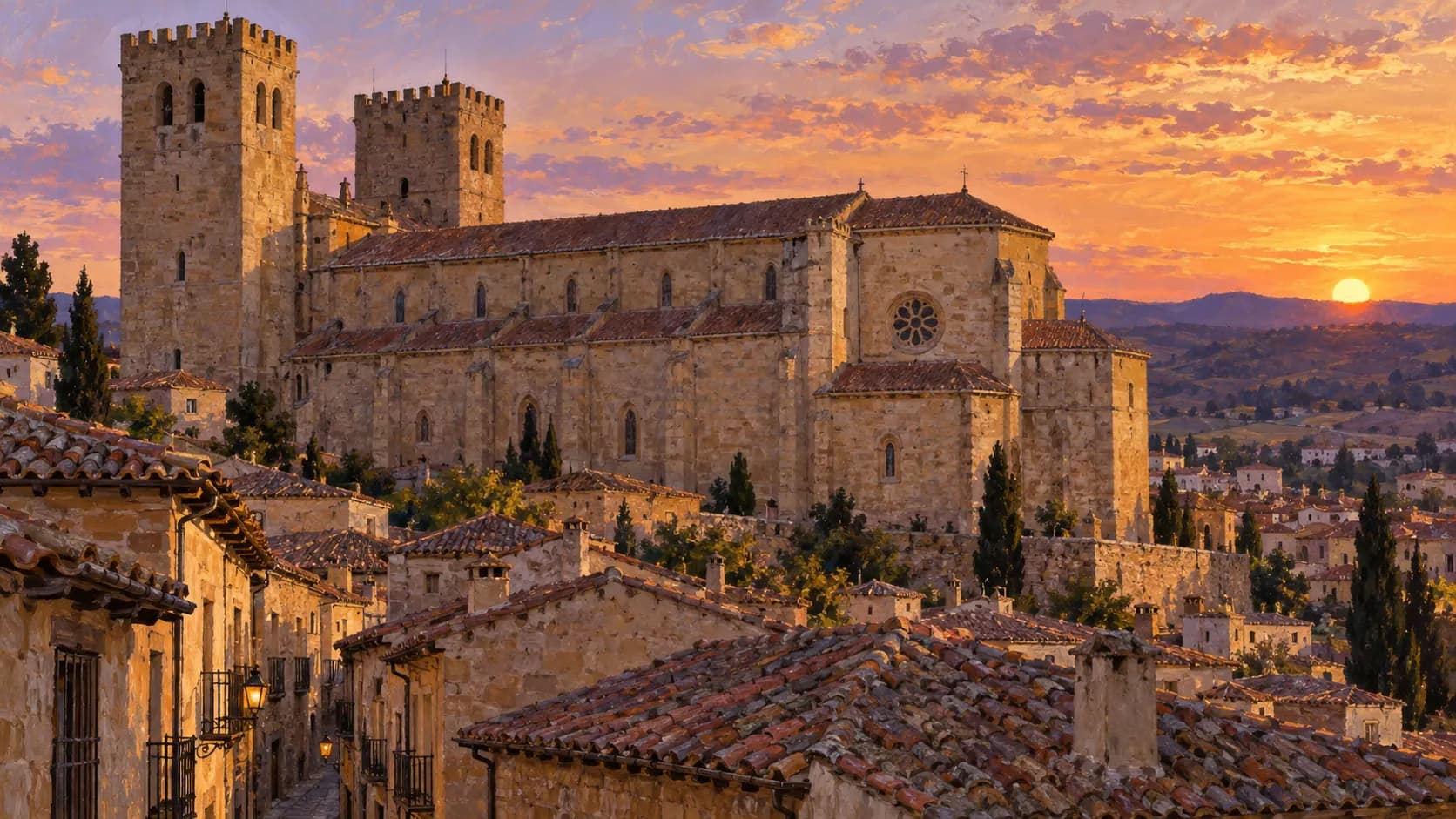 An interpretive painterly view of the cathedral and Sigüenza's streets.
In Sigüenza, a cathedral can also look like a castle. Its two large battlemented towers are visible from outside the old town and raise a question before you enter: why did a place of worship need to speak the language of defence?
The Castile-La Mancha tourism listing dates the beginning of construction to 1124 and describes its fortress-like character. The complex changed over the centuries; reducing it to a single date would leave out much of its story.
You can begin in the square, comparing the towers with the streets leading to them. Even if you know the town, this view changes its scale: not a medieval backdrop, but a building that has accompanied different generations' decisions, fears and celebrations.
Explore Sigüenza Cathedral in WAONDERBeyond nine places: what the catalogue contains
Our local working inventory, reviewed on 29 September 2026, contains 36,811 exported records for Castile-La Mancha. These are not 36,811 distinct monuments or 36,811 verified conversations in the published app. It includes 22,048 map-only points and 14,763 records that are not limited to the map; of the latter, 1,862 are areas or zones, not individual buildings. The remaining 12,901 are not automatically unique sites open to the public either.
We chose ten main categories to turn the catalogue's scale into ideas for exploration. Each record is counted once under its primary category. The table is a selection, not a complete breakdown or an official heritage inventory.
| Category | Records | A question for your next outing |
|---|---|---|
| Mountains | 7,128 | What landform shapes the view from your town? 4,722 are map-only points; a conversation is not promised at every one. |
| Churches | 3,537 | What does the facade or setting of an overlooked local church tell you? Seeing it on a map does not mean you can enter. |
| Archaeological heritage | 2,705 | Who lived here before this became a ruin? 2,017 are map-only; check the individual entry before visiting. |
| Monuments | 998 | Why was that feature you pass each day built? The category includes different kinds of public memory. |
| Viewpoints | 771 | What changes when you see your city from another angle? 283 are map-only; none guarantees a signed or accessible path. |
| Industrial heritage | 518 | What work left its mark on a building, mill or former industrial site, as at Almadén? |
| Museums | 224 | What would you like to understand before a visit? Check opening times and tickets with the museum. |
| Castles | 198 | What did that fortress defend, and whom did it aim to impress? Belmonte and Alcalá del Júcar offer different answers. |
| Theatres | 141 | How did audiences gather before modern halls? Almagro is a starting point, not a definition of the whole category. |
| Palaces | 64 | What message did a facade like the Infantado's send before anyone entered? |
A large number does not guarantee the same depth of information at every point, and a category does not promise physical access. What matters is being able to start with a real curiosity —a building on your way to work or a place for the weekend— and decide what you want to ask.
Your city deserves a second look
You can choose one of these places for a planned outing. Or you can open WAONDER when a detail that has always been there suddenly makes you stop. You do not need to cross five provinces to begin discovering something.
The buttons in each section lead to the selected place. The general button takes you to the Android and iOS download options at the bottom of this page. To keep exploring other covered territories, read about the Community of Madrid or explore Galicia.
Download WAONDER and take another look at the places around youLocal working inventory queried on 29 September 2026. The team communicated the region's addition; this selection alone does not certify import or functionality of each point in production. Linked sources support the historical facts; the images are interpretive illustrations, not documentary photographs.
Section
Waonder updates