Grand Central: the sky you walk past without looking
Above New York's daily rush, a painted sky holds traces of its artists and a story of care. Discover what to notice next time you walk through Grand Central.
While you check the time, another story waits overhead
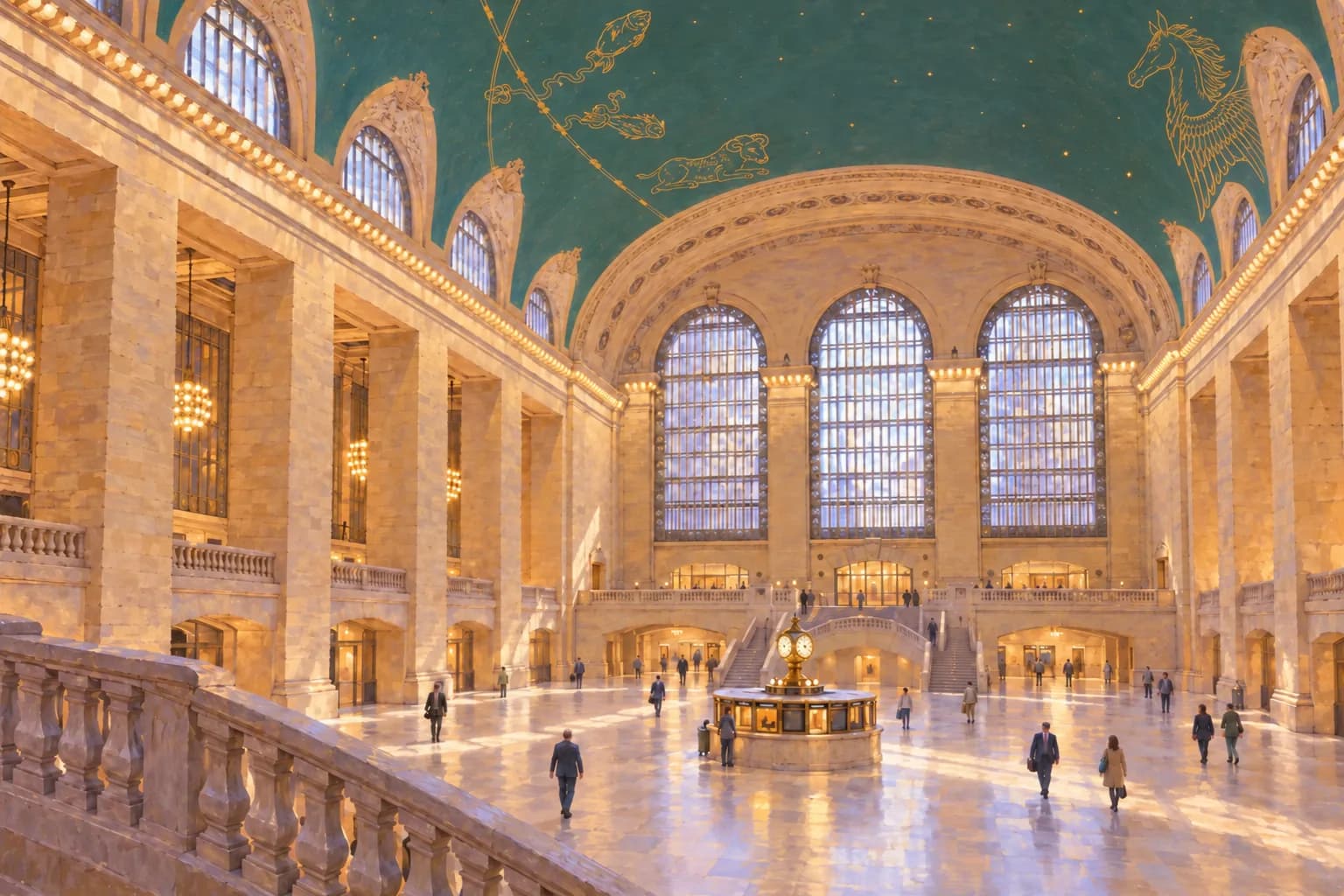
You enter Grand Central thinking about a train, someone waiting for you or simply getting across the concourse. You check the clock. Look for an exit. Above all those small urgencies, a blue-green sky stays in place, crossed by golden figures.
That ceiling has not reached us unchanged. People painted it, recreated it and brought it back from beneath the grime. Among its stars, ordinary lives left their traces too: people working overhead while others, below, carried on towards home.
Next time you walk through this familiar New York place, you may not need to make a special trip. Just give a moment to something that has been above you all along.
Find Grand Central in WAONDERA sky for a city that kept moving
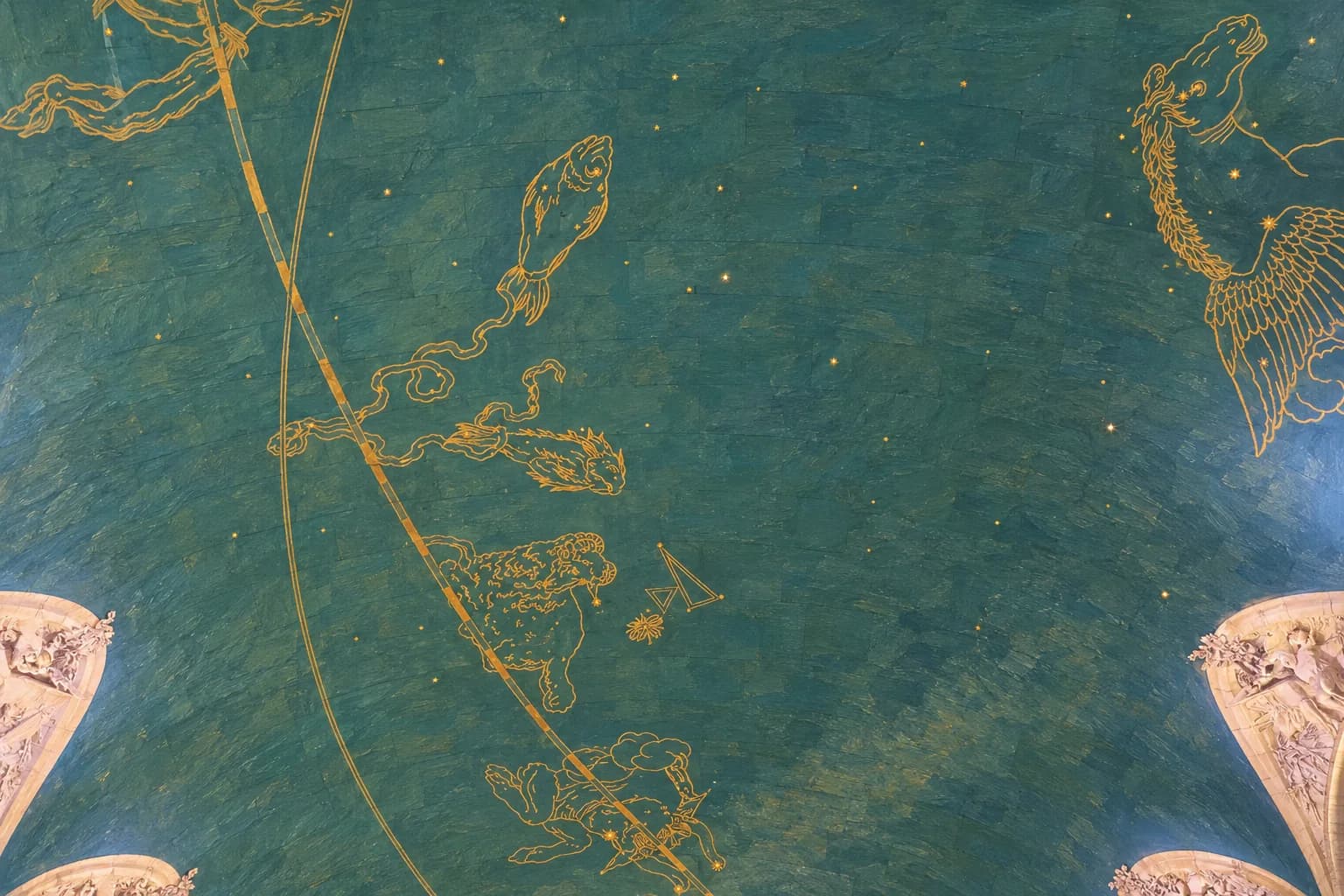 The Main Concourse sky: a painterly interpretation of its decoration, not an exact astronomical chart.
Grand Central opened in 1913. The terminal's official history, developed with the New York Transit Museum, recalls the beginning of a building that became part of the city's everyday life. Its Main Concourse was never an ordinary waiting space. Even now, entering means stepping off the street into an unexpectedly generous room.
Daylight comes through towering windows. Warm cornices frame the vault. Overhead, the celestial figures look as though they were drawn with a thread of gold: not sculptures projecting into the room, but lines occupying an enormous surface without crowding it.
That apparent lightness took many hands. According to Columbia Magazine, the scheme used a chart by astronomer Harold Jacoby; James Monroe Hewlett, Charles Basing and a large team of assistants painted the ceiling in 1913.
The design associated with Paul César Helleu, acknowledged in Beyer Blinder Belle's restoration account, made a place for moving through into somewhere worth looking around. You can cross it in a hurry. The vault offers a different possibility: let your eyes pause before your feet carry on.
Why does the sky seem reversed?
A detail can catch you out even when you think you know the room: the sky's orientation does not match the usual view from Earth. The terminal itself points out this reversal.
Was it a mistake or a choice? The John Canning conservation team does not consider either explanation proven.
The reversal is visible; its reason is less clear. For now, that question remains suspended above the concourse, beside figures that so many people have passed without noticing it.
Look for the lines first. Follow a figure until a shape or gesture becomes familiar, then take in the whole ceiling again. You do not need to know astronomy to enjoy it, or to treat the vault as a perfect scientific map.
The painters had lives beyond the ceiling
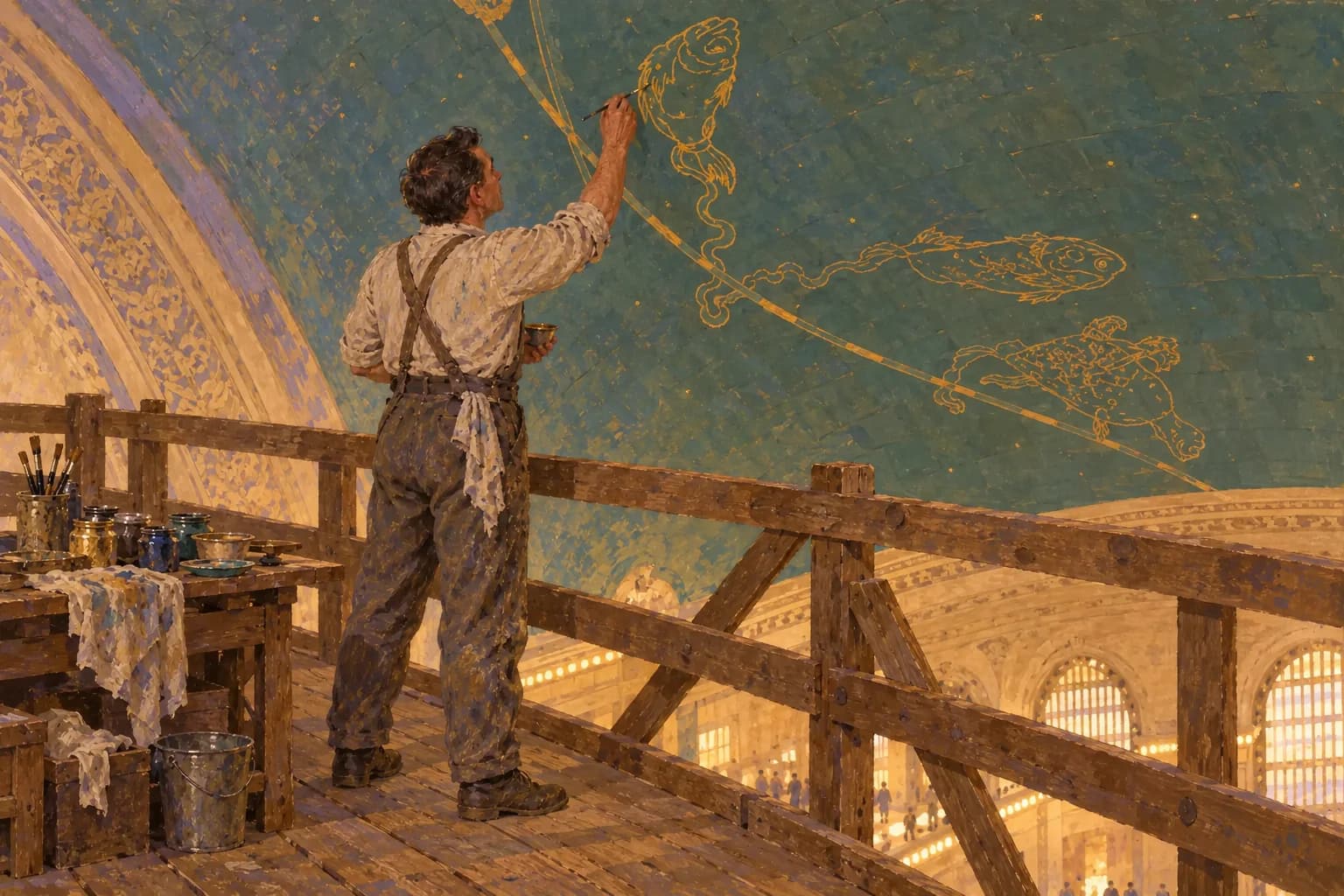 An evocative scene of the craft, not a portrait of an identified worker or a reproduction of a historical inscription.
The ceiling you see belongs to more than one period. Columbia explains that leaks damaged the original painting and a replica was made in 1945. This is not the untouched surface unveiled in 1913.
Studying it decades later, conservators found small human traces. Canning describes a note about the birth of twins beside Gemini, alongside other workers' personal marks. That is the team's restoration testimony, not something we promise you can read from the floor.
Gemini, the twins in the sky, beside twins who had just been born. While the station organized journeys, news of a family found a small place among the stars.
The artwork bears the names of well-known artists; these marks also offer a glimpse of less visible hands. In a ceiling intended to last for generations, something as close to home as the beginning of a family remained.
Bringing back the stars without erasing their makers
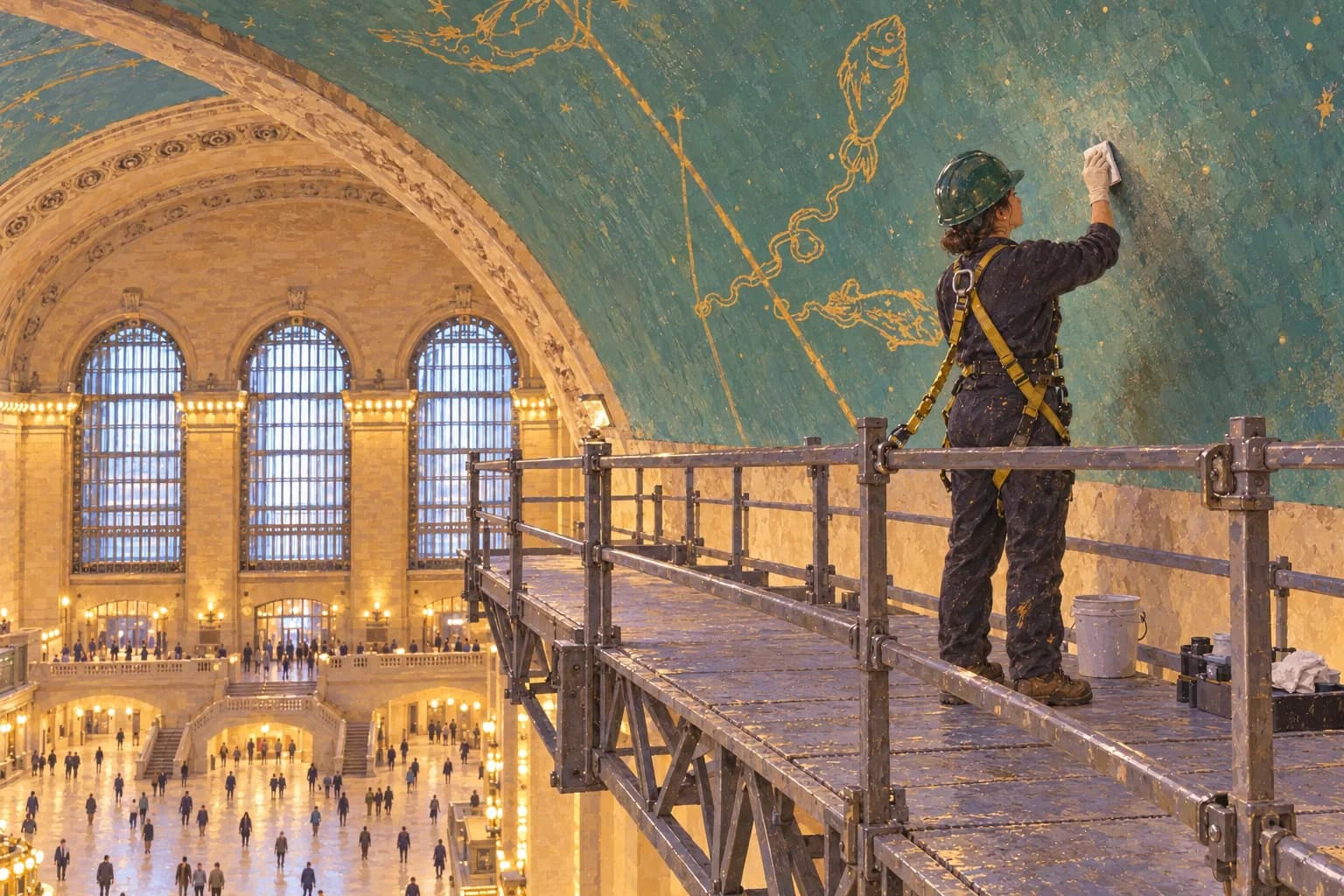 Conservation at height: an evocative reconstruction, not a photograph of a specific working day or a plan of the historical scaffold.
Over time, dirt dulled the color. Recovery needed something gentler than a fresh coat: removing what hid the paint without taking the paint away with it. John Canning's project account describes developing a suitable cleaner to protect the finishes and gilding.
The popular story of a sky blackened solely by cigarettes deserves caution too. The same company attributes the buildup to pollution and soot. Calling it a simple tobacco cleanup would hide the work of understanding what was actually on the surface.
The team's account describes an elevated platform that allowed people to pass below. Caring for the sky and keeping the station moving were not separate projects. Below, journeys continued; above, patient work on the painting went on.
The wider rehabilitation culminated in 1998, as the terminal's history records. Fisher Marantz Stone's lighting work helped the blue-green sky become visible again. Recovering a place meant allowing people to see it, too.
Its care did not stop there. EverGreene documents plaster and finish repairs in 2020–2021, around the mural and elsewhere in the concourse. Next time you see the room as a whole, remember that its continuity depends on small tasks you may never notice.
Let the clock be a beginning, not the end
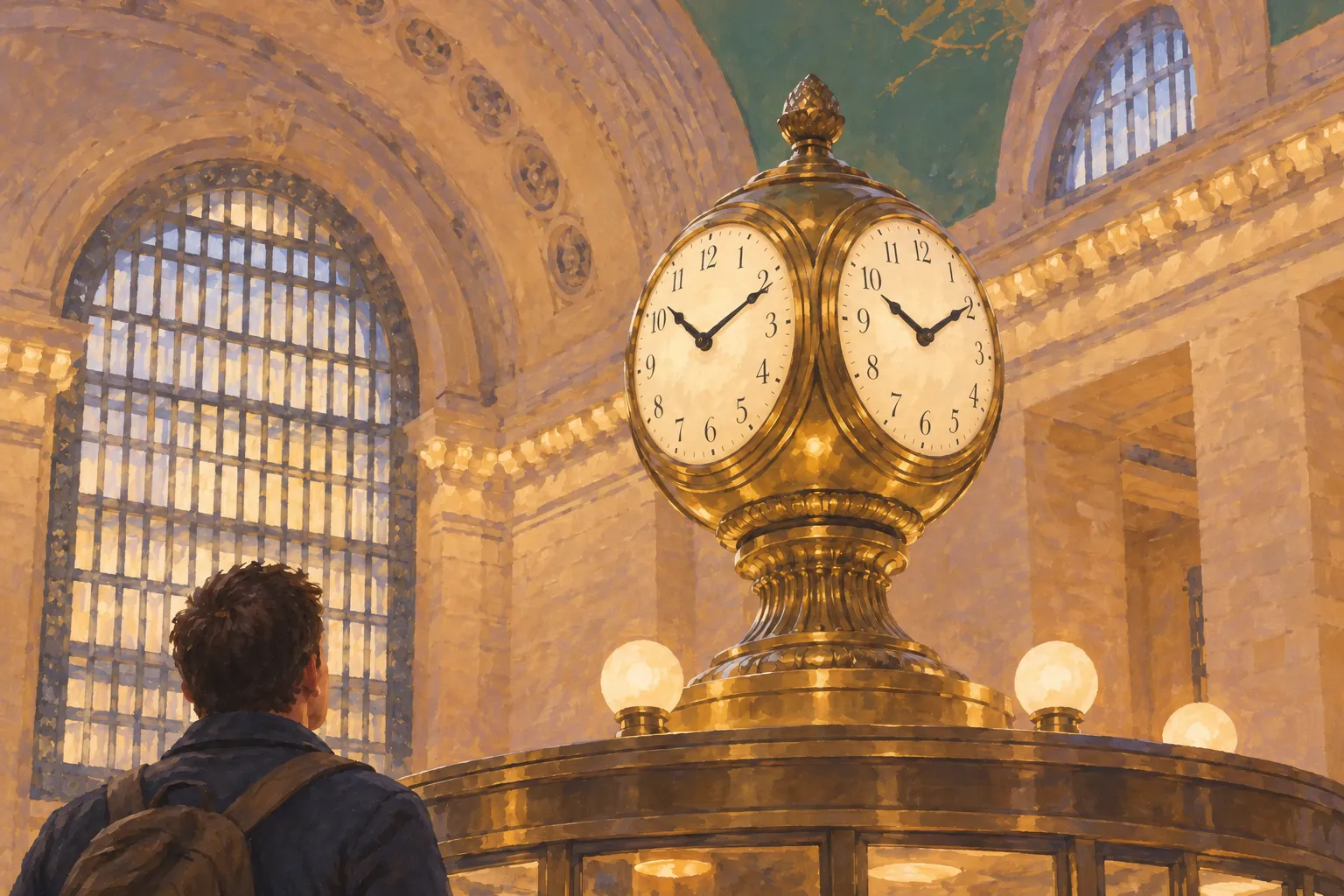 The concourse meeting point: an illustrated interpretation retaining the real clock's characteristic shape and finial.
Start at the information booth clock in the Main Concourse. Its pale faces and brass casing make an easy landmark to recognize. The official guide also points out acorns and oak leaves in the building's details: another small motif to seek out after that vast ceiling.
Step aside from the flow of travelers and look up. Notice the shift from warm stone to blue-green paint. Find a golden figure. Think of the hands that drew it, and those that had to reach it much later to look after it.
To find your way or plan a visit, check the terminal map and official visitor information. This story concerns the historic concourse, not the newer Grand Central Madison space. You do not need to enter restricted areas or stop in the middle of people's path to enjoy it.
If you want to keep looking at your city differently, our selection of New York places offers other starting points. Grand Central can be a very ordinary one: somewhere you already passed through, now with people and stories behind the things you see.
You may leave by the same door as always. What changes is what you take with you.
Follow Grand Central's story in WAONDERSection
Stories behind places