Segovia in WAONDER: what comes after looking at the Aqueduct
From the arcade to Casa de los Picos, San Martín, the Cathedral and the Alcázar: five ways to explore Segovia as the city joins WAONDER.
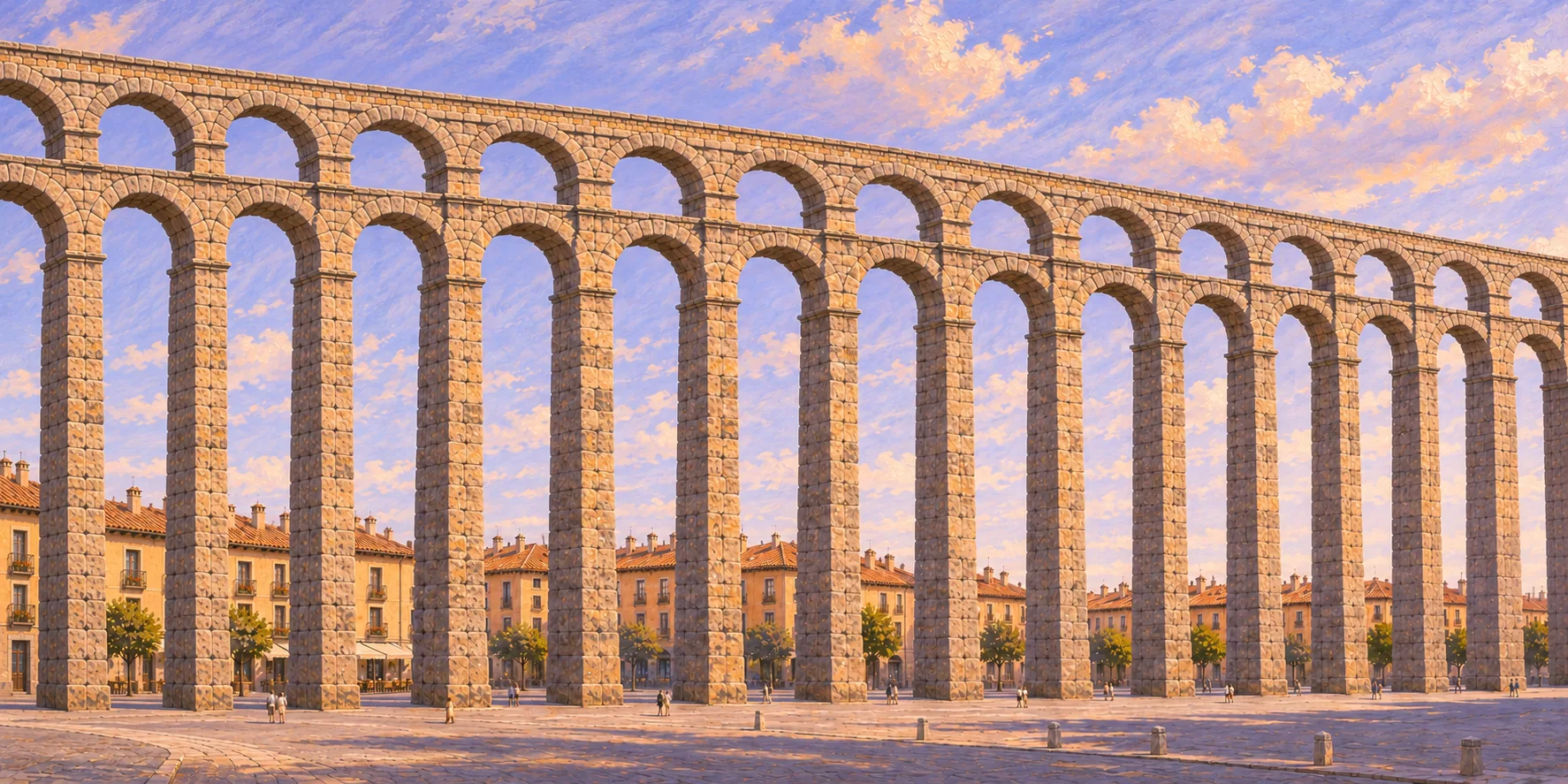
The first glance usually goes upwards. The Aqueduct's granite cuts across the sky, and for a moment it is hard to think about anything else. Then comes a choice: take the photograph and move on, or stay with a question.
Where was that water going? Why cover a house in stone points? How can a cloister be older than the cathedral that contains it?
Segovia is joining WAONDER. We have added places and map references within the municipality to accompany that curiosity, whether you are planning a visit or regularly walking through the city. These five landmarks offer somewhere to begin, not a list to finish in a morning.
Take WAONDER on your next walk in SegoviaChoose a question, not a race
The Aqueduct-to-Alcázar axis described by Segovia's tourism office helps place the landmarks. You can also split it into separate outings:
- Stone put to work: the arcade and Casa de los Picos, noticing how form and purpose fit together.
- A pause under cover: San Martín's portico and, with a planned visit, the Cathedral and cloister.
- The city at its edge: the Alcázar, looking at the relationship between a fortress and the rock beneath it.
These are editorial suggestions, not guided routes inside the app. The old town has slopes and uneven paving. Choose your stretch and any indoor visits around your interests and access needs, rather than making every stop compulsory.
The Aqueduct: before the postcard, there was water
The arcade is enjoyed from below, but its purpose lay above people's heads. The municipal history of the Aqueduct recalls that the system continued supplying the city into the twentieth century.
It was not built to make us stop and stare. It answered an everyday need: getting water across a change in ground level. Seen that way, the repeated forms become more than a pattern. They support the passage of something absent from the photograph.
Look first at the continuous line of the piers, then at the top of the structure. Next time you pass through Azoguejo, its height can suggest a problem solved, rather than merely a number to remember. Something built to serve a city can also become part of how that city remembers itself.
Find the Aqueduct arcade in WAONDERCasa de los Picos: a façade worth seeing from the side
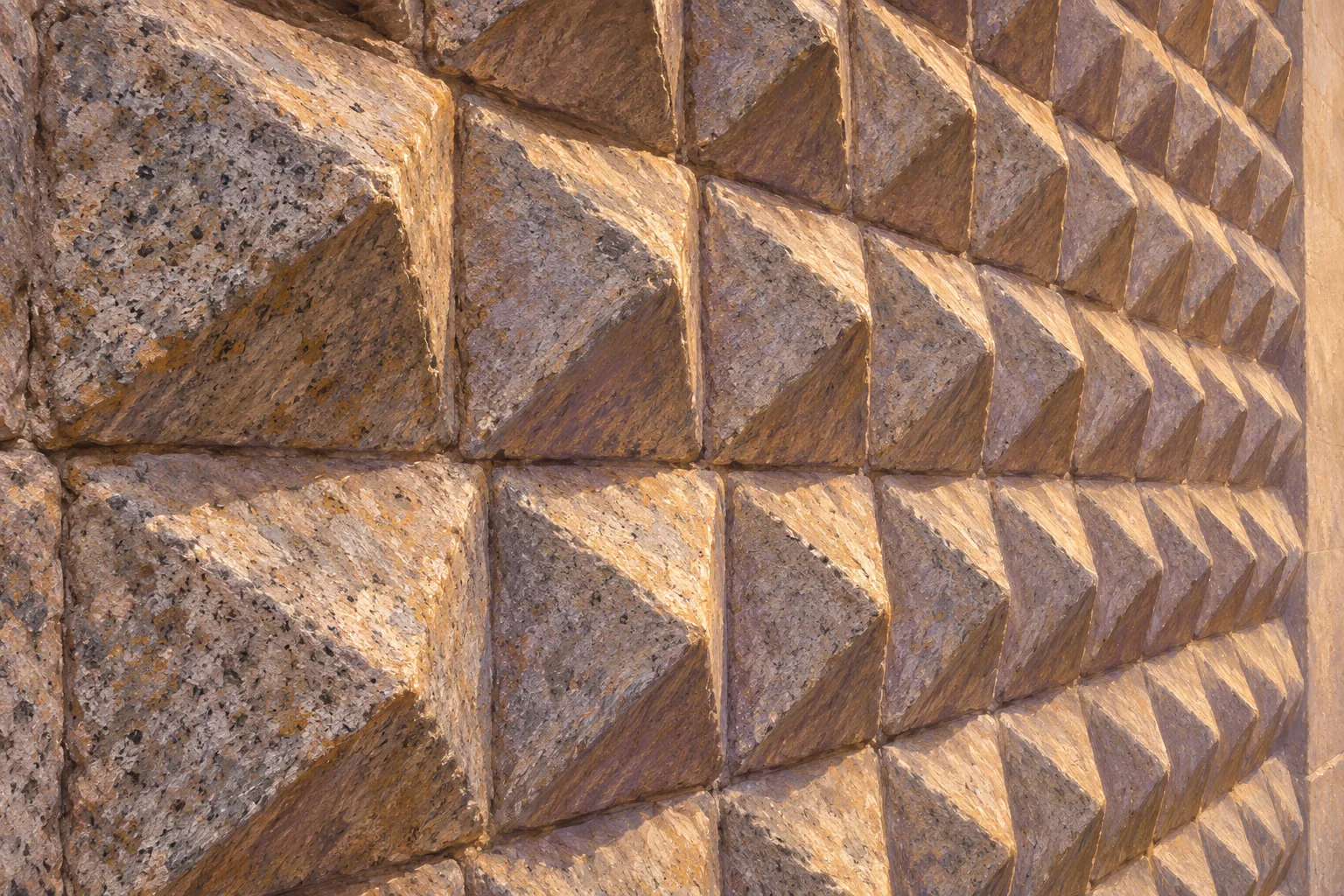 The granite points turn a surface into relief. A painterly detail study, not a reconstruction of the complete façade.
A small change in position can make this stone look different. Each point catches light on separate faces; shadows reveal what a straight-on glance can flatten.
The municipal description of Casa de los Picos links its defensive appearance to the former San Martín gate. Today the building houses an art and design school. Those two uses offer a reason to pause: a house intended to make an imposing statement is also somewhere people learn to look and create.
You need not enter to study the façade. Official information currently lists it as closed to tourist visits, so do not plan your outing around courtyard access.
Find Casa de los Picos in WAONDERSan Martín: the threshold is part of the building
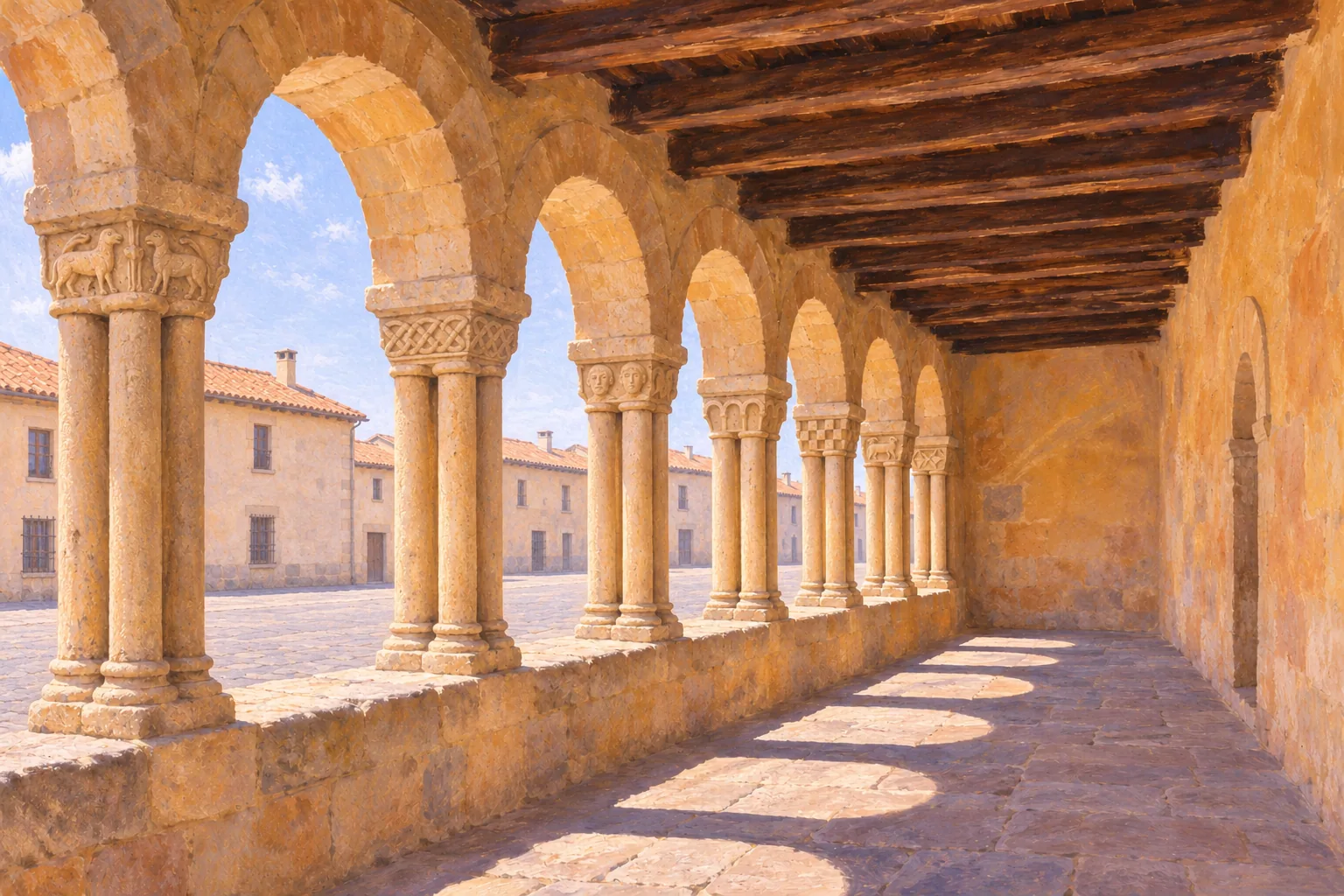 Columns, arches and shade can be read from the exterior portico. Carvings and surroundings are interpreted, not reproduced stone by stone.
Not everything worth noticing lies beyond a door. At San Martín, the outer gallery encourages a slower rhythm: column, arch, a gap of light; another column and another shadow.
Segovia's tourism office highlights the portico and its capitals, while noting that the church opens for worship. Respect that purpose rather than treating it as an exhibition space that is always available.
If you do not go inside, your stop need not feel unfinished. Compare the supports, locate the covered passage and notice how the architecture mediates between street and interior. Even a short visit can have a particular point to it.
Find San Martín in WAONDERThe Cathedral: preservation also meant moving
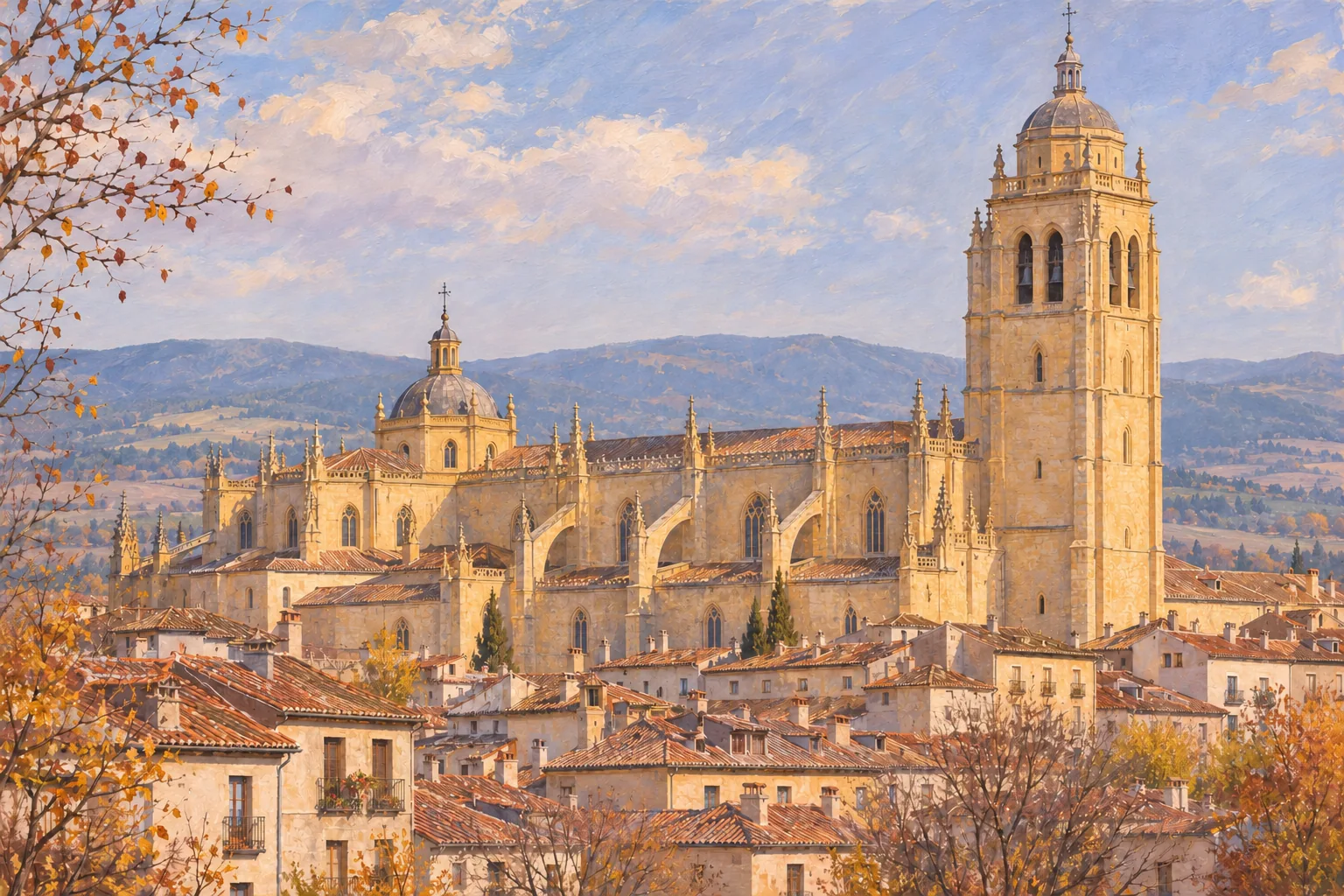 The Cathedral among Segovia's rooftops. A painterly elevated viewpoint, not an advertised public lookout or a measured view.
From outside, the skyline seems to sum up one building. Its history contains things that arrived from somewhere else. The Cathedral records that the new construction began in 1525, after damage to its predecessor.
The cloister was not abandoned with the old building. It was dismantled and moved to become part of the new cathedral. Entering that space means encountering architecture that had to be put back together, not simply built for the first time.
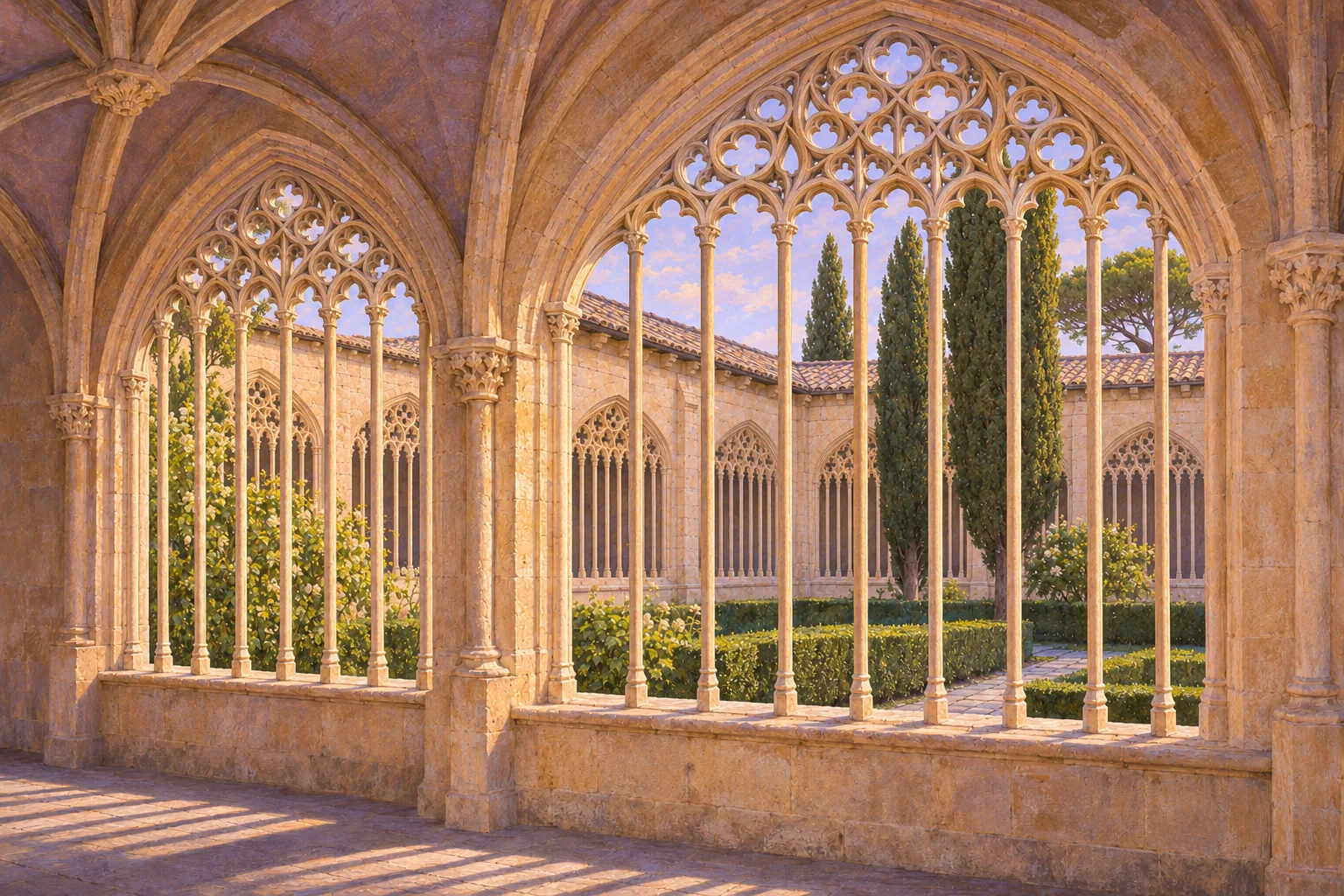 The cloister that changed its setting. An illustration of the present space with interpreted details, not a documented scene of its relocation.
Look at how one piece of tracery meets the next. These galleries did more than outlive the earlier cathedral: their stones were fitted together again in a different place. Walking through the cloister makes preservation tangible, piece by piece.
If you decide to enter, check current visiting conditions on the Cathedral's website. Admission to the church and access to other spaces should not be assumed to be the same thing.
Find Segovia Cathedral in WAONDERThe Alcázar: look at the rock before the castle
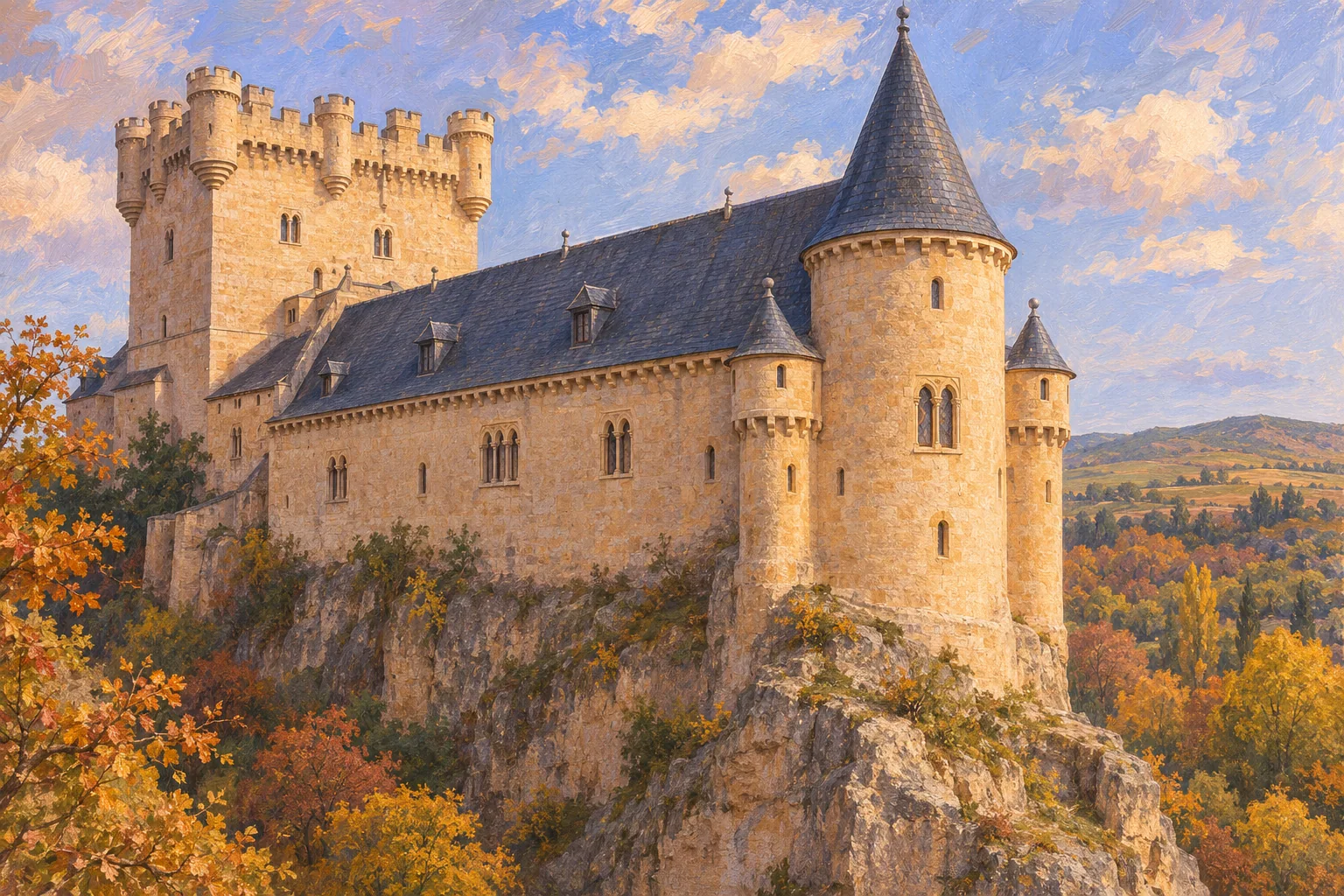 Stone, slate and changing ground levels at the Alcázar. A painterly interpretation, not an exact architectural reconstruction.
It is tempting to stop at the pointed roofs. Try starting lower: with the rock, the slope, and how the building occupies that edge. The Alcázar's profile reads differently when you keep the ground beneath it in the picture.
Nor has everything survived unchanged from a single period. The Alcázar's managing foundation describes the 1862 fire and restoration. The fortress we see is also a consequence of what was lost and what people chose to recover.
Give it an outing of its own if you wish, rather than adding it to an already crowded day. Before booking, distinguish the palace visit from access to the tower: check what each ticket includes and choose the part you want to explore.
Find the Alcázar of Segovia in WAONDERWhat Segovia's catalogue adds
The addition comprises 1,214 records within the municipality, with inventory reviewed on 8 November 2026. That does not mean 1,214 visitable monuments: 675 serve a map-reference role; the other 539 include places and areas with differing levels of information. This does not imply coverage of the whole province.
This selection of categories explains the variety, rather than turning a walk into a tally:
| Catalogue category | Records | One way to use it |
|---|---|---|
| Archaeological heritage and remains | 130 | Look for traces of earlier structures, not only complete buildings. |
| Monuments and historical memory | 115 | Ask who or what people chose to give a presence in the city. |
| Churches and other religious features | 110 | Choose between architecture, thresholds and details from different periods. |
| Parks | 99 | Make room for a green pause between stone landmarks. |
| Gardens | 143 | Notice the spaces that accompany buildings as well. |
| Public art | 67 | Pause at a work you may previously have used only as a landmark. |
| Viewpoints and observation points | 52 | Compare city views, checking actual access. |
| Palaces and historic mansions | 38 | Read façades, doorways and traces of earlier uses. |
| Museums | 13 | Plan an indoor visit when you want to explore further. |
These 767 records form a selection, not the complete breakdown. Categories contain map references and do not guarantee public access: of the 143 garden records, for example, 121 are map-only. Nor does every religious record represent a separate church. Counts describe the catalogue's composition; they do not establish a visit, opening time or complete conversation for every point.
A first outing can be small
If you live in Segovia, you need not wait for a special occasion to look again at somewhere close by. If you are visiting, you need not prove you have seen everything. Leave with one idea: follow the water's path, watch light between the granite points, or recognise a part of a building that had a previous life.
If you alternate these outings with time near Spain's capital, our Community of Madrid selection offers another starting point, not a walking continuation of this one.
WAONDER can accompany that curiosity about the places added. The point of a walk is not to tick off five names. It is for one of them to become more than a name.
Download WAONDER to keep exploring SegoviaSection
Waonder updates