Segovia’s Alcázar: the drawings that helped bring its ceilings back
A fire, rescued books and an artist’s careful drawings: a story that helps you look beyond Segovia’s castle silhouette and recognize survival and restoration.
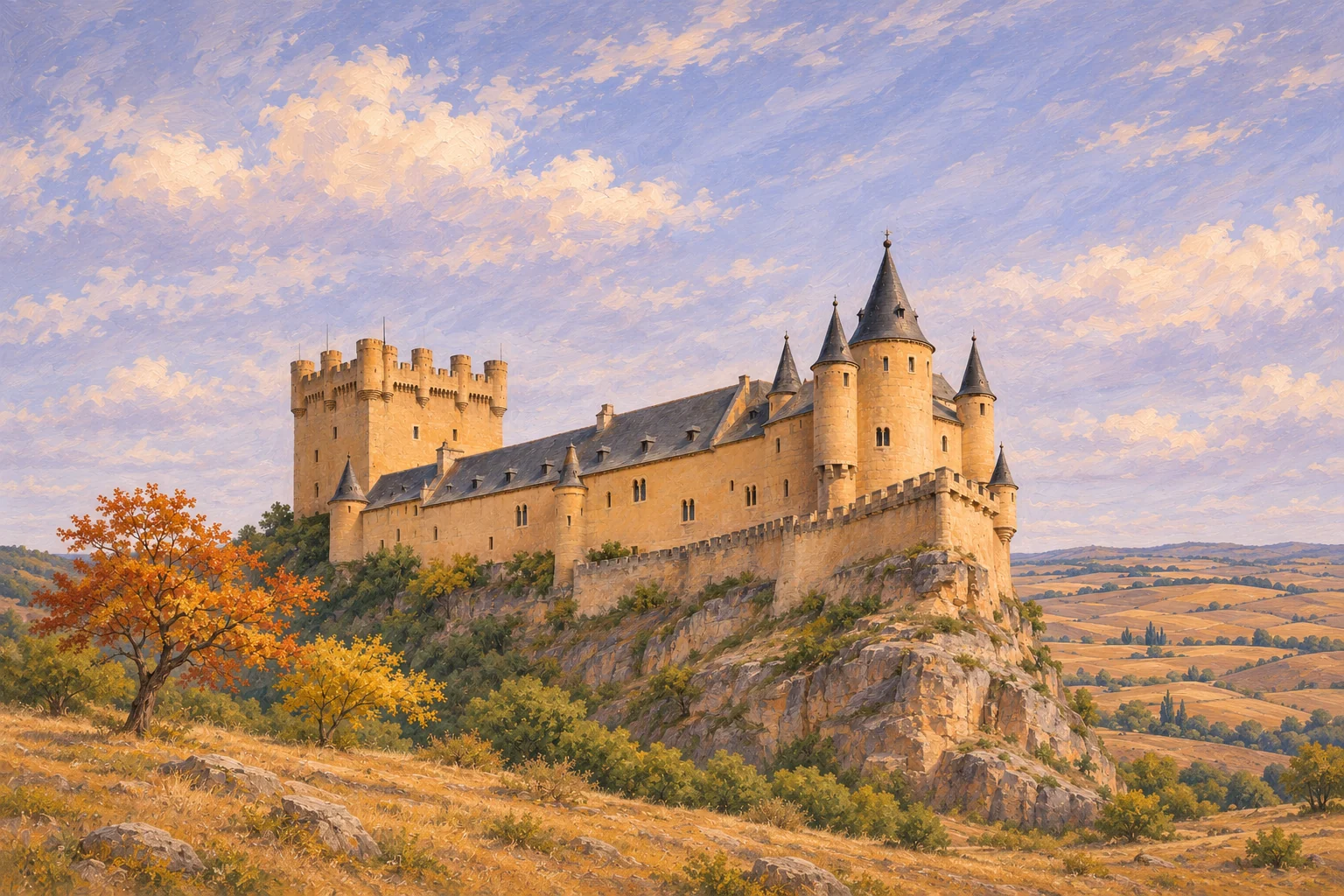
The first photograph of Segovia’s Alcázar usually seeks its outline: stone above rock, dark roofs and towers that seem to push a prow out toward the valley. Inside, your eyes rise again, this time toward the ceilings.
Between those two images lies an absence that is not immediately obvious. On March 6, 1862, a fire destroyed the roofs and badly damaged the palace. Some of what we see today was recovered later. Doing that required something far more fragile than stone: drawings preserved on paper.
The question is not whether the Alcázar is “real.” It is what survived, what had to be remade, and how many hands made it possible for us to walk in again.
Find Segovia’s Alcázar in WAONDERA silhouette shaped by more than one century
The castle occupies a rocky spur between the Eresma and Clamores valleys. Its profile combines different decisions, not one medieval building campaign. The Patronato’s visitor leaflet connects the slate roofs and spires with Philip II’s alterations.
That offers a simple comparison before going inside: the weight of the walls and the apparent lightness of the pointed roofs. Different materials and solutions now read as a single recognizable outline.
The exterior is an introduction, but cannot tell you the age of every room. A palace can keep its place in the landscape while changing profoundly within.
The fire also found a school
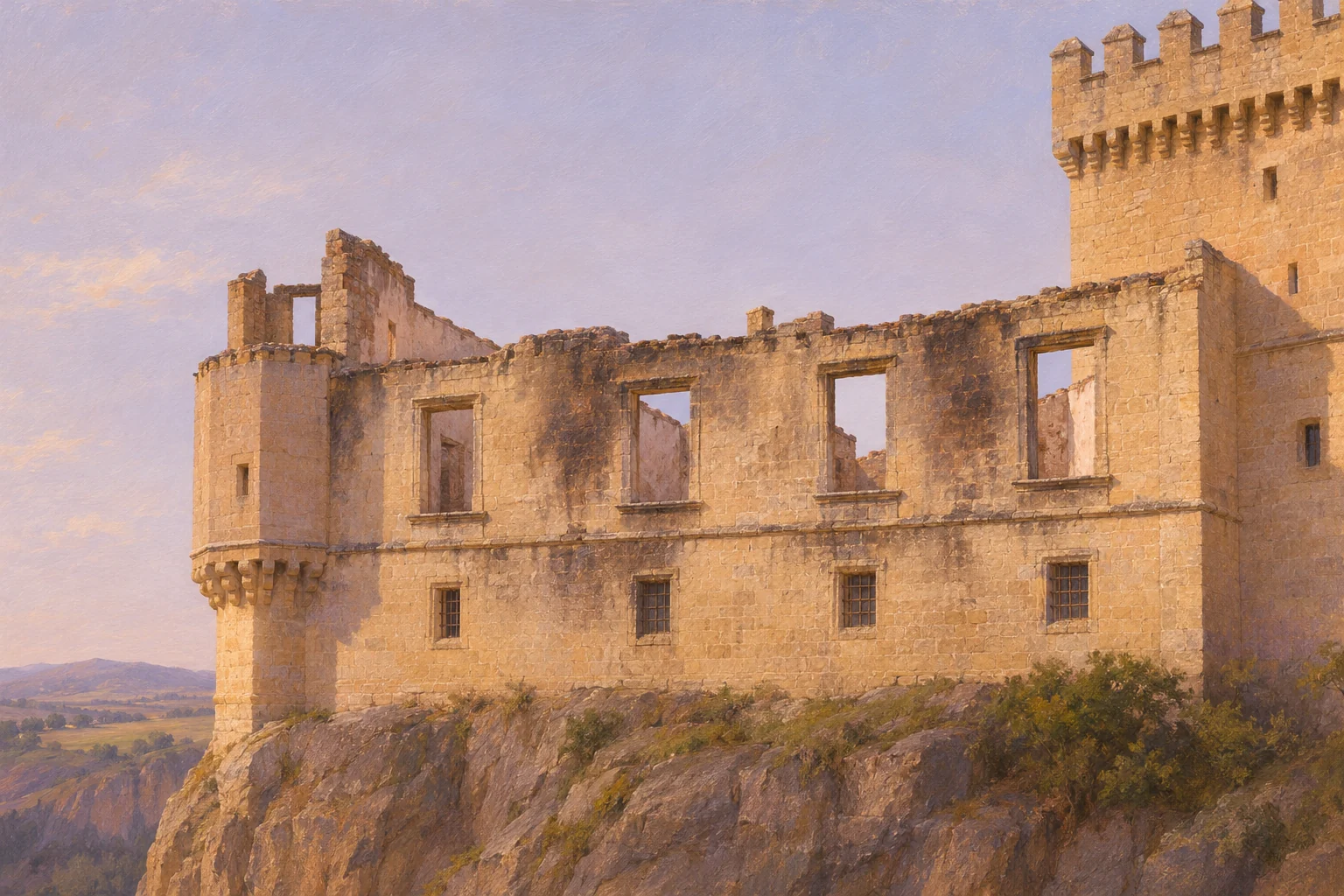 An interpretation of lost roofs informed by historical documentation, not an exact reconstruction of damage to individual windows or walls.
What burned in 1862 was not only an old royal residence. The building had housed the Royal Artillery College since 1764. The Academy’s account recalls the fire and its move to the convent of San Francisco.
That use matters. Behind the decorated rooms were study, books and instruments. The disaster struck a place of learning, not merely a collection of ceremonial spaces.
Accounts often summarize the event by saying that the Alcázar was destroyed. The loss was enormous, but that does not mean every stone disappeared. Later images show masonry standing where roofs no longer enclosed the rooms.
Books that still carry the mark
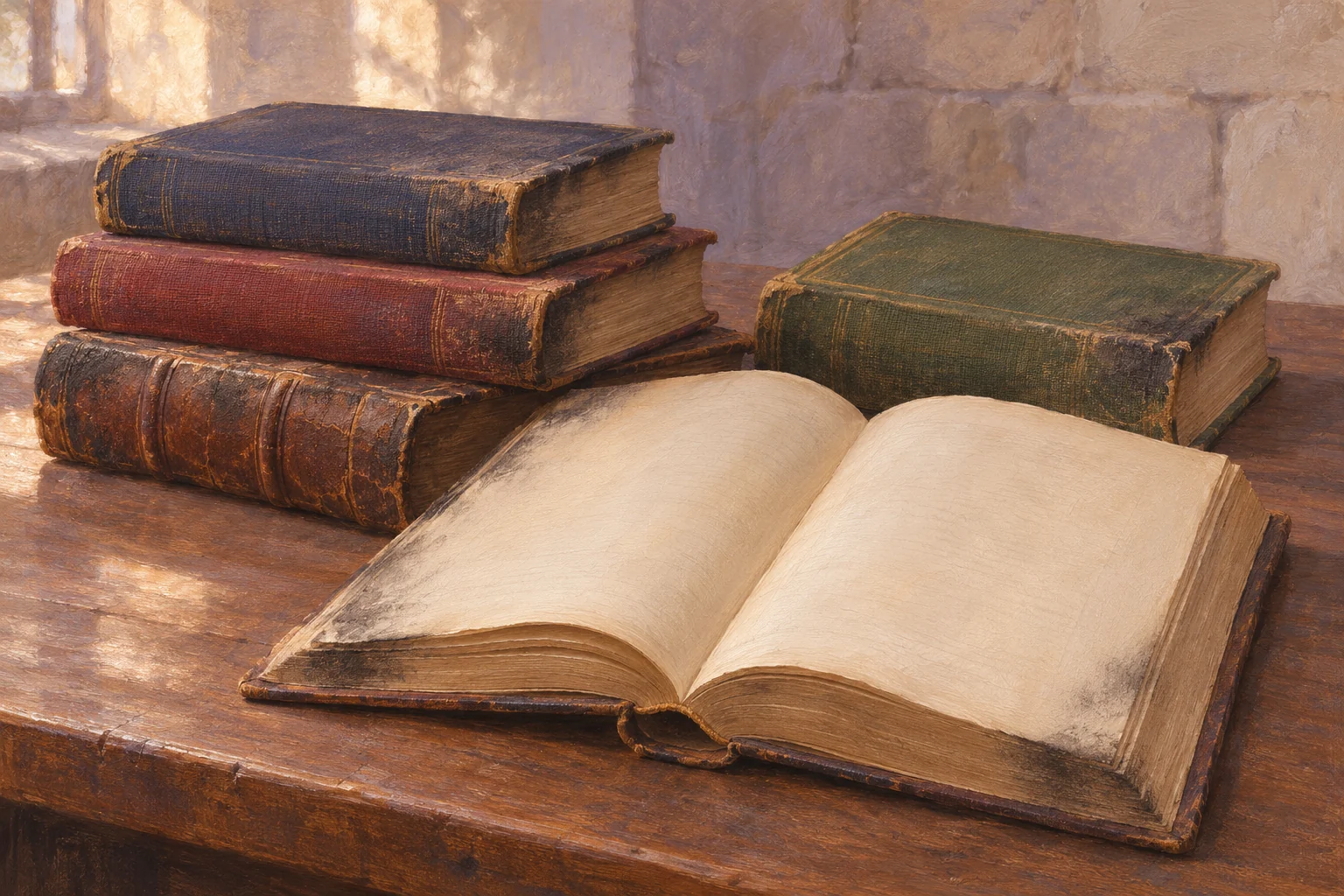 Imagined objects illustrating the library’s rescue, not identifiable surviving volumes or a documented historic table.
The Artillery Academy’s commemorative account says cadets saved books by throwing them through windows. It adds that some surviving books remain blackened by smoke.
A missing roof occupies a large space in a photograph. A dark mark on a book can fit in a hand. Both belong to the same event, but the second brings the loss closer to a specific task: getting whatever could still be saved out of the building.
The rescued books carry the school’s story forward. Learning did not end with the fire: it moved, taking part of its material memory along. Smoke marks make those volumes more than the contents of their pages.
Drawing before knowing it would be needed
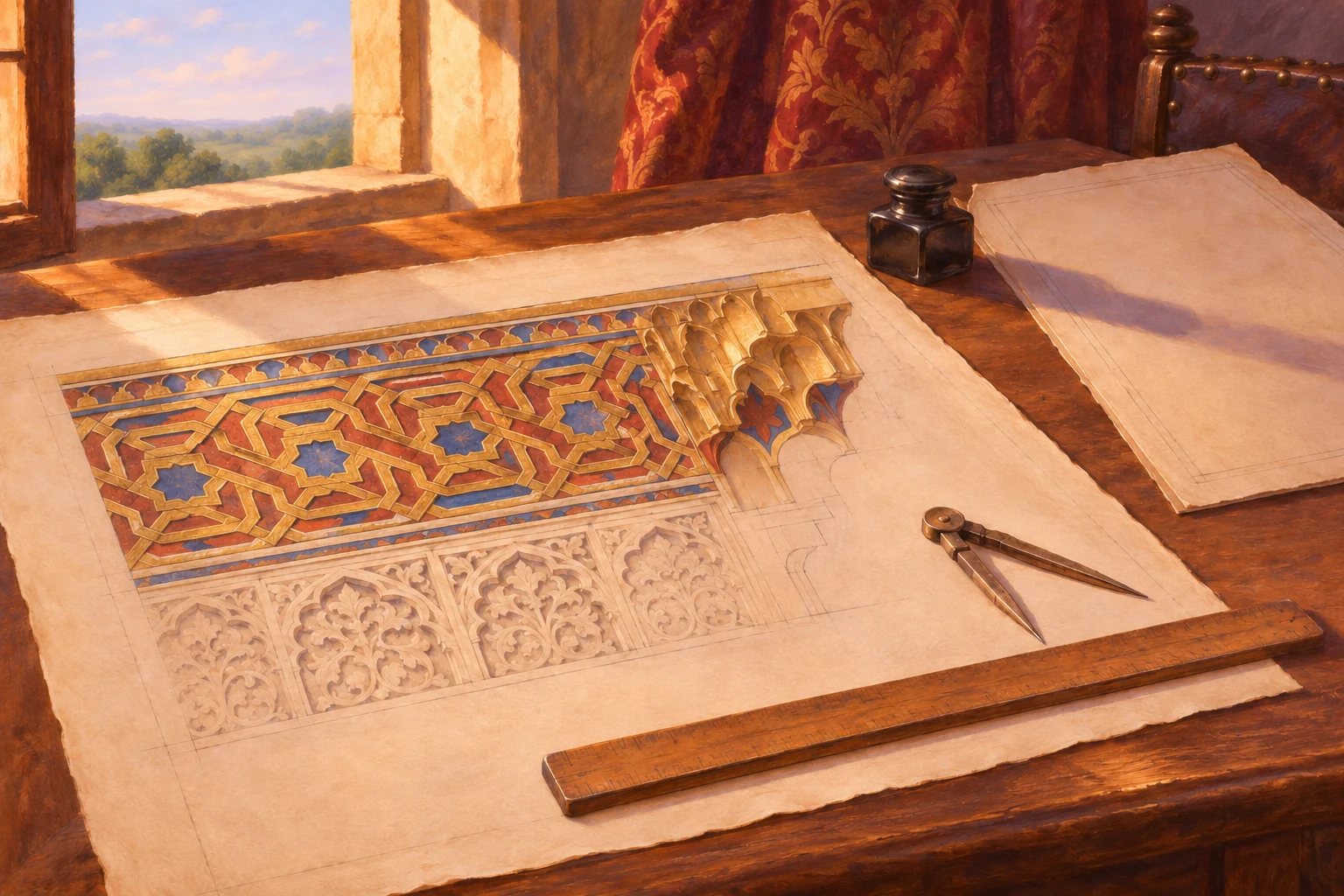 The work of recording a detail. This is neither Avrial’s studio nor a facsimile of one of his sheets.
José María Avrial had documented the Alcázar before the fire. The Real Academia de Bellas Artes de San Fernando holds his 1844 study of the Galera frieze: more than a general impression of a room, it records the arrangement of its decoration.
A detailed drawing preserves relationships: what sits beside what, how a motif repeats, where a shape changes. That patience serves a different purpose from an image interested only in the castle’s handsome outline.
The Patronato’s study of the castle’s iconography explains the documentary role of such views in restoration. A record of an existing interior eventually helped people recover a lost one.
Rebuilding did not happen all at once
Restoration began in 1882, twenty years after the fire. The Alcázar’s documentary study records that beginning and its archival traces. Recovery of the building and its rooms continued in stages.
Between losing a roof and seeing it again lay decisions, crafts and documents. The time needed to rebuild cannot fit inside the dramatic instant of the fire.
Nor did every element arrive by the same route. Segovia’s tourism office identifies the Throne Room ceiling as coming from Urones de Castroponce. A transferred element, a reconstruction and a surviving piece tell different stories, even when encountered during the same visit.
The Galera: looking up, remembering the work
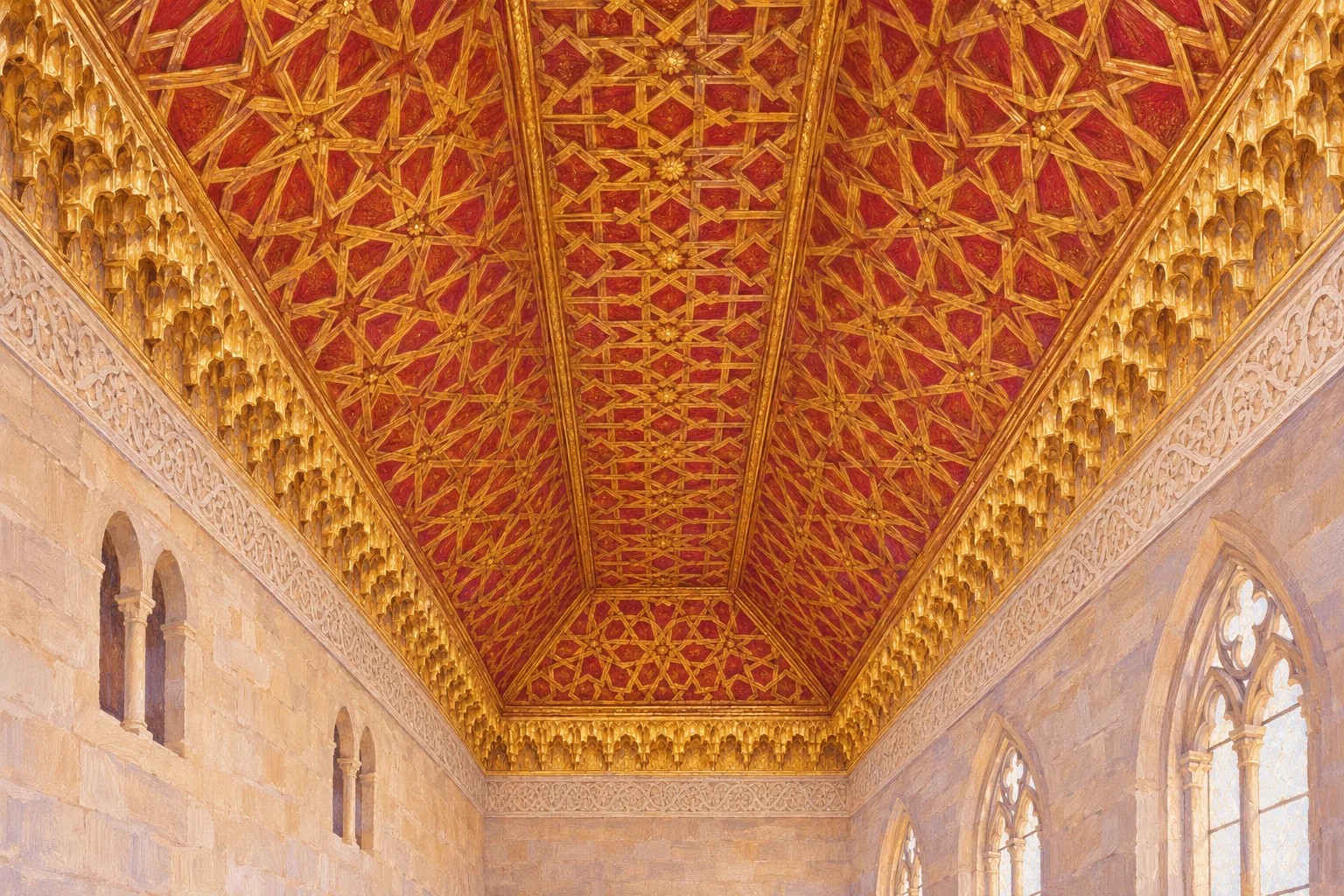 Interpretation of the restored room’s general form and materials, not each individual pattern or inscription. This is not an intact surviving medieval ceiling.
The Galera takes its name from a roof resembling an inverted ship’s hull. Today, its reds, gold and geometry draw your eyes upward again.
In a 2018 interview, conservators Ana Lourdes Blanco and Milagros Torres explained the collective work and use of Avrial’s drawings. They also recalled old wall paintings that did survive in the Ajimeces room.
Not everything is new, and not everything remained untouched. The visit grows richer when there is room for both: material that endured, and the dedication needed to recover what was missing.
You do not have to climb everything
Before going, check the Patronato’s ticket options, notices and conditions. The Torre de Juan II adds a spiral-stair climb of 152 steps; it is not an accessible continuation for every visitor. Choose the ticket and route that suit you.
Inside, follow three details without turning the visit into an exam: an old wall, the meeting of wall and roof, and decoration someone had to study in order to remake it. Respect barriers and do not touch the exhibits.
For more of the city, our Segovia selection and story of the Aqueduct’s water offer other perspectives, not a route automatically available in the app.
When you leave, the Alcázar’s outline will look much the same. But above its walls there will also be paper, books and the work that made it possible not to give the building up as lost.
Look closer at the Alcázar with WAONDER Download WAONDERSection
Stories behind places