Milan’s Monumentale: the stories behind the silence
From Manzoni to the BBPR memorial at the Cimitero Monumentale: art, names and memory, with the context to prepare a respectful visit.
In some places, the first decision is not what to photograph, but how to enter. Milan’s Cimitero Monumentale is one of them. We can admire an arch, follow a form in bronze or recognize a surname while remembering that this is a cemetery. Someone nearby may have come for a very different reason.
Its artistic importance does not erase that reality. It makes it more complex. Here a city has given memory a shape through architecture, portraits and names, and through an almost empty structure that holds earth brought from far away.
This reading suggests a few things to consider closely, not a catalog of graves to complete. The cemetery is normally closed on non-holiday Mondays. Check municipal notices and visiting conditions and plan for an open day. Reading a story today does not require visiting it today.
Look up the Cimitero Monumentale in WAONDERAn entrance that tells us about a city’s ambitions
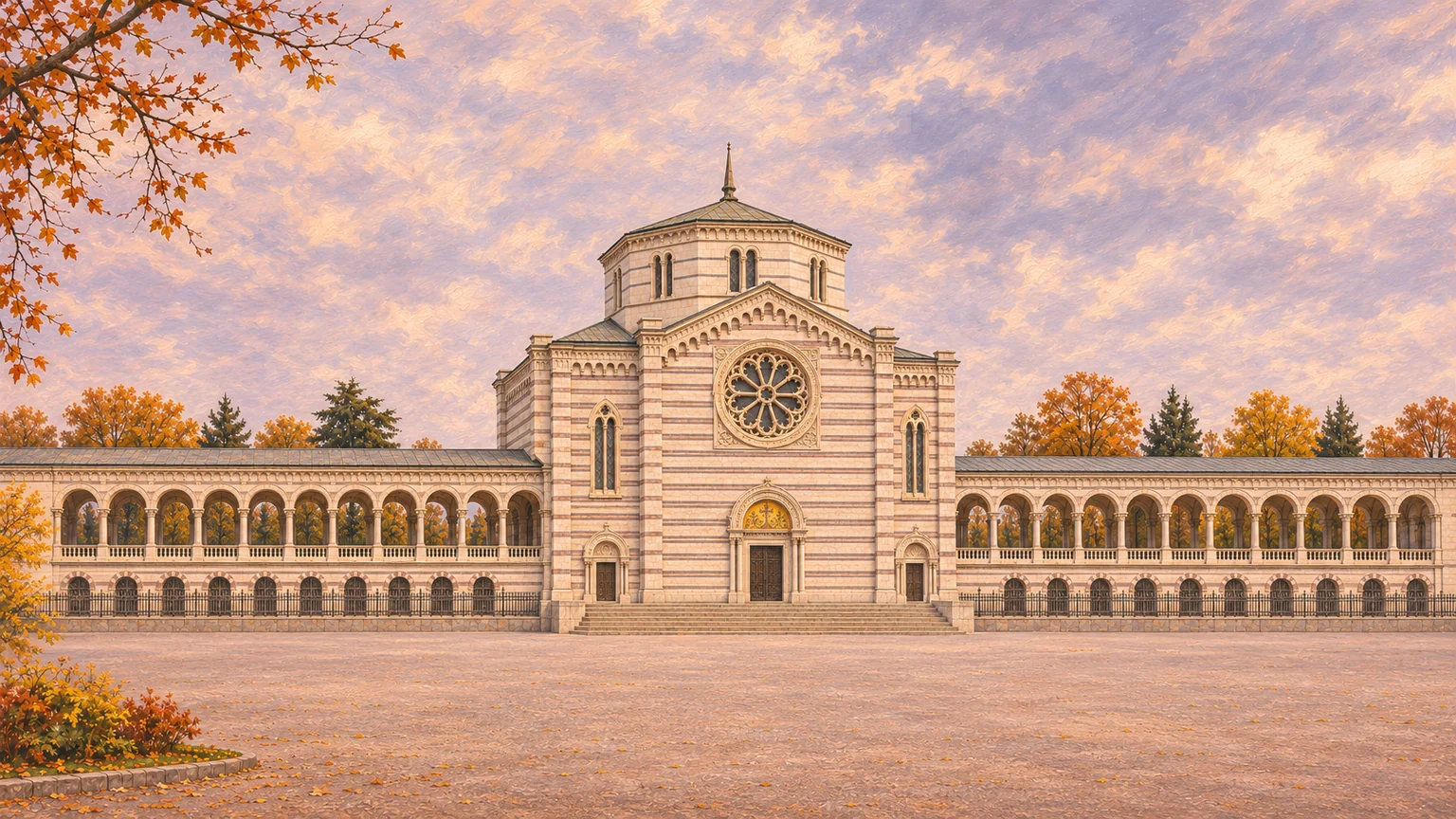
Before seeking one particular work, look at the entrance as a whole. The Famedio occupies its center, with a rose window, bands of stone and galleries to either side. Architecture welcomes us before we can read a single name.
Carlo Maciachini designed the complex. Its official history describes development in stages, not a setting completed all at once. That matters when we look: the Monumentale is memory built over time, not a collection frozen at a single date.
The municipal itinerary devoted to Maciachini encourages attention to materials and different forms. Start simply: follow a horizontal band until it meets an arch. Noticing joints and changes of stone gives us a way to pause without making every corner another photograph to obtain.
A name in the Famedio does not always mark a grave
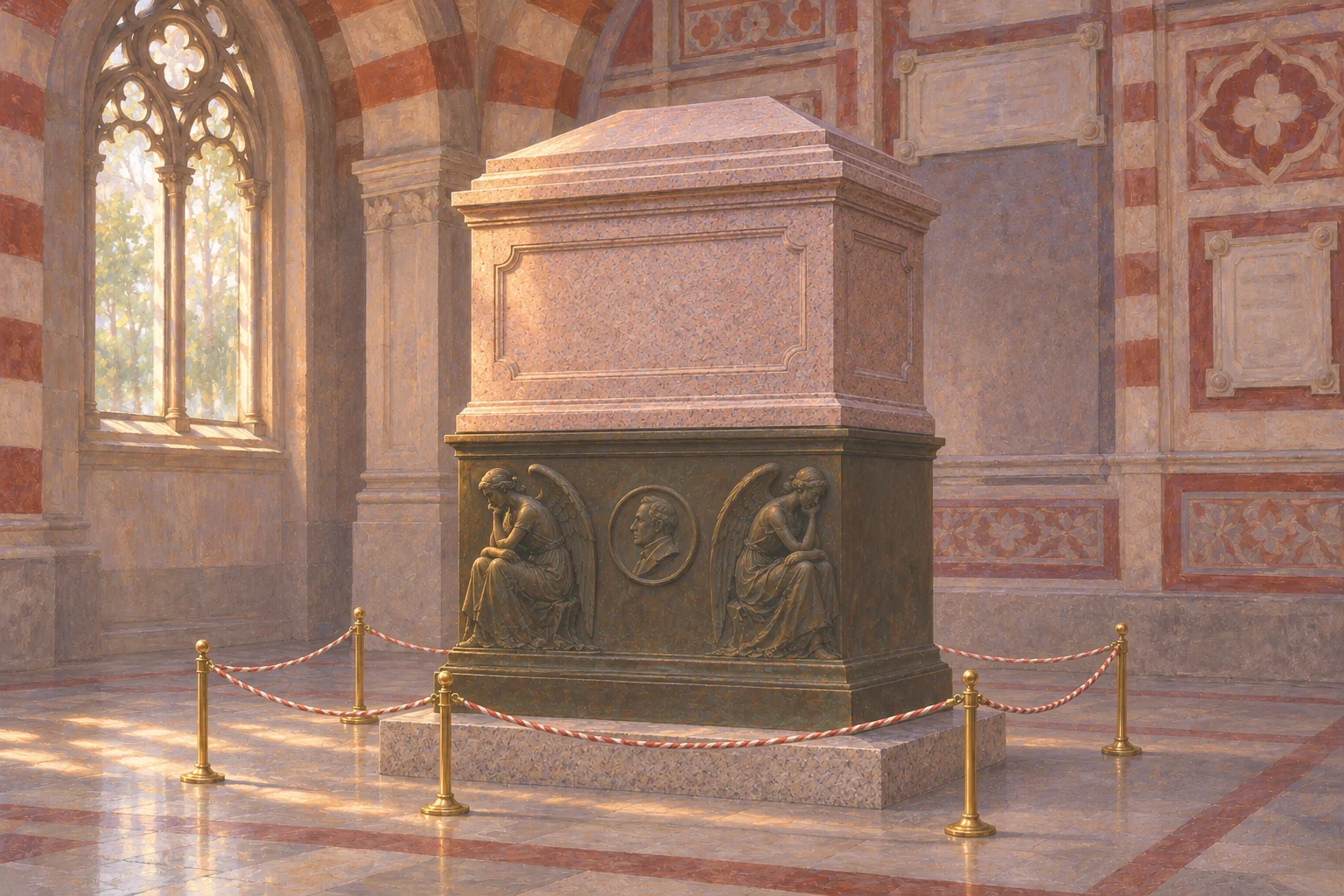 An illustration focused on materials and volumes, not a reproduction of inscriptions or every figure in the monument’s reliefs.
The Famedio brings civic memory together, but being remembered here does not necessarily mean being buried in this hall. The cemetery’s own explanation distinguishes the two: some names belong to people buried elsewhere, even beyond the cemetery. Reading a plaque and finding a grave are different things.
At the center is the tomb of Alessandro Manzoni. The heritage entry identifies Maciachini’s granite sarcophagus and its base with reliefs by Giannino Castiglioni, added in 1958.
Manzoni wrote I promessi sposi, known in English as The Betrothed; Casa Manzoni preserves and studies its editions. The contrast between granite and bronze gives that name another dimension: Milan remembers the writer through a monument that has changed over time, as well as through his books.
Look up Manzoni’s monument in WAONDERGive the galleries a slower pace
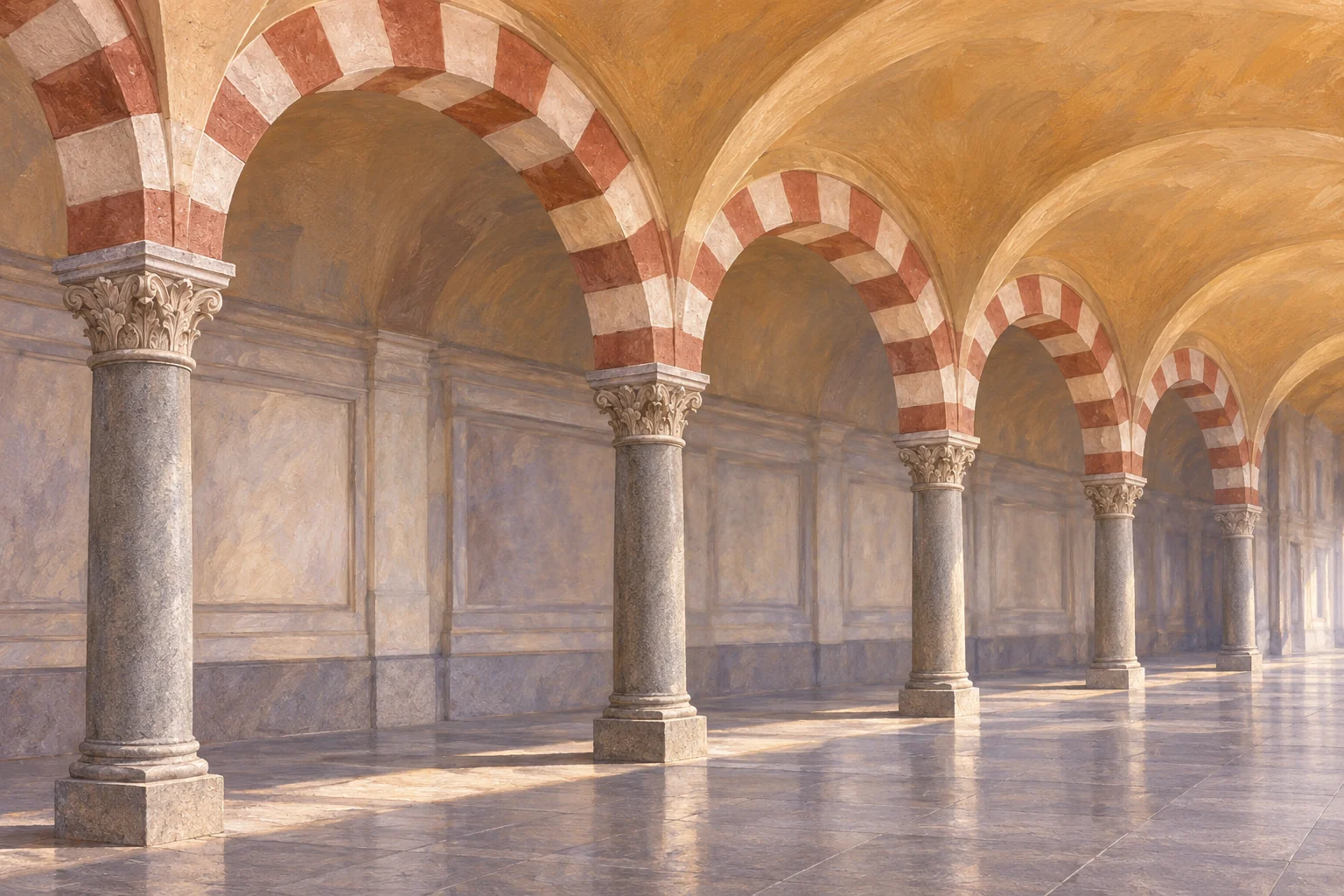 An interpretive study of architectural rhythm, with monuments omitted from the detail; not an inventory or a promise of empty galleries.
The galleries change the relationship between walking and looking. Repeated supports establish a rhythm; individual works interrupt it and call for a different kind of attention. Rather than moving from famous surname to famous surname, choose one stretch and notice how architecture and remembrance coexist.
The municipal gallery itinerary provides names, artists and locations for a closer visit. Use it to identify a work, rather than assuming every nearby sculpture shares its maker or meaning. A figure with wings cannot always be explained with the same word.
Keep paths clear and accept a change of direction if relatives, a ceremony or a restricted area require it. This is not a detour that spoils the experience. It acknowledges the present purpose of the place we came to understand.
A light structure facing an immense loss
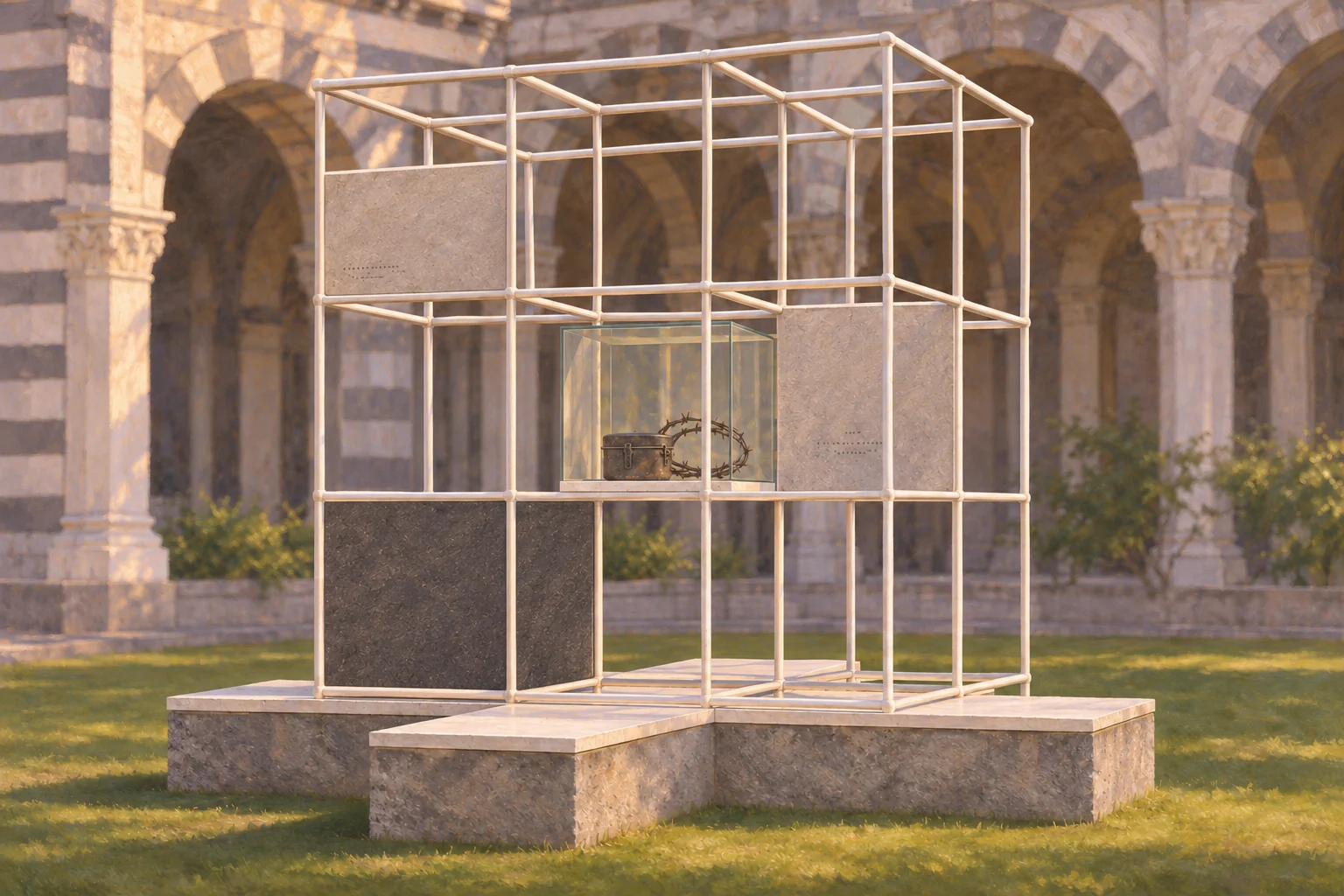 An interpretation of spatial organization and materials, not a scale drawing, transcription of panels or record of a ceremony.
In the hemicycle, the Monumento ai Caduti nei campi di sterminio nazisti, honoring those who died in Nazi camps, proposes another language. A white metal framework allows our gaze to pass through. It needs no great solid mass of stone to carry weight in a visit.
The municipal entry credits the BBPR practice and describes the relationship of cube, cross and panels. Its history connects to particular people, not only a formal decision.
ANED recounts the loss of Gian Luigi Banfi through deportation. The name BBPR keeps the initials of Banfi, Belgiojoso, Peressutti and Rogers. Knowing this changes those four letters: one still names someone who did not return.
Here, absence is not abstract: it has a name connected to those who continued building after the war. Before the clarity of the structure, we can leave a moment unfilled, without immediately seeking the next explanation or photograph.
Earth brought from far away
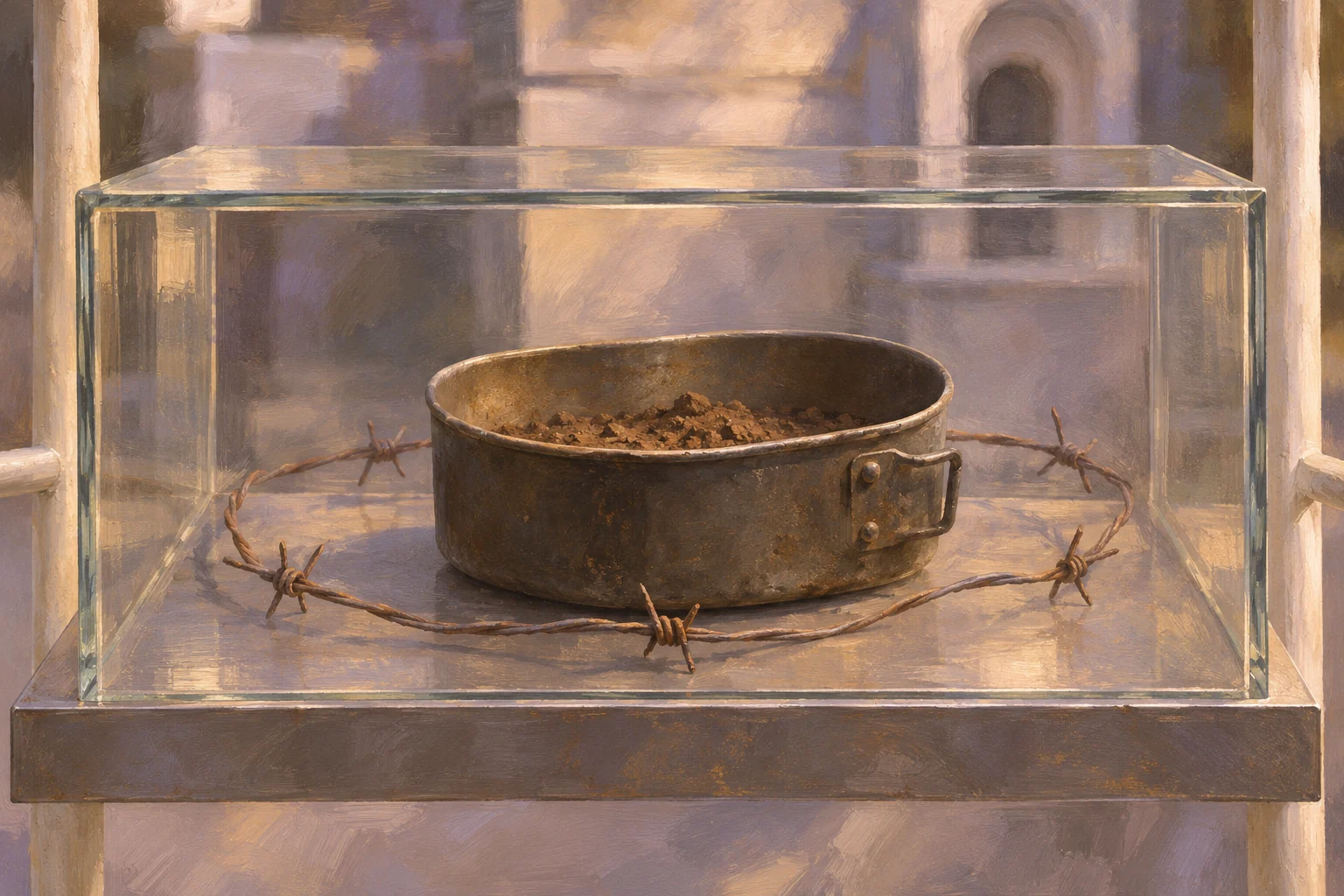 An evocative detail of documented material meaning, not a facsimile of the vessel or evidence of its present condition.
An important detail is easy to miss if we see the whole memorial only as geometry. ANED’s account of its conservation identifies the case, vessel, wire and earth from Mauthausen.
It is earth, not victims’ ashes. That distinction avoids attributing something to the monument that it does not contain. It lets us attend to what it does hold: a material connection with a distant place, brought into Milan’s space of remembrance.
Look from the permitted distance, without touching the structure or reaching through barriers for a photograph. The vessel is small. The attention it deserves does not depend on size. Perhaps this is what you will remember on leaving, when the entrance building fills your view again.
Leave with a story rather than a collection
Choose a visit you can make without rushing. The Monumentale website gathers access, orientation and visiting information; check notices, last admission and conditions before setting out. Do not assume all areas, levels and activities share access arrangements, or that free admission means an unreserved guided tour.
Before photographing, check the rules and staff guidance. Do not frame people in mourning or lean on graves. You can keep a memory without making other people, or their privacy, part of your content.
Our selection of places in Italy offers ideas for other outings. This article links to the cemetery and Manzoni’s monument separately; those links do not replace orientation within the grounds.
Perhaps you will come home with fewer photographs than expected, but with something more precise: a distinction between honoring and burying, a material you did not previously recognize, an initial that now has a story. Sometimes knowing a city better begins with learning to lower our voice.
Keep discovering the Monumentale with WAONDER Download WAONDERSection
Stories behind places