Galleria Umberto I: a sky of iron and glass above Naples
Come for the light, stay for the details: the roof, glass pavement lights and urban history that turn a walk through Naples’ gallery into a closer look.
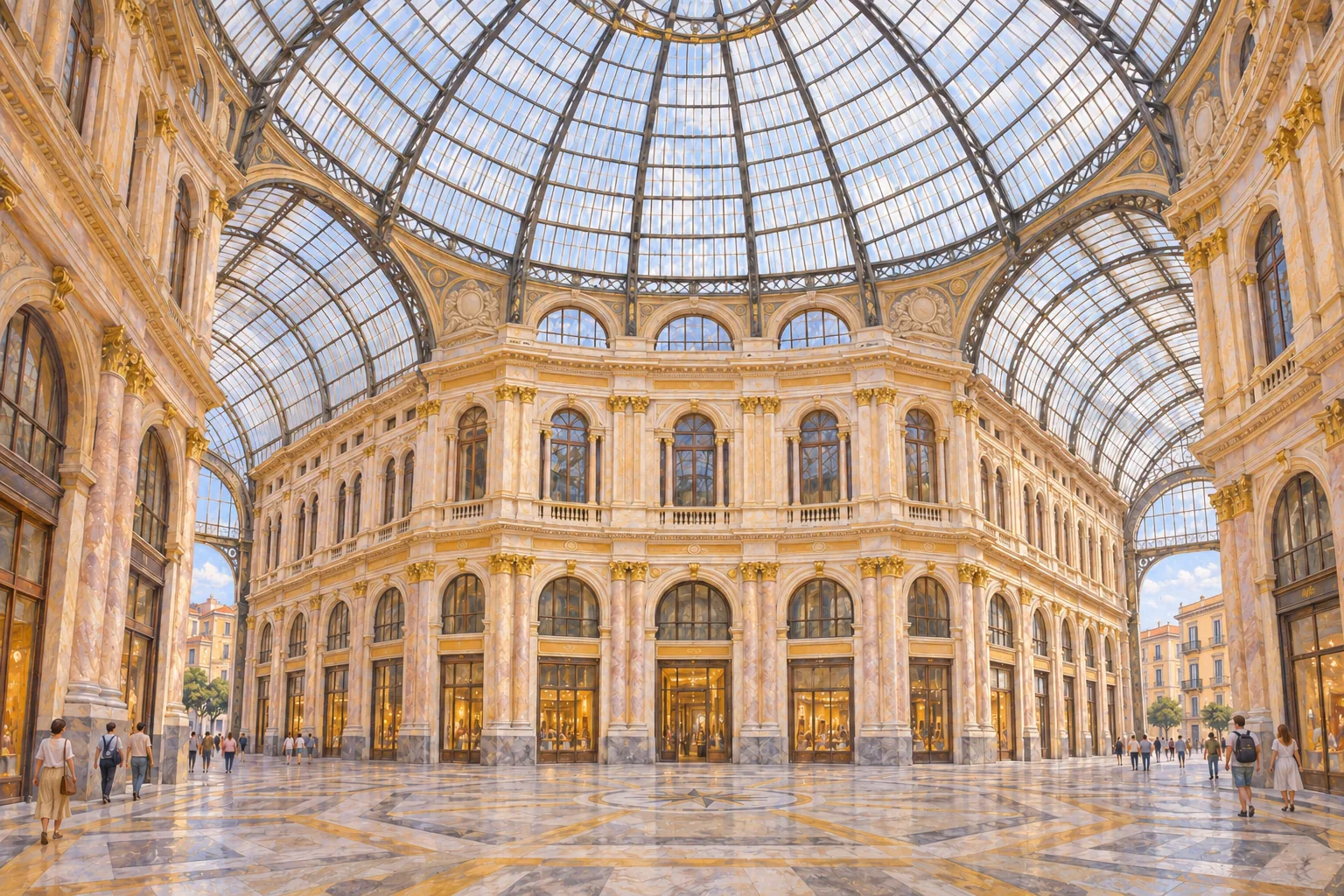
The first temptation is to lift your phone. The roof opens above you, dark iron lines divide the light, and the facades seem to compete to reach it. At Galleria Umberto I, looking up comes almost naturally.
The second look takes a little more intention: lower your eyes. Beneath your shoes are marble, tiny tesserae and circles of glass with something to tell you too. Between roof and pavement lies more than the story of an attractive building. It is the story of a city that wanted to change its image, and a place that still needs care to remain alive.
Find Galleria Umberto I in WAONDERA street that learned to have a roof
The City of Naples’ description dates construction to 1887–1890, within the urban transformation known as the Risanamento. This is not a palace understood from one front and entered through one door.
The gallery forms a crossroads: one arm connects the via Toledo and via Verdi entrances; the other links via San Carlo and via Santa Brigida, as the municipal project explains. Stand beneath the dome and find the four exits. This is a small covered junction, not a room that ends at its walls.
That makes it interesting for someone who already knows Naples too. Looking again does not require setting aside an entire cultural day. Notice the moment the street changes: the sky starts passing through glass, the floor repeats another geometry, and windows become interior facades.
Not everything beneath a roof stops belonging to the life of the city. This architecture makes more sense when you watch where people continue walking, as well as taking its photograph.
Iron drawing the light
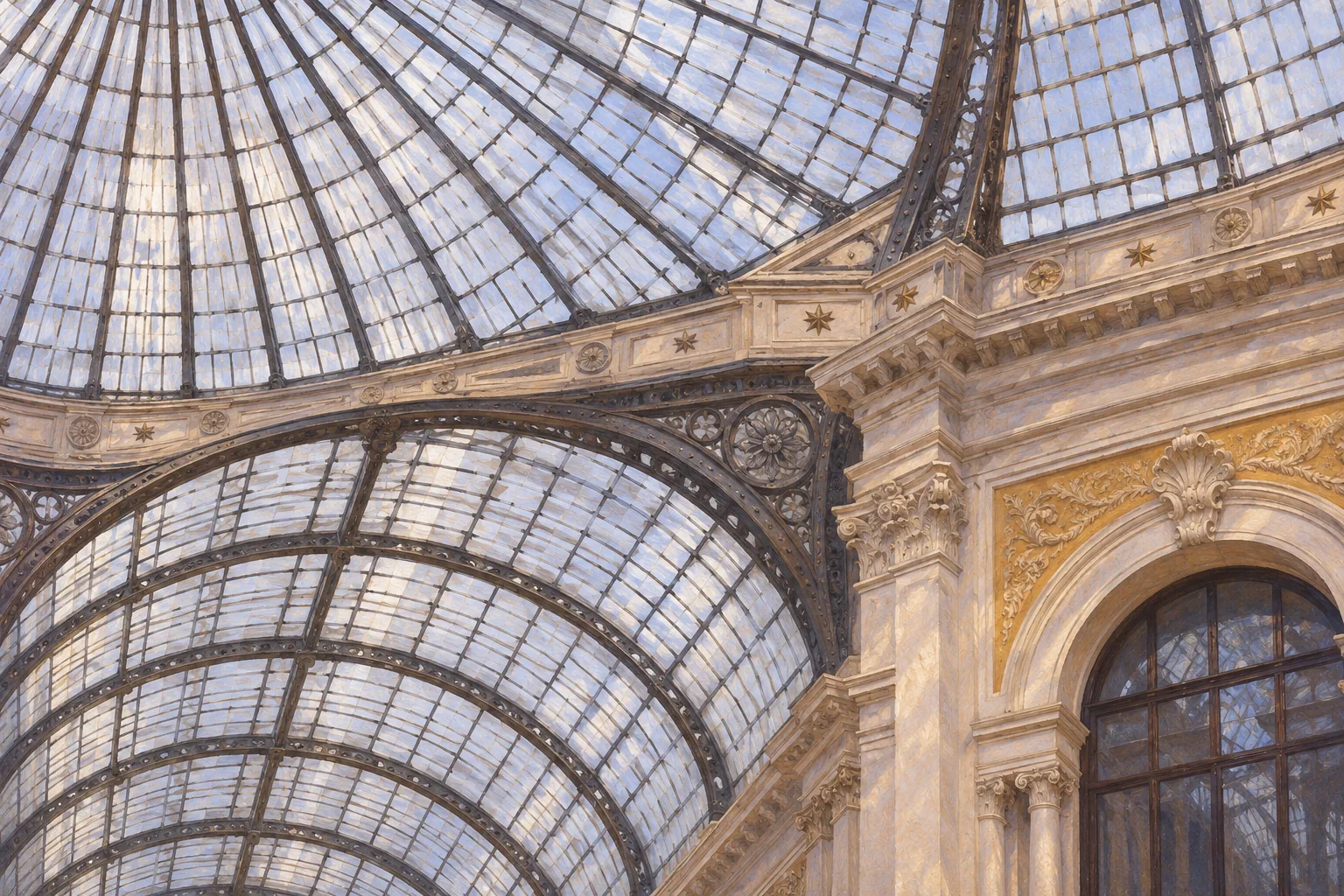 Reading the roof as structure, not a painted sky. An interpreted architectural detail, not a technical survey of its ornament.
Campania’s Regional Cultural Heritage Centre describes the dome and iron-and-glass vaults. The combination lets you read two things together: the form of the roof and the outside light it admits.
Find one substantial line, then the smaller panes it organizes. Not every element has the same visual weight. Ribs gather the drawing; glass multiplies the surfaces through which brightness enters.
Look at the meeting of an elongated vault and the central space, rather than keeping only the image of a circle overhead. The gallery stops looking like a sequence of unrelated roofs. It starts to read as a collection of routes coming together.
Lightness does not mean an absence of structure. Part of the beauty lies in being able to see it work. The illustrations interpret that relationship; they do not reproduce every ornament or measurement of the building.
The floor has more than one way to shine
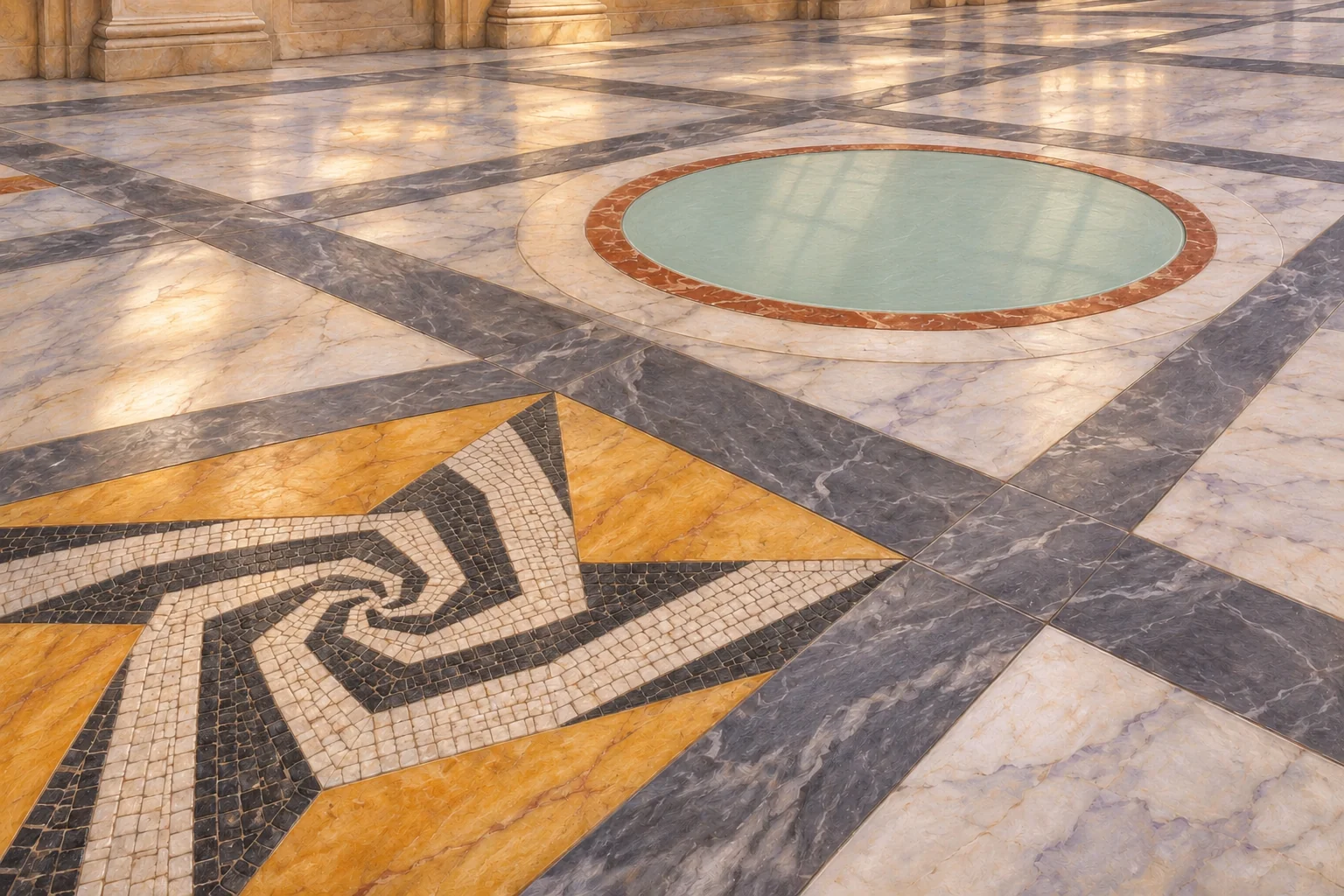 Different materials share the path. The circular element represents a glass pavement light, not a pool; patterns and veining are simplified.
The municipal conservation project published in 2022 distinguishes white, grey and yellow marbles, mosaics and circular glass lights set into the pavement. The surface beneath your feet is not made with one technique alone.
That last detail can change a visit: an opening for light can also be below your feet. From above, it looks like another circle in the composition, but it is more than a patch of color.
Compare a veined surface with one assembled from small pieces. Marble lets you follow a vein that does not repeat exactly; mosaic builds an image by bringing many units together. The floor stops being a shiny background and becomes a combination of material decisions.
In the central area, look for the wind rose and zodiac motifs recorded in municipal documentation. Treat them as images worth noticing, not a reason to import rituals from another gallery. The Umberto I is in Naples. It does not need Milan’s bull borrowed for it to have its own story.
The new city did not begin on empty ground
A construction date fits on a line. The transformation of a neighborhood does not. The Risanamento changed urban fabric and ways of living; the gallery did not appear on a site without a history.
In his study of urban transformation, Gustavo Adolfo Nobile Mattei, also drawing on Matilde Serao’s critical perspective, recalls urban losses and social problems that new monumental architecture did not solve by itself.
You do not have to stop admiring the roof to keep those questions open. What occupied this place before? What do we value when we call a transformation an improvement? Are we looking only at the new facade, or also at what fell outside it?
The heritage valued today can coexist with the loss of other parts of a city. Looking from the gallery’s thresholds, as well as from its center, is a reminder that this beauty belongs to a much larger transformation.
The gallery can be beautiful and still invite a question about more than beauty.
A place in use also needs room for care
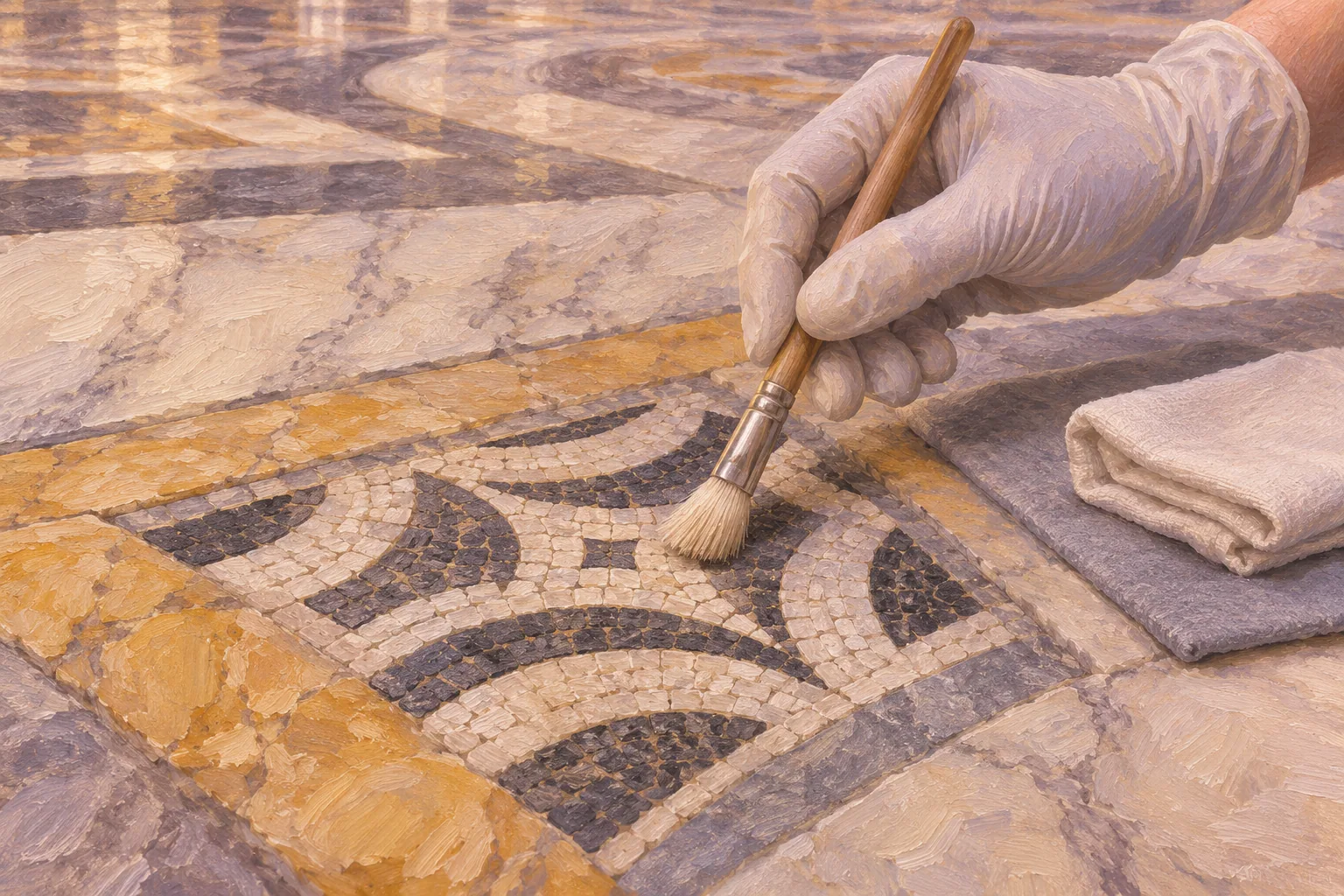 An evocation of heritage care, not an identifiable conservator, a specific intervention or treatment instructions.
Looking down brings another kind of work into view: conservation. A Soprintendenza account of the pavement describes cleaning, fracture repair and maintenance in response to wear from use.
It records work in earlier years, not a construction update for this November or proof that every area is finished and open. But it explains something that remains useful: shine does not preserve itself.
Behind the monumental image lies care at a small scale. A tessera, an edge, a joint. And there is a practical relationship between people moving through the space and those responsible for protecting it.
As a visitor, you do not need to treat the material or test its strength. Respect barriers, avoid adding coins, marks or little rituals to floor motifs, and leave space for others to pass. The place does not become less valuable because it is still used. That use makes learning to share it important.
Leaving is part of the visit too
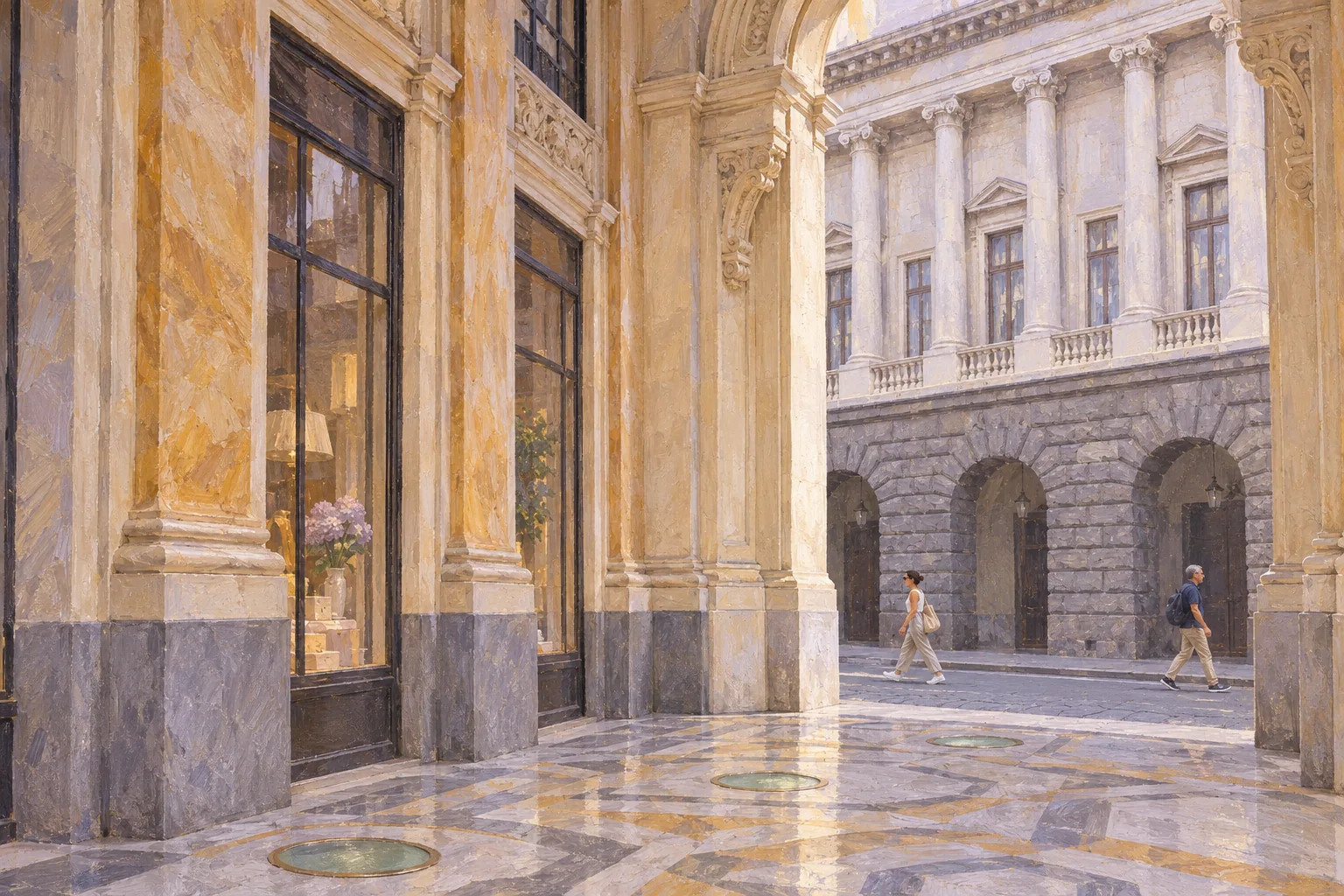 Between gallery and street. Facades and pedestrians are interpreted, not a measured view or a promise of theater access.
Before leaving, look again at the boundary between inside and outside. The roof ends, but the city continues. Photographing an isolated building is different from understanding a place that connects other routes.
A short visit can hold three questions: What supports the light? What materials are under my feet? What changed here for this space to exist? You do not need to answer all three or buy anything for the pause to mean something.
Check on-site directions and official information before relying on a particular passage. A heritage description does not establish current restrictions, shop openings or hours. Step out of the pedestrian flow when you stop to look up; that is part of visiting too.
To continue into other cities, our Italy selection in WAONDER offers more starting points. Here, though, you can keep something small: crossing a familiar gallery again and discovering that you had not yet looked at its floor.
Explore Galleria Umberto I in WAONDER Download WAONDER to keep discovering NaplesSection
Stories behind places