Florence’s Innocenti: what half a token could keep
Behind the Innocenti’s arches, small tokens connect objects and lives. Explore a Florence of care, archives and questions whose endings are not always known.

A broken coin looks like something that has lost its value. At Florence’s Innocenti, a small identifying token changes the question: not what it could buy, but whom it might help someone recognize.
November 20, World Children’s Day, offers an occasion to approach this history. UNICEF explains the day’s connection with children’s rights. For that day, and for any return to the square, here is a visit that will still matter after the date has passed.
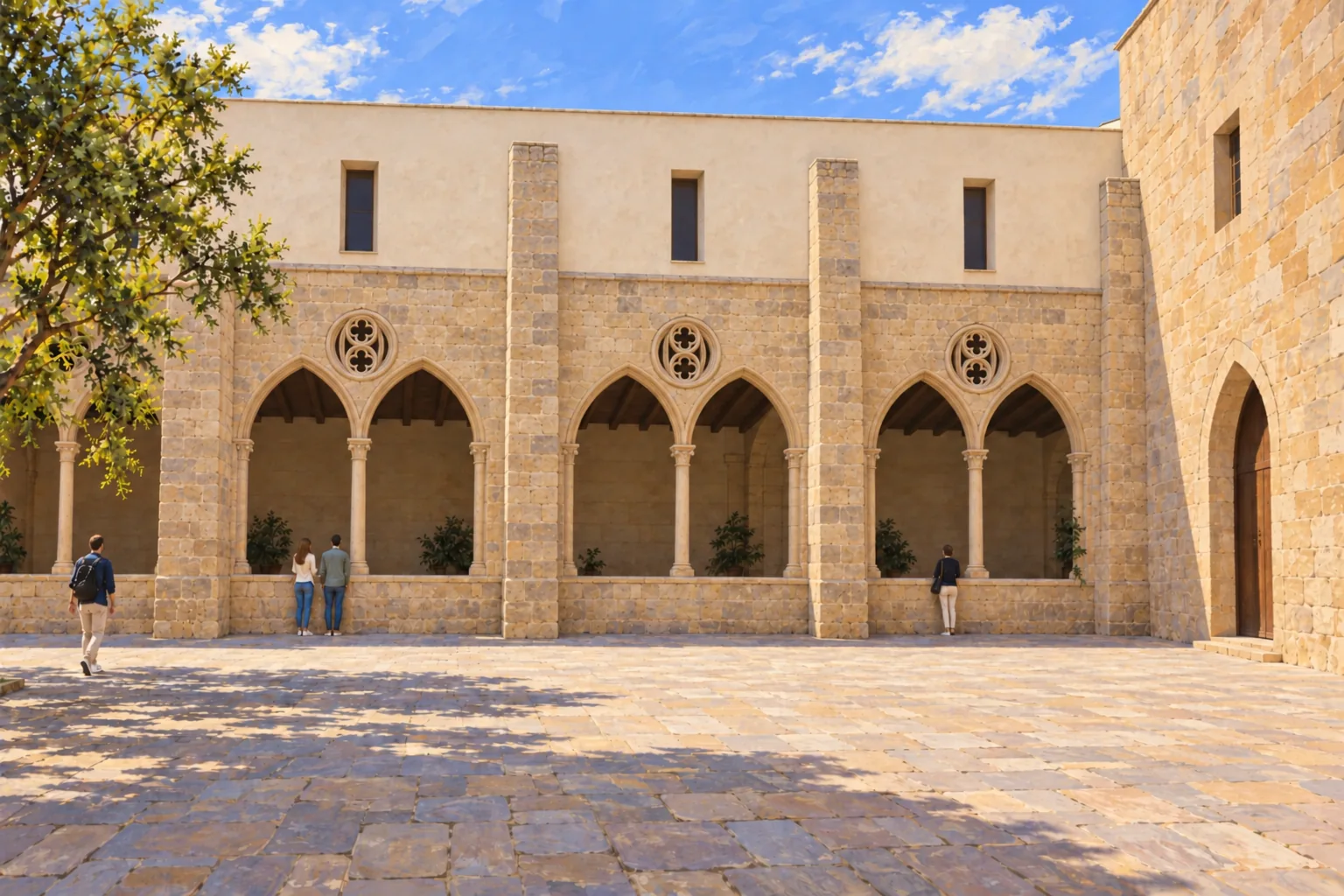
Behind the loggia on Piazza della Santissima Annunziata lies a history of care, work and memory. A small token can preserve a connection with a child. Following that life also requires the documents that remained linked to the object.
Look up the Museo degli Innocenti in WAONDERWhat one half could hold
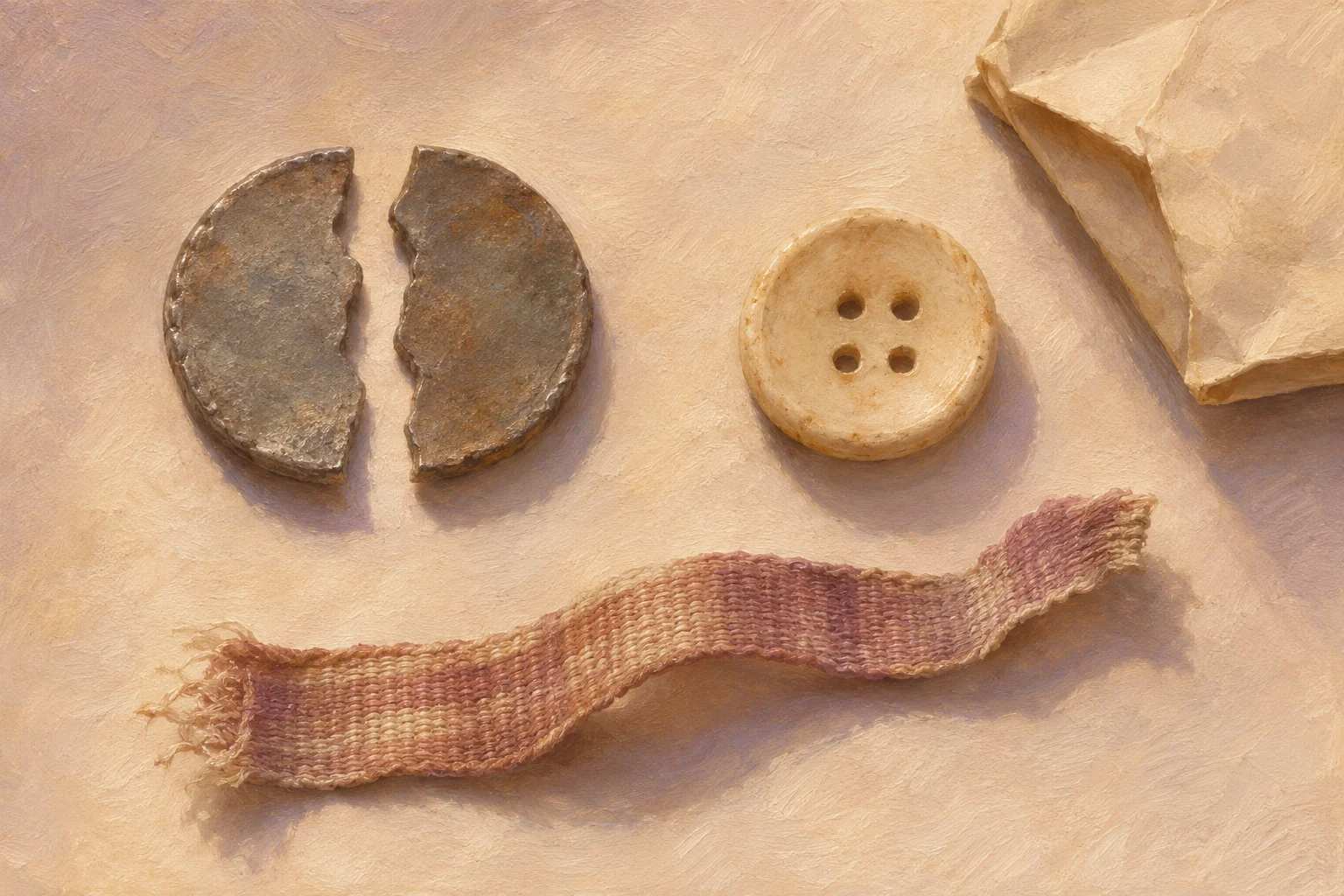 An explanatory arrangement of generic objects. It does not reproduce an actual group of tokens or attribute them to a particular child or family.
The segnali di riconoscimento were objects accompanying children brought to the old Ospedale. Coins, medals or ribbons, often divided, could help identify a child if their family returned, as the archive’s specialists explain.
One part could remain with the child, another with the person who brought them. But a surviving token does not, on its own, prove that the two halves ever met again. The object opens a possibility; it does not automatically give us the ending.
That difference matters when looking at it. This is neither a jewel valued for its material nor a promise that always came true. Sometimes what remains is precisely that: a small part of a story for which more pages are still needed.
A building designed to receive children
The scale changes when you look up toward the loggia. The museum’s history places the start of the project in 1419 and the first child’s arrival in 1445. Brunelleschi designed the building; its arches were not conceived simply to beautify a square.
Look at the repeating columns, gray stone against pale plaster and depth of the covered space. Beauty has a particular relationship with the purpose of this place. The architecture itinerary follows that relationship into the complex’s courtyards and spaces.
It helps not to translate Spedale as though it meant precisely a modern hospital. Nor should we call every child received here an orphan: the existence of family tokens itself reveals a more complicated reality.
Care was everyday work, too
The institution did not function through a great architectural idea alone. The Innocenti’s own history recalls wet nurses working inside and outside the establishment, and the practical care of young children. Feeding, attending and recording belong to this heritage as well.
One name brings the beginnings closer: Agata e Smeralda, one girl, was the first child received. The institute’s transcription of her arrival states that she brought no other identifying token. Her first entry contains no coin: identifying tokens did not accompany every child in the same way.
Records let us speak about people, rather than only an anonymous institution. They also call for care: a life’s appearance in writing does not mean that its complete story has reached us.
An object needs its documents
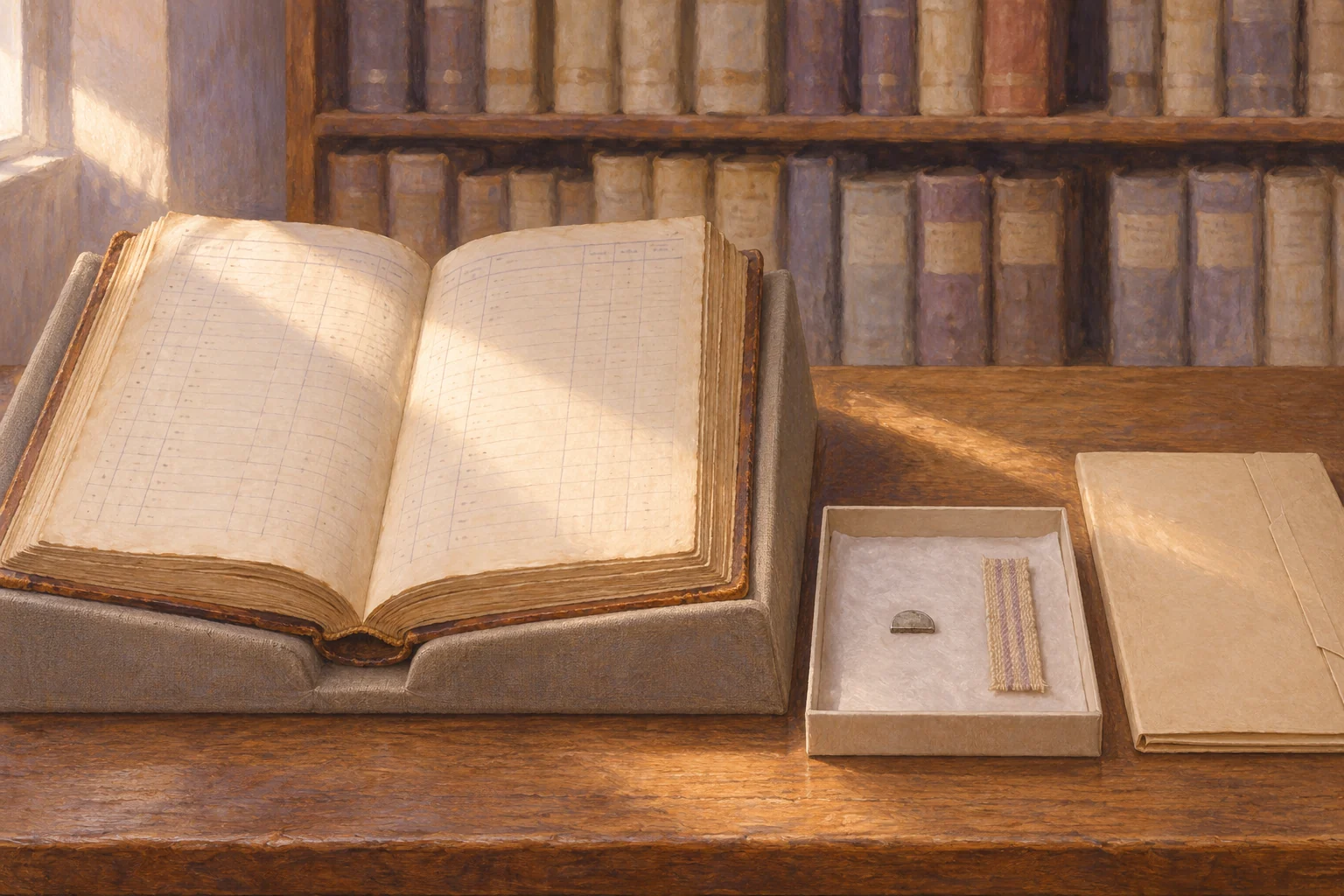 An explanatory scene linking object and record, not a reproduction of an actual file, desk or room in the archive.
The Innocenti foundation says the archive preserves more than 40,000 tokens, mainly from the nineteenth century. That is not 40,000 objects on display, nor a collection made entirely during the Renaissance.
The inventory adds another distinction. After the window for anonymous reception closed in 1875, objects continued to arrive, although their function had changed. The archival series for 1890–1921 explains this persistence. The same kind of object does not always describe the same relationship with the institution.
Keeping it without context would be like keeping a key without knowing which door it fitted. Value also lies in preserving the link between token, description and admission. Gaps do not make an archive less valuable: they remind us how far we can follow a life without finishing it in our own way.
The children above the arches
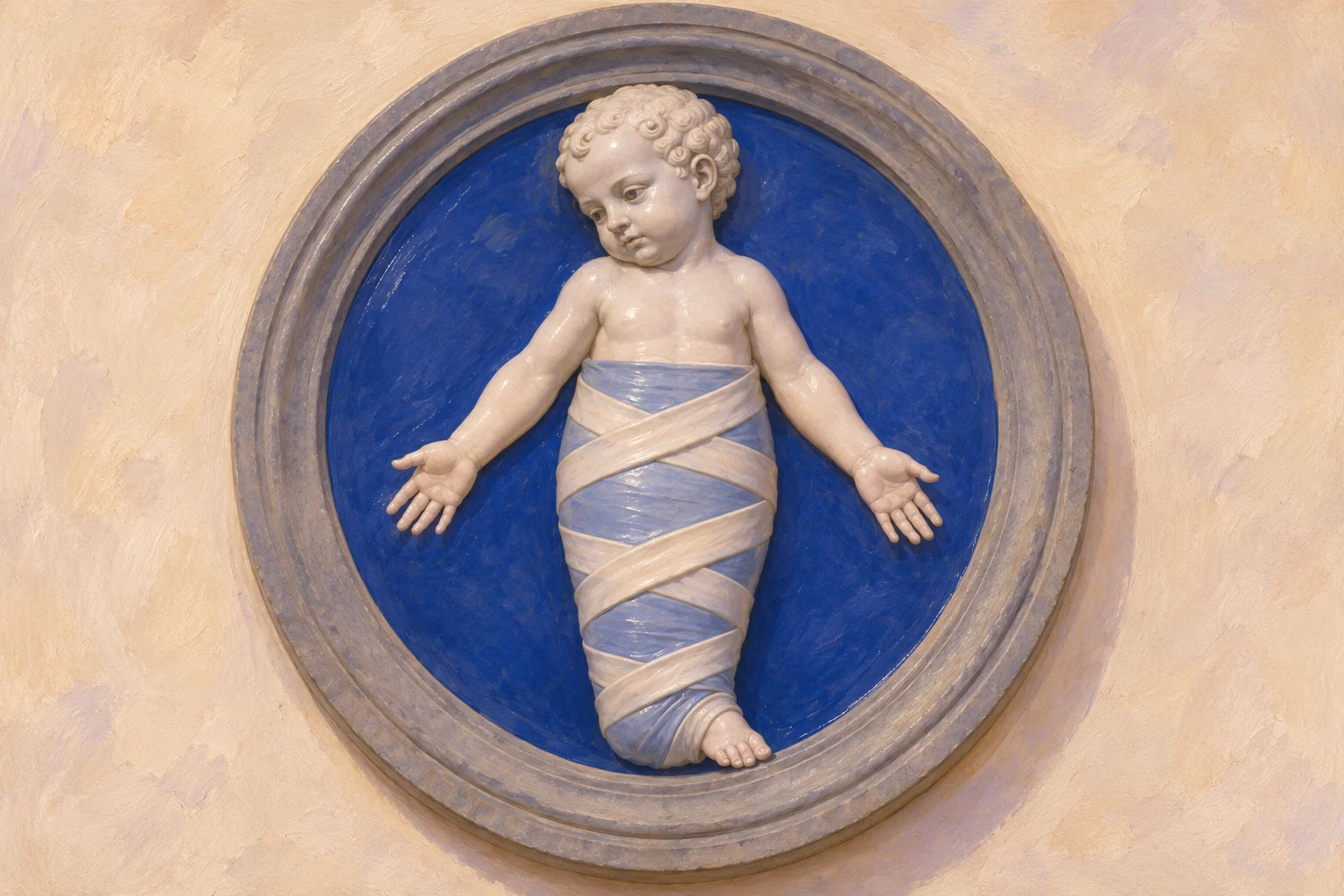 A painted interpretation of the putti motif, not a facsimile of a particular object or a portrait of an identified child.
On the facade, white figures against blue condense the identity of the place. The tondi conservation record documents Andrea della Robbia’s glazed terracottas of 1487 and the nineteenth-century Ginori additions.
The Art Bonus information explains that two originals were kept indoors after restoration. Not everything visible on the facade today has the same material history.
You can photograph the loggia’s rhythm, then return to a single circle. The overall view shows the architecture; the detail recalls whom it represented. No roundel replaces the biography held in documents inside.
How to approach this history
 An interpretation of the present courtyard from an oblique viewpoint. It depicts no scheduled activity and does not reproduce every decorative motif exactly.
The museum’s history itinerary presents tokens in an installation of small drawers and connects them with documentation. There is something different about giving attention to a modest object after seeing a monumental facade.
Before setting out, check current admission conditions and accessibility information. The historical collection, exterior and temporary exhibitions are not the same visit. If help planning would be useful, the museum also publishes easy-to-read materials.
You need not cover all of Florence in a day. Our selection of Italian cities offers other starting points; this place deserves time of its own. When you return to the square, the arches will still be beautiful. But perhaps you will also remember a small object that could not tell everything and that someone nevertheless chose to keep.
Return to the Innocenti with WAONDER Download WAONDERSection
News in context