Autumn in New York: what Central Park’s leaves cannot tell you
Elms, tiles, an angel and Bow Bridge’s curve: look beyond the autumn photograph with Central Park stories and practical notices for your next outing.
The photograph can be the beginning, not the end
You see a photograph of Central Park dressed in yellow and think: this year, I have to go. Or you live in New York, have been passing nearby for weeks, and are waiting for the day the park looks different.
Autumn offers a lovely excuse to return. But leaves alone cannot tell you who imagined that promenade, what was carved into its stairways, or why an angel ended up looking toward the water. You can take home a photograph and a story that changes your next familiar walk.
This time, we look at the Mall, Bethesda Terrace and Bow Bridge. Not to chase a postcard identical to one online, but to notice what remains when the colors change.
Take WAONDER on your next New York walkFirst, a useful warning: New York does not turn gold all at once
The I LOVE NY report for October 7–13, 2026 makes the distinction clear. It reported 30% foliage change on Manhattan’s Lower East Side and 15% in Jackson Heights, Queens. Those are observations for those places, not percentages for Central Park or the whole city. Peak color somewhere in New York State does not mean your neighbourhood park reaches it that weekend.
To choose your day, check Central Park’s foliage tracker, which distinguishes no change, changing, peak and post-peak. Check the weather and the park’s alerts, too. Reports change; there is no perfect-photo date we can promise.
If green still dominates, your outing has not failed. Choose something you want to understand as well as a color you want to find. The illustrations here evoke autumn; they do not show today’s foliage or construction conditions.
The Mall: a living ceiling that did not happen by accident
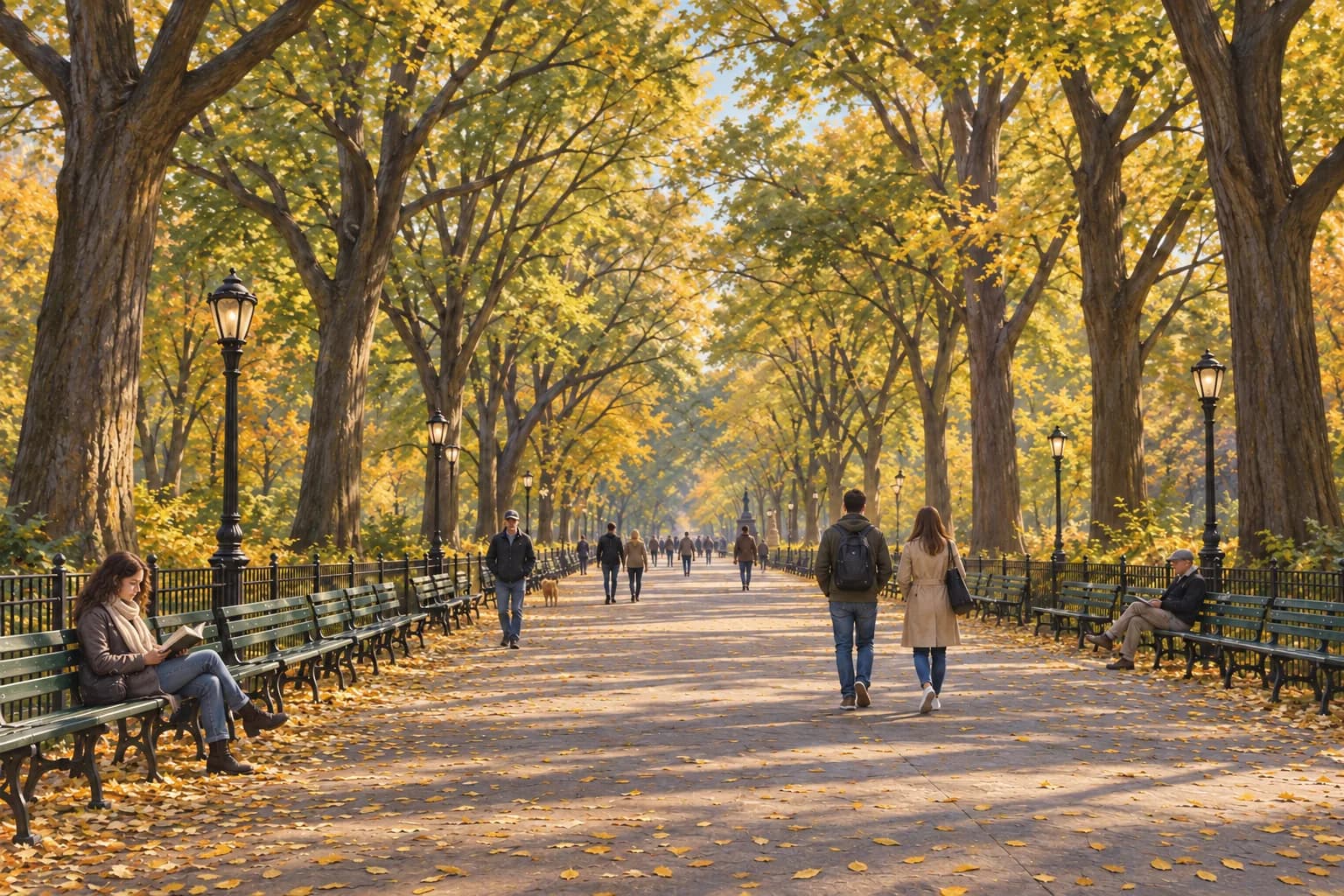 An imagined autumn morning, not a foliage bulletin. Notice the path, benches and branches: this scene has a structure.
Walk into the Mall and try something simple. Before reaching for your phone, look along the avenue. Then look up. A straight line lies beneath a web of branches that is anything but straight.
The Conservancy explains that Olmsted and Vaux designed this space as a formal promenade for walking and gathering. American elms form its leafy canopy. The feeling of being inside an outdoor room does not require walls.
That ceiling needs care. The American elm profile describes monitoring for Dutch elm disease and protecting roots from soil compaction. Respect the fences: before it becomes a beautiful photograph, this is a living tree.
A question to take with you: how does your walk change when you stop looking at separate trees and notice the space they make together?
If you know the park, compare that impression with your memory of another season. If this is your first visit, you do not need to name every species before you begin noticing. A familiar avenue can teach you something without a new place appearing on the map.
Bethesda Terrace: there are seasons in the stone, too
 Nature appears in the architecture’s decoration, not just behind it. A painted interpretation, not a record of current site conditions.
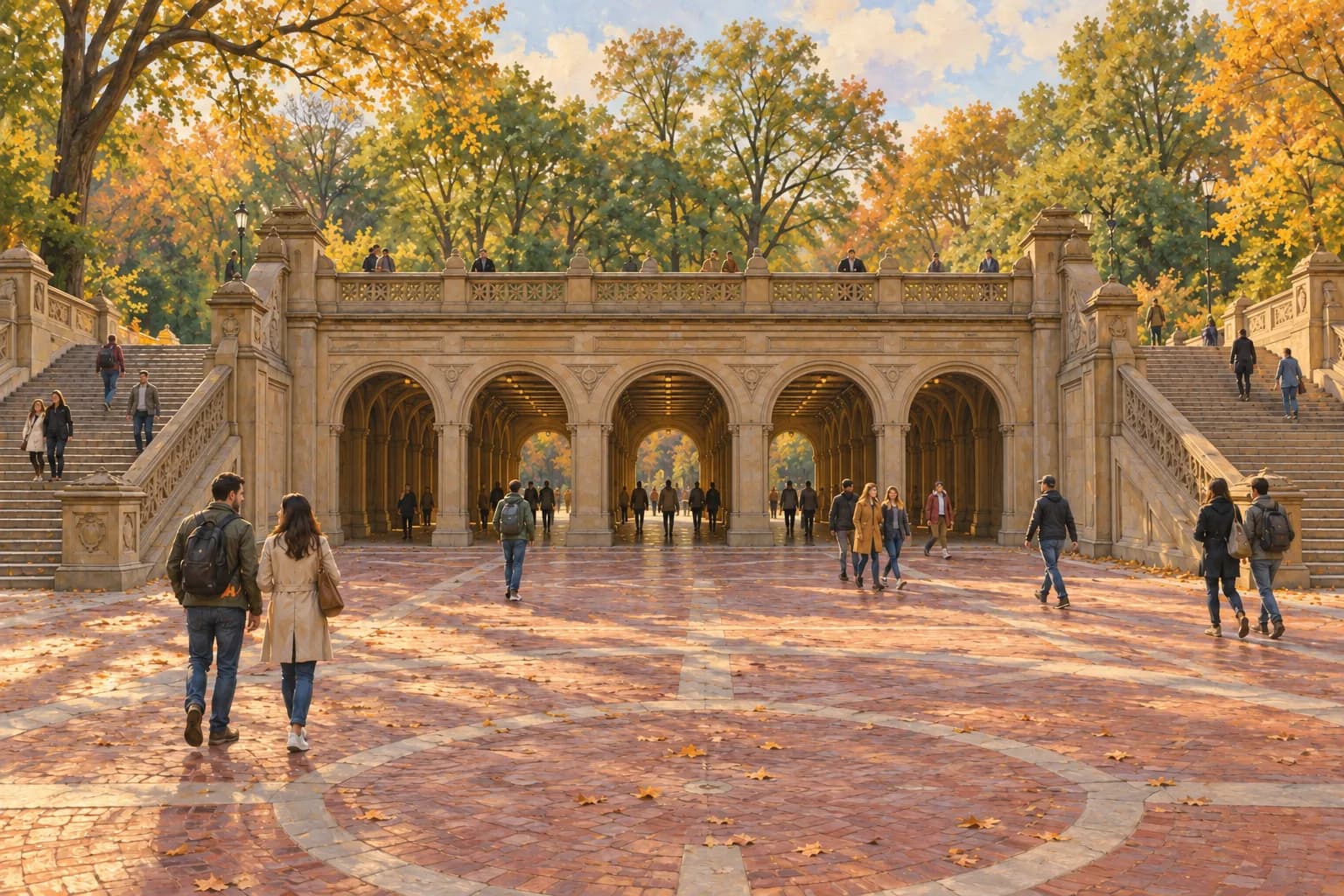
As you reach Bethesda Terrace, change scale. From large branches to the details of a railing. Autumn here is not only something that falls to the ground: it can also be sought in stone.
The Terrace description credits Calvert Vaux with its design and Jacob Wrey Mould with its carvings. Stairways and piers carry seasonal motifs: fruit, flowers, plants and birds. You do not have to turn your visit into a symbolism exam. Find a plant detail and consider why someone placed it beside a landscape that really changes.
Next time a leaf makes you stop, give a relief the same attention. No touching or climbing the carvings: looking closely is enough.
A ceiling worth losing a minute to
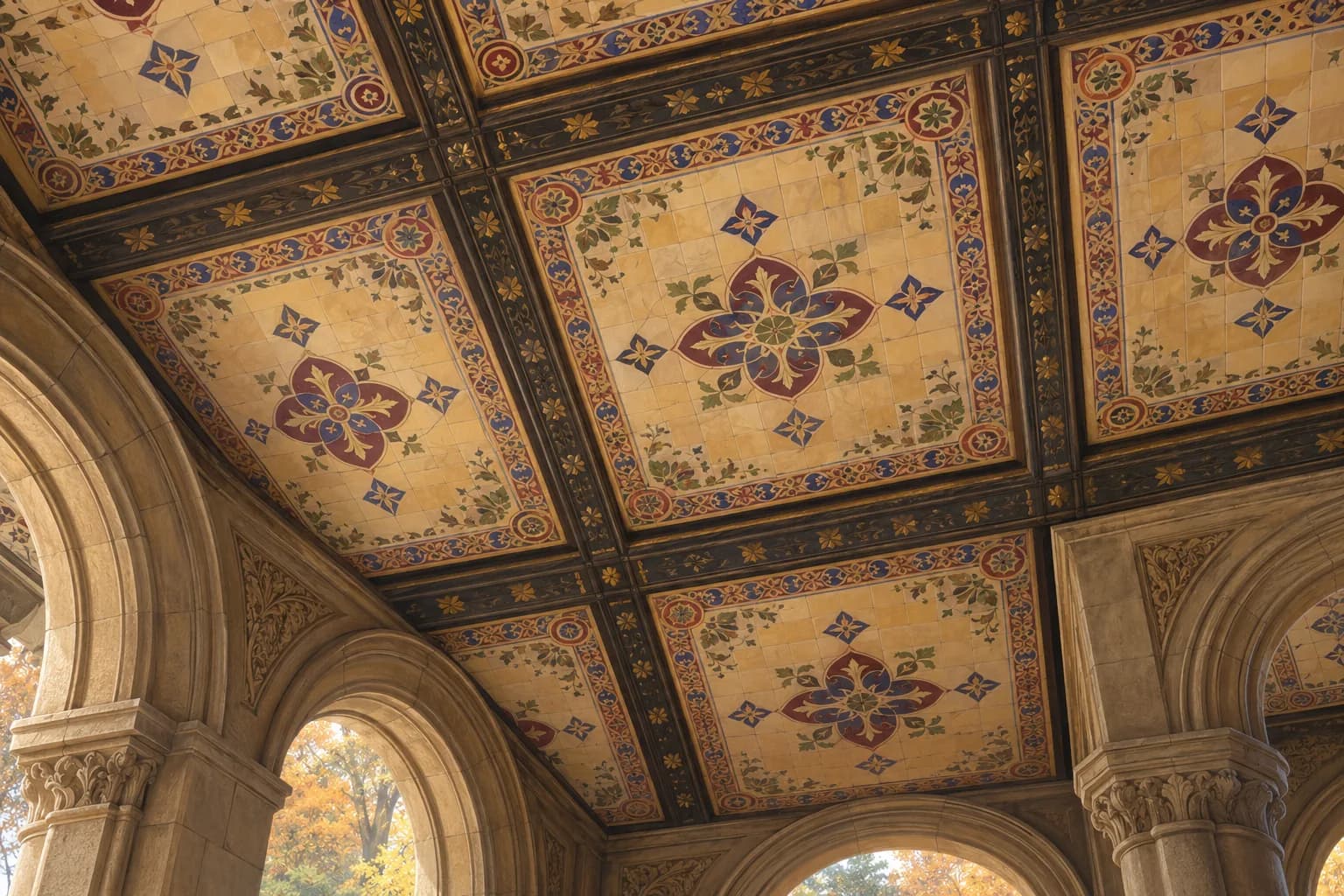 An interpretation of the panels and their family of patterns, not a tile-for-tile copy. This is a flat ceiling, not a painted vault.
If the passage is open, step into the Arcade and look up. The Conservancy’s account of the ceiling describes almost 16,000 Minton tiles arranged in 49 panels, patterned with colored clay. Its restoration was completed in 2007.
The number is impressive; what you can do with it is smaller. Choose one panel, follow its pattern, then see how it repeats. You came looking for color in the canopy and found it overhead, made by human hands.
Do not block the passage while framing it. Sometimes putting your phone away for a few seconds leaves a clearer memory than trying to fit the entire ceiling into one picture.
The angel: when the story matters more than running water
 An illustrated study of Emma Stebbins’ sculpture. It does not document current works or guarantee an unobstructed view.
At Bethesda Fountain, an angel extends a hand. It is easy to see a lovely gesture and move on. Knowing what it celebrates gives you another way to look.
The Fountain profile explains that Emma Stebbins created Angel of the Waters and that it was dedicated in 1873. The fountain commemorates water arriving through the Croton Aqueduct in 1842; the lily refers to purity. A delicate image connects to an essential urban need: clean water.
Pause over that difference. The photograph can preserve the wings. The story lets you remember why they are there.
Notice checked October 11, 2026: the Conservancy reports a restoration begun in August 2026. The fountain is turned off; according to its institutional notice, the Terrace remains open. Do not arrive expecting cascading water, or assume the works leave every detail visible. Check the notice before going; we are not promising a reopening date.
Find Bethesda Fountain in WAONDERBow Bridge: step outside the frame to understand the curve
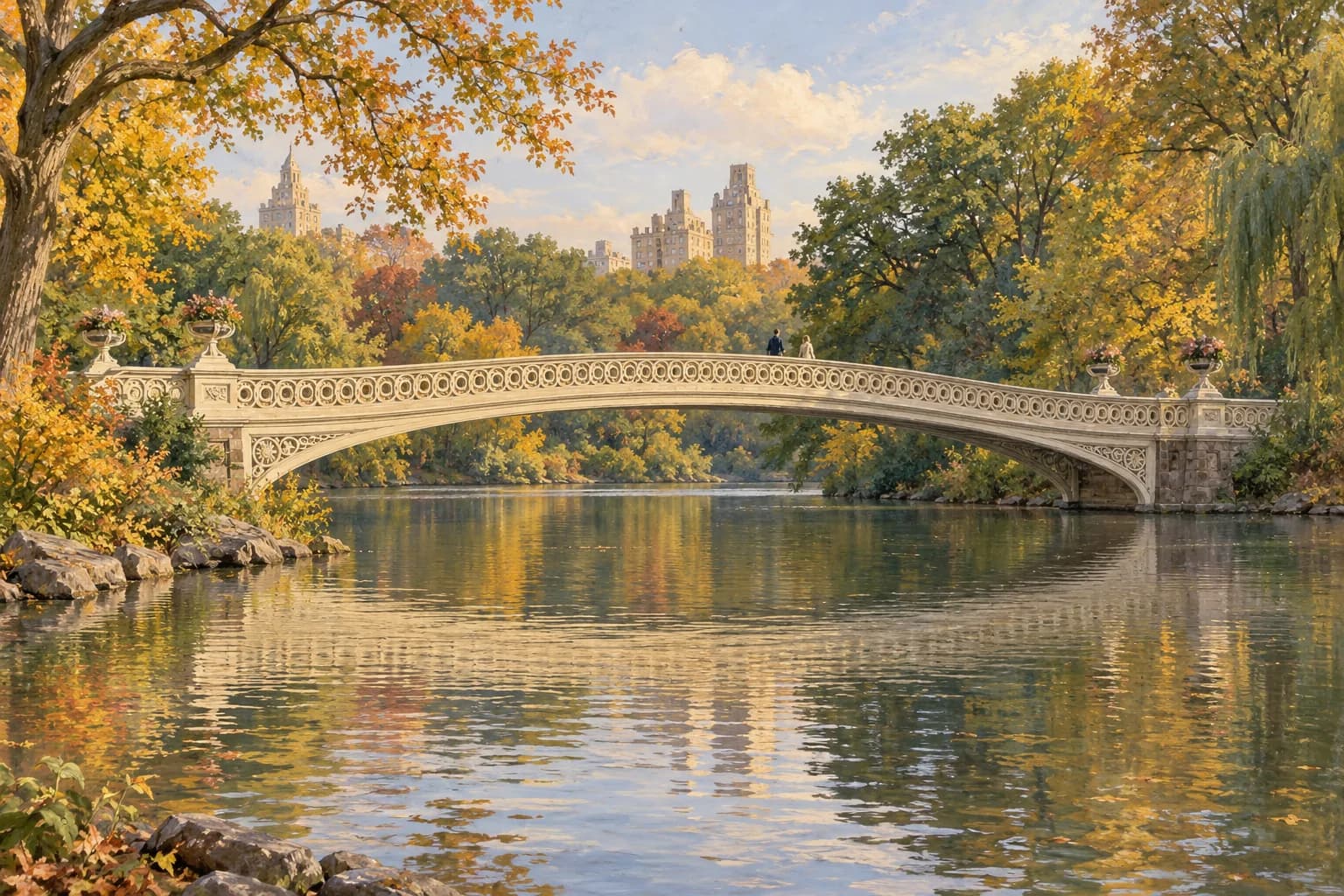
Bow Bridge might be where you take your favorite photograph of the day. Take it. Then, if conditions allow you to cross, notice something less obvious than the leaves: its low profile and railing.
The Conservancy describes its gentle bow-like curve and connection between the Bethesda area and the Ramble. The bridge does more than look lovely in a reflection. It lets you move from one part of the landscape into another.
 Another view of the same bridge: a practical railing can have a pattern worth pausing over.
Try two views: from the shore, follow the whole curve; from the deck, notice how ornament accompanies something that protects you from the edge. These are two ways to understand one object. One needs distance; the other needs attention.
Do not block the bridge to get them. If it is crowded, keep the first and return another day for the second. For someone who lives here, being able to come back is part of the pleasure. You do not have to discover everything at once.
Find Bow Bridge in WAONDERYour next outing does not need perfect peak color
Choose just one question: the Mall’s living ceiling, a Bethesda motif, or Bow Bridge’s curve. Use the official map to locate it and check alerts. This selection is not an automatic in-app route or an accessibility-verified itinerary. We have not made a field visit to confirm every passage is open.
If curiosity remains, continue with Balto’s Central Park story for another outing, or explore more New York places in WAONDER. There is no need to add everything to the same morning.
WAONDER can accompany that moment when a place stops being background and becomes a question. Place buttons lead to their shared links; if you need to install the app, the download buttons bring together Android and iOS. Opening depends on your device: installation does not guarantee that it resumes the previous place automatically.
Take the photograph. And, if you can, something that will not show in it: a reason to look again.
Download WAONDER and return with another questionSection
News in context