Brooklyn Bridge: the woman who helped bring New York together
Emily Warren Roebling studied plans, relayed engineering decisions and defended the project. Discover the human story behind Brooklyn Bridge and where to remember her work.
Among all those cables, there is a life to remember
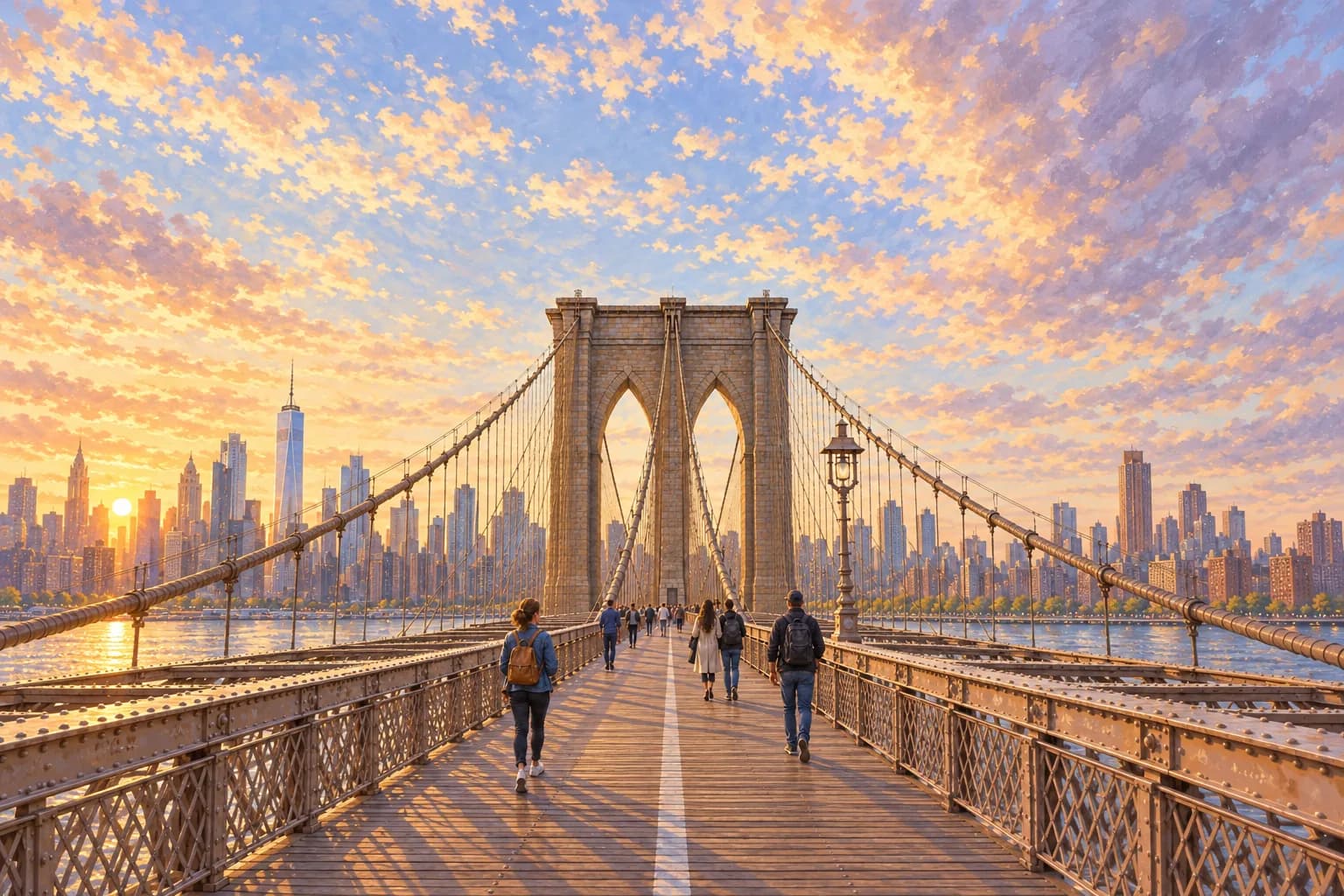
On Brooklyn Bridge, the cables draw your eyes upwards. Then come the twin stone arches, the river, the city. You can cross many times and still find a different view.
But there was a time when that view did not exist. The bridge was under construction, its chief engineer had fallen ill, and work had to continue without him beside the towers. Emily Warren Roebling helped keep together the instructions, people and decisions that brought the bridge to completion.
She did not design it single-handedly. Her story is more interesting than that shortcut: she learned what she needed to take part in an extraordinary undertaking, then sustained a responsibility for years that does not show up in photographs of the skyline.
Next time you walk beneath those arches, there is a name worth taking with you.
Find Brooklyn Bridge in WAONDERBefore the bridge: two cities and a river
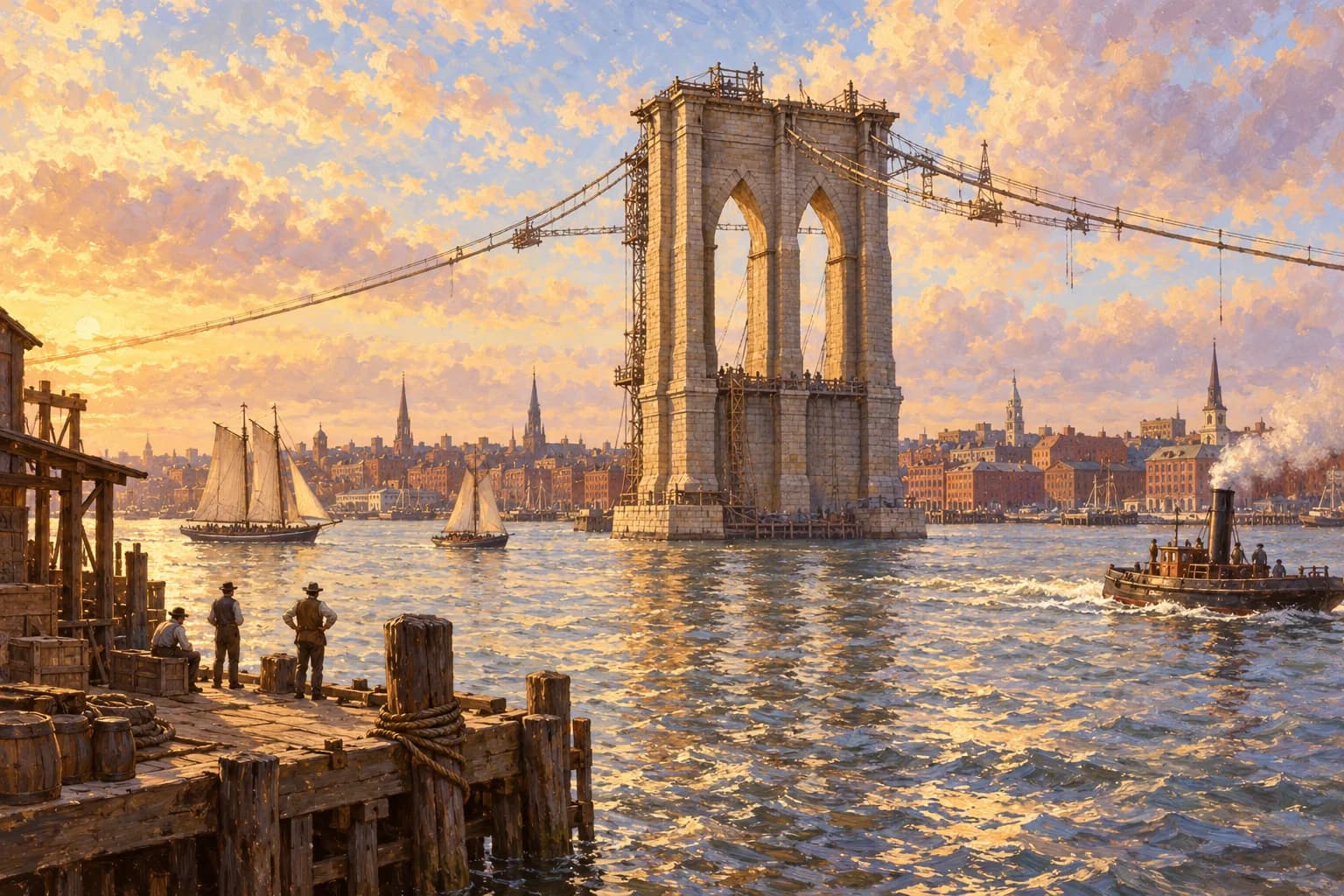 The river during construction: an evocation of the late 1870s, not an exact reconstruction of a documented day.
Today, the connection seems natural. In the nineteenth century, building it meant imagining something that was not yet part of the landscape: a crossing above the East River between the then separate cities of New York and Brooklyn.
The design was John A. Roebling's. NYC DOT's history dates construction to 1869–1883. That is an easy interval to read; a much harder one to live through on a building site.
John did not see it finished. He died in 1869, and his son Washington took over as chief engineer. The family archive described by NYU and the Center for Brooklyn History traces that handover: from the generation that conceived the bridge to the one that had to turn it into stone, cable and a way across.
Look at the weight of a tower. Follow a cable out towards the middle of the river and notice the distance. Between those two things lies the problem they had to solve, not merely a beautiful silhouette.
The work beneath the water
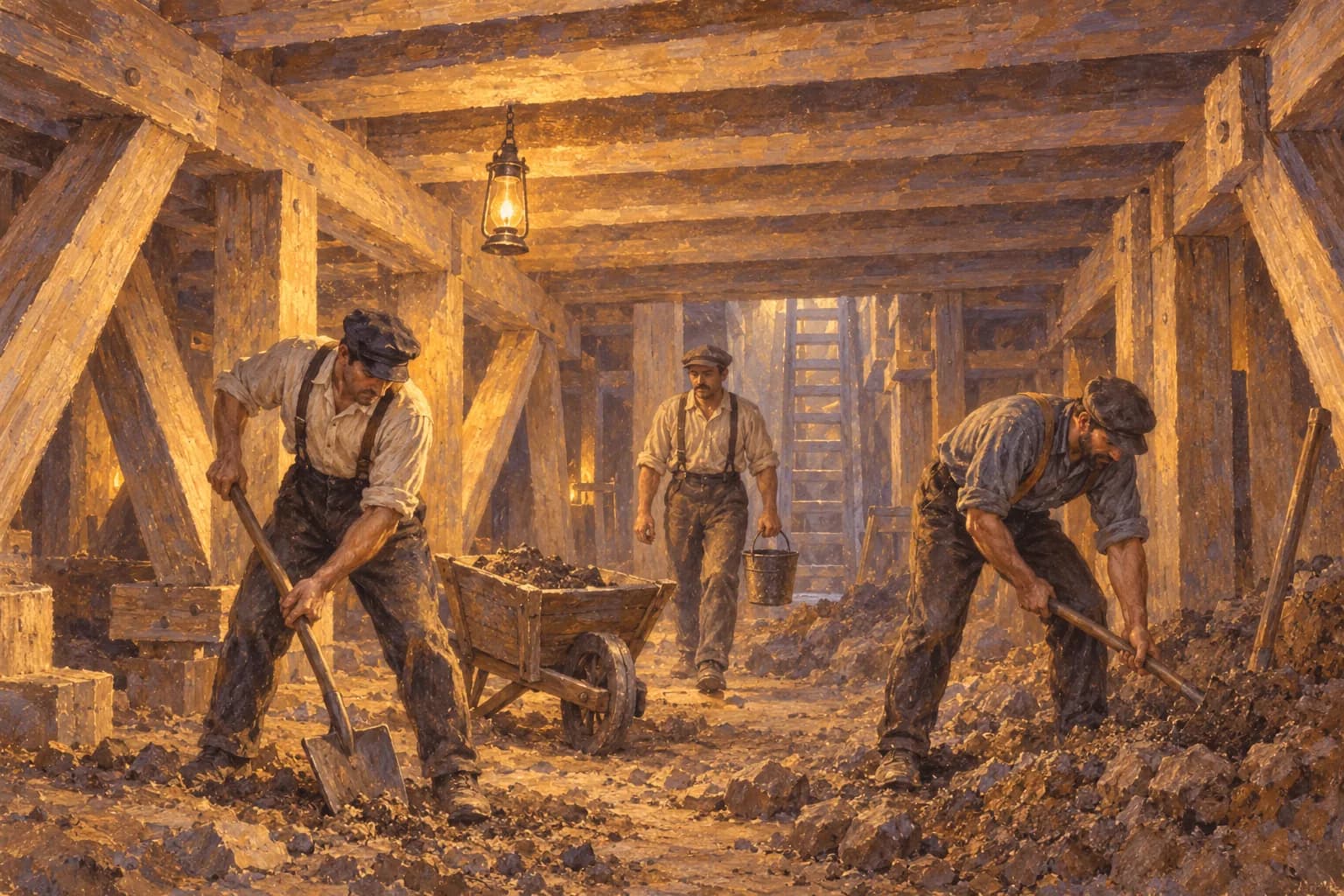 The labor beneath the towers: an evocation of a foundation caisson interior, informed by 1870 engravings; not a technical diagram.
Before the towers could support the bridge, their foundations had to be built. Large caissons contained pressurized chambers where workers excavated the riverbed. Illustrations from 1870 held by the Library of Congress show a world of beams, tools, compartments and manual labor very different from the apparent lightness of the cables seen from shore.
Washington entered those spaces too. In 1872, he suffered severe effects of what was called caisson disease, associated with decompression. According to the correspondence archive, the illness eventually prevented him from visiting the construction site again.
The journey from home to bridge was no longer one he could make. From his Brooklyn Heights residence, he watched the work through a telescope while retaining technical leadership.
The problem was not only how to hold a structure above the water. It was also how to keep building when the person directing it could no longer be there.
Emily learned to understand what she was carrying
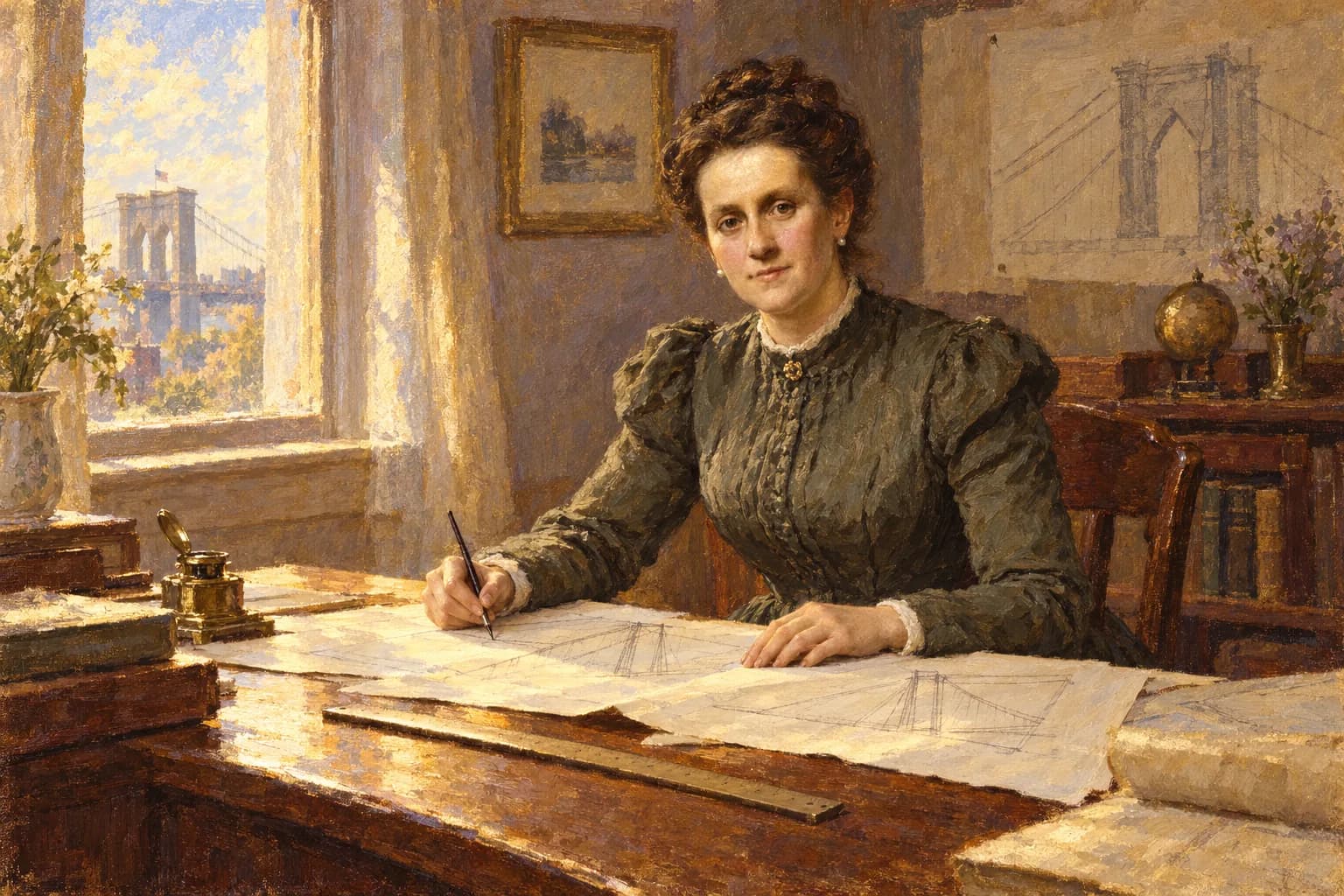 Emily and the work of the plans: an evocative scene, with her appearance informed by later portraits, not a photograph of this room.
Emily did more than carry a sheet of paper from a house to an office. To communicate instructions with authority, she needed to understand them. NYU's archive describes the engineering knowledge Washington taught her so she could act as an informed intermediary.
The biography researched by Brooklyn Bridge Park makes that work concrete: studying plans, copying specifications, writing and explaining instructions to assistant engineers. She also dealt with contractors and representatives of the project.
The bridge grew outside; some of the effort keeping it moving happened among documents and conversations. An instruction needed to arrive clearly explained. A difficulty on site needed to travel back with enough precision to be resolved.
In 1881, Emily led the bridge trustees along the new elevated promenade, according to that same biography. The place where we now walk to look at the river was still a work in progress that needed explaining. She could explain it. The woman who had learned to read its plans could also show what was taking shape above the water.
In 1882, when Washington's prolonged illness put his position as chief engineer in jeopardy, Emily defended his continued appointment. Brooklyn Bridge Park records her role in that defense. She was not an ornamental presence beside a famous surname: she was involved in keeping the work going.
Nor was this a one-person achievement. Assistant engineers, laborers and manufacturers made the whole possible. NYU's account of alumni associated with the bridge, for example, remembers James J. Wood and Arthur V. Abbott for machinery and systems used in its cables. Remembering Emily does not require forgetting the people who worked alongside her.
A carriage crossing what had once been a promise
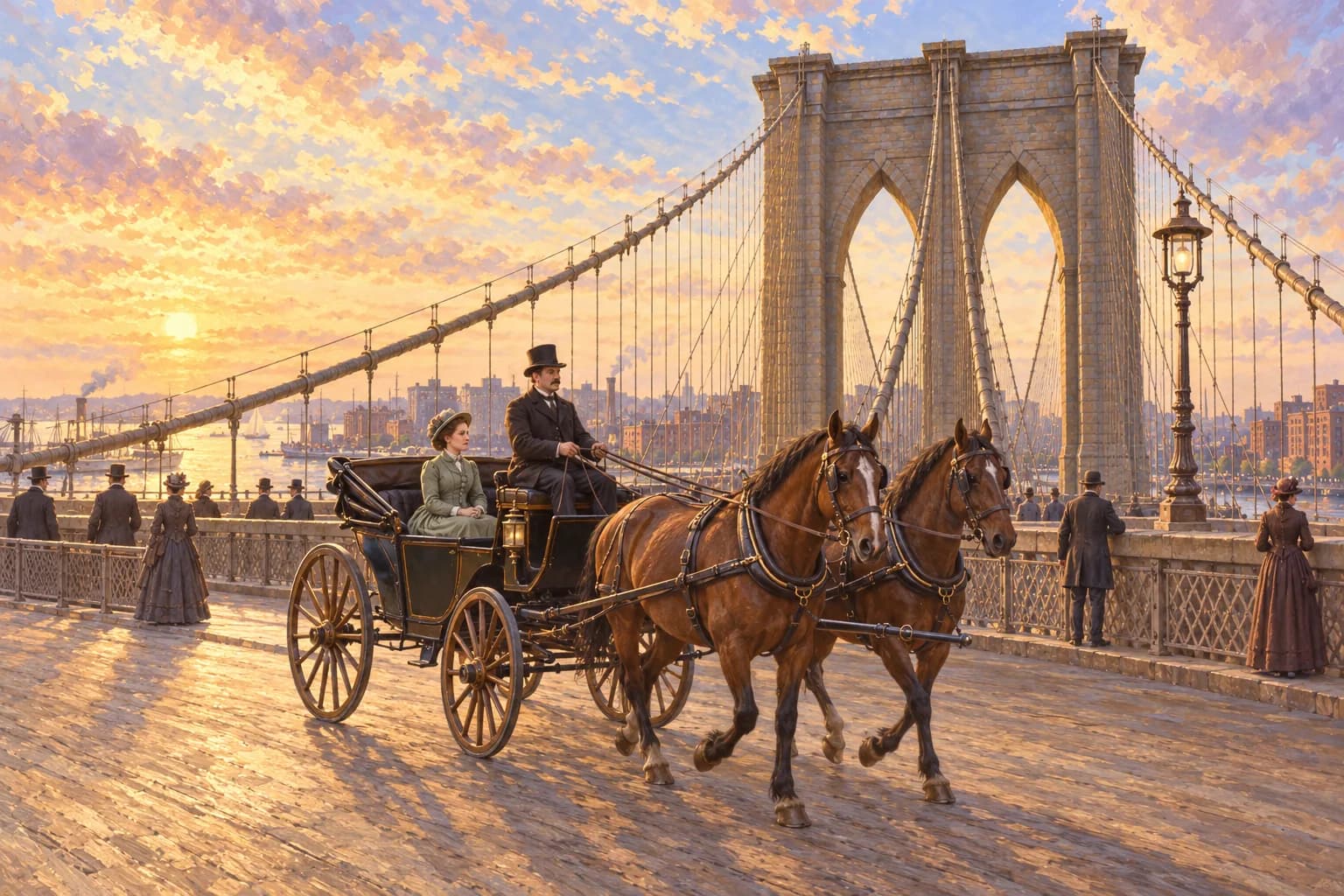 The opening of 1883, evoked in paint: not a reproduction of a photograph or of the exact route taken by Emily's carriage.
The bridge opened on May 24, 1883, a date recorded by the Library of Congress. That day, the connection stopped being a project watched from the riverbanks. People could cross it.
Brooklyn Bridge Park places Emily in the first carriage at the opening. That does not make her the first person ever to set foot on a structure already used by workers. It means that, when the bridge was presented to the city, her work had a visible place.
And it was recognized at the time. The Brooklyn Museum's account recalls the honor she received at the inauguration. Telling the story as if nobody knew about her until recently would remove another part of it: her contemporaries knew of her contribution too.
There is a vast distance between a plan and an open crossing. Emily was present at both ends: in the patient work of understanding and communicating, and in the public moment when people could travel across the result.
Her life did not end on the other side
In 1899, Emily completed NYU's Women's Law Course and received a certificate, according to the university's account. Her life could not be contained within the role of an engineer's wife.
She also wrote A Wife's Disabilities, an essay criticizing legal restrictions affecting married women. A historical study published in NYU Law Review places it in the context of that legal education.
There is no need to turn every episode into a lesson to see the continuity: the woman who spent years understanding a great construction project kept seeking tools to understand and challenge the world she lived in.
The bridge gives us a way to remember her. On its own, it cannot tell everything she was.
Two ways to look at the same place
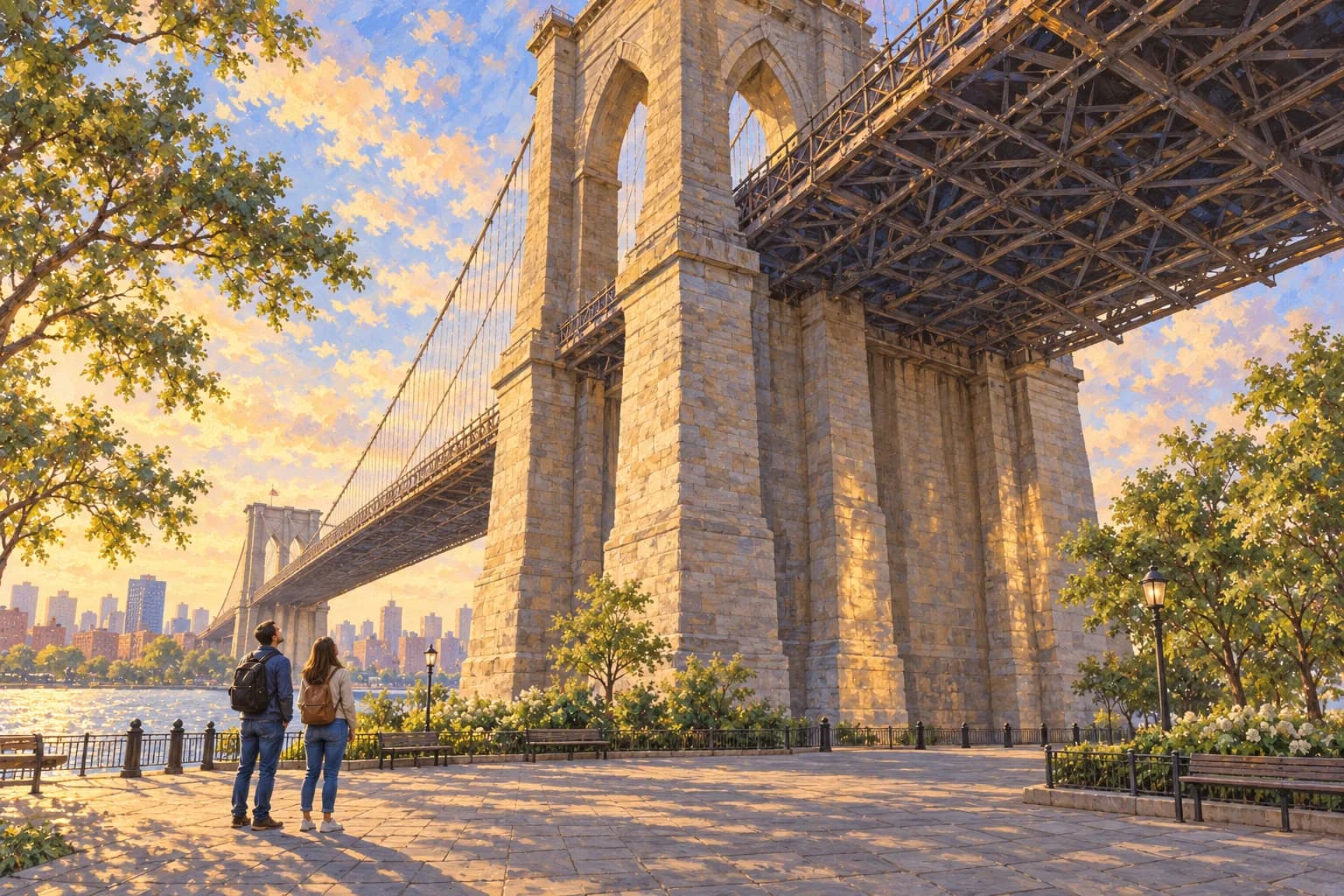 Returning to the bridge from below: a painterly interpretation of today's plaza and its scale, not an exact photographic view.
From the raised promenade, look at the towers' twin pointed arches and the different directions of the cables. The Library of Congress engineering record explains how diagonal stays supplement the suspension system. What looks like a drawing against the sky also performs a structural task.
To remember Emily another way, find Emily Warren Roebling Plaza in Brooklyn Bridge Park, beneath the bridge. The park opened this space on December 9, 2021. Here, the scale changes: instead of crossing above the river, you look up at the structure that makes the crossing possible.
The bridge promenade and the park plaza are separate places; continuing along the deck does not bring you into the plaza. Use the bridge information and the park map to plan your way and check notices before setting out. Keep the walkway clear when you stop; the protected cycle lane is separate from the pedestrian promenade.
If this is part of your city, you do not need to wait for an out-of-town visitor to return. And if you want to keep discovering the lives behind its buildings, Grand Central's painted sky holds another story of work often left above our daily rush. Our New York selection offers other places to start.
Your next photograph may still show the river, the cables and the towers. Now you will also know someone worth remembering as you look at it.
Explore Brooklyn Bridge in WAONDERSection
Stories behind places