A San Francisco waterfront walk: from the Ferry Building clock to Cupid’s Span
Three stops beside the bay: the market, Pier 14, and Cupid’s Span. A flexible walk to discover stories and see your city differently.
A clock, a pier, and an arrow: another way to see the bay
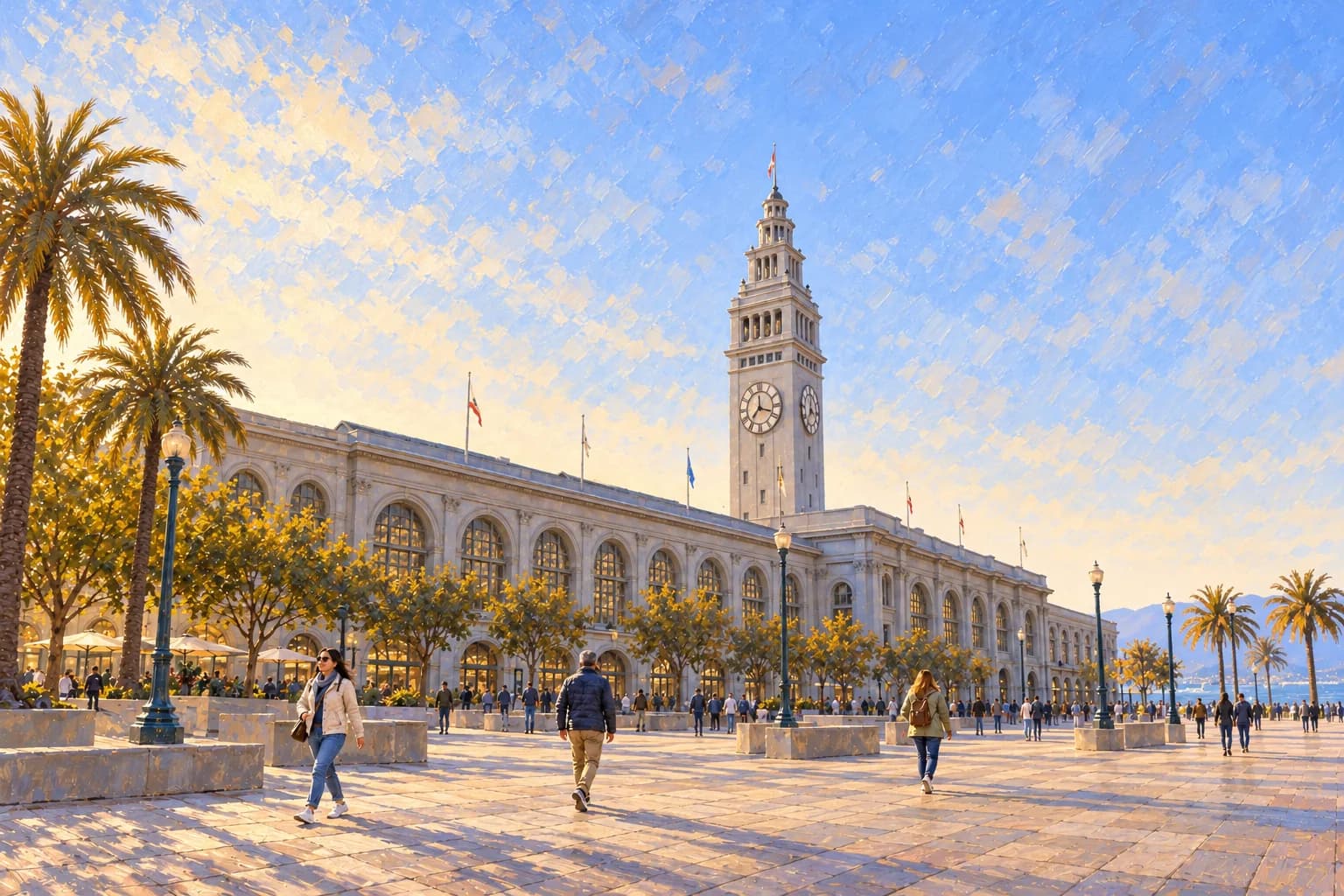
Some walks do not need a list of ten must-sees. On San Francisco’s Embarcadero, you can begin beneath a clock, take a few steps out over the water, and finish beside an arrow that seems to have found the city instead of its target. The Ferry Building, Pier 14, and Cupid’s Span offer three different ways to look at the same bay.
Set aside an hour to an hour and a half to leave time for pauses, rather than following a timed itinerary. Add the market, choose just one stop, or return another day. This is a San Francisco walk, not an attempt to cover the whole Bay Area.
Download WAONDER for your next walkBefore you go: choose the morning you want
The order is straightforward: Ferry Building → Pier 14 → Rincon Park. From the building, follow the Embarcadero promenade south with the bay beside you. Pier 14 is an out-and-back detour over the water; return to the main promenade before continuing to Rincon Park, between Howard and Harrison. MTC’s Bay Trail guide places the stops in that sequence.
- Ferry Building: look at the clock and the facade’s arches. The bay becomes an everyday entrance to the city.
- Pier 14: notice the pier and its supports, then turn toward the city. Moving over water changes the perspective.
- Rincon Park / Cupid’s Span: find the buried arrow and the bow’s tension. A familiar object becomes strange through its scale.
To include the Ferry Plaza Farmers Market, Foodwise lists 8 a.m.–2 p.m. on Saturdays and 10 a.m.–2 p.m. on Tuesdays and Thursdays, in San Francisco local time. These hours were checked on October 17, 2026: confirm them before setting out. The outdoor market and the building’s indoor businesses are different, and individual businesses do not all share opening hours.
If you choose a Monday, do not plan around that farmers market: enjoy the outdoor walk and save the market for another day.
The walk makes sense without buying anything. A light layer for the wind, comfortable shoes, and time to look may be more useful than trying to reach each stop at an exact minute.
Ferry Building: when the clock was a gateway
The tower is visible well before you reach it. Once you are close, look at the long facade and its arches, too: the building is more than the clock that usually claims the photograph.
The Ferry Building opened in 1898 as a terminal. Bridges and cars reduced the role of ferries; an elevated freeway eventually stood between the city and the facade. Damaged in the 1989 Loma Prieta earthquake, that roadway was subsequently demolished. The restored building reopened as a marketplace in 2003, according to its official history.
That transformation changes what you see today: a place associated with arriving and departing also became somewhere to stay. You can explore that difference through a simple observation. Look at the clock, then at people passing beneath it who are not necessarily traveling.
 An imagined market morning; it does not portray identified vendors or a specific trading day.
The market brings smaller details into focus: from a tower to a box of fruit, from the bay to a conversation beside a stall. It need not become a hunt for the perfect purchase. Stop to buy something, or simply take a look at the building from the water side.
Explore the Ferry Building in WAONDERPier 14: walk toward the water to see the city again
Continue south and find the entrance to Pier 14. Check the signs before entering: access can be closed. If there is a barrier or notice, stay on the main promenade. The outing does not depend on completing every stop.
The pier is more than a viewpoint. Its designers, ROMA, explain that it combines a breakwater and promenade, and that they designed swiveling metal seats to let people change direction. Infrastructure protecting the waterfront also creates somewhere to pause and look at it.
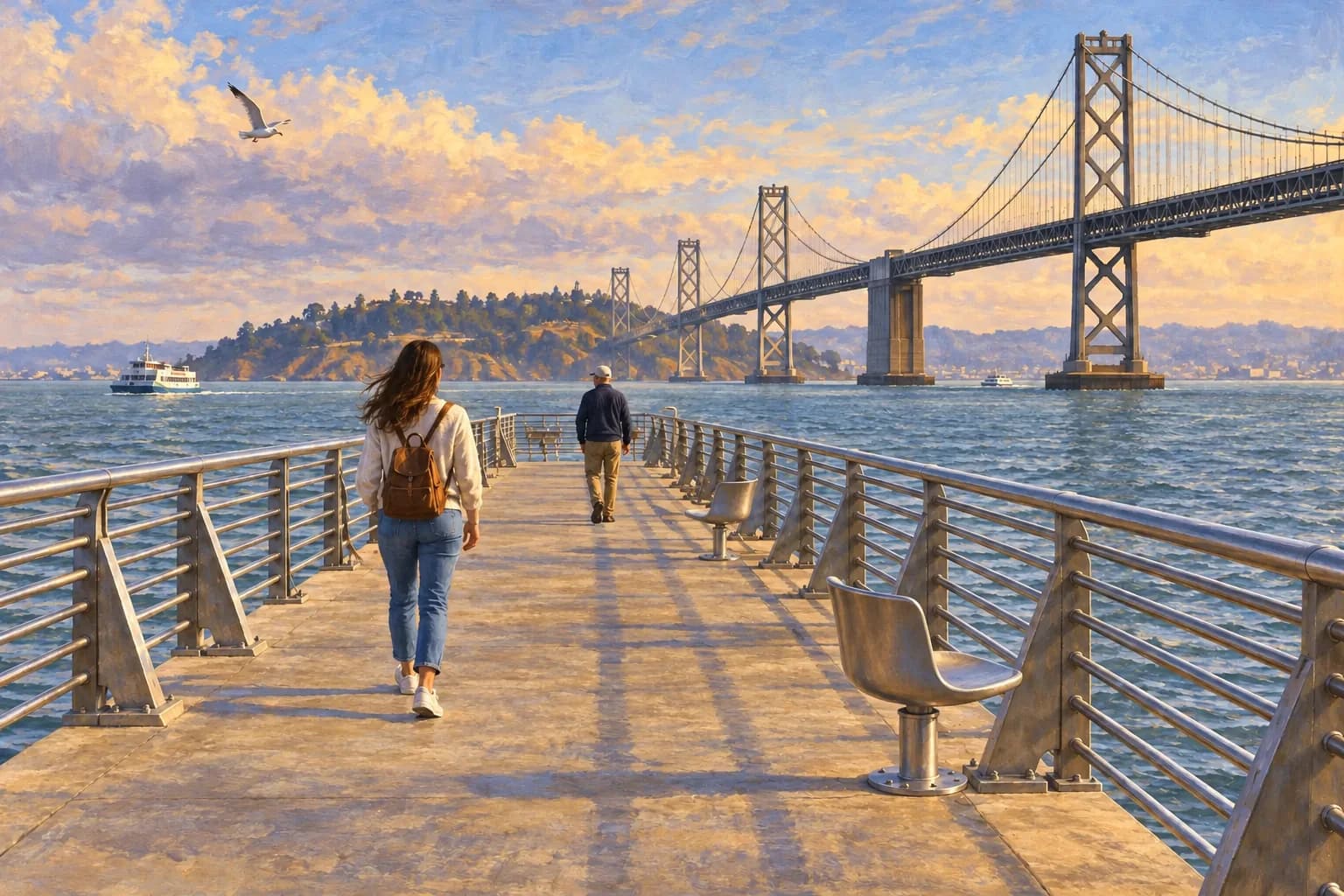 An illustration of the pier and bridge; check access and conditions at the site.
Try something that does not require reaching the end: walk to a comfortable point and turn around. The clock, the line of buildings, and the city’s edge relate differently when seen from over the water. Then face the bay again and find the towers and cables of the Bay Bridge, distinct from the Golden Gate that so often dominates images of San Francisco.
Stay inside the railings and leave space for other people. A good photograph does not require approaching an edge or occupying the pier’s full width.
Discover Pier 14 in WAONDERCupid’s Span: the arrow is not flying
Back on the Embarcadero, continue toward Rincon Park. The Port of San Francisco describes its lawns, paths, and benches facing the bay. Here the walk changes tone: an enormous bow appears, the work of Claes Oldenburg and Coosje van Bruggen.
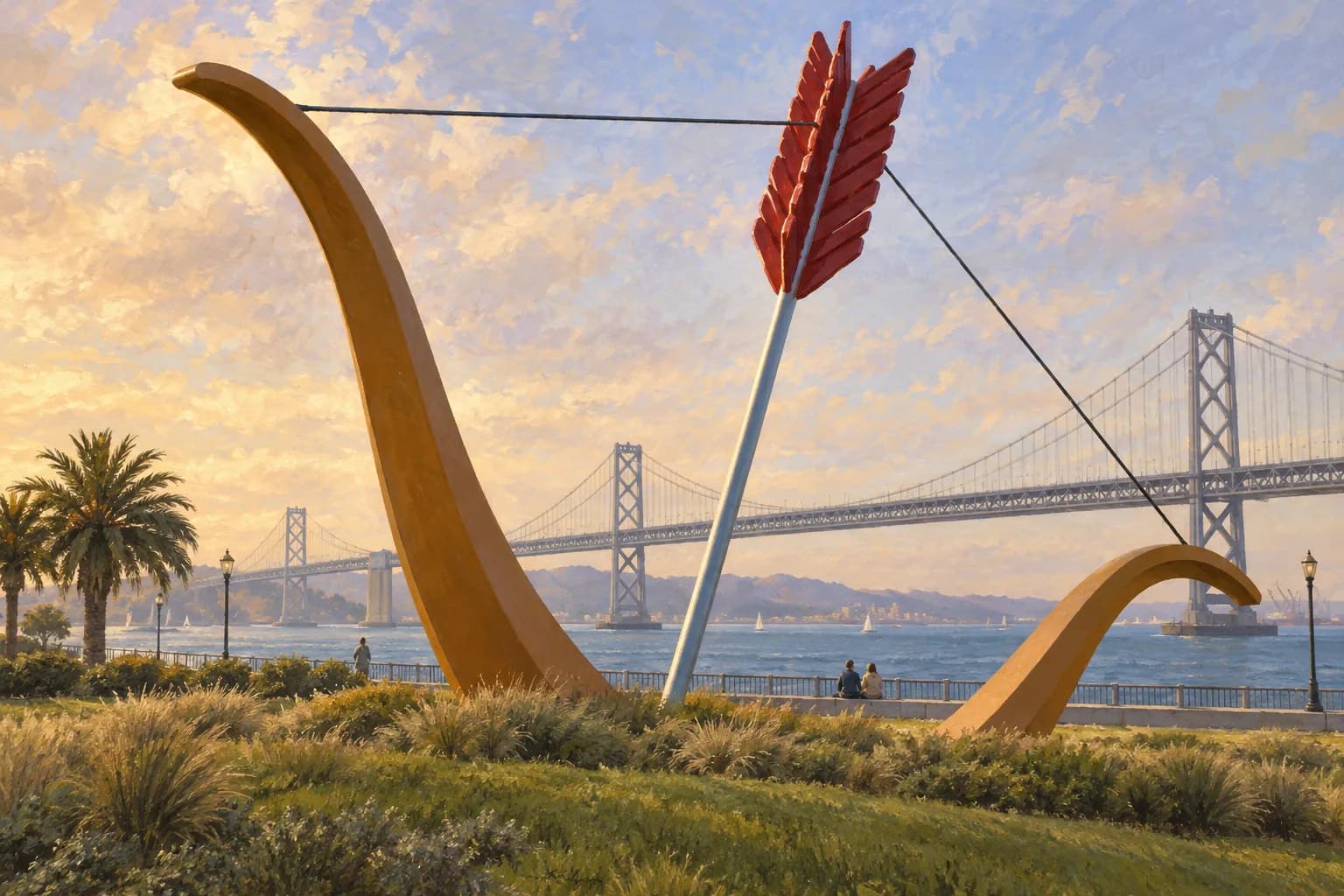 A painterly interpretation of the sculpture: the arrow’s point is buried, not floating in the air.
Look at the red part first: it is the arrow’s fletching, not its tip. The shaft slopes toward the ground and the bow emerges partly from it. That change in orientation transforms a familiar object: instead of appearing ready to fire into the sky, it directs attention toward the city itself.
SFMOMA’s explanation of the work’s scale model connects its forms with the nearby bridge and a sailboat. Look for those echoes in the taut cables, curve, and tilt. You do not have to see precisely the same thing for the place to become more interesting: you have already moved from recognizing a bow to wondering why it takes this form.
Find another angle from the path. The bridge can enter or leave the frame, changing the relationship between sculpture and bay. Keep your exploration to the walking spaces; there is no need to climb the artwork.
Take another look at Cupid’s Span with WAONDERA walk you can repeat without seeing it the same way
You can finish on a bench or head back to the Ferry Building. Use this selection as a starting point for a walk at your own pace: the WAONDER buttons link to each place separately, not to a combined route.
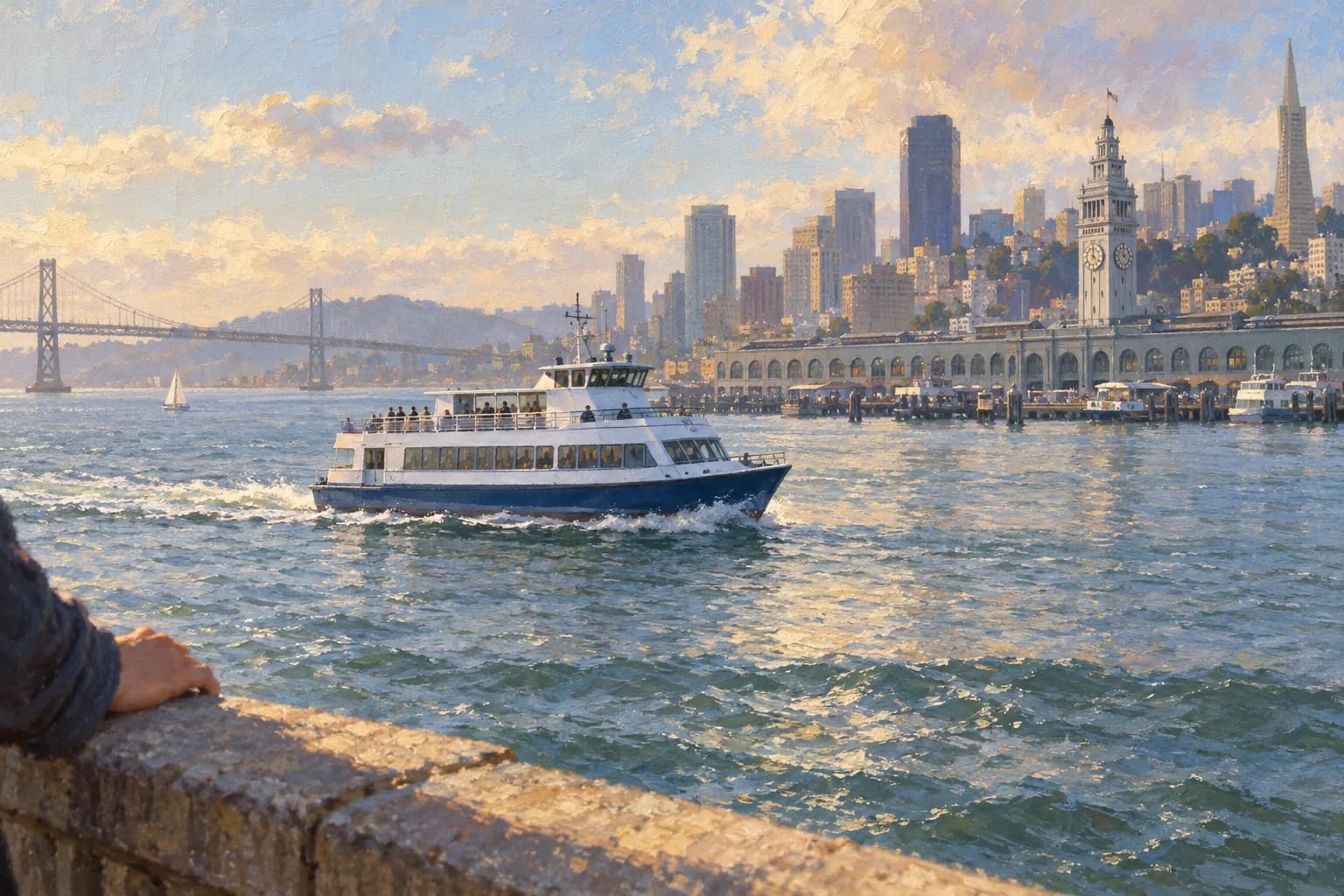 An evocation of activity on the bay, not a specific ferry departure or timetable.
Next time, you could begin with the market; another day, give the pier or bow’s shapes more attention. The appeal of a recurring walk is not that a new monument appears each time, but that what you recognize in a familiar one changes.
Our selection of places around the Bay Area can extend your curiosity beyond this stretch. For today, one question is enough: what had you overlooked in a place you thought you knew?
Bring WAONDER on your next walkSection
Ideas for city walks