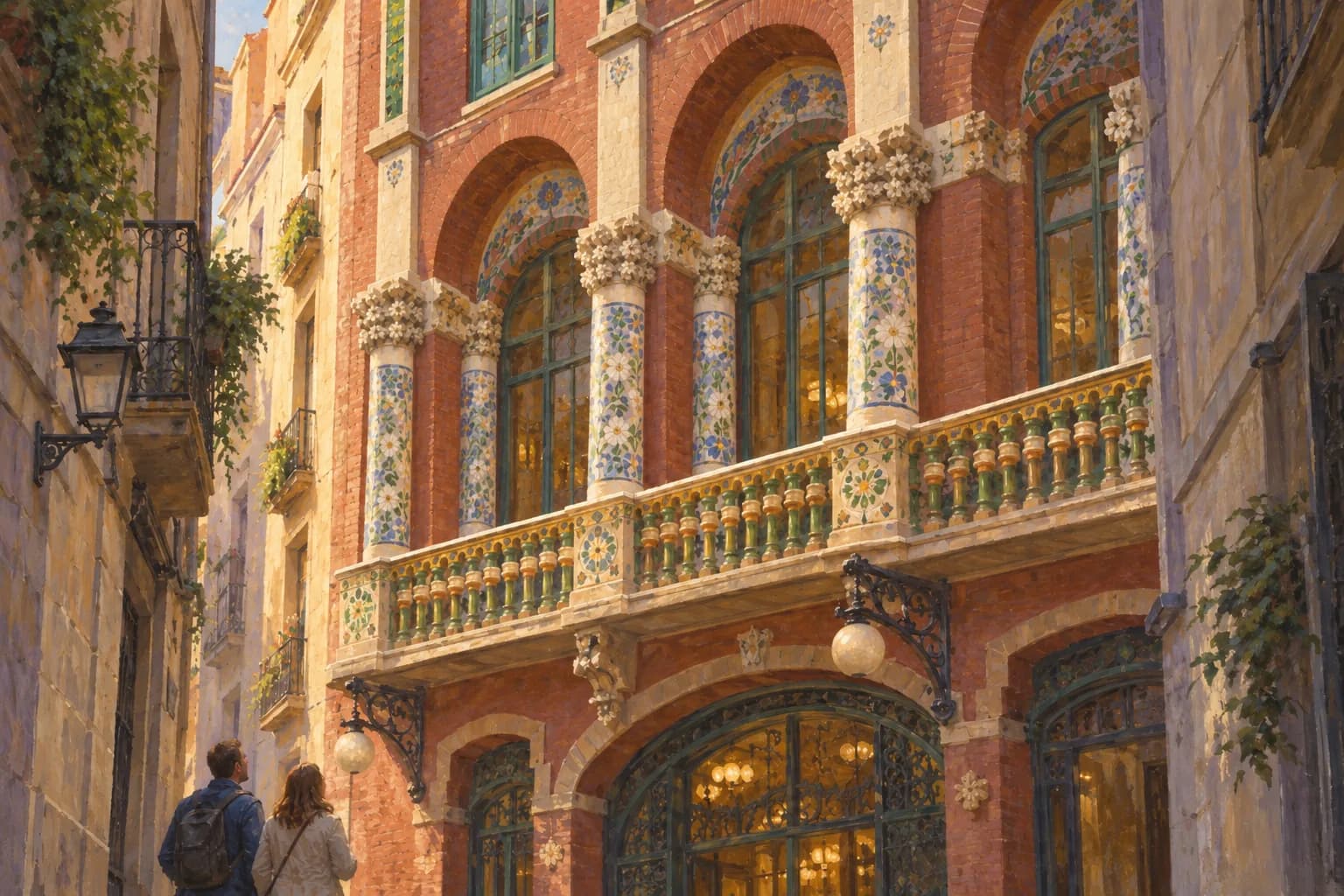
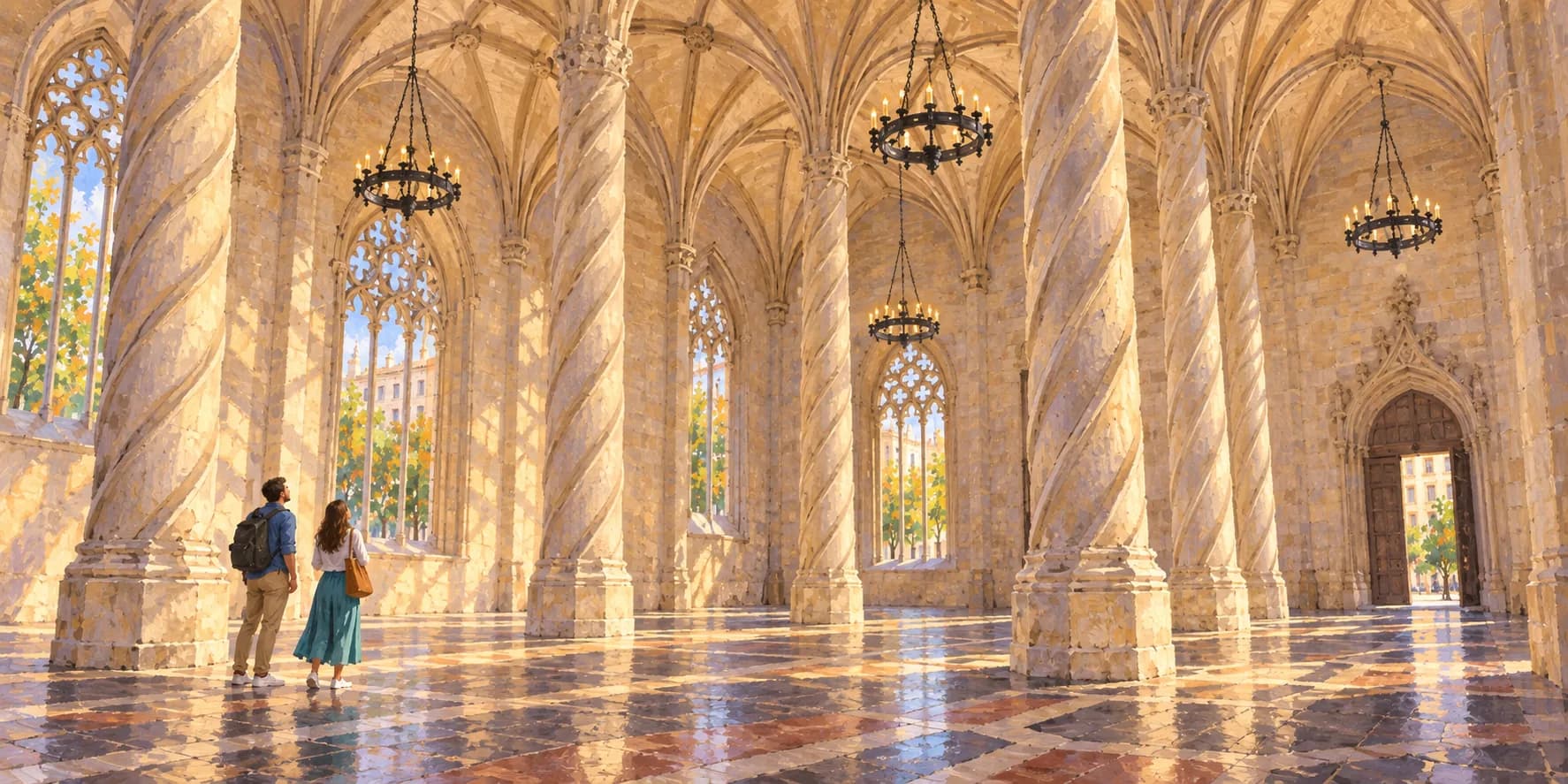
A morning in Valencia: three familiar places worth another look
From North Station ceramics to the Central Market's daylight and the Silk Exchange's columns: rediscover Valencia through three new questions.
You do not need another city. You need another question
Some buildings become almost invisible through familiarity. The station where you meet someone. The market you enter with a shopping list. The Silk Exchange you recognise without remembering the last time you really looked at it.
This morning is not about collecting landmarks. It is about three ways a city works: welcoming arrivals, feeding the people who stay, and giving trade a place to happen. In Valencia, you can explore all three on a walk through the centre.
The stops are North Station, the Central Market and the Silk Exchange. Knowing their names does not spoil the plan. The point is to return with something particular to notice, rather than three visits to tick off.
Take WAONDER on your next walkBefore you leave: choose a morning, not a race
Start at Carrer de Xàtiva, 24, outside Estació del Nord. Follow Marqués de Sotelo towards Plaça de l'Ajuntament, then María Cristina towards the Central Market. The Silk Exchange stands across the square from the market: the final change of building is also a change of century.
Set aside around 90 minutes to two hours as a suggested allowance, plus whatever time you want for interiors, shopping or a break. This is not a measured journey time and does not include queues. It is an editorial walking selection, not an automatic route offered inside the app. Consult a map and adapt to conditions on the day.
For a working market, the day of the week matters more than the season. On 11 October 2026, its website lists Monday–Saturday, 7:30am–3pm. Check the Central Market's opening information before leaving, particularly around public holidays. On a Sunday or in the afternoon, think of this as a walk to study the exteriors, not the same indoor experience.
The Silk Exchange has separate admission arrangements. Check its visitor information; an open market does not mean both interiors are available. Works, closures and restricted areas can also affect the station. We have not audited step-free access along the entire walk: confirm entrances with each institution if that matters for your visit.
First stop: a station with the countryside on its facade
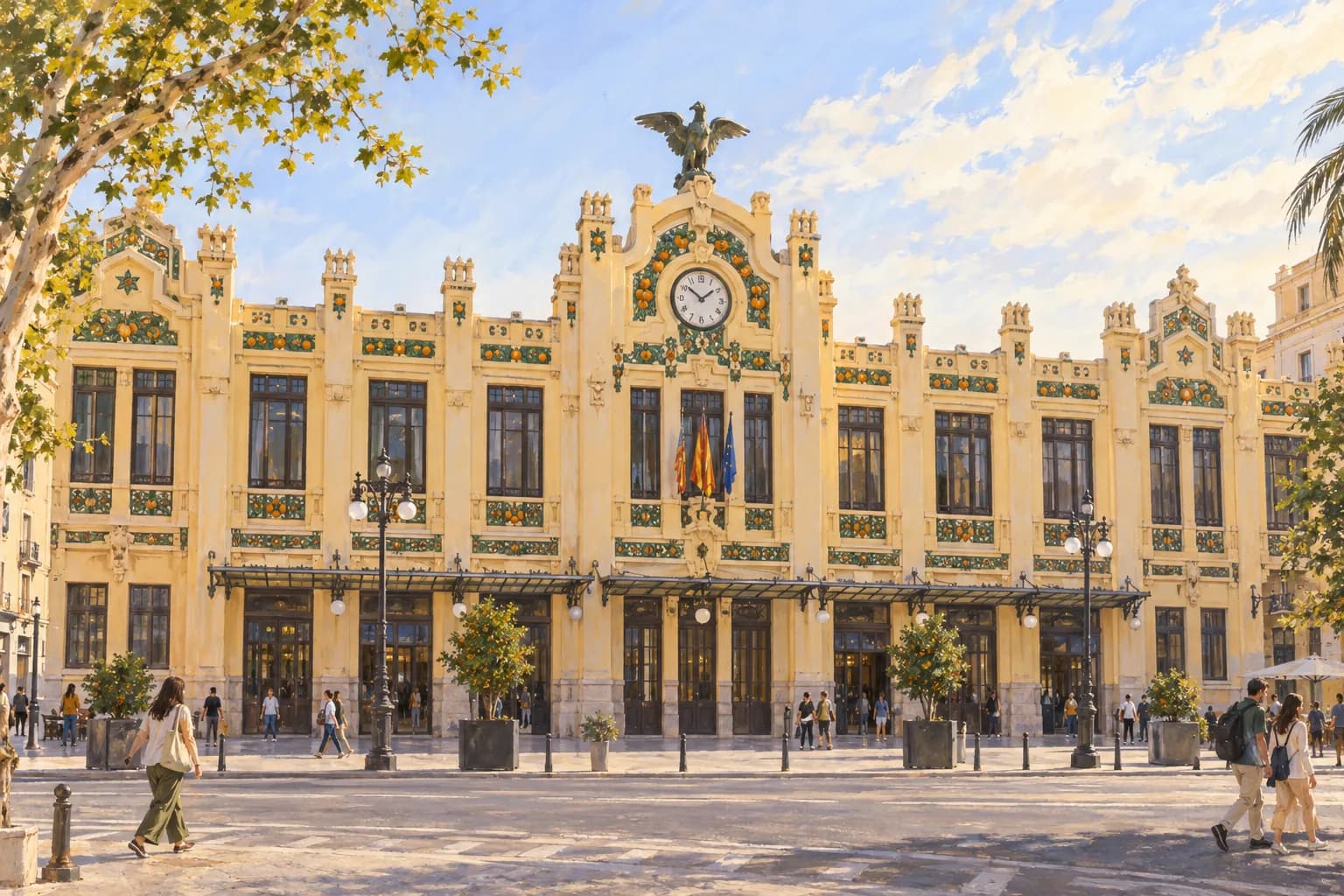
Before looking for a platform, look at the building. Can you find an orange among its decorations?
The city's North Station record identifies Demetrio Ribes as its architect and dates the opening to 1917. Its long frontage combines projecting sections, ceramics and windows. Inside, woodwork and mosaics make a passing-through space worth a pause.
Orange and flower motifs connect the building to the surrounding agricultural landscape, as Visit Valencia explains. It is a small detail with a larger effect: the city and the land around it appear together at the place where travellers arrive.
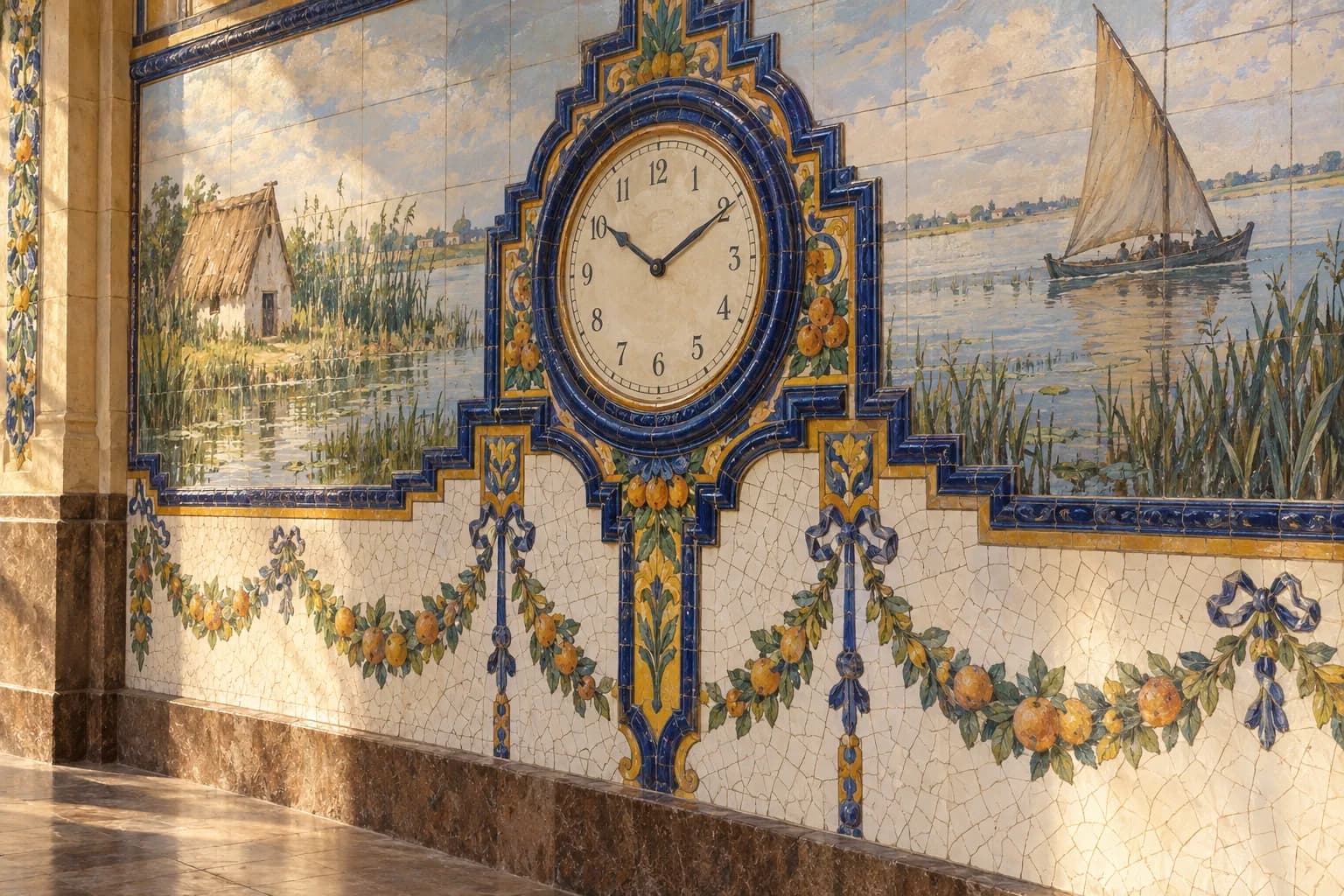 An illustrated interpretation of its ceramics: a landscape can appear on a wall, too. This does not reproduce every tile in the mural.
Your small mission: find a plant motif, then a change of material—from ceramics to wood, or glass to metal. If the public areas are accessible, look without getting in the way of passengers. Notice what changes when the train information is no longer the only thing you are reading.
If you cannot enter, the stop still works. The facade starts a question: what did Valencia want arriving travellers to see of the city? You do not need to assign a precise historical meaning to every ornament to appreciate the care given to a practical building.
Find North Station in WAONDERSecond stop: a busy market is not empty of history
Continue through the city hall square to the market. Change how you look again: instead of an entrance to the city, here is a building devoted to daily life.
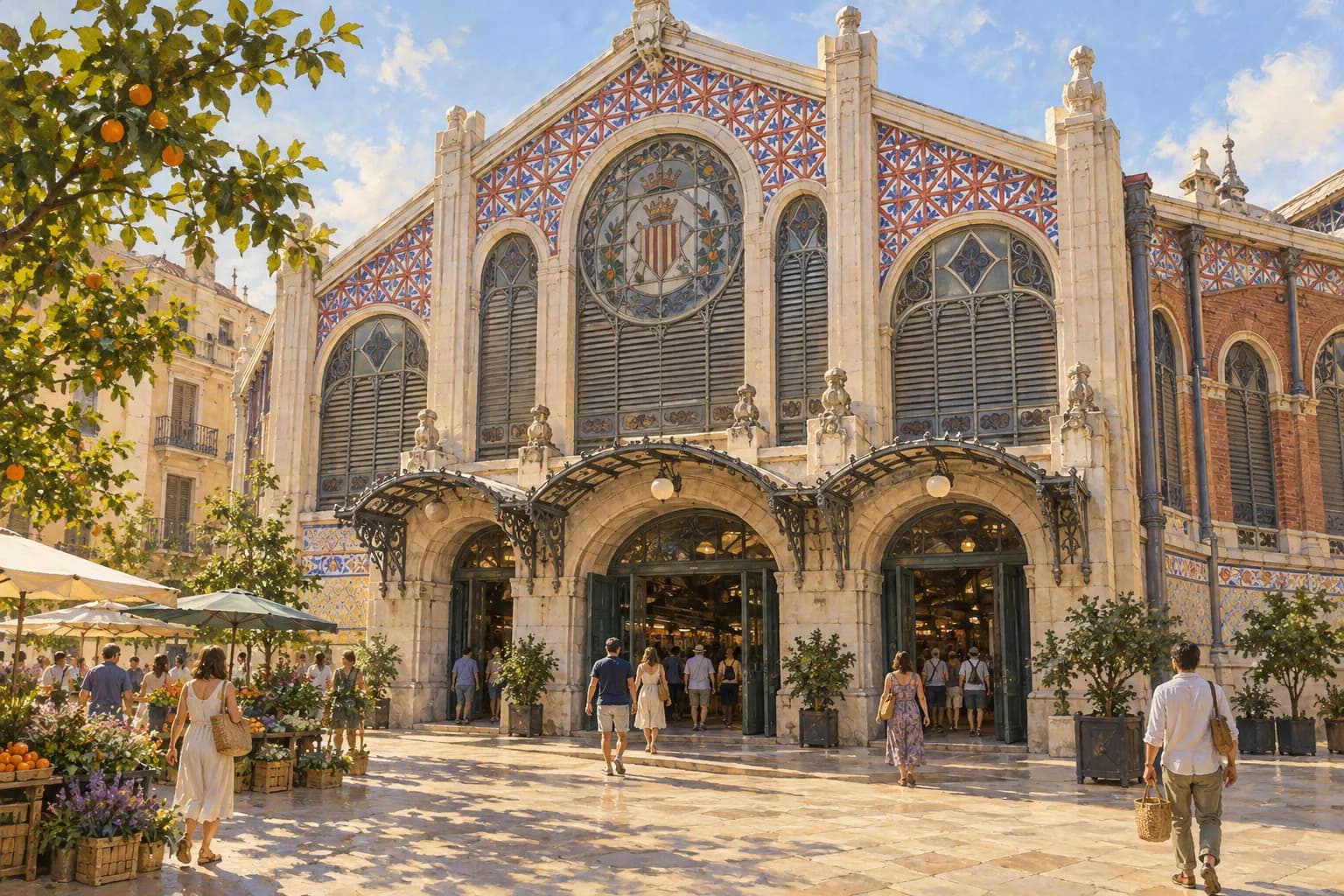 Before entering, look at stone, iron, glass and ceramics together. An illustration of the entrance, not a photograph of today's conditions.
The present building opened on 23 January 1928, according to the market's own history. It was not built as scenery for a camera walk. It remains a working market, and that distinction should shape your visit.
Keep aisles and work areas clear. Look at a stall without treating the people shopping or selling as photographic props. Then look up.
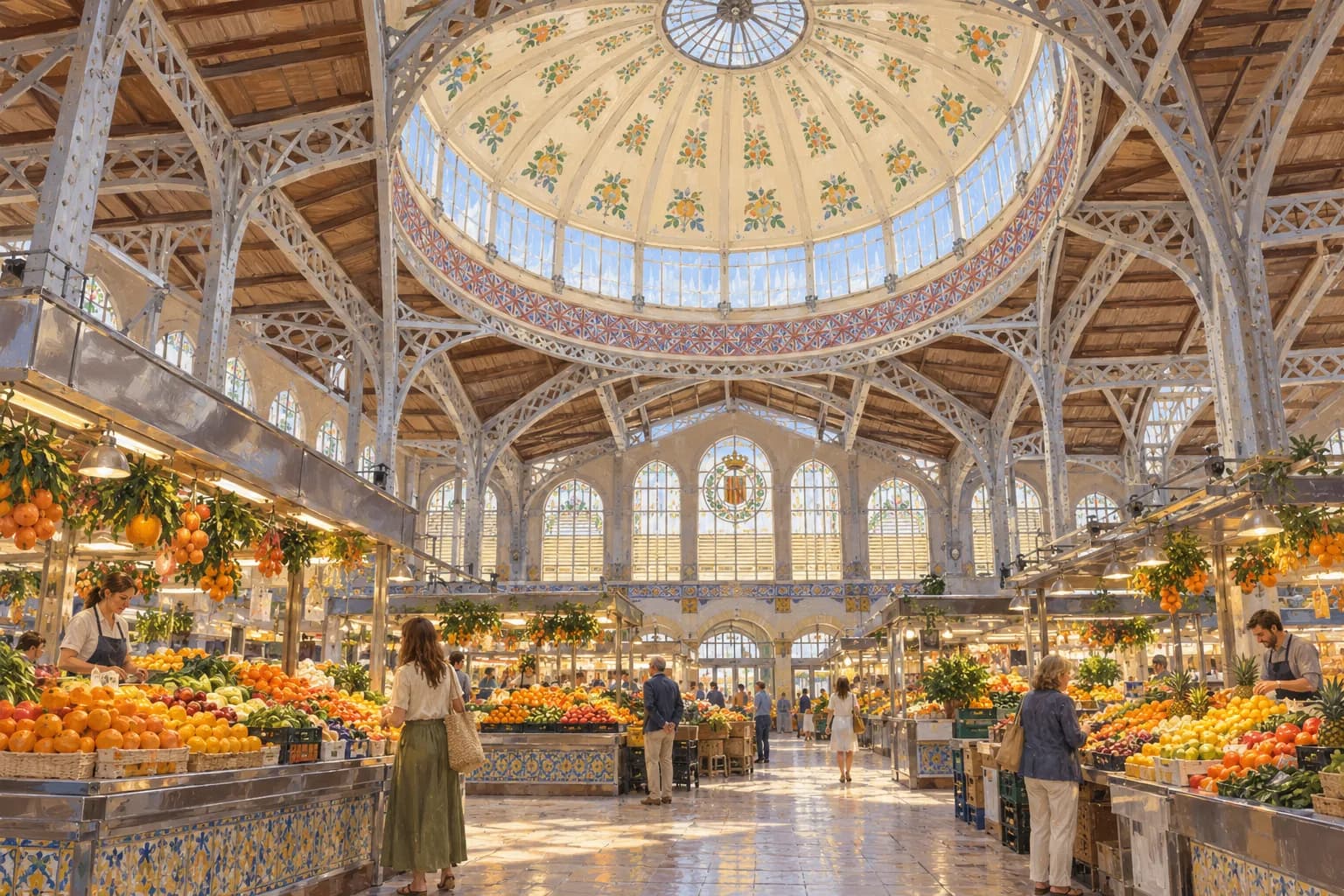 The eye travels from food to daylight and the supports overhead. A painted interpretation of the interior.
The municipal description helps explain the building's arrangement and roofs. You can trace a real structure with your eyes: a support, a truss, a window. Architecture brings daylight to a place where someone must choose what to take home.
Your small mission: find a food whose colour also appears in the decoration, then work out where the light enters. The resemblance does not need a historical meaning. It is an observation game, not a theory about the architect.
If you buy something, the walk gains another connection to the city. You remember not just a dome, but a building that still performs an ordinary task. If the doors are closed, compare ceramics and canopies outside, without mistaking that for a visit to the market at work.
Find the Central Market in WAONDERThird stop: these columns do not hold up a church
Leaving the market, the Silk Exchange introduces another kind of trade and another architecture. Look at its stone, windows and roofline first. If admission is available, let the hall change your sense of scale.
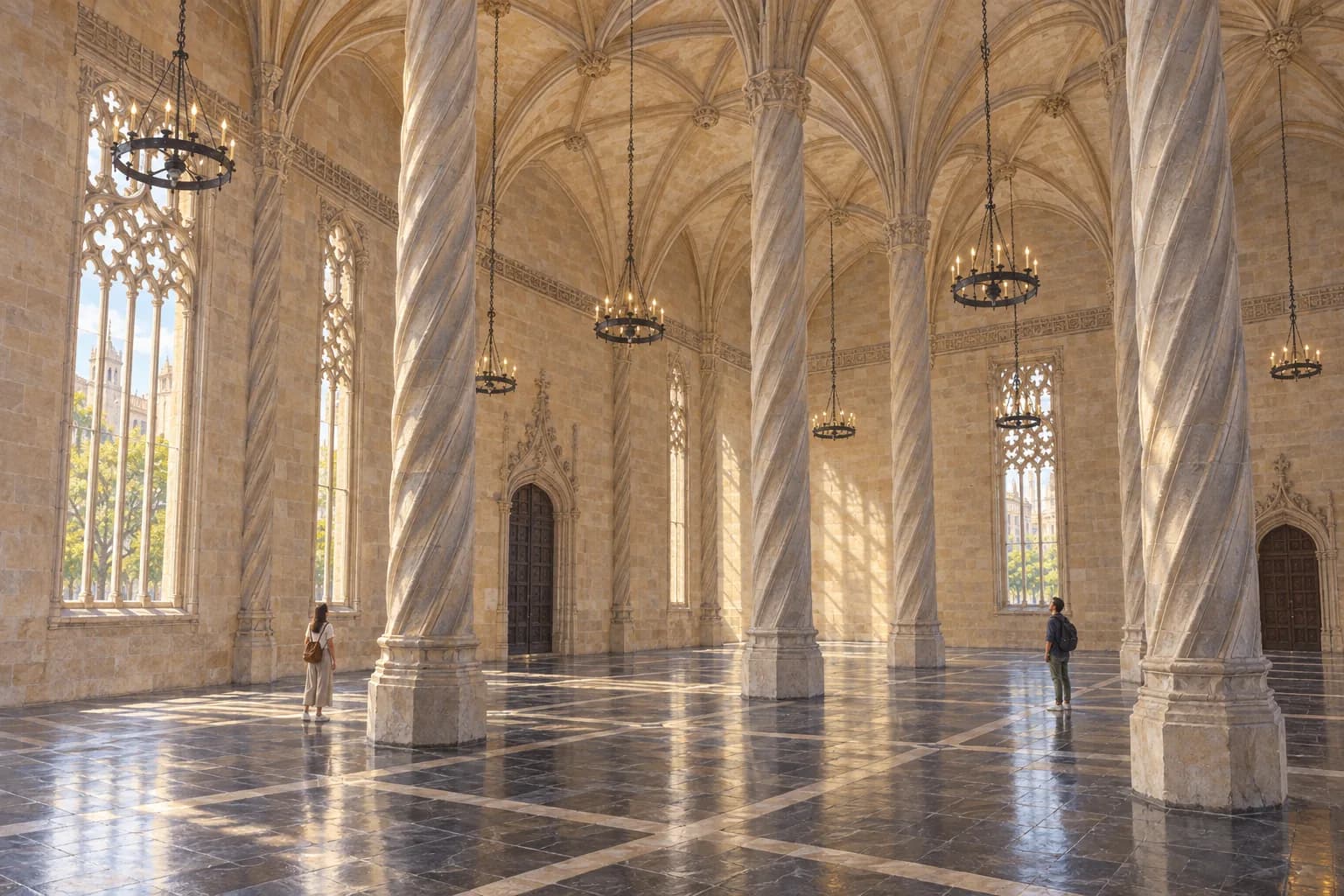 Twisting columns continue into the vault's ribs. An illustration of the hall, with visitors indicating scale.
The Lonja is a secular building, not a religious temple. UNESCO, which inscribed it as World Heritage in 1996, connects its trading hall to Valencia's commercial importance in the fifteenth and sixteenth centuries.
Inside, follow a column from its base to the ribs overhead. A simple action changes the visit: ceiling and floor no longer seem separate. You notice the continuity of stone that makes the room possible.
Your small mission: compare a column with the wall around it. Then look for the band of lettering along the hall. UNESCO explains that its inscription reminded merchants of moral obligations. You need not decipher the Latin to see that trade here also had rules written on the walls.
The regional tourism description introduces the ensemble and its orange-tree courtyard. If accessible, finish there: after the height of the columns, you return to the scale of trees, light and shade.
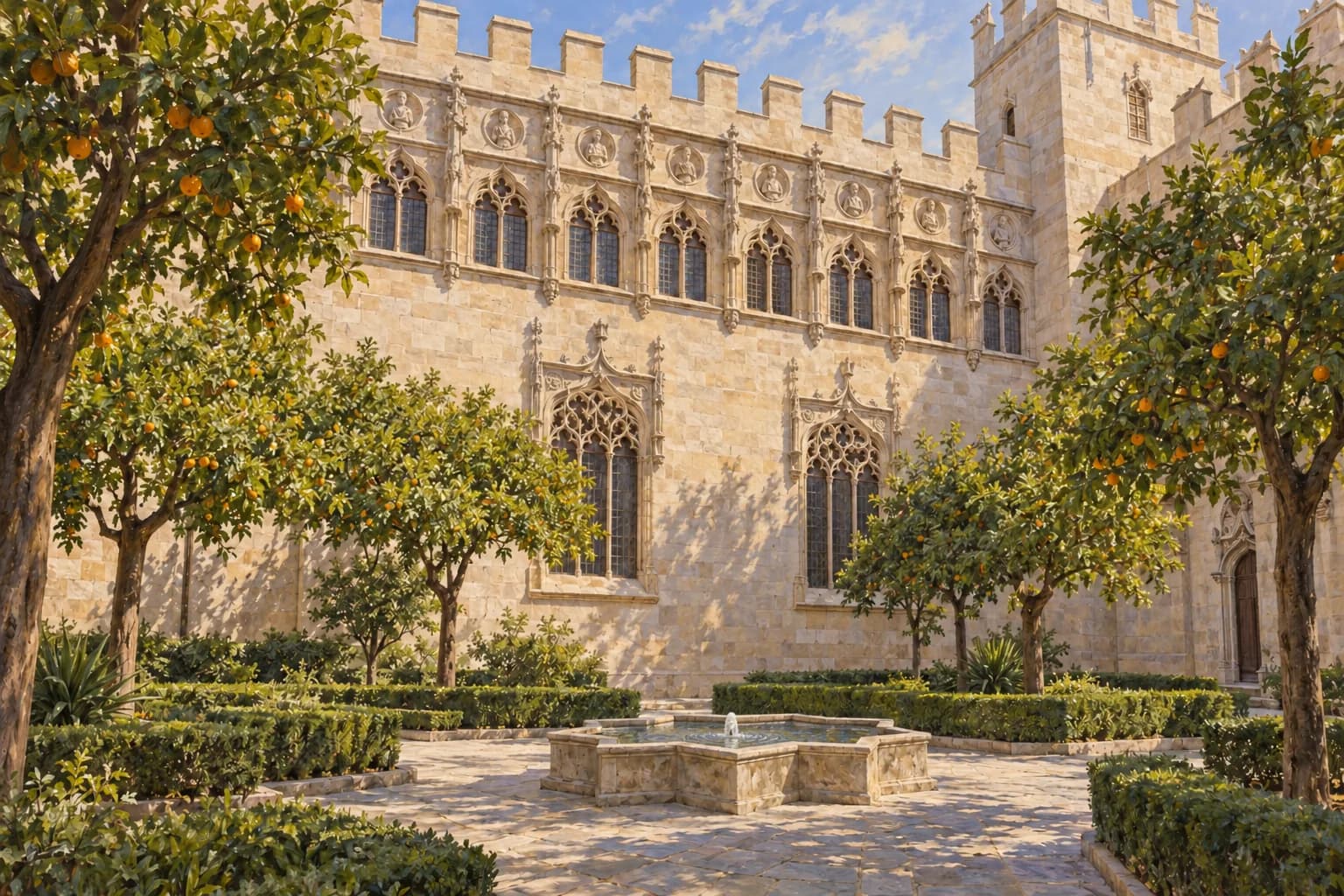 A quieter ending inside the ensemble. An interpretation of the courtyard; access and visiting conditions can change.
If the exchange is closed, make an outdoor comparison instead. Market and Lonja stand close together, but their materials and forms tell of different periods. An unavailable interior need not become a promised stop just to complete a list.
Find the Silk Exchange in WAONDERSomething to take home without buying a souvenir
An orange made into an ornament. Light reaching the stalls. A column that seems to continue across the ceiling. Small enough to miss, specific enough to remember next time.
That is the purpose of the walk: a familiar place becomes more than a name. You need not repeat all three visits every weekend. Return to one with another question, bring someone who has not looked at it this way, or pause while passing on an ordinary errand.
Our Valencian Community selection offers a wider view if you want to go further. For this morning, staying close and looking carefully is enough.
Each stop's button links to its place in WAONDER. If you do not have the app, the destination page offers download options. We do not assume installation automatically retains that place; you can search for its name afterwards. This walk remains useful without installing anything.
Next time you pass the station, market or Silk Exchange, you will have something to notice before reaching for your camera.
Download WAONDER to keep exploringSection
Ideas for city walks