High Line: the railway New York learned to see again
Before the gardens came freight trains, disuse and neighbors defending another possibility. Read that transformation in the details of today’s High Line.
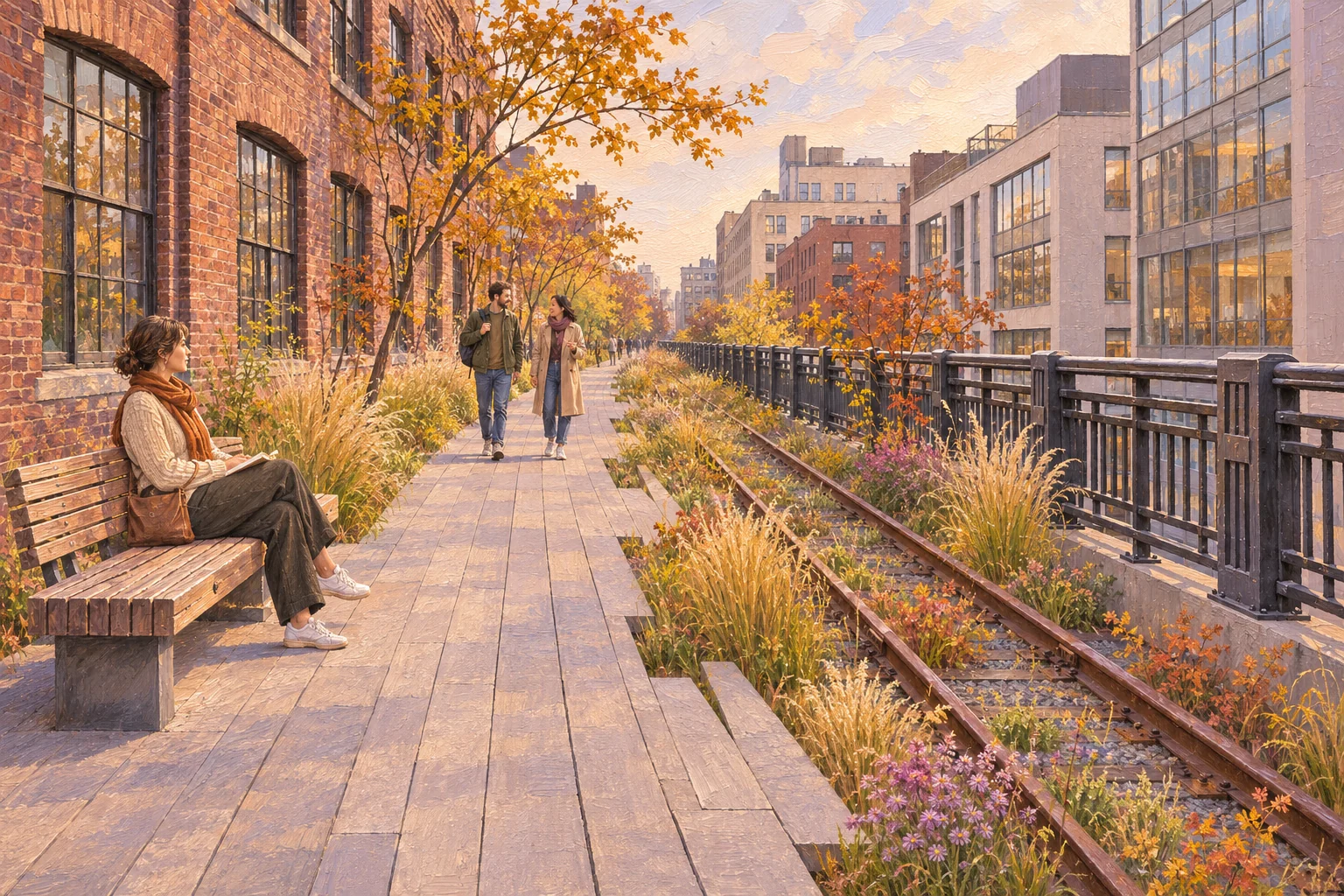
Among the High Line’s plants is a detail you might overlook precisely because it fits so well: a rail. It looks like part of the garden’s drawing, a line accompanying the path. But it recalls a different kind of work.
Before people walked between these buildings, goods needed to reach them. Then came the years without trains. And there was a time when preserving the structure was not the obvious outcome.
This elevated park on Manhattan’s West Side does not begin with a beautiful view. It begins with a harder question: what do we do with something that no longer serves its original purpose? The rails let you bring that question back into an ordinary walk.
Find the High Line in WAONDERBefore carrying walkers, it carried food
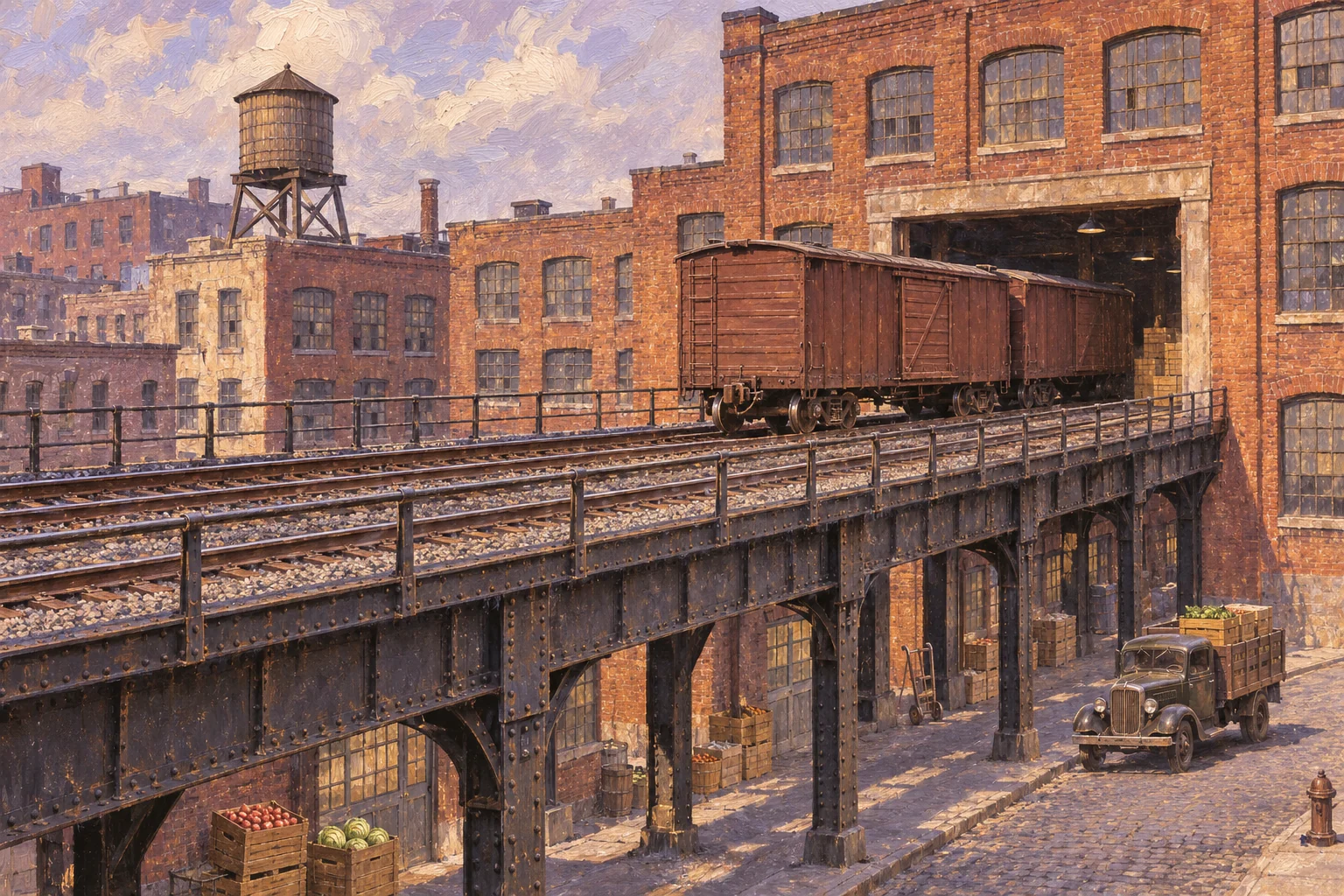 A railway serving warehouses. An interpretation of the industrial period, not a documented train, building or particular day.
The Hagley Museum and Library archive holds a 1934 brochure showing tracks reaching the upper floors of industrial buildings. That relationship between railway and warehouse helps explain the height: this was not a platform built for admiring Manhattan.
Before the elevated line, trains ran through the streets. Hagley describes the conflicts of that shared traffic: raising the railway also meant separating freight from everyday movement at street level.
One final load is particularly memorable. Friends of the High Line’s historical fact sheet says the last train, in 1980, carried three carloads of frozen turkeys. An ordinary consignment at the end of a service, not a monument to the railway itself.
When the trains stopped
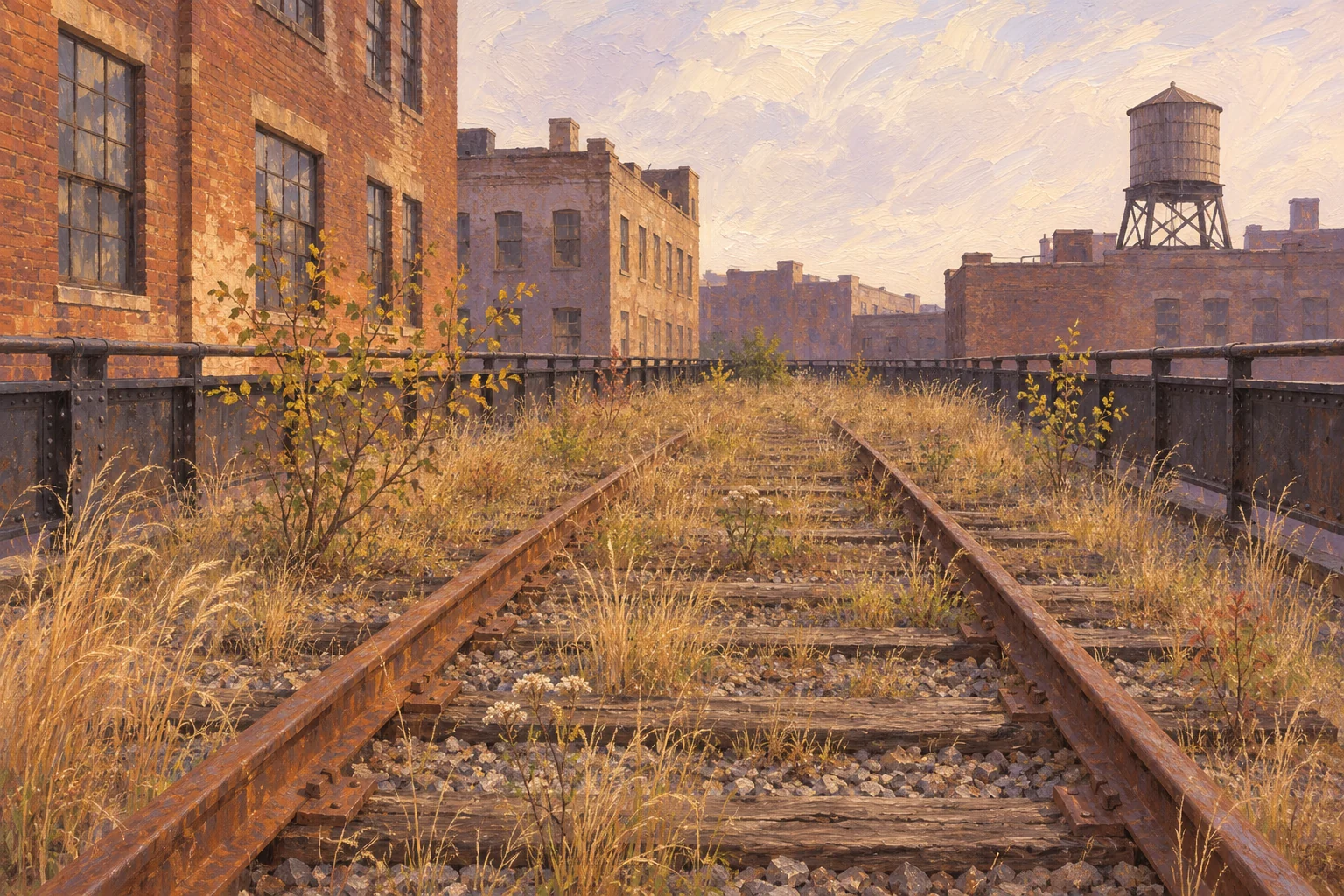 Between freight use and the park. Vegetation and surroundings evoke the years of disuse, not a photograph of a precise year or location.
A railway ceasing to operate does not settle what should happen to its space. From the street, it might look like an obstacle. Seen differently, it is a continuous structure that would be impossible to recover once removed.
Spontaneous vegetation grew during that interval. The design team’s statement places that inheritance among the later project’s defining ideas. An unplanned landscape suggested possibilities for a place that would need deliberate design and care.
The distinction matters. Today’s garden is not abandoned ground with a gate opened for visitors. It acknowledges that period while turning it into a public experience. Moving from one condition to the other required much more than permission to enter.
Two neighbors at the beginning, many people afterwards
In 1999, Joshua David and Robert Hammond founded Friends of the High Line. NYCEDC’s timeline records the neighborhood initiative and the municipal steps that made transformation possible.
Their names matter because they make a decision tangible: organizing to defend a possibility before it became obvious. But making them two solitary saviors would erase the people who studied, negotiated, designed, funded and later maintained the space.
A city does not keep something merely by discovering that it could be beautiful. Someone has to explain whom it will serve, how it can be sustained and what must change so others can use it. The least photogenic part of the story is also what makes today’s photograph possible.
Imagination had to do its homework
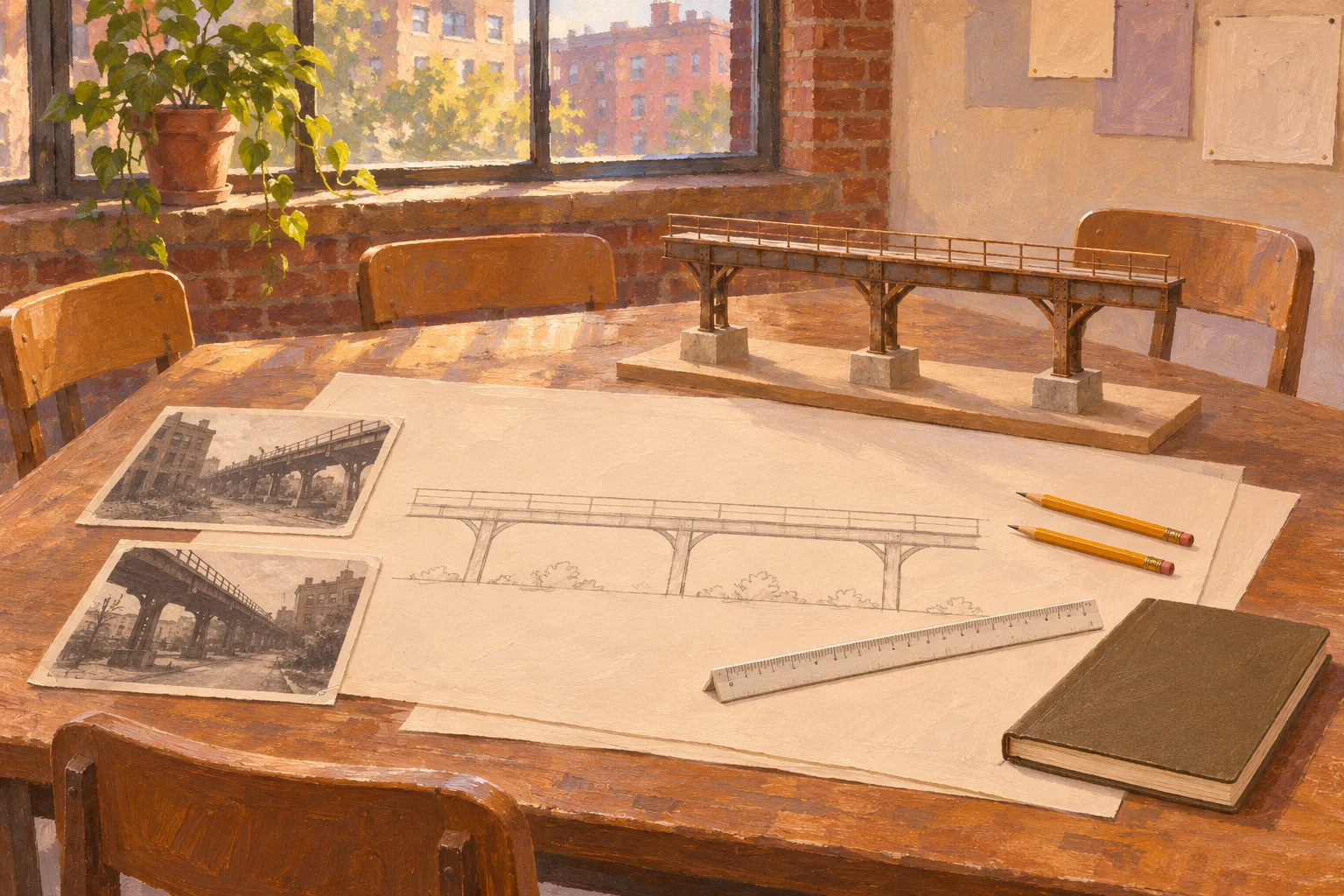 An evocation of studying alternatives. It does not depict a real meeting or reproduce project drawings or documents.
The Design Trust for Public Space, a participant in the process, explains that it proposed a feasibility study before a competition. Physical condition, potential uses and community needs had to be examined.
That pause matters. Between “don’t demolish it” and “make it a park” lay questions that needed answers. Good intentions would not repair steel, authorize entrances or, by themselves, draw a shared space.
The Landscape Architecture Foundation’s case study describes repairs, waterproofing and drainage before paving and planting. Beneath the greenery are decisions you cannot see, but which separate an attractive image from a usable place.
A garden that does not entirely hide its past
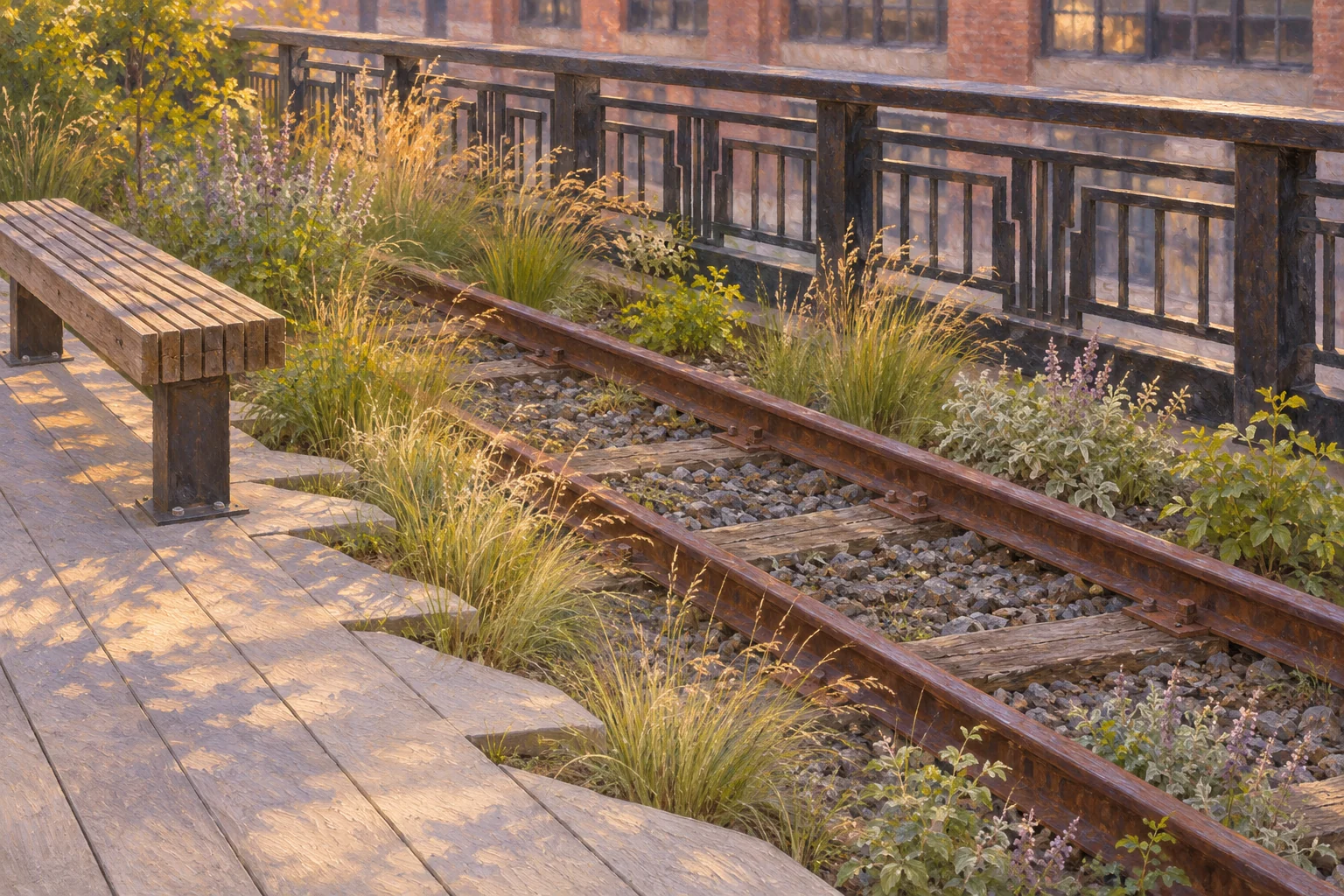 Materials from different stages sharing space. An interpretation of rail, planting and paving meeting, not a technical survey.
The design brought together Field Operations, Diller Scofidio + Renfro and Piet Oudolf. The first section opened in 2009. The railway structure did not disappear behind an entirely new setting.
To read it, choose three details. First, a rail continuing through plants. Then the long paving pieces and their meeting with the planted edge. Finally, the height of a nearby window: you are relating to the building from a different level than the sidewalk.
You can stop at just one. You do not have to complete the whole High Line to understand the combination. Notice how a material recalling transport lives alongside one making walking possible now. Preservation does not always mean leaving things untouched; here, it also means deciding what can keep telling a story within a different use.
The park does not end at its railing
Looking at the transformation only from inside would leave out the neighborhood. The municipal record also includes West Chelsea’s rezoning. Reusing infrastructure and changing its surroundings were part of the same urban process.
That does not establish that everyone benefited equally, or that every property change can be attributed to the park. It does invite a useful question when you descend: how does the place we visit relate to the people still living and working around it?
You need not answer it completely on one walk. It is enough not to confuse a busy public space with a story without tensions, or a preserved structure with a city standing still.
Return without chasing another postcard
Before setting out, consult the official 2026 guide and the operator’s visitor notices. Some access points use stairs, others elevators or ramps; check the specific entrance you need rather than assuming it is operational. The guide also lists restrictions such as bicycles and pets; check the specific conditions if you need a service animal.
This outing does not depend on a temporary artwork, a particular elevator or guaranteed flowers. Choose a suitable section, stay on the paths and leave room for others when stopping. A real November day may offer different colors and skies from our illustrations.
To keep reading New York’s infrastructure through its people, continue with Emily Roebling and the Brooklyn Bridge. It is another city story, not the next stop on a walking route.
Next time you notice a rail among the plants, perhaps you will remember that more than an object was kept. Space remained for New York to do something different with it. The train had stopped passing; the possibility of pausing was still to be built.
Look closer at the High Line with WAONDER Download WAONDERSection
Stories behind places