Arènes de Lutèce: the Roman Paris people still come to play in
An amphitheater, threatened excavations and a neighborhood still using the space. Read the Arènes de Lutèce without mistaking reconstruction for untouched ruins.
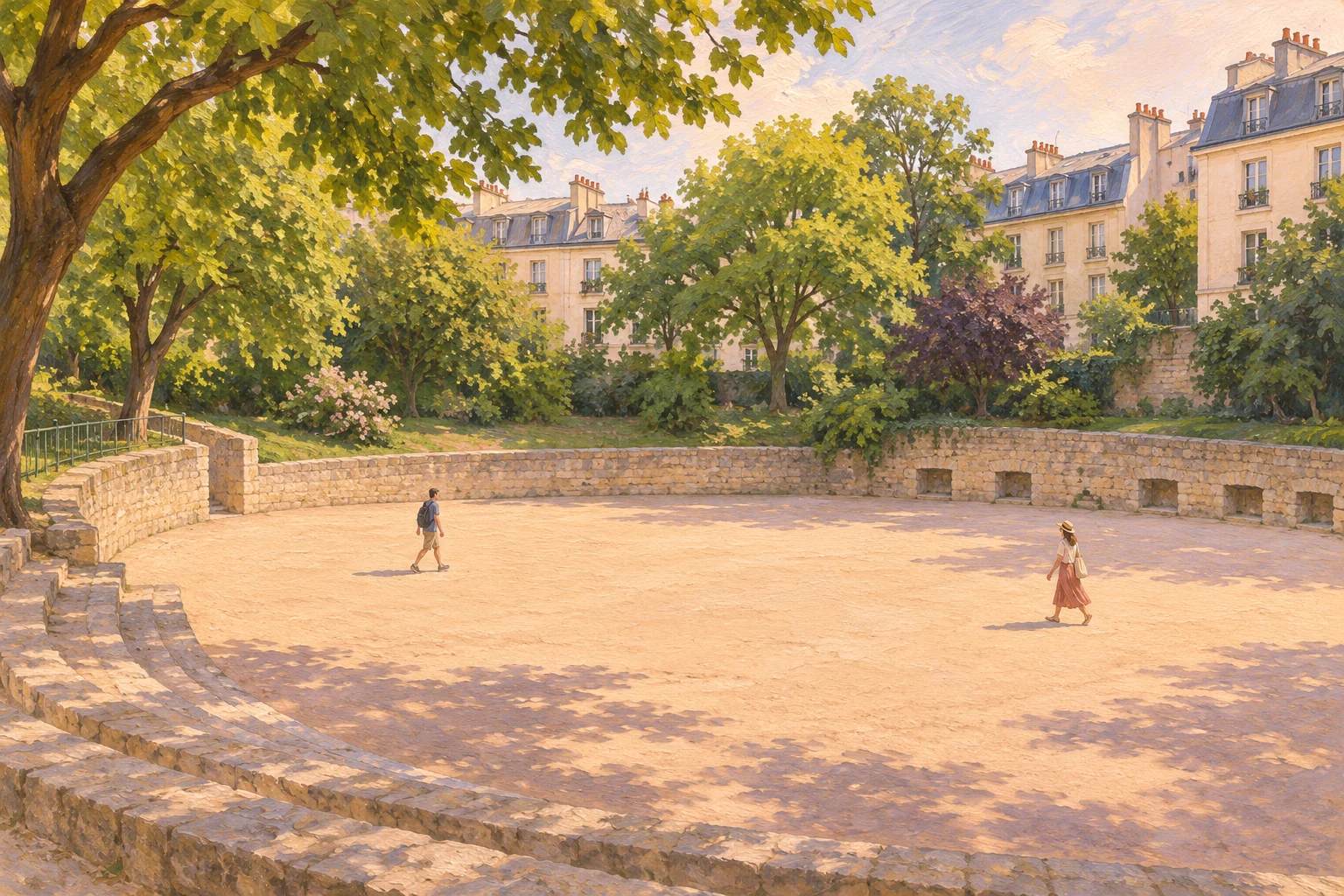
Pétanque balls on the ground. Someone sitting on a step, in no hurry to leave. That neighborhood scale is not necessarily what the word “amphitheater” brings to mind.
The Arènes de Lutèce, in Paris’s 5th arrondissement, allow those things to coexist. The past is not separated from daily life by a display case: it occupies a place people still enter simply to spend some time. Yet these are not Roman seats that have survived untouched.
There were losses, excavations, public decisions and reconstruction. Knowing that changes the visit. Instead of searching for a miniature Colosseum, you begin to notice how much had to happen for this open space to remain within the city.
Find the Arènes de Lutèce in WAONDERThere was a stage here too
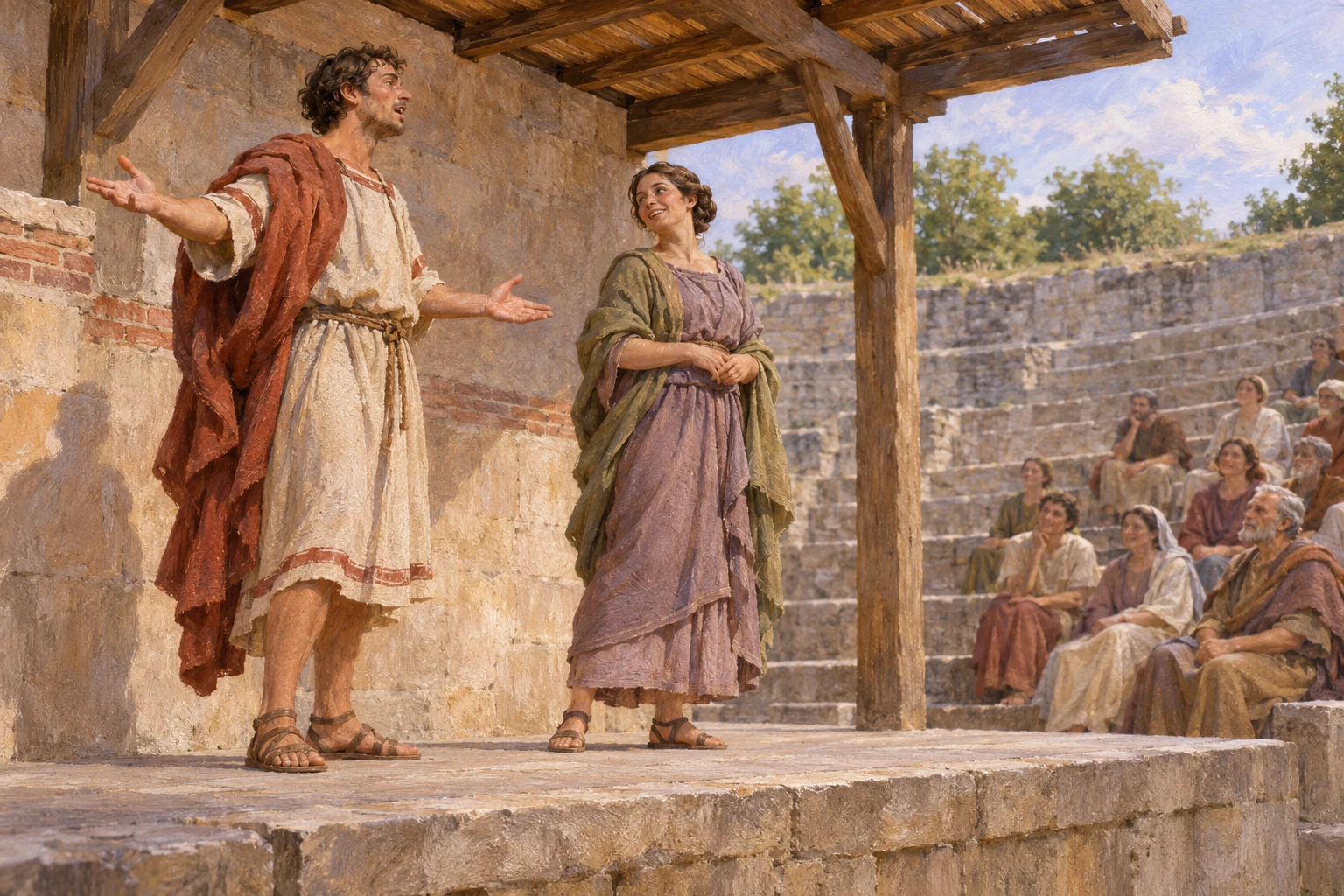 Theatrical performance as one possible use. The setting and characters are evocative, not an exact reconstruction of a production or the building.
France’s Ministry of Culture describes a mixed amphitheater with a stage: an arena combined with a performance area. Imagining gladiators does not explain everything that took place here.
Its study of the stage mentions mime, pantomime and sung performances. That variety brings the building closer to a familiar need: gathering to watch something together.
Looking across the open ground, consider two different arrangements: an arena surrounded by an audience, and a stage facing its spectators. That mixed use helps explain why this place does not quite resemble the oval amphitheater you might have expected.
An origin without a certain birthday
There is no foundation year we can repeat without qualification. The archaeological account of its dating acknowledges uncertainty and suggests construction before the end of the first century; other institutional records place it in the second. Keeping that difference is preferable to giving the monument a precise birthday the evidence cannot establish.
The arena also hosted combat, according to the study of that space. We do not need to depict it to understand that different performances called for different uses of the building.
Nor did its life end in a single moment of abandonment. Archaeological records describe reused material. A stone could stop belonging to a gathering place and become a resource for another structure. What we now seek out as heritage was, at other times, available building material.
Trenches a photograph still lets us see
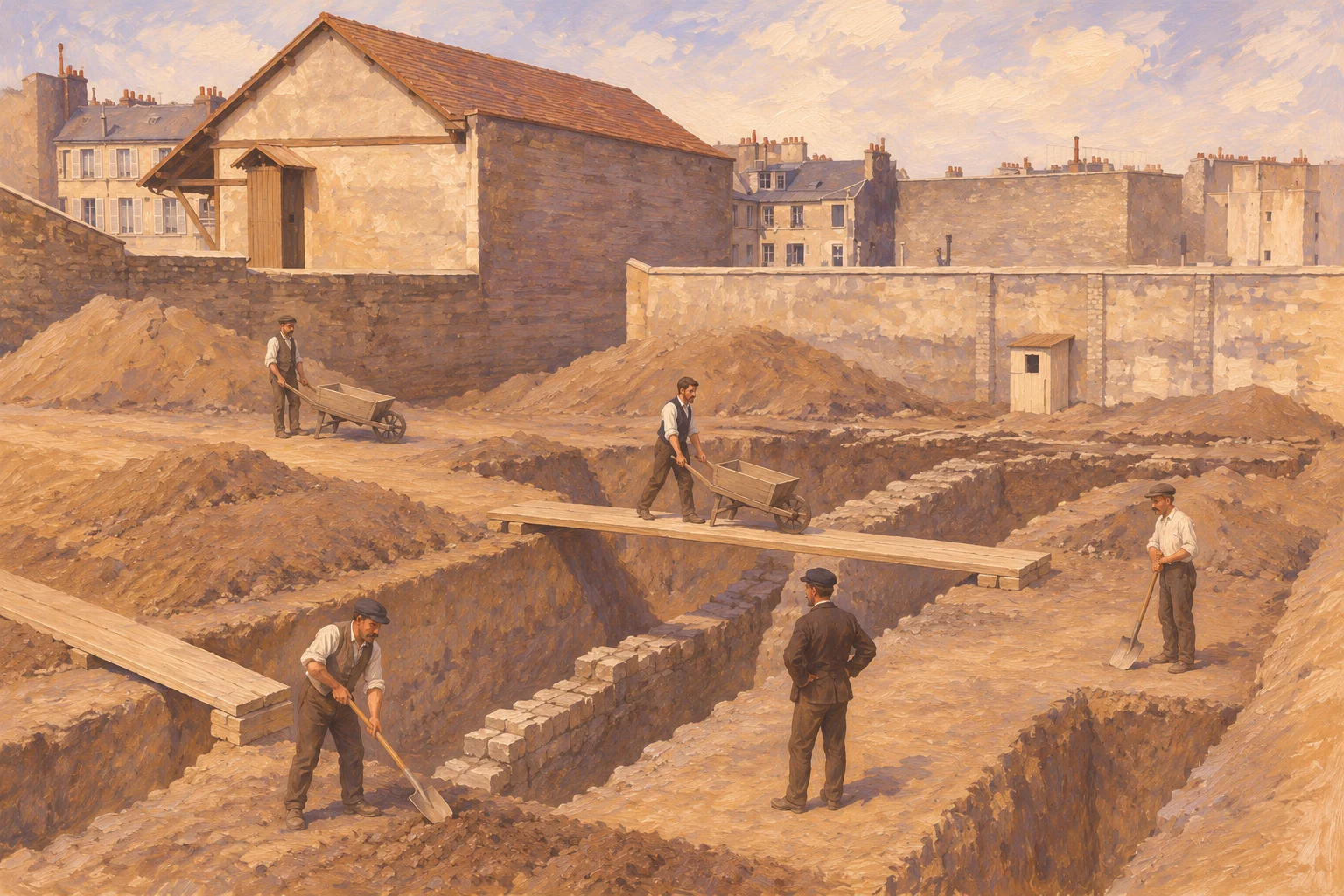 A painted interpretation of Pierre Emonts’s view held by Carnavalet, dated April 17, 1883. Not a color photograph or a new excavation record.
The history of the discoveries records the medieval place-name “Arennes” and Théodore Vacquer’s work. This was not somewhere whose existence had vanished from all memory until someone happened to hit a stone.
Pierre Emonts’s photograph in the Musée Carnavalet collection shows the 1883 excavation surrounded by urban buildings. Its record explains the conflict with an omnibus company’s depot and the loss of remains during earlier works.
There is no isolated ruin in an empty landscape in that image. There are house walls, shifted earth and people working. It makes the problem tangible: finding something ancient does not automatically decide what a city will do with it. Different uses and projects were competing for the same ground.
Hugo was not alone before the ruins
The municipal account recalls the involvement of Victor Hugo and Victor Duruy. Their names help explain that preservation also required a public defense of the place’s value.
But reducing the story to a writer’s intervention would leave out excavators, associations, municipal decisions and the work that followed. A famous voice can make a cause heard; it cannot replace everyone sustaining it.
Historic-monument protection came on March 31, 1884. The date offers more than an entry in a timeline: recognition had to become a commitment able to outlast the enthusiasm of the moment.
When you stop here, you can think about that less visible part of heritage too. Not only who built it, but who decided the city should still make room for it.
Today’s step is not proof of a Roman seat
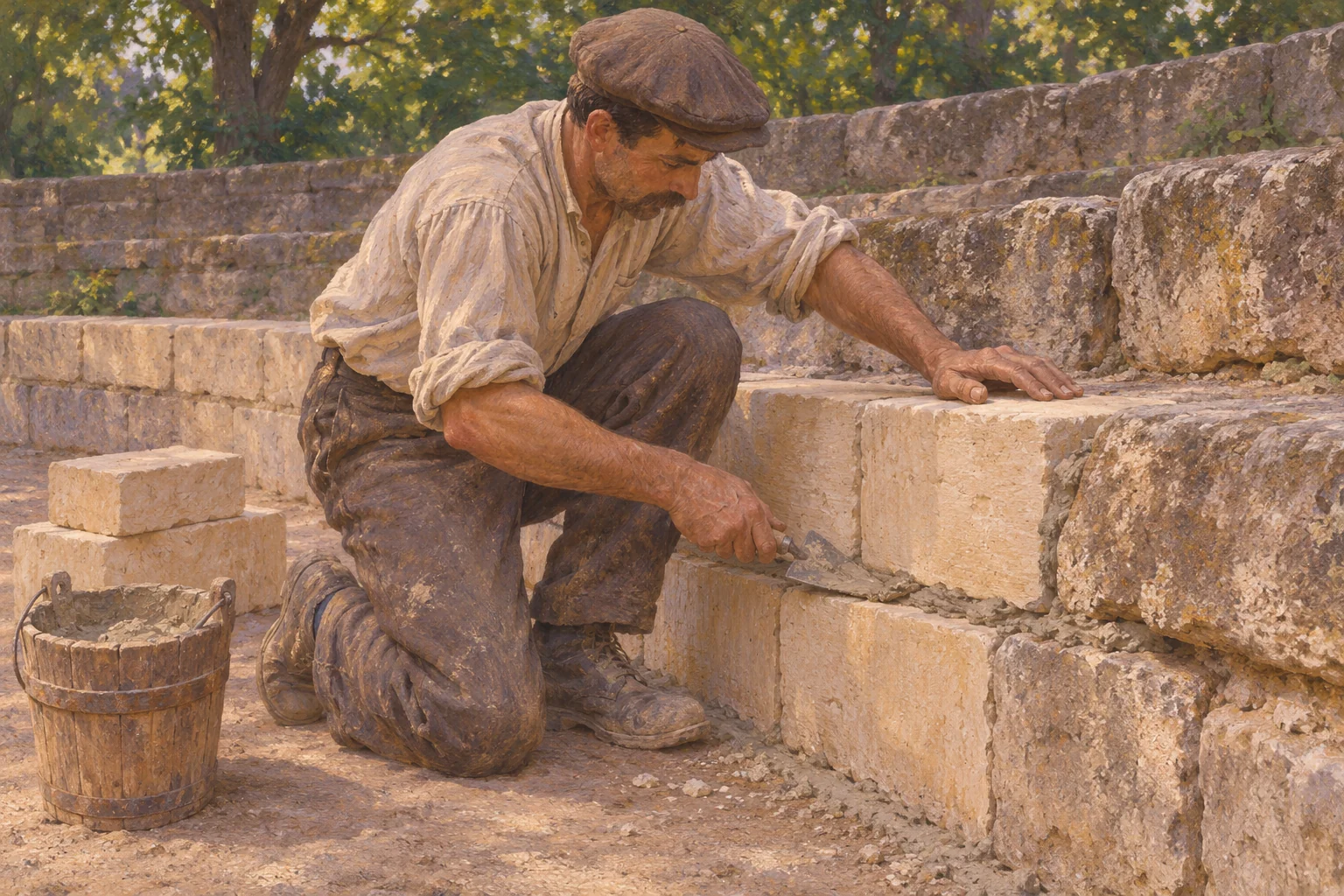 The material work of reconstruction, evoked in the early twentieth century. No real worker or particular intervention is identified.
There is one detail worth taking into your visit: the study of the cavea — the tiered seating for spectators — says no seating was found in its original position. It mentions inscribed blocks probably belonging to benches, whose arrangement remains uncertain.
So you cannot treat every present-day step as evidence of where someone sat almost two millennia ago. Considerable reconstruction took place in the early twentieth century, involving decisions and interpretations of incomplete remains.
That does not empty the site of interest. It adds another layer: what you see holds both an ancient trace and a later way of understanding and displaying it. The curve helps you read the space; caution keeps that reading from becoming certainty about every stone.
You do not need to find an inscription or touch a wall to take that idea away. Look instead at how the stepped shape makes sitting possible and how the open ground remains in front of it.
A visit that fits an ordinary day
The city lists 4 rue des Arènes as the reference address and notes partial accessibility. Check its current hours and conditions: they vary with the season. Do not plan an arrival on the assumption that the garden stays open at night.
Once inside, look for three relationships: the breadth of the ground against the modest height of the walls; the curve of the seating; and the homes appearing around it. The city does not disappear so that you can contemplate antiquity. It remains close by.
If you find a game or people resting, leave room for that use and keep routes clear. They are not extras in our visit. Nor is there any need to climb structures or take over the ground to obtain a photograph without anyone in it.
Someone waiting for another turn
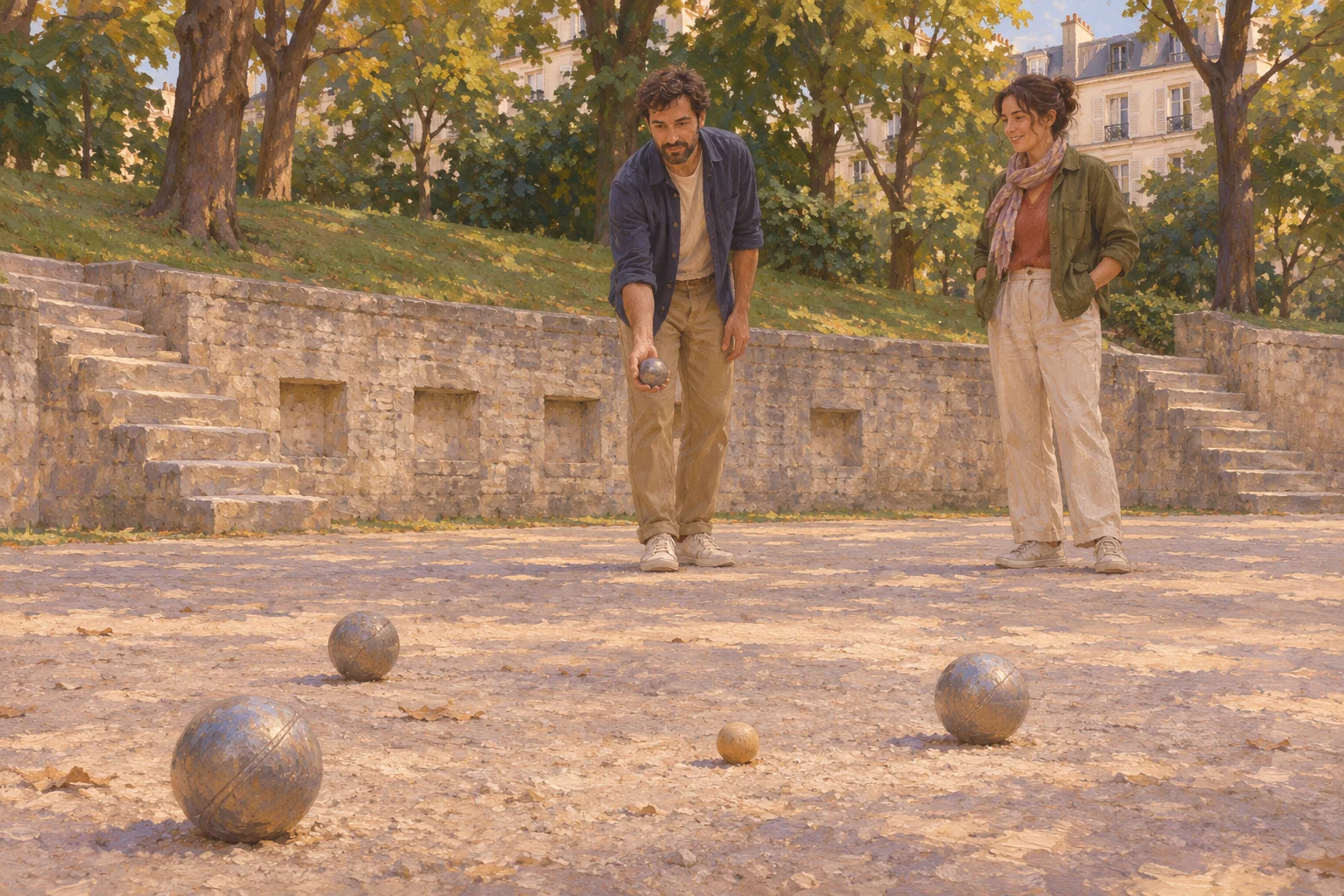 Everyday life in a historic setting. An interpreted scene, not a particular game or an activity guaranteed during your visit.
Pétanque is among the uses described by the municipality. Its presence does not turn the present into a copy of ancient entertainment: nobody is living exactly the same life again.
The connection is simpler. There is still somewhere to pause and share space. After the losses and the work of preserving the site, that ordinary use matters too.
For another way of looking at a Paris walk, read about the covered passages around Richelieu. That is another neighborhood and another story, not the immediate next stop on this walk.
Perhaps the image you take away from the Arènes will not be an empty ruin. Perhaps it will be someone waiting for a game to finish. Ancient Paris does not have to be left alone for us to recognize it.
Keep exploring the Arènes with WAONDER Download WAONDERSection
Stories behind places